1 搭建Eureka Server高可用集群
1.1 概述
- 在上面的章节,实现了单节点的Eureka Server的服务注册和服务发现功能。Eureka Client会定时连接到Eureka Server,获取注册表中的信息并缓存到本地。微服务在消费远程API的时候总是使用本地缓存中的数据。因此一般来说,即使Eureka Server出现宕机,也不会影响到服务之间的调用。但是如果Eureka Server宕机的时候,某些微服务也出现了不可用的情况,Eureka SClient中的缓存如果不被刷新,就可能影响到微服务的调用,甚至影响到整个应用系统的高可用。因此,在生产环境中,通常会部署一个高可用的Eureka Server集群。
- Eureka Server可用通过运行多个实例并相互注册的方式实现高可用部署,Eureka Server实例会彼此增量的同步信息,从而确保所有节点数据一致。事实上,节点之间相互注册时Eureka Server的默认行为。
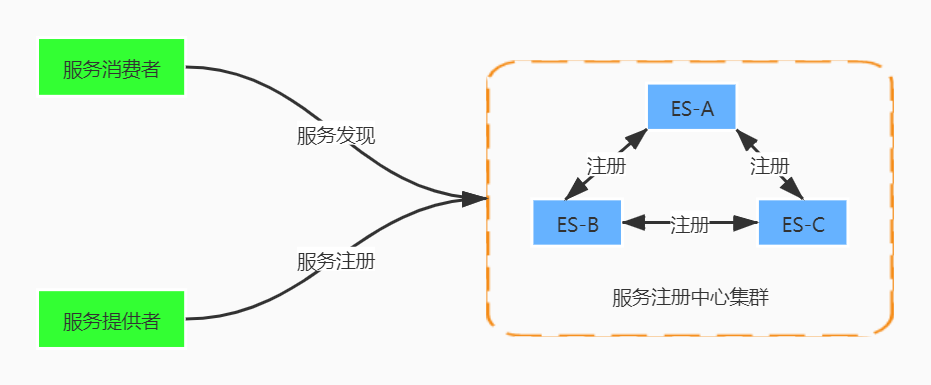
1.2 搭建Eureka Server高可用集群
1.2.1 修改本机的host文件
- 由于个人计算机中进行测试很难模拟多主机的情况,Eureka配置server集群的时候需要修改host文件。在win10中host文件的路径是C:\Windows\System32\drivers\etc\hosts。
127.0.0.1 eureka7001.com127.0.0.1 eureka7002.com127.0.0.1 eureka7003.com
1.2.2 修改原先的Eureka Server
- application.yml:
server:# 单机版的端口# port: 9000port: 7001 #端口#配置Eureka Servereureka:instance:# 主机地址名称# hostname: localhost # 单机版的主机地址名称hostname: eureka7001.comclient:register-with-eureka: false # 是否将自己注册到注册中心fetch-registry: false # 是否从Eureka中获取服务列表service-url: # 配置暴露给Eureka Client的请求地址# 单机版# defaultZone: http://${eureka.instance.hostname}:${server.port}/eureka/defaultZone: http://eureka7002.com:7002/eureka/,http://eureka7003.com:7003/eureka/
- 将原先的Eureka的模块名修改为eureka_service7001,其pom.xml如下:
<?xml version="1.0" encoding="UTF-8"?><project xmlns="http://maven.apache.org/POM/4.0.0"xmlns:xsi="http://www.w3.org/2001/XMLSchema-instance"xsi:schemaLocation="http://maven.apache.org/POM/4.0.0 http://maven.apache.org/xsd/maven-4.0.0.xsd"><parent><artifactId>spring_cloud_demo</artifactId><groupId>org.sunxiaping</groupId><version>1.0</version></parent><modelVersion>4.0.0</modelVersion><!-- 此处修改 --><artifactId>eureka_service7001</artifactId><dependencies><!-- 导入Eureka Server对应的坐标 --><dependency><groupId>org.springframework.cloud</groupId><artifactId>spring-cloud-starter-netflix-eureka-server</artifactId></dependency></dependencies></project>
- 修改启动类:
package com.sunxiaping.eureka;import org.springframework.boot.SpringApplication;import org.springframework.boot.autoconfigure.SpringBootApplication;import org.springframework.cloud.netflix.eureka.server.EnableEurekaServer;/*** @author 许威威* @version 1.0*/@SpringBootApplication@EnableEurekaServer //开启Eureka Server//将启动类名称由EurekaApplication修改为Eureka7001Applicationpublic class Eureka7001Application {public static void main(String[] args) {SpringApplication.run(Eureka7001Application.class, args);}}
- 修改总工程的pom.xml:
<?xml version="1.0" encoding="UTF-8"?><project xmlns="http://maven.apache.org/POM/4.0.0"xmlns:xsi="http://www.w3.org/2001/XMLSchema-instance"xsi:schemaLocation="http://maven.apache.org/POM/4.0.0 http://maven.apache.org/xsd/maven-4.0.0.xsd"><modelVersion>4.0.0</modelVersion><packaging>pom</packaging><modules><module>product_service</module><module>spring_cloud_common</module><module>order_service</module><!-- 此处修改 --><module>eureka_service7001</module></modules><parent><groupId>org.springframework.boot</groupId><artifactId>spring-boot-starter-parent</artifactId><version>2.1.6.RELEASE</version></parent><groupId>org.sunxiaping</groupId><artifactId>spring_cloud_demo</artifactId><version>1.0</version><properties><project.build.sourceEncoding>UTF-8</project.build.sourceEncoding><project.reporting.outputEncoding>UTF-8</project.reporting.outputEncoding><java.version>1.8</java.version></properties><dependencies><dependency><groupId>org.springframework.boot</groupId><artifactId>spring-boot-starter-web</artifactId></dependency><dependency><groupId>org.springframework.boot</groupId><artifactId>spring-boot-starter-test</artifactId><scope>test</scope></dependency><dependency><groupId>org.projectlombok</groupId><artifactId>lombok</artifactId><version>1.18.4</version><scope>provided</scope></dependency></dependencies><dependencyManagement><dependencies><dependency><groupId>org.springframework.cloud</groupId><artifactId>spring-cloud-dependencies</artifactId><version>Greenwich.RELEASE</version><type>pom</type><scope>import</scope></dependency></dependencies></dependencyManagement><repositories><repository><id>spring-snapshots</id><name>Spring Snapshots</name><url>http://repo.spring.io/libs-snapshot-local</url><snapshots><enabled>true</enabled></snapshots></repository><repository><id>spring-milestones</id><name>Spring Milestones</name><url>http://repo.spring.io/libs-milestone-local</url><snapshots><enabled>false</enabled></snapshots></repository><repository><id>spring-releases</id><name>Spring Releases</name><url>http://repo.spring.io/libs-release-local</url><snapshots><enabled>false</enabled></snapshots></repository></repositories><pluginRepositories><pluginRepository><id>spring-snapshots</id><name>Spring Snapshots</name><url>http://repo.spring.io/libs-snapshot-local</url><snapshots><enabled>true</enabled></snapshots></pluginRepository><pluginRepository><id>spring-milestones</id><name>Spring Milestones</name><url>http://repo.spring.io/libs-milestone-local</url><snapshots><enabled>false</enabled></snapshots></pluginRepository></pluginRepositories><build><finalName>spring_cloud_demo</finalName><resources><resource><directory>src/main/resources</directory><filtering>true</filtering></resource></resources><plugins><plugin><groupId>org.apache.maven.plugins</groupId><artifactId>maven-resources-plugin</artifactId><configuration><delimiters><delimit>$</delimit></delimiters></configuration></plugin></plugins></build></project>
1.2.3 搭建eureka_service7002模块
- pom.xml(复制eureka_service7001模块的pom.xml):
<?xml version="1.0" encoding="UTF-8"?><project xmlns="http://maven.apache.org/POM/4.0.0"xmlns:xsi="http://www.w3.org/2001/XMLSchema-instance"xsi:schemaLocation="http://maven.apache.org/POM/4.0.0 http://maven.apache.org/xsd/maven-4.0.0.xsd"><parent><artifactId>spring_cloud_demo</artifactId><groupId>org.sunxiaping</groupId><version>1.0</version></parent><modelVersion>4.0.0</modelVersion><artifactId>eureka_service7002</artifactId><dependencies><!-- 导入Eureka Server对应的坐标 --><dependency><groupId>org.springframework.cloud</groupId><artifactId>spring-cloud-starter-netflix-eureka-server</artifactId></dependency></dependencies></project>
- application.yml:
server:# 单机版的端口# port: 9000port: 7002 #端口#配置Eureka Servereureka:instance:# 主机地址名称# hostname: localhost # 单机版的主机地址名称hostname: eureka7002.comclient:register-with-eureka: false # 是否将自己注册到注册中心fetch-registry: false # 是否从Eureka中获取服务列表service-url: # 配置暴露给Eureka Client的请求地址# 单机版# defaultZone: http://${eureka.instance.hostname}:${server.port}/eureka/defaultZone: http://eureka7001.com:7001/eureka/,http://eureka7003.com:7003/eureka/
- 总工程的pom.xml
<?xml version="1.0" encoding="UTF-8"?><project xmlns="http://maven.apache.org/POM/4.0.0"xmlns:xsi="http://www.w3.org/2001/XMLSchema-instance"xsi:schemaLocation="http://maven.apache.org/POM/4.0.0 http://maven.apache.org/xsd/maven-4.0.0.xsd"><modelVersion>4.0.0</modelVersion><packaging>pom</packaging><modules><module>product_service</module><module>spring_cloud_common</module><module>order_service</module><!-- 此处修改 --><module>eureka_service7001</module><module>eureka_service7002</module></modules><parent><groupId>org.springframework.boot</groupId><artifactId>spring-boot-starter-parent</artifactId><version>2.1.6.RELEASE</version></parent><groupId>org.sunxiaping</groupId><artifactId>spring_cloud_demo</artifactId><version>1.0</version><properties><project.build.sourceEncoding>UTF-8</project.build.sourceEncoding><project.reporting.outputEncoding>UTF-8</project.reporting.outputEncoding><java.version>1.8</java.version></properties><dependencies><dependency><groupId>org.springframework.boot</groupId><artifactId>spring-boot-starter-web</artifactId></dependency><dependency><groupId>org.springframework.boot</groupId><artifactId>spring-boot-starter-test</artifactId><scope>test</scope></dependency><dependency><groupId>org.projectlombok</groupId><artifactId>lombok</artifactId><version>1.18.4</version><scope>provided</scope></dependency></dependencies><dependencyManagement><dependencies><dependency><groupId>org.springframework.cloud</groupId><artifactId>spring-cloud-dependencies</artifactId><version>Greenwich.RELEASE</version><type>pom</type><scope>import</scope></dependency></dependencies></dependencyManagement><repositories><repository><id>spring-snapshots</id><name>Spring Snapshots</name><url>http://repo.spring.io/libs-snapshot-local</url><snapshots><enabled>true</enabled></snapshots></repository><repository><id>spring-milestones</id><name>Spring Milestones</name><url>http://repo.spring.io/libs-milestone-local</url><snapshots><enabled>false</enabled></snapshots></repository><repository><id>spring-releases</id><name>Spring Releases</name><url>http://repo.spring.io/libs-release-local</url><snapshots><enabled>false</enabled></snapshots></repository></repositories><pluginRepositories><pluginRepository><id>spring-snapshots</id><name>Spring Snapshots</name><url>http://repo.spring.io/libs-snapshot-local</url><snapshots><enabled>true</enabled></snapshots></pluginRepository><pluginRepository><id>spring-milestones</id><name>Spring Milestones</name><url>http://repo.spring.io/libs-milestone-local</url><snapshots><enabled>false</enabled></snapshots></pluginRepository></pluginRepositories><build><finalName>spring_cloud_demo</finalName><resources><resource><directory>src/main/resources</directory><filtering>true</filtering></resource></resources><plugins><plugin><groupId>org.apache.maven.plugins</groupId><artifactId>maven-resources-plugin</artifactId><configuration><delimiters><delimit>$</delimit></delimiters></configuration></plugin></plugins></build></project>
- 启动类:
package com.sunxiaping.eureka;import org.springframework.boot.SpringApplication;import org.springframework.boot.autoconfigure.SpringBootApplication;import org.springframework.cloud.netflix.eureka.server.EnableEurekaServer;/*** @author 许威威* @version 1.0*/@SpringBootApplication@EnableEurekaServer //开启Eureka Serverpublic class Eureka7002Application {public static void main(String[] args) {SpringApplication.run(Eureka7002Application.class, args);}}
1.2.4 搭建eureka_service7003模块
- pom.xml(复制eureka_service7001模块的pom.xml):
<?xml version="1.0" encoding="UTF-8"?><project xmlns="http://maven.apache.org/POM/4.0.0"xmlns:xsi="http://www.w3.org/2001/XMLSchema-instance"xsi:schemaLocation="http://maven.apache.org/POM/4.0.0 http://maven.apache.org/xsd/maven-4.0.0.xsd"><parent><artifactId>spring_cloud_demo</artifactId><groupId>org.sunxiaping</groupId><version>1.0</version></parent><modelVersion>4.0.0</modelVersion><artifactId>eureka_service7003</artifactId><dependencies><!-- 导入Eureka Server对应的坐标 --><dependency><groupId>org.springframework.cloud</groupId><artifactId>spring-cloud-starter-netflix-eureka-server</artifactId></dependency></dependencies></project>
- application.yml:
server:# 单机版的端口# port: 9000port: 7003 #端口#配置Eureka Servereureka:instance:# 主机地址名称# hostname: localhost # 单机版的主机地址名称hostname: eureka7003.comclient:register-with-eureka: false # 是否将自己注册到注册中心fetch-registry: false # 是否从Eureka中获取服务列表service-url: # 配置暴露给Eureka Client的请求地址# 单机版# defaultZone: http://${eureka.instance.hostname}:${server.port}/eureka/defaultZone: http://eureka7001.com:7001/eureka/,http://eureka7002.com:7002/eureka/
- 总工程的pom.xml:
<?xml version="1.0" encoding="UTF-8"?><project xmlns="http://maven.apache.org/POM/4.0.0"xmlns:xsi="http://www.w3.org/2001/XMLSchema-instance"xsi:schemaLocation="http://maven.apache.org/POM/4.0.0 http://maven.apache.org/xsd/maven-4.0.0.xsd"><modelVersion>4.0.0</modelVersion><packaging>pom</packaging><modules><module>product_service</module><module>spring_cloud_common</module><module>order_service</module><!-- 此处修改 --><module>eureka_service7001</module><module>eureka_service7002</module><module>eureka_service7003</module></modules><parent><groupId>org.springframework.boot</groupId><artifactId>spring-boot-starter-parent</artifactId><version>2.1.6.RELEASE</version></parent><groupId>org.sunxiaping</groupId><artifactId>spring_cloud_demo</artifactId><version>1.0</version><properties><project.build.sourceEncoding>UTF-8</project.build.sourceEncoding><project.reporting.outputEncoding>UTF-8</project.reporting.outputEncoding><java.version>1.8</java.version></properties><dependencies><dependency><groupId>org.springframework.boot</groupId><artifactId>spring-boot-starter-web</artifactId></dependency><dependency><groupId>org.springframework.boot</groupId><artifactId>spring-boot-starter-test</artifactId><scope>test</scope></dependency><dependency><groupId>org.projectlombok</groupId><artifactId>lombok</artifactId><version>1.18.4</version><scope>provided</scope></dependency></dependencies><dependencyManagement><dependencies><dependency><groupId>org.springframework.cloud</groupId><artifactId>spring-cloud-dependencies</artifactId><version>Greenwich.RELEASE</version><type>pom</type><scope>import</scope></dependency></dependencies></dependencyManagement><repositories><repository><id>spring-snapshots</id><name>Spring Snapshots</name><url>http://repo.spring.io/libs-snapshot-local</url><snapshots><enabled>true</enabled></snapshots></repository><repository><id>spring-milestones</id><name>Spring Milestones</name><url>http://repo.spring.io/libs-milestone-local</url><snapshots><enabled>false</enabled></snapshots></repository><repository><id>spring-releases</id><name>Spring Releases</name><url>http://repo.spring.io/libs-release-local</url><snapshots><enabled>false</enabled></snapshots></repository></repositories><pluginRepositories><pluginRepository><id>spring-snapshots</id><name>Spring Snapshots</name><url>http://repo.spring.io/libs-snapshot-local</url><snapshots><enabled>true</enabled></snapshots></pluginRepository><pluginRepository><id>spring-milestones</id><name>Spring Milestones</name><url>http://repo.spring.io/libs-milestone-local</url><snapshots><enabled>false</enabled></snapshots></pluginRepository></pluginRepositories><build><finalName>spring_cloud_demo</finalName><resources><resource><directory>src/main/resources</directory><filtering>true</filtering></resource></resources><plugins><plugin><groupId>org.apache.maven.plugins</groupId><artifactId>maven-resources-plugin</artifactId><configuration><delimiters><delimit>$</delimit></delimiters></configuration></plugin></plugins></build></project>
- 启动类:
package com.sunxiaping.eureka;import org.springframework.boot.SpringApplication;import org.springframework.boot.autoconfigure.SpringBootApplication;import org.springframework.cloud.netflix.eureka.server.EnableEurekaServer;/*** @author 许威威* @version 1.0*/@SpringBootApplication@EnableEurekaServer //开启Eureka Serverpublic class Eureka7003Application {public static void main(String[] args) {SpringApplication.run(Eureka7003Application.class, args);}}
1.2.5 修改商品微服务的yml,将注册地址改为Eureka Server集群地址
- application.yml:
server:port: 9001 # 微服务的端口号spring:application:name: service-product # 微服务的名称datasource:url: jdbc:mysql://192.168.237.100:3306/test?useUnicode=true&characterEncoding=UTF-8&autoReconnect=true&useSSL=false&serverTimezone=GMT%2B8&allowPublicKeyRetrieval=truedriver-class-name: com.mysql.cj.jdbc.Driverusername: rootpassword: 123456jpa:generate-ddl: trueshow-sql: trueopen-in-view: truedatabase: mysql# 配置 eurekaeureka:instance:# 主机名称:服务名称修改,其实就是向eureka server中注册的实例idinstance-id: service-product:9001# 显示IP信息prefer-ip-address: trueclient:service-url: # 此处修改为 Eureka Server的集群地址defaultZone: http://eureka7001.com:7001/eureka/,http://eureka7002.com:7002/eureka/,http://eureka7003.com:7003/eureka/# 微服务info内容详细信息info:app.name: xxxcompany.name: xxxbuild.artifactId: $project.artifactId$build.version: $project.version$
2 Eureka中的常见问题
2.1 服务注册慢
- 默认情况下,服务注册到Eureka Server的过程较慢。
- 服务的注册设计到心跳,默认心跳的间隔为30s。在实例、服务器和客户端都在本地缓存中具有相同的元数据之前,服务不可用于客户端发现。可用通过配置
eureka.instance.lease-renewal-interval-in-seconds(心跳续约间隔)来加快客户端连接到其他服务的过程。在生产中,最好使用默认值,因为在服务器内部有一些计算,它们对续约做出假设。
2.2 服务节点剔除问题
- 默认情况下,由于Eureka Server剔除失效服务间隔时间为90s且存在自我保护机制。所以不能有效而迅速的剔除失效节点,这对于开发或测试会造成困扰。解决方案如下:
- 对于Eureka Client:配置开启健康检查,并设置续约时间。
# 配置 eurekaeureka:instance:# 主机名称:服务名称修改,其实就是向eureka server中注册的实例idinstance-id: service-product:9001# 显示IP信息prefer-ip-address: truelease-renewal-interval-in-seconds: 5 # 发送心跳续约间隔(默认30秒)lease-expiration-duration-in-seconds: 10 # Eureka Client发送心跳给Eureka Server端后,续约到期时间(默认90秒)client:healthcheck:enable: true #开启健康检查(依赖spring-boot-actuator)service-url: # 此处修改为 Eureka Server的集群地址defaultZone: http://eureka7001.com:7001/eureka/,http://eureka7002.com:7002/eureka/,http://eureka7003.com:7003/eureka/
- 对于Eureka Server:配置关闭自我保护,设置剔除无效节点的时间间隔。
#配置Eureka Servereureka:instance:# 主机地址名称# hostname: localhost # 单机版的主机地址名称hostname: eureka7001.comclient:register-with-eureka: false # 是否将自己注册到注册中心fetch-registry: false # 是否从Eureka中获取服务列表service-url: # 配置暴露给Eureka Client的请求地址# 单机版# defaultZone: http://${eureka.instance.hostname}:${server.port}/eureka/defaultZone: http://eureka7002.com:7002/eureka/,http://eureka7003.com:7003/eureka/server:enable-self-preservation: false # 关闭自我保护eviction-interval-timer-in-ms: 4000 #剔除时间间隔,单位:毫秒
3 Eureka的源码解析
3.1 Eureka服务注册核心源码解析
3.1.1 @EnableEurekaServer注解的作用
- 通过@EnableEurekaServer注解激活EurekaServer。
@Target({ElementType.TYPE})@Retention(RetentionPolicy.RUNTIME)@Documented@Import({EurekaServerMarkerConfiguration.class})public @interface EnableEurekaServer {}
- @EnableEurekaServer注解向Spring容器中导入了一个EurekaServerMarkerConfiguration组件,EurekaServerMarkerConfiguration组件的源码如下:
@Configurationpublic class EurekaServerMarkerConfiguration {//向容器中导入了Marker组件,Marker组件是实例化核心配置类的前提条件@Beanpublic Marker eurekaServerMarkerBean() {return new Marker();}class Marker {}}
3.1.2 自动装载核心配置类
- SpringCloud对EurekaServer的封装使得发布EurekaServer变得无比简单,根据自动状态的原则可以在spring-cloud-netflix-eureka-server-2.1.0.RELEASE.jar下找到spring.factories文件。
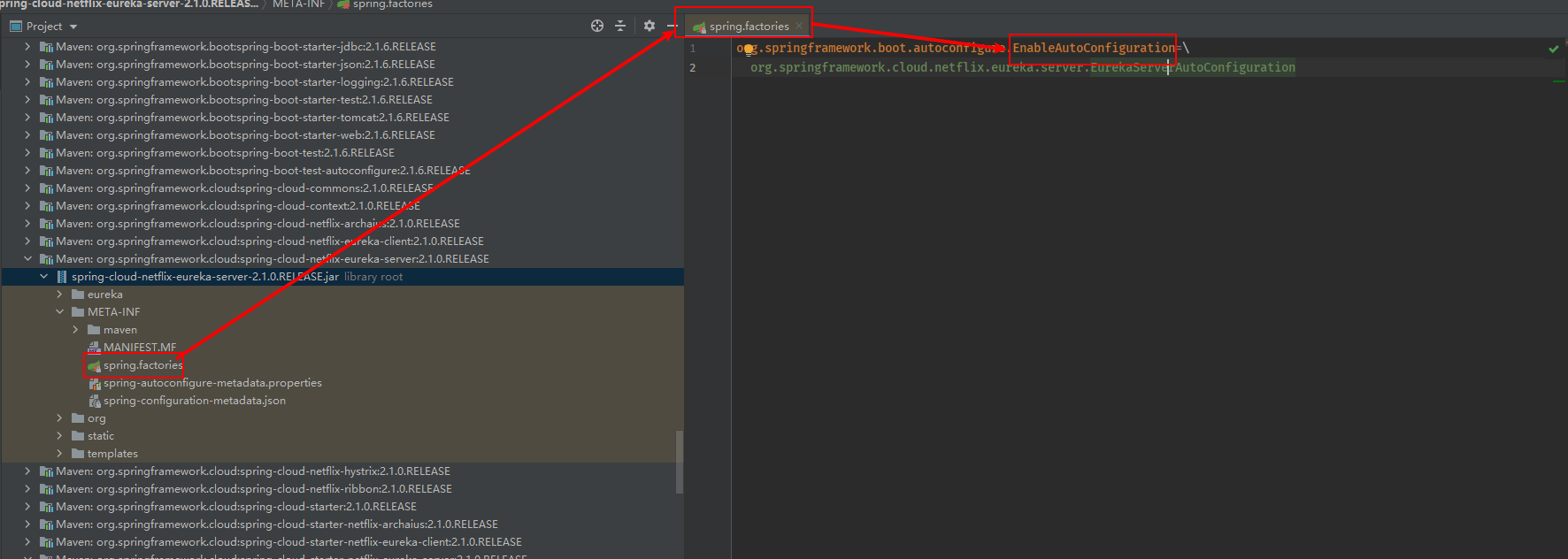
- 根据SpringBoot自动配置原理,即SpringBoot启动的时候会加载所有jar包下的META-INF下的spring.factories文件中的org.springframework.boot.autoconfigure.EnableAutoConfiguration对应的自动配置类。所以,SpringBoot启动的时候会加载EurekaServerAutoConfiguration(EurekaServer的自动配置类),其源码如下:
@Configuration@Import(EurekaServerInitializerConfiguration.class)@ConditionalOnBean(EurekaServerMarkerConfiguration.Marker.class)@EnableConfigurationProperties({ EurekaDashboardProperties.class,InstanceRegistryProperties.class })@PropertySource("classpath:/eureka/server.properties")public class EurekaServerAutoConfiguration extends WebMvcConfigurerAdapter {//其他略}
- 接下来解释EurekaServerAutoConfiguration(Eureka Server自动配置类)的作用:
 EurekaServerAutoConfiguration(Eureka Server自动配置类)生效的前提是容器中存在EurekaServerMarkerConfiguration.Marker组件(可以从
@ConditionalOnBean(EurekaServerMarkerConfiguration.Marker.class)这段代码看出),而@EnableEurekaServer注解的作用就是向容器中添加EurekaServerMarkerConfiguration.Marker组件,所以如果不在启动类中配置@EnableEurekaServer的话,那么EurekaServerAutoConfiguration(Eureka Server自动配置类)就不会起作用。 从
从@EnableConfigurationProperties({ EurekaDashboardProperties.class,InstanceRegistryProperties.class })代码中,我们知道EurekaServerAutoConfiguration(Eureka Server)向容器中导入了EurekaDashboardProperties和InstanceRegistryProperties两个组件。- EurekaDashboardProperties:配置EurekaServer管理台。
- InstanceRegistryProperties:配置期望续约数量和默认的通信数量。
 通过
通过@Import(EurekaServerInitializerConfiguration.class)引入启动类。
3.1.3 EurekaServerInitializerConfiguration
- EurekaServerInitializerConfiguration.java
@Configurationpublic class EurekaServerInitializerConfigurationimplements ServletContextAware, SmartLifecycle, Ordered {private static final Log log = LogFactory.getLog(EurekaServerInitializerConfiguration.class);@Autowiredprivate EurekaServerConfig eurekaServerConfig;private ServletContext servletContext;@Autowiredprivate ApplicationContext applicationContext;@Autowiredprivate EurekaServerBootstrap eurekaServerBootstrap;private boolean running;private int order = 1;@Overridepublic void setServletContext(ServletContext servletContext) {this.servletContext = servletContext;}@Overridepublic void start() {new Thread(new Runnable() {@Overridepublic void run() {try {//TODO: is this class even needed now?eurekaServerBootstrap.contextInitialized(EurekaServerInitializerConfiguration.this.servletContext);log.info("Started Eureka Server");publish(new EurekaRegistryAvailableEvent(getEurekaServerConfig()));EurekaServerInitializerConfiguration.this.running = true;publish(new EurekaServerStartedEvent(getEurekaServerConfig()));}catch (Exception ex) {// Help!log.error("Could not initialize Eureka servlet context", ex);}}}).start();}private EurekaServerConfig getEurekaServerConfig() {return this.eurekaServerConfig;}private void publish(ApplicationEvent event) {this.applicationContext.publishEvent(event);}@Overridepublic void stop() {this.running = false;eurekaServerBootstrap.contextDestroyed(this.servletContext);}@Overridepublic boolean isRunning() {return this.running;}@Overridepublic int getPhase() {return 0;}@Overridepublic boolean isAutoStartup() {return true;}@Overridepublic void stop(Runnable callback) {callback.run();}@Overridepublic int getOrder() {return this.order;}}
- 从源码中,可以看出EurekaServerInitializerConfiguration实现了SmartLifecycle,意味着Spring容器启动时会指定start()方法。加载所有的EurekaServer的配置。
3.1.4 EurekaServerAutoConfiguration
- EurekaServerAutoConfiguration的部分源码如下:
@Configuration@Import(EurekaServerInitializerConfiguration.class)@ConditionalOnBean(EurekaServerMarkerConfiguration.Marker.class)@EnableConfigurationProperties({ EurekaDashboardProperties.class,InstanceRegistryProperties.class })@PropertySource("classpath:/eureka/server.properties")public class EurekaServerAutoConfiguration extends WebMvcConfigurerAdapter {//实例化了Eureka Server的管控台Controller类EurekaController@Bean@ConditionalOnProperty(prefix = "eureka.dashboard", name = "enabled", matchIfMissing = true)public EurekaController eurekaController() {return new EurekaController(this.applicationInfoManager);}//实例化EurekaServerBootstrap类@Beanpublic EurekaServerBootstrap eurekaServerBootstrap(PeerAwareInstanceRegistry registry,EurekaServerContext serverContext) {return new EurekaServerBootstrap(this.applicationInfoManager,this.eurekaClientConfig, this.eurekaServerConfig, registry,serverContext);}//实例化jersey相关配置类@Beanpublic FilterRegistrationBean jerseyFilterRegistration(javax.ws.rs.core.Application eurekaJerseyApp) {FilterRegistrationBean bean = new FilterRegistrationBean();bean.setFilter(new ServletContainer(eurekaJerseyApp));bean.setOrder(Ordered.LOWEST_PRECEDENCE);bean.setUrlPatterns(Collections.singletonList(EurekaConstants.DEFAULT_PREFIX + "/*"));return bean;}//jerseyApplication方法,在容器中存放了一个jerseyApplication对象,//jerseyApplication方法和Spring源码扫描@Component逻辑类似,扫描@Path和@Provider标签,然后封装成BeanDefinition,//封装到APPlication里面的Set容器。然后Filter过滤器来过滤URL进行映射到对象的Controller@Beanpublic javax.ws.rs.core.Application jerseyApplication(Environment environment,ResourceLoader resourceLoader) {ClassPathScanningCandidateComponentProvider provider = new ClassPathScanningCandidateComponentProvider(false, environment);// Filter to include only classes that have a particular annotation.//provider.addIncludeFilter(new AnnotationTypeFilter(Path.class));provider.addIncludeFilter(new AnnotationTypeFilter(Provider.class));// Find classes in Eureka packages (or subpackages)//Set<Class<?>> classes = new HashSet<>();for (String basePackage : EUREKA_PACKAGES) {Set<BeanDefinition> beans = provider.findCandidateComponents(basePackage);for (BeanDefinition bd : beans) {Class<?> cls = ClassUtils.resolveClassName(bd.getBeanClassName(),resourceLoader.getClassLoader());classes.add(cls);}}}
3.1.5 暴露的服务端接口
- 由于集成了Jersey,我们可以找到Eureka Server的依赖包中的
eureka-core-1.9.8.jar,可以看到一些列的XxxResource。
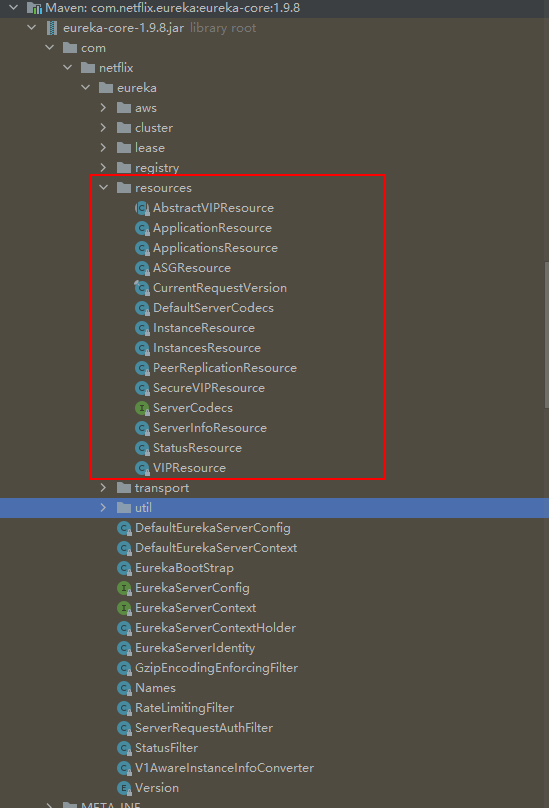
- 上面的这些类都是通过Jersey发布的供客户端调用的服务接口。
3.1.6 服务端接收客户端的注册
- 在ApplicationResource的addInstance()方法中可以看到
this.registry.register(info, "true".equals(isReplication));。
@Produces({"application/xml", "application/json"})public class ApplicationResource {@POST@Consumes({"application/json", "application/xml"})public Response addInstance(InstanceInfo info, @HeaderParam("x-netflix-discovery-replication") String isReplication) {logger.debug("Registering instance {} (replication={})", info.getId(), isReplication);if (this.isBlank(info.getId())) {return Response.status(400).entity("Missing instanceId").build();} else if (this.isBlank(info.getHostName())) {return Response.status(400).entity("Missing hostname").build();} else if (this.isBlank(info.getIPAddr())) {return Response.status(400).entity("Missing ip address").build();} else if (this.isBlank(info.getAppName())) {return Response.status(400).entity("Missing appName").build();} else if (!this.appName.equals(info.getAppName())) {return Response.status(400).entity("Mismatched appName, expecting " + this.appName + " but was " + info.getAppName()).build();} else if (info.getDataCenterInfo() == null) {return Response.status(400).entity("Missing dataCenterInfo").build();} else if (info.getDataCenterInfo().getName() == null) {return Response.status(400).entity("Missing dataCenterInfo Name").build();} else {DataCenterInfo dataCenterInfo = info.getDataCenterInfo();if (dataCenterInfo instanceof UniqueIdentifier) {String dataCenterInfoId = ((UniqueIdentifier)dataCenterInfo).getId();if (this.isBlank(dataCenterInfoId)) {boolean experimental = "true".equalsIgnoreCase(this.serverConfig.getExperimental("registration.validation.dataCenterInfoId"));if (experimental) {String entity = "DataCenterInfo of type " + dataCenterInfo.getClass() + " must contain a valid id";return Response.status(400).entity(entity).build();}if (dataCenterInfo instanceof AmazonInfo) {AmazonInfo amazonInfo = (AmazonInfo)dataCenterInfo;String effectiveId = amazonInfo.get(MetaDataKey.instanceId);if (effectiveId == null) {amazonInfo.getMetadata().put(MetaDataKey.instanceId.getName(), info.getId());}} else {logger.warn("Registering DataCenterInfo of type {} without an appropriate id", dataCenterInfo.getClass());}}}this.registry.register(info, "true".equals(isReplication));return Response.status(204).build();}}}
- register()方法的有关源码如下:
@Singletonpublic class PeerAwareInstanceRegistryImpl extends AbstractInstanceRegistry implements PeerAwareInstanceRegistry {@Overridepublic void register(final InstanceInfo info, final boolean isReplication) {//默认有效时长为90秒int leaseDuration = Lease.DEFAULT_DURATION_IN_SECS;if (info.getLeaseInfo() != null && info.getLeaseInfo().getDurationInSecs() > 0) {leaseDuration = info.getLeaseInfo().getDurationInSecs();}//注册实例super.register(info, leaseDuration, isReplication);//同步到其他的Eureka Server服务replicateToPeers(Action.Register, info.getAppName(), info.getId(), info, null, isReplication);}//其他略}
- 继续找到父类的register方法可以看到整个注册过程:
public abstract class AbstractInstanceRegistry implements InstanceRegistry {//线程安全的Map,存放所有注册的实例对象private final ConcurrentHashMap<String, Map<String, Lease<InstanceInfo>>> registry= new ConcurrentHashMap<String, Map<String, Lease<InstanceInfo>>>();public void register(InstanceInfo registrant, int leaseDuration, boolean isReplication) {try {read.lock();Map<String, Lease<InstanceInfo>> gMap = registry.get(registrant.getAppName());REGISTER.increment(isReplication);//如果第一个实例注册会给registry put进去一个空的if (gMap == null) {final ConcurrentHashMap<String, Lease<InstanceInfo>> gNewMap = new ConcurrentHashMap<String, Lease<InstanceInfo>>();gMap = registry.putIfAbsent(registrant.getAppName(), gNewMap);if (gMap == null) {gMap = gNewMap;}}// 根据注册的实例对象id,获取已经存在的LeaseLease<InstanceInfo> existingLease = gMap.get(registrant.getId());// Retain the last dirty timestamp without overwriting it, if there is already a leaseif (existingLease != null && (existingLease.getHolder() != null)) {Long existingLastDirtyTimestamp = existingLease.getHolder().getLastDirtyTimestamp();Long registrationLastDirtyTimestamp = registrant.getLastDirtyTimestamp();logger.debug("Existing lease found (existing={}, provided={}", existingLastDirtyTimestamp, registrationLastDirtyTimestamp);// this is a > instead of a >= because if the timestamps are equal, we still take the remote transmitted// InstanceInfo instead of the server local copy.if (existingLastDirtyTimestamp > registrationLastDirtyTimestamp) {logger.warn("There is an existing lease and the existing lease's dirty timestamp {} is greater" +" than the one that is being registered {}", existingLastDirtyTimestamp, registrationLastDirtyTimestamp);logger.warn("Using the existing instanceInfo instead of the new instanceInfo as the registrant");registrant = existingLease.getHolder();}} else {// The lease does not exist and hence it is a new registrationsynchronized (lock) {if (this.expectedNumberOfClientsSendingRenews > 0) {// Since the client wants to register it, increase the number of clients sending renewsthis.expectedNumberOfClientsSendingRenews = this.expectedNumberOfClientsSendingRenews + 1;updateRenewsPerMinThreshold();}}logger.debug("No previous lease information found; it is new registration");}Lease<InstanceInfo> lease = new Lease<InstanceInfo>(registrant, leaseDuration);if (existingLease != null) {lease.setServiceUpTimestamp(existingLease.getServiceUpTimestamp());}//将lease存入gMapgMap.put(registrant.getId(), lease);synchronized (recentRegisteredQueue) {recentRegisteredQueue.add(new Pair<Long, String>(System.currentTimeMillis(),registrant.getAppName() + "(" + registrant.getId() + ")"));}// This is where the initial state transfer of overridden status happensif (!InstanceStatus.UNKNOWN.equals(registrant.getOverriddenStatus())) {logger.debug("Found overridden status {} for instance {}. Checking to see if needs to be add to the "+ "overrides", registrant.getOverriddenStatus(), registrant.getId());if (!overriddenInstanceStatusMap.containsKey(registrant.getId())) {logger.info("Not found overridden id {} and hence adding it", registrant.getId());overriddenInstanceStatusMap.put(registrant.getId(), registrant.getOverriddenStatus());}}InstanceStatus overriddenStatusFromMap = overriddenInstanceStatusMap.get(registrant.getId());if (overriddenStatusFromMap != null) {logger.info("Storing overridden status {} from map", overriddenStatusFromMap);registrant.setOverriddenStatus(overriddenStatusFromMap);}// Set the status based on the overridden status rulesInstanceStatus overriddenInstanceStatus = getOverriddenInstanceStatus(registrant, existingLease, isReplication);registrant.setStatusWithoutDirty(overriddenInstanceStatus);// If the lease is registered with UP status, set lease service up timestampif (InstanceStatus.UP.equals(registrant.getStatus())) {lease.serviceUp();}registrant.setActionType(ActionType.ADDED);recentlyChangedQueue.add(new RecentlyChangedItem(lease));registrant.setLastUpdatedTimestamp();invalidateCache(registrant.getAppName(), registrant.getVIPAddress(), registrant.getSecureVipAddress());logger.info("Registered instance {}/{} with status {} (replication={})",registrant.getAppName(), registrant.getId(), registrant.getStatus(), isReplication);} finally {read.unlock();}}//其他略}
3.1.7 服务端接收客户端的续约
- 在InstanceResource的renewLease方法中完成客户端的心跳(续约)处理,其中最关键的方法就是
registry.renew(app.getName(), id, isFromReplicaNode);。
@Produces({"application/xml", "application/json"})public class InstanceResource {@PUTpublic Response renewLease(@HeaderParam(PeerEurekaNode.HEADER_REPLICATION) String isReplication,@QueryParam("overriddenstatus") String overriddenStatus,@QueryParam("status") String status,@QueryParam("lastDirtyTimestamp") String lastDirtyTimestamp) {boolean isFromReplicaNode = "true".equals(isReplication);//服务端接收客户端的续约boolean isSuccess = registry.renew(app.getName(), id, isFromReplicaNode);// Not found in the registry, immediately ask for a registerif (!isSuccess) {logger.warn("Not Found (Renew): {} - {}", app.getName(), id);return Response.status(Status.NOT_FOUND).build();}// Check if we need to sync based on dirty time stamp, the client// instance might have changed some valueResponse response;if (lastDirtyTimestamp != null && serverConfig.shouldSyncWhenTimestampDiffers()) {response = this.validateDirtyTimestamp(Long.valueOf(lastDirtyTimestamp), isFromReplicaNode);// Store the overridden status since the validation found out the node that replicates winsif (response.getStatus() == Response.Status.NOT_FOUND.getStatusCode()&& (overriddenStatus != null)&& !(InstanceStatus.UNKNOWN.name().equals(overriddenStatus))&& isFromReplicaNode) {registry.storeOverriddenStatusIfRequired(app.getAppName(), id, InstanceStatus.valueOf(overriddenStatus));}} else {response = Response.ok().build();}logger.debug("Found (Renew): {} - {}; reply status={}", app.getName(), id, response.getStatus());return response;}}
- renew()方法的源码如下:
@Singletonpublic class PeerAwareInstanceRegistryImpl extends AbstractInstanceRegistry implements PeerAwareInstanceRegistry {public boolean renew(final String appName, final String id, final boolean isReplication) {//客户端续约if (super.renew(appName, id, isReplication)) {//同步到其他的Eureka Server服务replicateToPeers(Action.Heartbeat, appName, id, null, null, isReplication);return true;}return false;}//其他略}
- 继续找到父类的renew方法可以看到整个续约过程:
public abstract class AbstractInstanceRegistry implements InstanceRegistry {public boolean renew(String appName, String id, boolean isReplication) {RENEW.increment(isReplication);Map<String, Lease<InstanceInfo>> gMap = registry.get(appName);Lease<InstanceInfo> leaseToRenew = null;if (gMap != null) {//从Map中根据id获取实例对象的Lease对象leaseToRenew = gMap.get(id);}if (leaseToRenew == null) {RENEW_NOT_FOUND.increment(isReplication);logger.warn("DS: Registry: lease doesn't exist, registering resource: {} - {}", appName, id);return false;} else {//获取实例对象InstanceInfo instanceInfo = leaseToRenew.getHolder();if (instanceInfo != null) {// touchASGCache(instanceInfo.getASGName());InstanceStatus overriddenInstanceStatus = this.getOverriddenInstanceStatus(instanceInfo, leaseToRenew, isReplication);if (overriddenInstanceStatus == InstanceStatus.UNKNOWN) {logger.info("Instance status UNKNOWN possibly due to deleted override for instance {}"+ "; re-register required", instanceInfo.getId());RENEW_NOT_FOUND.increment(isReplication);return false;}if (!instanceInfo.getStatus().equals(overriddenInstanceStatus)) {logger.info("The instance status {} is different from overridden instance status {} for instance {}. "+ "Hence setting the status to overridden status", instanceInfo.getStatus().name(),instanceInfo.getOverriddenStatus().name(),instanceInfo.getId());//设置实例状态instanceInfo.setStatusWithoutDirty(overriddenInstanceStatus);}}//设置续约次数renewsLastMin.increment();leaseToRenew.renew();return true;}}}
3.1.8 服务剔除
- 在AbstractInstanceRegistry的postInit()方法中开启了一个每60秒调用一次EvictionTask的evict的定时器。
public abstract class AbstractInstanceRegistry implements InstanceRegistry {public void evict(long additionalLeaseMs) {logger.debug("Running the evict task");if (!isLeaseExpirationEnabled()) {logger.debug("DS: lease expiration is currently disabled.");return;}// We collect first all expired items, to evict them in random order. For large eviction sets,// if we do not that, we might wipe out whole apps before self preservation kicks in. By randomizing it,// the impact should be evenly distributed across all applications.List<Lease<InstanceInfo>> expiredLeases = new ArrayList<>();for (Entry<String, Map<String, Lease<InstanceInfo>>> groupEntry : registry.entrySet()) {Map<String, Lease<InstanceInfo>> leaseMap = groupEntry.getValue();if (leaseMap != null) {for (Entry<String, Lease<InstanceInfo>> leaseEntry : leaseMap.entrySet()) {Lease<InstanceInfo> lease = leaseEntry.getValue();if (lease.isExpired(additionalLeaseMs) && lease.getHolder() != null) {expiredLeases.add(lease);}}}}// To compensate for GC pauses or drifting local time, we need to use current registry size as a base for// triggering self-preservation. Without that we would wipe out full registry.int registrySize = (int) getLocalRegistrySize();int registrySizeThreshold = (int) (registrySize * serverConfig.getRenewalPercentThreshold());int evictionLimit = registrySize - registrySizeThreshold;int toEvict = Math.min(expiredLeases.size(), evictionLimit);if (toEvict > 0) {logger.info("Evicting {} items (expired={}, evictionLimit={})", toEvict, expiredLeases.size(), evictionLimit);Random random = new Random(System.currentTimeMillis());for (int i = 0; i < toEvict; i++) {// Pick a random item (Knuth shuffle algorithm)int next = i + random.nextInt(expiredLeases.size() - i);Collections.swap(expiredLeases, i, next);Lease<InstanceInfo> lease = expiredLeases.get(i);String appName = lease.getHolder().getAppName();String id = lease.getHolder().getId();EXPIRED.increment();logger.warn("DS: Registry: expired lease for {}/{}", appName, id);internalCancel(appName, id, false);}}}//其他略}
3.2 Eureka服务发现核心源码解析
3.2.1 自动装载
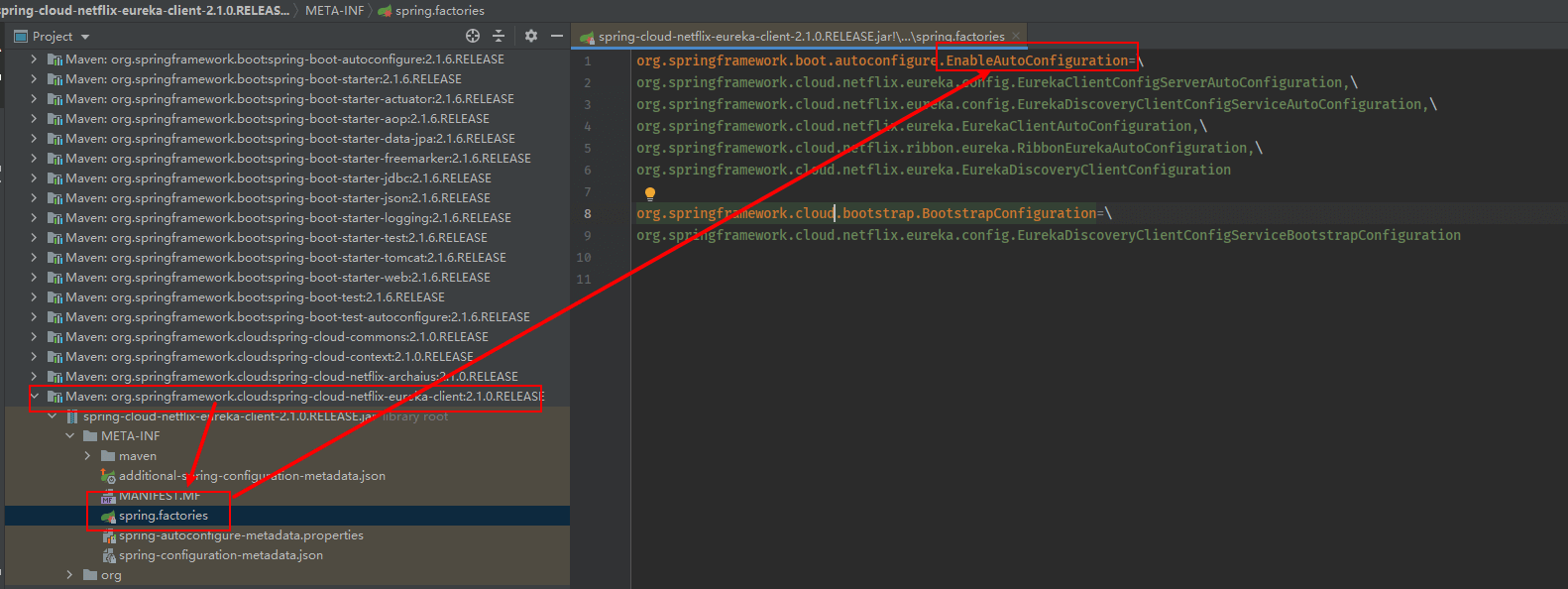
- 在消费者导入的坐标有spring-cloud-netflix-eureka-client-2.1.0.RELEASE.jar找到的spring.factories可以看到所有自动装载的配置类:
3.2.2 服务注册
- EurekaClientAutoConfiguration中注册了DiscoveryClient组件。
@Configuration@EnableConfigurationProperties@ConditionalOnClass(EurekaClientConfig.class)@Import(DiscoveryClientOptionalArgsConfiguration.class)@ConditionalOnBean(EurekaDiscoveryClientConfiguration.Marker.class)@ConditionalOnProperty(value = "eureka.client.enabled", matchIfMissing = true)@AutoConfigureBefore({ NoopDiscoveryClientAutoConfiguration.class,CommonsClientAutoConfiguration.class, ServiceRegistryAutoConfiguration.class })@AutoConfigureAfter(name = {"org.springframework.cloud.autoconfigure.RefreshAutoConfiguration","org.springframework.cloud.netflix.eureka.EurekaDiscoveryClientConfiguration","org.springframework.cloud.client.serviceregistry.AutoServiceRegistrationAutoConfiguration"})public class EurekaClientAutoConfiguration {@Beanpublic DiscoveryClient discoveryClient(EurekaClient client, EurekaClientConfig clientConfig) {return new EurekaDiscoveryClient(client, clientConfig);}//其他leukemia}
- DiscoveryClient中有register方法,即服务注册方法:
@Singletonpublic class DiscoveryClient implements EurekaClient {//服务注册boolean register() throws Throwable {logger.info("DiscoveryClient_{}: registering service...", this.appPathIdentifier);EurekaHttpResponse httpResponse;try {httpResponse = this.eurekaTransport.registrationClient.register(this.instanceInfo);} catch (Exception var3) {logger.warn("DiscoveryClient_{} - registration failed {}", new Object[]{this.appPathIdentifier, var3.getMessage(), var3});throw var3;}if (logger.isInfoEnabled()) {logger.info("DiscoveryClient_{} - registration status: {}", this.appPathIdentifier, httpResponse.getStatusCode());}return httpResponse.getStatusCode() == Status.NO_CONTENT.getStatusCode();}//其他略}
3.2.3 服务下架
- DiscoveryClient中有shutdown方法,即服务下架方法:
@Singletonpublic class DiscoveryClient implements EurekaClient {@PreDestroypublic synchronized void shutdown() {if (this.isShutdown.compareAndSet(false, true)) {logger.info("Shutting down DiscoveryClient ...");if (this.statusChangeListener != null && this.applicationInfoManager != null) {this.applicationInfoManager.unregisterStatusChangeListener(this.statusChangeListener.getId());}this.cancelScheduledTasks();if (this.applicationInfoManager != null && this.clientConfig.shouldRegisterWithEureka() && this.clientConfig.shouldUnregisterOnShutdown()) {this.applicationInfoManager.setInstanceStatus(InstanceStatus.DOWN);this.unregister();}if (this.eurekaTransport != null) {this.eurekaTransport.shutdown();}this.heartbeatStalenessMonitor.shutdown();this.registryStalenessMonitor.shutdown();logger.info("Completed shut down of DiscoveryClient");}}//其他略}
3.2.4 心跳续约
- DiscoveryClient的HeartbeatThread中定义了续约的操作:
@Singletonpublic class DiscoveryClient implements EurekaClient {private class HeartbeatThread implements Runnable {private HeartbeatThread() {}public void run() {if (DiscoveryClient.this.renew()) {DiscoveryClient.this.lastSuccessfulHeartbeatTimestamp = System.currentTimeMillis();}}}boolean renew() {try {EurekaHttpResponse<InstanceInfo> httpResponse = this.eurekaTransport.registrationClient.sendHeartBeat(this.instanceInfo.getAppName(), this.instanceInfo.getId(), this.instanceInfo, (InstanceStatus)null);logger.debug("DiscoveryClient_{} - Heartbeat status: {}", this.appPathIdentifier, httpResponse.getStatusCode());if (httpResponse.getStatusCode() == Status.NOT_FOUND.getStatusCode()) {this.REREGISTER_COUNTER.increment();logger.info("DiscoveryClient_{} - Re-registering apps/{}", this.appPathIdentifier, this.instanceInfo.getAppName());long timestamp = this.instanceInfo.setIsDirtyWithTime();boolean success = this.register();if (success) {this.instanceInfo.unsetIsDirty(timestamp);}return success;} else {return httpResponse.getStatusCode() == Status.OK.getStatusCode();}} catch (Throwable var5) {logger.error("DiscoveryClient_{} - was unable to send heartbeat!", this.appPathIdentifier, var5);return false;}}//其他略}

若有收获,就点个赞吧
0 人点赞


