Follow Button Logic and Endpoint:
Now we need to prepare to import a button on HTML page to let users can manually organize their following or followed.
profiles/api:
- create directory /profiles/api
- and create 3 files
- /profiles/api/init.py
- (empty)
- /profiles/api/urls.py ```python from django.urls import path
- /profiles/api/init.py
from .views import ( user_follow_view, )
urlpatterns = [ path(‘<str:username/follow’, user_follow_view), ]
- /profiles/api/views.py```pythonimport randomfrom django.http import HttpResponse, JsonResponse, HttpResponseRedirectfrom django.shortcuts import render, redirectfrom django.utils.http import is_safe_urlfrom django.conf import settingsfrom django.contrib.auth import get_user_modelfrom rest_framework.authentication import SessionAuthenticationfrom rest_framework.decorators import api_view, permission_classes, authentication_classesfrom rest_framework.permissions import IsAuthenticatedfrom rest_framework.response import Responsefrom ..models import ProfileUser = get_user_model()ALLOWED_HOSTS = settings.ALLOWED_HOSTS@api_view(['GET', 'POST'])@permission_classes([IsAuthenticated])def user_follow_view(request, username, *args, **kwargs):me = request.userother_user_qs = User.objects.filter(username=username)if not other_user_qs.exists():return Response({}, status=404)other = other_user_qs.first()profile = other.profiledata = request.data or {}action = data.get("action")print(data)if action == "follow": # if I am not following this profileprofile.followers.add(me) # start followingelif action == "unfollow": # elseprofile.followers.remove(me) # stop followingelse:passcurrent_followers_qs = profile.followers.all()return Response({"count": current_followers_qs.count()}, status=200)# we don't just use profile.followers.all() here because 'User' is not JSON serializable
add a path for api url in /Twittme/urls.py
# ...urlpatterns = [path('admin/', admin.site.urls),path('api/tweets/', include('tweets.api.urls')),path('', tweets_list_view),path('login/', login_view),path('logout/', logout_view),path('register/', register_view),path('<int:tweet_id>', tweets_detail_view),re_path(r'profiles?/', include('profiles.urls')),re_path(r'api/profiles?/', include('profiles.api.urls')), # new]# ...
Test case:
to test, runserver
access http://localhost/api/profiles/[username]/follow
we apply username as “root” here,
count is 0 right now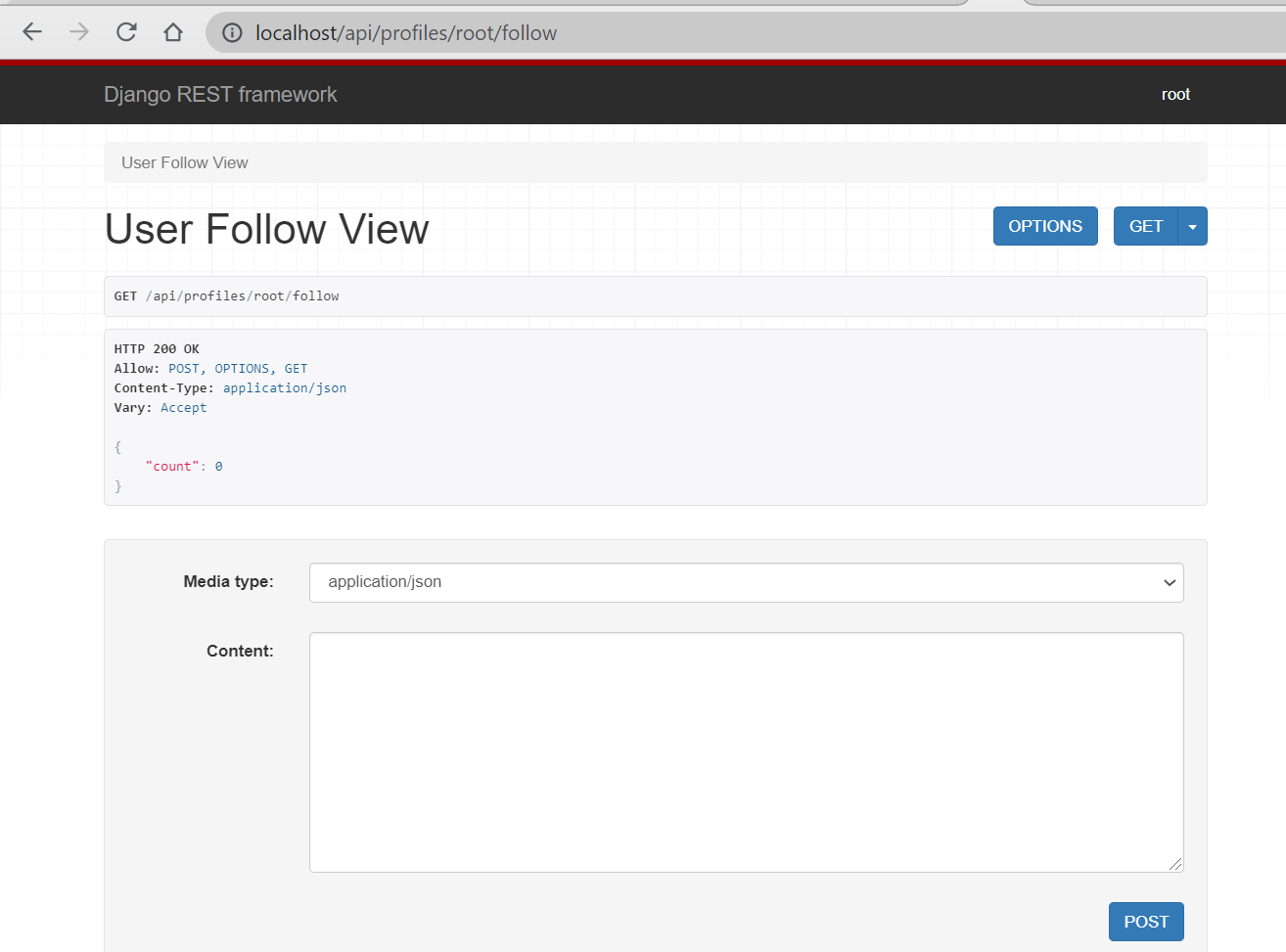
we POST content {“action”: “follow”}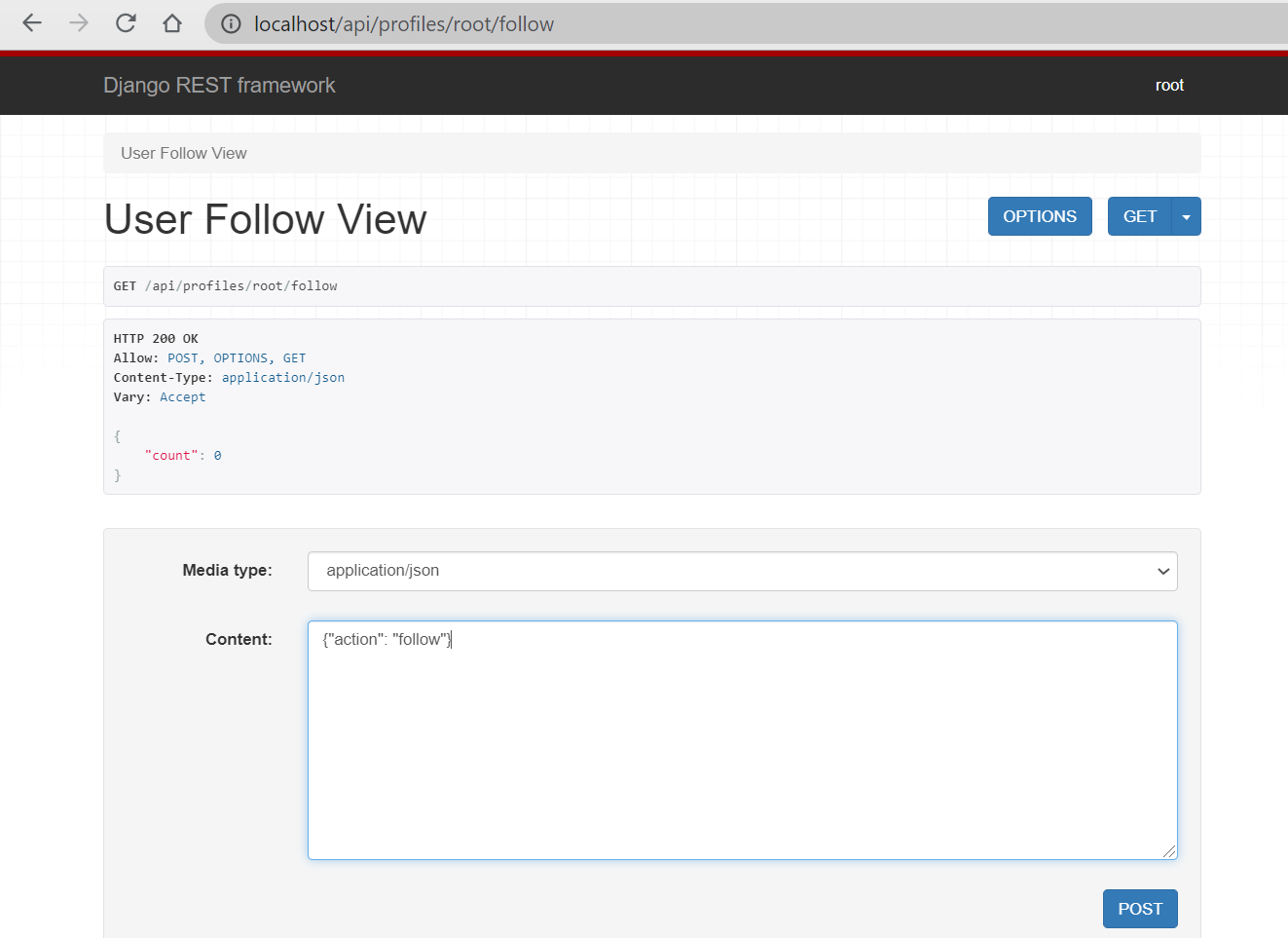
and count becomes 1
This time we POST content {“action”: “unfollow”}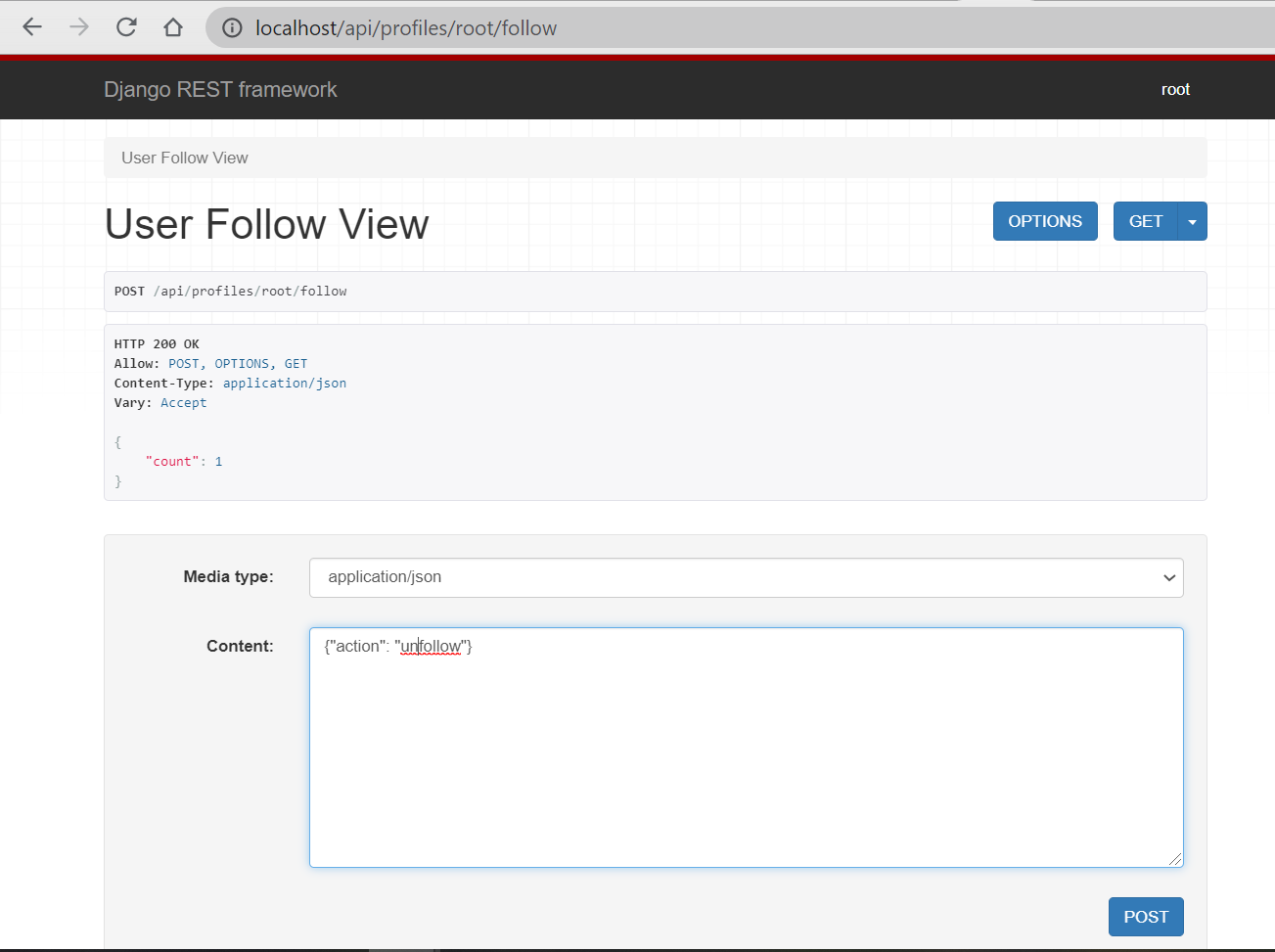
count is reduced to 0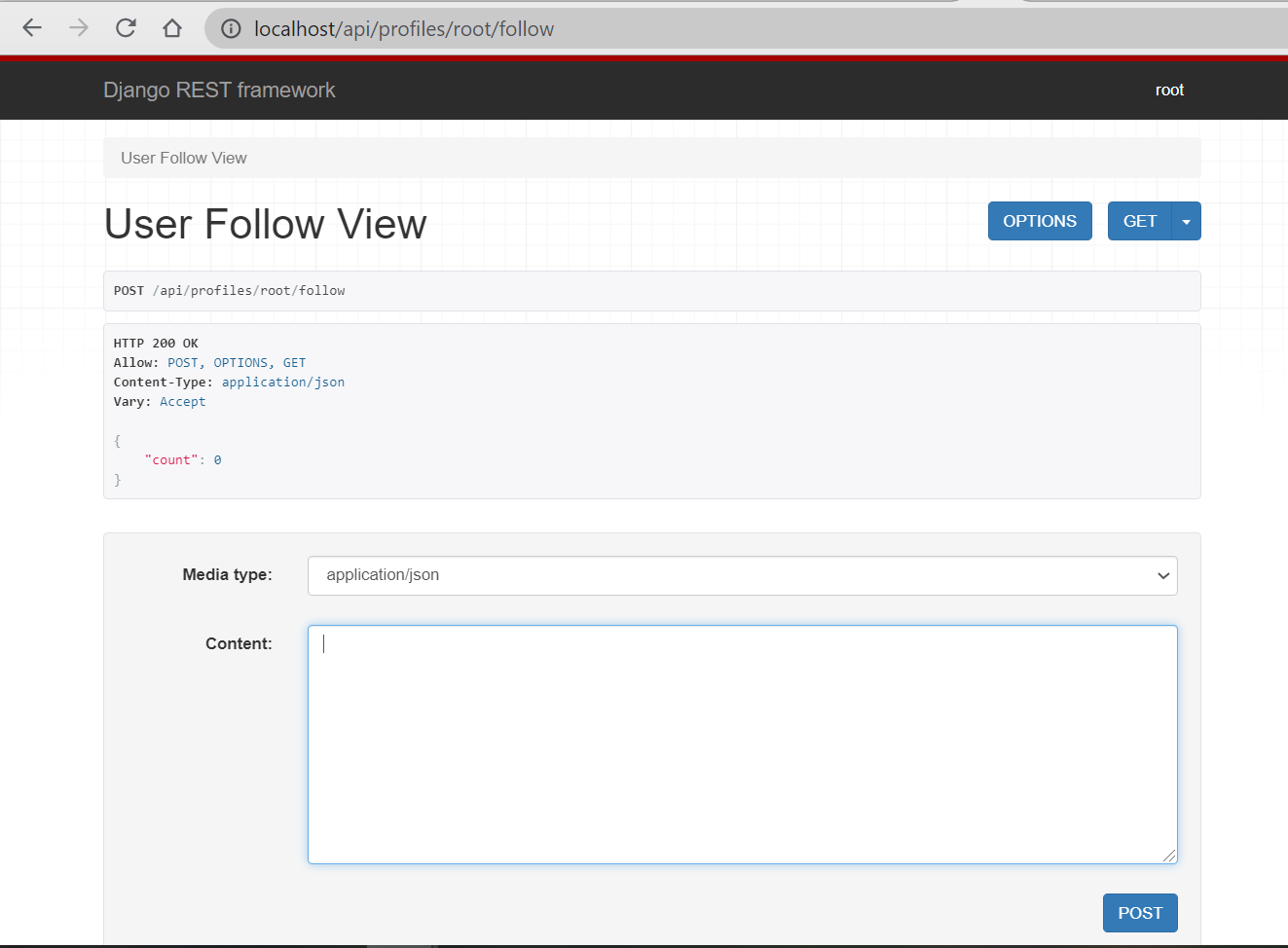
But if we POST content {“action”: “unfollow”} again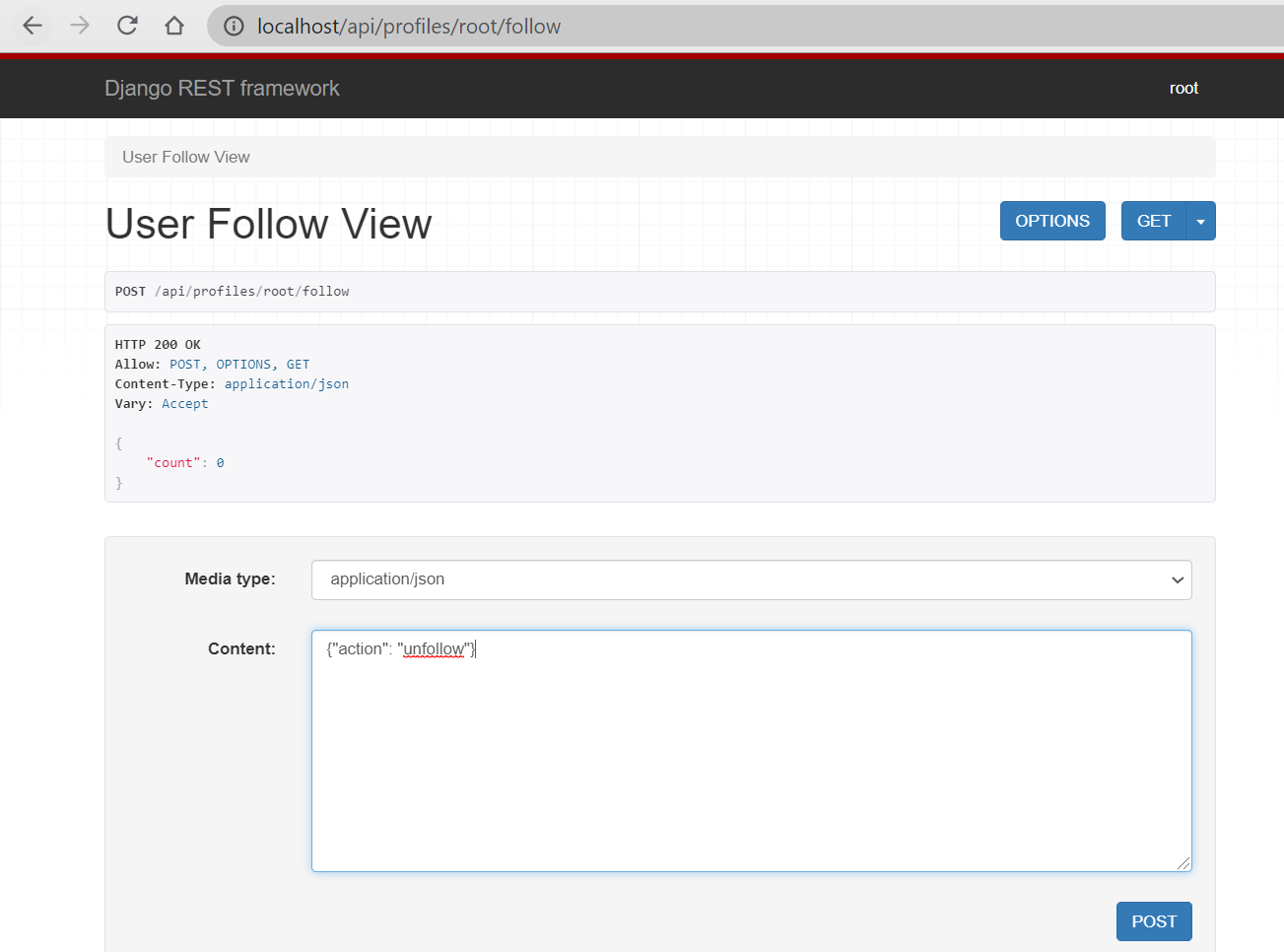
count won’t be -1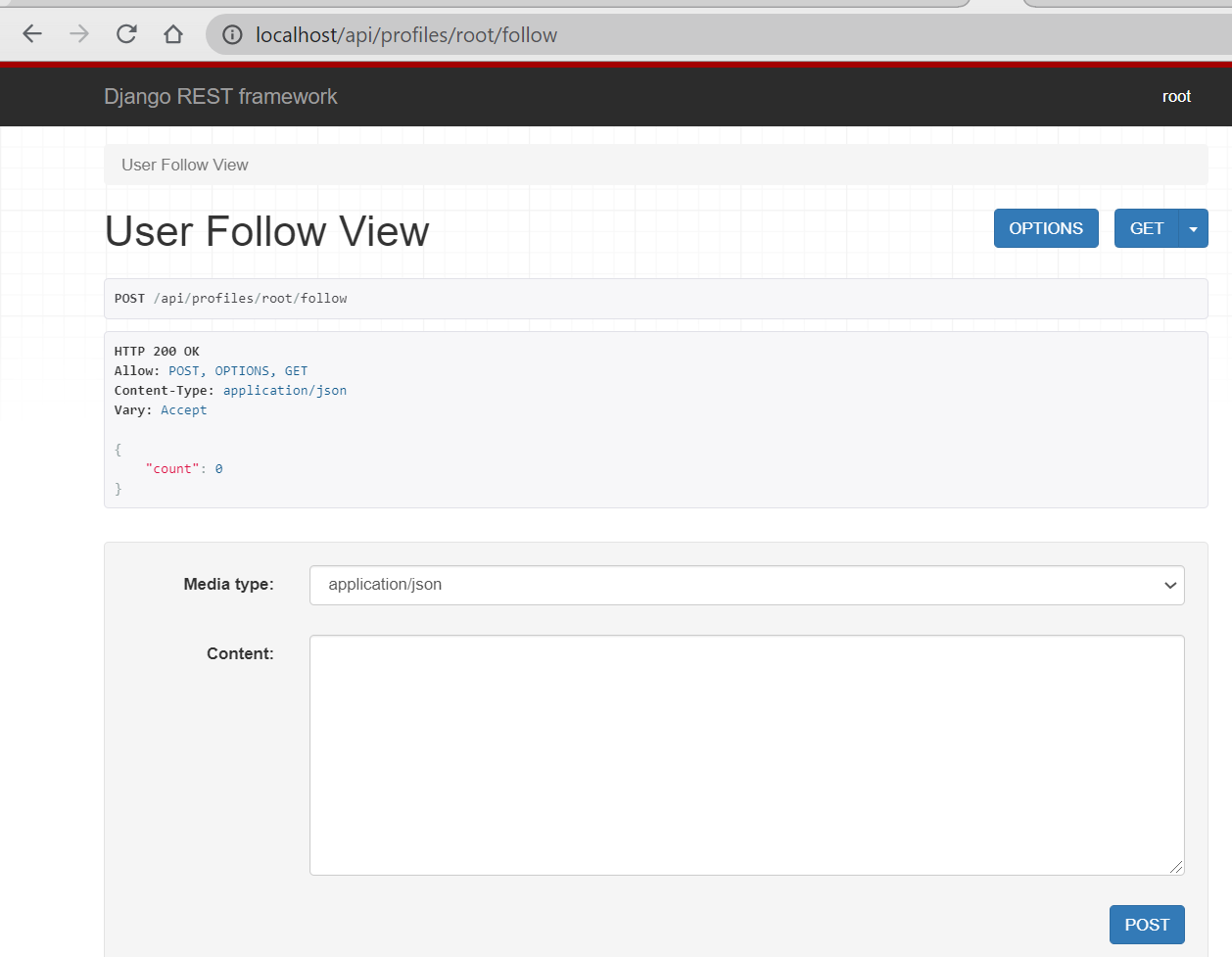
Same as {“action”: “follow”} when count is 1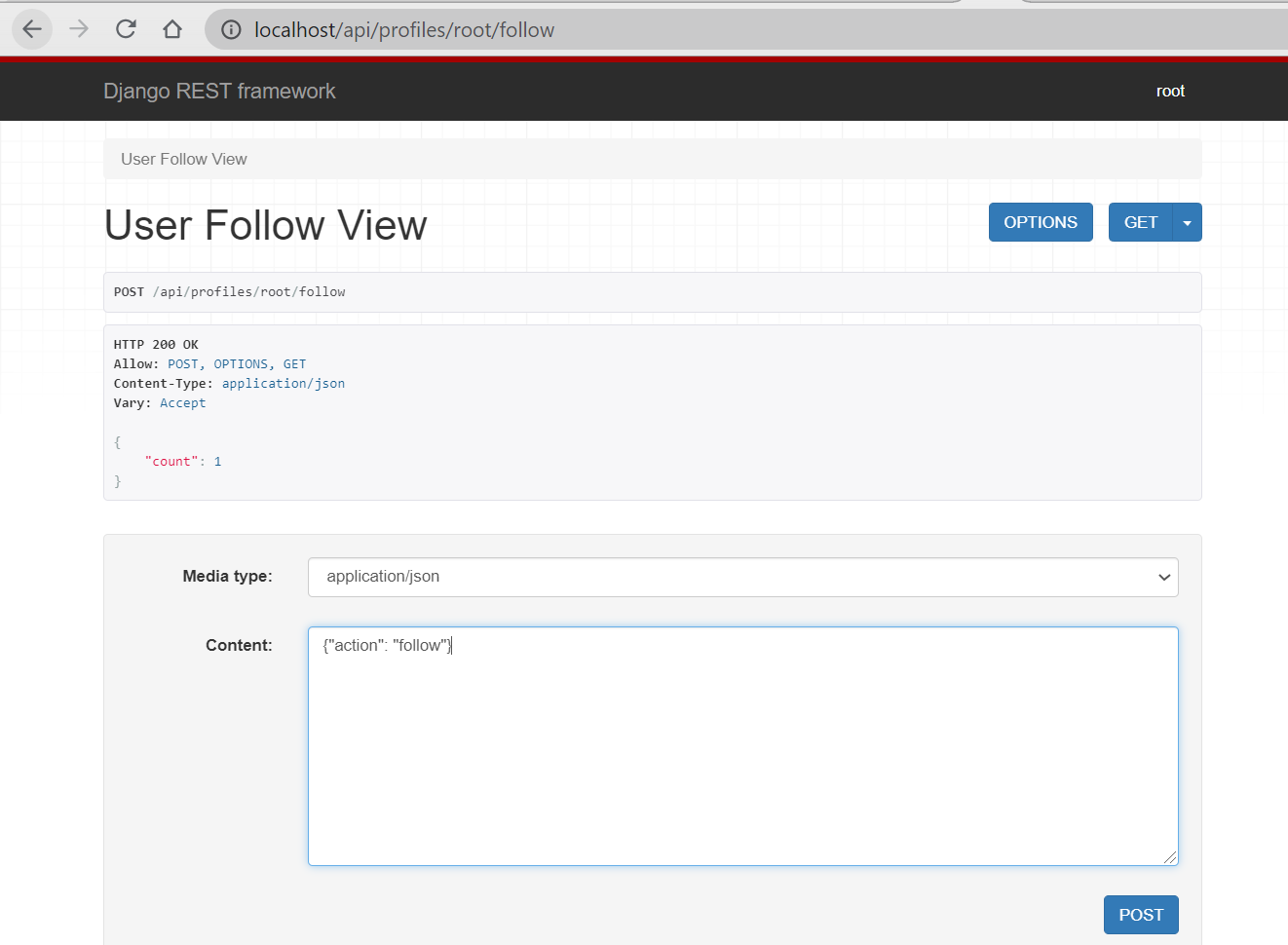
count won’t be 2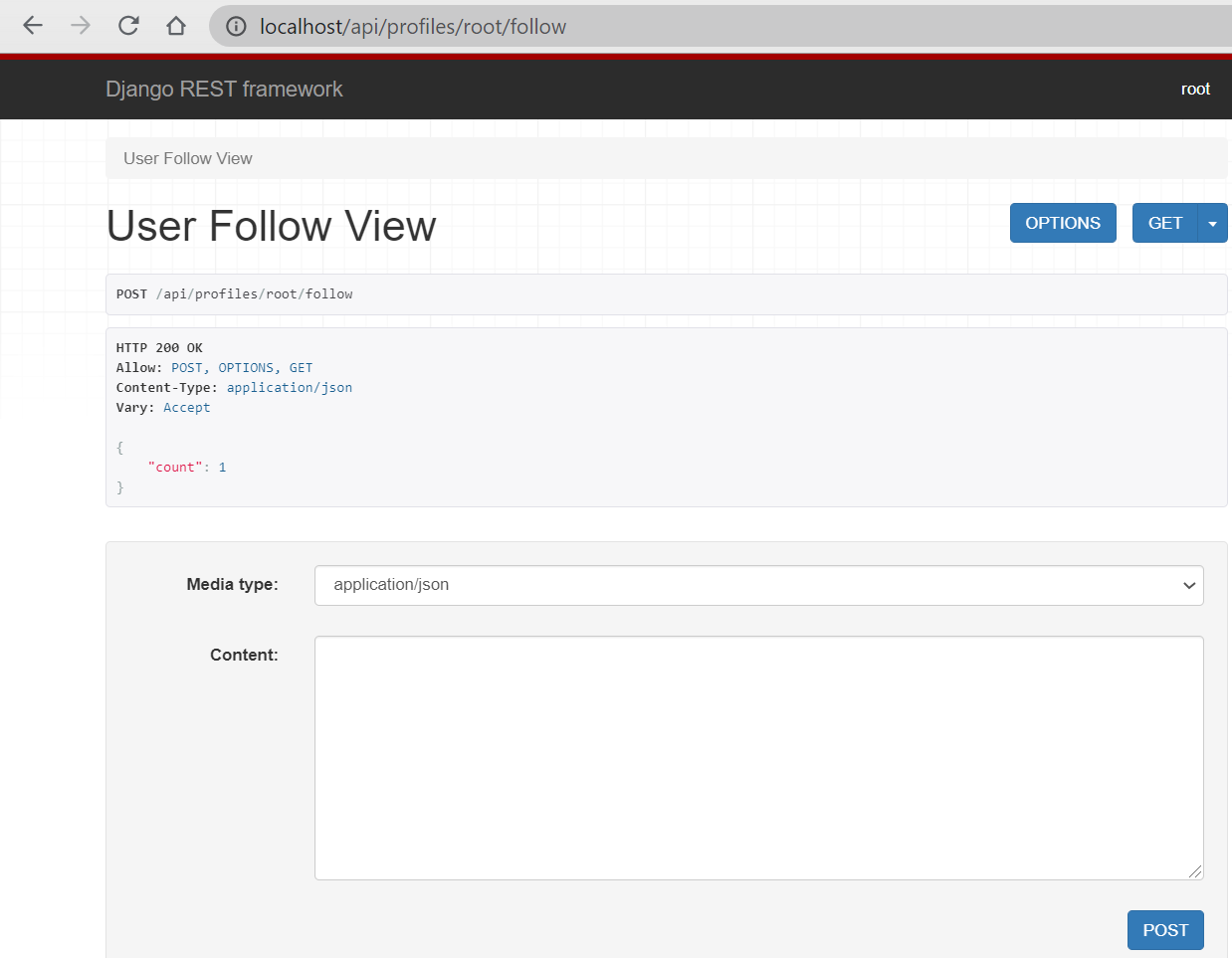
That’s because it’s actually keep adding and removing the same user who follows a profile, and 1 user is either following or not following a profile.
“data” in /profiles/api/views.py will always be {“action”: “follow”} or {“action”: “unfollow”}
**
Profile Following Unit Test Cases:
In this step, we can try to setup a unit test cases for profiles/api
Test case:
- add new contents in /profiles/tests.py ```python from django.contrib.auth import get_user_model from django.test import TestCase
from rest_framework.test import APIClient # new
from .models import Profile
User = get_user_model()
class ProfileTestCase(TestCase): def setUp(self): self.user = User.objects.create_user( username=’cfe’, password=’somepassword’) self.userb = User.objects.create_user( username=’cfe-2’, password=’somepassword2’)
def get_client(self): # newclient = APIClient()client.login(username=self.user.username, password='somepassword')return clientdef test_profile_created_via_signal(self):qs = Profile.objects.all()self.assertEqual(qs.count(), 2)def test_following(self): # new, to test following stepfirst = self.usersecond = self.userbfirst.profile.followers.add(second) # added a followersecond_user_following_whom = second.following.all()# from a user, check other user is being followed.qs = second_user_following_whom.filter(user=first)# check new user has is not following anyonefirst_user_following_no_one = first.following.all()self.assertTrue(qs.exists())self.assertFalse(first_user_following_no_one.exists())def test_follow_api_endpoint(self): # new, to test unfollowing stepclient = self.get_client()response = client.post(f"/api/profiles/{self.userb.username}/follow", {"action": "follow"})r_data = response.json()count = r_data.get("count")self.assertEqual(count, 1)def test_unfollow_api_endpoint(self):first = self.usersecond = self.userbfirst.profile.followers.add(second) # add a followerclient = self.get_client()response = client.post(f"/api/profiles/{self.userb.username}/follow",{"action": "unfollow"})r_data = response.json()count = r_data.get("count")self.assertEqual(count, 0)
to test, run test case in the terminal```bash[root@localhost Twittme]# python3 ./manage.py test profilesCreating test database for alias 'default'...System check identified no issues (0 silenced).<QueryDict: {'action': ['follow']}>...<QueryDict: {'action': ['unfollow']}>.----------------------------------------------------------------------Ran 4 tests in 3.028sOKDestroying test database for alias 'default'...
all cases are passed, so that the following and unfollowing step is successful.
“Not the same user”:
There is a problem that we cannot let a user follow itself.
add this checking in /profiles/api/views.py
@api_view(['GET', 'POST'])@permission_classes([IsAuthenticated])def user_follow_view(request, username, *args, **kwargs):me = request.userother_user_qs = User.objects.filter(username=username)if me.username == username: # to check is follower and followed use the same onemy_followers = me.profile.followers.all()return Response({"count": my_followers.count()}, status=200)if not other_user_qs.exists():return Response({}, status=404)other = other_user_qs.first()profile = other.profiledata = request.data or {}action = data.get("action")print(data)if action == "follow": # if I am not following this profileprofile.followers.add(me) # start followingelif action == "unfollow": # elseprofile.followers.remove(me) # stop followingelse:passcurrent_followers_qs = profile.followers.all()return Response({"count": current_followers_qs.count()}, status=200)
add the test case about “a use cannot follow oneself” in /profiles/tests.py
# ...def test_cannot_follow_api_endpoint(self): # test the setting that a user cannot follow itselfclient = self.get_client()response = client.post(f"/api/profiles/{self.user.username}/follow",{"action": "follow"})r_data = response.json()count = r_data.get("count")self.assertEqual(count, 0)
to test, run test case in the terminal ```bash [root@localhost Twittme]# python3 ./manage.py test profiles Creating test database for alias ‘default’… System check identified no issues (0 silenced). .
Ran 5 tests in 4.101s
OK Destroying test database for alias ‘default’…
``` all cases are passed, so that a user cannot follow itself.

若有收获,就点个赞吧
0 人点赞


