Network Characteristics
要求及数据集:hw1.pdfCA-GrQc.txt
代码:
################################################################################# CS 224W (Fall 2019) - HW1# Starter code for Question 1# Last Updated: Sep 25, 2019################################################################################import snapimport numpy as npimport matplotlib.pyplot as pltimport random# SetuperdosRenyi = NonesmallWorld = NonecollabNet = None# Problem 1.1def genErdosRenyi(N=5242, E=14484):""":param - N: number of nodes:param - E: number of edgesreturn type: snap.PUNGraphreturn: Erdos-Renyi graph with N nodes and E edges"""############################################################################# TODO: Your code here!Graph = snap.TUNGraph().New()for i in range(N):Graph.AddNode(i + 1)for i in range(E):a, b = random.randint(1, N), random.randint(1, N)while a == b:a, b = random.randint(1, N), random.randint(1, N)Graph.AddEdge(a, b)############################################################################return Graphdef genCircle(N=5242):""":param - N: number of nodesreturn type: snap.PUNGraphreturn: Circle graph with N nodes and N edges. Imagine the nodes form acircle and each node is connected to its two direct neighbors."""############################################################################# TODO: Your code here!# Graph = snap.TUNGraph()Graph = snap.TUNGraph().New()for i in range(N):Graph.AddNode(i + 1)############################################################################return Graphdef connectNbrOfNbr(Graph, N=5242):""":param - Graph: snap.PUNGraph object representing a circle graph on N nodes:param - N: number of nodesreturn type: snap.PUNGraphreturn: Graph object with additional N edges added by connecting each nodeto the neighbors of its neighbors"""############################################################################# TODO: Your code here!for i in range(N - 2):if not i:Graph.AddEdge(i + 1, N)Graph.AddEdge(i + 1, N - 1)Graph.AddEdge(i + 2, N)Graph.AddEdge(N - 1, N)Graph.AddEdge(i + 1, i + 2)Graph.AddEdge(i + 1, i + 3)############################################################################return Graphdef connectRandomNodes(Graph, M=4000):""":param - Graph: snap.PUNGraph object representing an undirected graph:param - M: number of edges to be addedreturn type: snap.PUNGraphreturn: Graph object with additional M edges added by connecting M randomlyselected pairs of nodes not already connected."""############################################################################# TODO: Your code here!for i in range(M):a, b = random.randint(1, Graph.GetNodes()), random.randint(1, Graph.GetNodes())while a == b or Graph.IsEdge(a, b):a, b = random.randint(1, Graph.GetNodes()), random.randint(1, Graph.GetNodes())Graph.AddEdge(a, b)############################################################################return Graphdef genSmallWorld(N=5242, E=14484):""":param - N: number of nodes:param - E: number of edgesreturn type: snap.PUNGraphreturn: Small-World graph with N nodes and E edges"""Graph = genCircle(N)Graph = connectNbrOfNbr(Graph, N)Graph = connectRandomNodes(Graph, 4000)return Graphdef loadCollabNet(path):""":param - path: path to edge list filereturn type: snap.PUNGraphreturn: Graph loaded from edge list at `path and self edges removedDo not forget to remove the self edges!"""############################################################################# TODO: Your code here!Graph = snap.LoadEdgeList(snap.TUNGraph, path)for edge in Graph.Edges():if edge.GetSrcNId() == edge.GetDstNId:Graph.DelEdge(edge.GetSrcNId(), edge.GetDstNId)############################################################################return Graphdef getDataPointsToPlot(Graph):""":param - Graph: snap.PUNGraph object representing an undirected graphreturn values:X: list of degreesY: list of frequencies: Y[i] = fraction of nodes with degree X[i]"""############################################################################# TODO: Your code here!X, Y = [], []map = {}for node in Graph.Nodes():out_deg = node.GetOutDeg()if out_deg not in map:map[out_deg] = 1else:map[out_deg] += 1X = [item for item in map.keys()]X.sort()Y = [map[x] for x in X]############################################################################return X, Ydef Q1_1():"""Code for HW1 Q1.1"""global erdosRenyi, smallWorld, collabNeterdosRenyi = genErdosRenyi(5242, 14484)smallWorld = genSmallWorld(5242, 14484)collabNet = loadCollabNet("ca-GrQc.txt")x_erdosRenyi, y_erdosRenyi = getDataPointsToPlot(erdosRenyi)plt.loglog(x_erdosRenyi, y_erdosRenyi, color='y', label='Erdos Renyi Network')x_smallWorld, y_smallWorld = getDataPointsToPlot(smallWorld)plt.loglog(x_smallWorld, y_smallWorld, linestyle='dashed', color='r', label='Small World Network')x_collabNet, y_collabNet = getDataPointsToPlot(collabNet)plt.loglog(x_collabNet, y_collabNet, linestyle='dotted', color='b', label='Collaboration Network')plt.xlabel('Node Degree (log)')plt.ylabel('Proportion of Nodes with a Given Degree (log)')plt.title('Degree Distribution of Erdos Renyi, Small World, and Collaboration Networks')plt.legend()plt.show()# Execute code for Q1.1Q1_1()# Problem 1.2 - Clustering Coefficientdef calcClusteringCoefficientSingleNode(Node, Graph):""":param - Node: node from snap.PUNGraph object. Graph.Nodes() will give aniterable of nodes in a graph:param - Graph: snap.PUNGraph object representing an undirected graphreturn type: floatreturns: local clustering coeffient of Node"""############################################################################# TODO: Your code here!C = 0.0k = Node.GetOutDeg()if k == 0 or k == 1:return Cneighbours = []for i in range(k):neighbours.append(Node.GetOutNId(i))exc = 0degs = 0for node in neighbours:deg = Graph.GetNI(node).GetOutDeg()degs += degfor i in range(deg):if Graph.GetNI(node).GetOutNId(i) not in neighbours:exc += 1e = (degs - exc) / 2C = float(2 * e) / float(k * (k - 1))############################################################################return Cdef calcClusteringCoefficient(Graph):""":param - Graph: snap.PUNGraph object representing an undirected graphreturn type: floatreturns: clustering coeffient of Graph"""############################################################################# TODO: Your code here! If you filled out calcClusteringCoefficientSingleNode,# you'll probably want to call it in a loop hereC = 0.0for node in Graph.Nodes():C += calcClusteringCoefficientSingleNode(node, Graph)C /= float(Graph.GetNodes())############################################################################return Cdef Q1_2():"""Code for Q1.2"""C_erdosRenyi = calcClusteringCoefficient(erdosRenyi)C_smallWorld = calcClusteringCoefficient(smallWorld)C_collabNet = calcClusteringCoefficient(collabNet)print('Clustering Coefficient for Erdos Renyi Network: %f' % C_erdosRenyi)print('Clustering Coefficient for Small World Network: %f' % C_smallWorld)print('Clustering Coefficient for Collaboration Network: %f' % C_collabNet)# Execute code for Q1.2Q1_2()
结果:
我画出来是这样的,不知道对不对: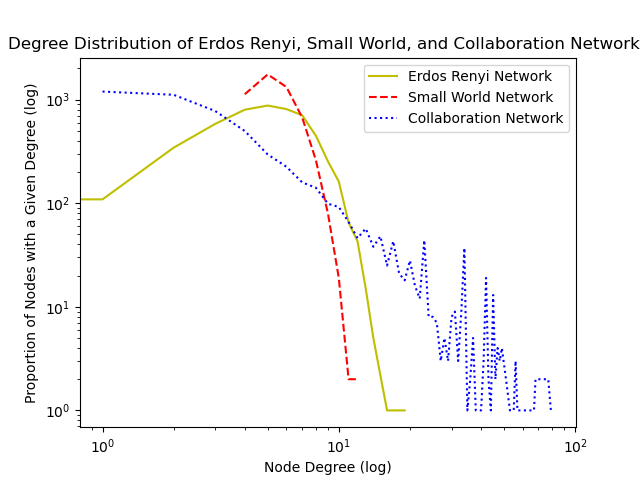
Clustering Coefficient for Erdos Renyi Network: 0.001620Clustering Coefficient for Small World Network: 0.283908Clustering Coefficient for Collaboration Network: 0.532029
Structural Roles: Rolx and ReFex
数据集:hw1-q2.zip
代码:
import snapimport numpy as npimport matplotlib.pyplot as pltdef take_first(item):return item[0]def basic_features(j):G = snap.TUNGraph.Load(snap.TFIn("hw1-q2.graph"))x = calculate_basic_feature(G, j)similarity = []for i in range(G.GetMxNId() - 1):if i + 1 == j:continuey = calculate_basic_feature(G, i + 1)if not np.linalg.norm(x) or not np.linalg.norm(y):sim = 0else:sim = np.dot(x, y) / (np.linalg.norm(x) * np.linalg.norm(y))similarity.append((sim, i + 1))similarity.sort(key=take_first, reverse=True)print(similarity[0], similarity[1], similarity[2])def calculate_basic_feature(graph, nid):node = graph.GetNI(nid)degree = node.GetOutDeg()neighbours = []for i in range(degree):neighbours.append(node.GetOutNId(i))exc = 0degs = 0for id in neighbours:deg = graph.GetNI(id).GetOutDeg()degs += degfor i in range(deg):if graph.GetNI(id).GetOutNId(i) not in neighbours:exc += 1edges = float(degs - exc) / 2.0 + degreereturn np.array([degree, edges, exc]).astype(np.float64)def generate_initial_matrix(G):matrix = np.array([])for i in range(G.GetMxNId() - 1):x = calculate_basic_feature(G, i + 1)matrix = np.append(matrix, x)return matrix.reshape(G.GetMxNId() - 1, -1)def recursive_features(G, features):matrix = np.array([])length = features.shape[1]for i in range(G.GetMxNId() - 1):sum = np.zeros(length)node = G.GetNI(i + 1)for i in range(node.GetOutDeg()):sum += features[node.GetOutNId(i) - 1]if not node.GetOutDeg():mean = np.zeros(length)else:mean = sum / float(node.GetOutDeg())new_feature = np.concatenate([mean, sum])matrix = np.append(matrix, new_feature)matrix = matrix.reshape(G.GetMxNId() - 1, -1)matrix = np.append(features, matrix, axis=1)return matrixdef top_5(features, k):size = features.shape[0]similarity = []x = features[k - 1]for i in range(size):if i == k - 1:continuey = features[i]if not np.linalg.norm(x) or not np.linalg.norm(y):sim = 0else:sim = np.dot(x, y) / (np.linalg.norm(x) * np.linalg.norm(y))similarity.append((sim, i + 1))similarity.sort(key=take_first, reverse=True)for i in range(5):print(similarity[i])plot_role(similarity)def plot_role(similarity):similarity = [item[0] for item in similarity]plt.hist(similarity, bins=100)plt.xlabel('cosine similarity with node 9')plt.ylabel('number of nodes')plt.title('role discovery')plt.show()if __name__ == '__main__':# basic_features(9)G = snap.TUNGraph.Load(snap.TFIn("hw1-q2.graph"))feature = generate_initial_matrix(G)feature = recursive_features(G, feature)feature = recursive_features(G, feature)top_5(feature, 9)
结果:
还是不知道对不对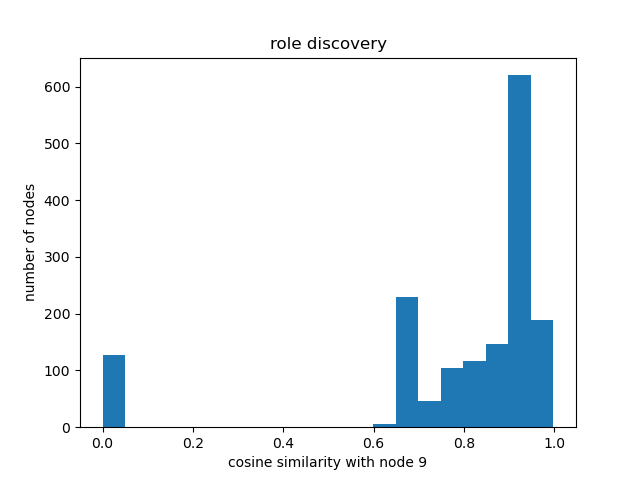
(0.9996996545960188, 415) (0.9985681322700889, 496) (0.9985681322700888, 16)(0.9979737326427643, 973)(0.99665936768074, 415)(0.9944804316381064, 537)(0.9942402370209513, 496)(0.9934389028651474, 24)

若有收获,就点个赞吧
0 人点赞


