题目
Given a binary tree where node values are digits from 1 to 9. A path in the binary tree is said to be pseudo-palindromic if at least one permutation of the node values in the path is a palindrome.
Return the number of pseudo-palindromic paths going from the root node to leaf nodes.
Example 1:
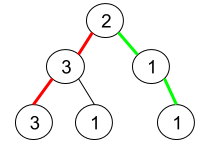
Input: root = [2,3,1,3,1,null,1]Output: 2Explanation: The figure above represents the given binary tree. There are three paths going from the root node to leaf nodes: the red path [2,3,3], the green path [2,1,1], and the path [2,3,1]. Among these paths only red path and green path are pseudo-palindromic paths since the red path [2,3,3] can be rearranged in [3,2,3] (palindrome) and the green path [2,1,1] can be rearranged in [1,2,1] (palindrome).
Example 2:
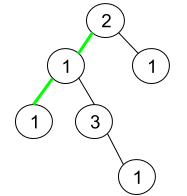
Input: root = [2,1,1,1,3,null,null,null,null,null,1]Output: 1Explanation: The figure above represents the given binary tree. There are three paths going from the root node to leaf nodes: the green path [2,1,1], the path [2,1,3,1], and the path [2,1]. Among these paths only the green path is pseudo-palindromic since [2,1,1] can be rearranged in [1,2,1] (palindrome).
Example 3:
Input: root = [9]Output: 1
Constraints:
- The given binary tree will have between
1and10^5nodes. - Node values are digits from
1to9.
题意
在二叉树中找到一条从根结点到叶结点的路径,使路径上的数字能按照某种顺序组成回文序列,求这样的路径的个数。
思路
回溯法。到达叶结点时,判断当前路径上出现次数为奇数的数字是否只有0个或1个,是的话说明能构成回文序列。
代码实现
Java
class Solution {public int pseudoPalindromicPaths (TreeNode root) {return dfs(root, 0, new boolean[10]);}private int dfs(TreeNode root, int oddNum, boolean[] isOdd) {oddNum += isOdd[root.val] ? -1 : 1;if (root.left == null && root.right == null) {return oddNum <= 1 ? 1 : 0;}isOdd[root.val] = !isOdd[root.val]; // 注意在这里改变状态,如果放在最上面,在叶结点判断返回之前要恢复原状态int leftCount = root.left != null ? dfs(root.left, oddNum, isOdd) : 0;int rightCount = root.right != null ? dfs(root.right, oddNum, isOdd) : 0;isOdd[root.val] = !isOdd[root.val];return leftCount + rightCount;}}

若有收获,就点个赞吧
0 人点赞


