题目
Given an undirected graph, return true if and only if it is bipartite.
Recall that a graph is bipartite if we can split its set of nodes into two independent subsets A and B, such that every edge in the graph has one node in A and another node in B.
The graph is given in the following form: graph[i] is a list of indexes j for which the edge between nodes i and j exists. Each node is an integer between 0 and graph.length - 1. There are no self edges or parallel edges: graph[i] does not contain i, and it doesn’t contain any element twice.
Example 1:
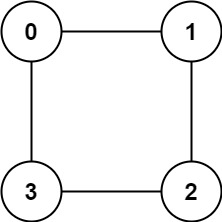
Input: graph = [[1,3],[0,2],[1,3],[0,2]]Output: trueExplanation: We can divide the vertices into two groups: {0, 2} and {1, 3}.
Example 2:
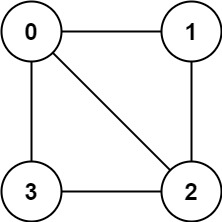
Input: graph = [[1,2,3],[0,2],[0,1,3],[0,2]]Output: falseExplanation: We cannot find a way to divide the set of nodes into two independent subsets.
Constraints:
1 <= graph.length <= 1000 <= graph[i].length < 1000 <= graph[i][j] <= graph.length - 1graph[i][j] != i- All the values of
graph[i]are unique. - The graph is guaranteed to be undirected.
题意
给定一个图,将其中结点划分为两个集合,使得每条边的两个结点分属于两个不同的集合。
思路
直接用BFS或DFS遍历所有结点,将当前结点的所有邻接结点标记为与当前结点不一样的值,如果出现两个相邻结点被标记为相同的值则返回false。注意给的图不一定是连通图。
代码实现
Java
class Solution {public boolean isBipartite(int[][] graph) {int[] color = new int[graph.length];for (int i = 0; i < graph.length; i++) {if (color[i] != 0) continue;color[i] = 1;Queue<Integer> q = new ArrayDeque<>();q.offer(i);while (!q.isEmpty()) {int cur = q.poll();for (int next : graph[cur]) {if (color[next] == color[cur]) return false;if (color[next] == 0) {color[next] = 3 - color[cur];q.offer(next);}}}}return true;}}

若有收获,就点个赞吧
0 人点赞


