leetcode 链接:200. 岛屿数量
题目
给你一个由 '1'(陆地)和 '0'(水)组成的的二维网格,请你计算网格中岛屿的数量。
岛屿总是被水包围,并且每座岛屿只能由水平方向和/或竖直方向上相邻的陆地连接形成。
此外,你可以假设该网格的四条边均被水包围。
示例: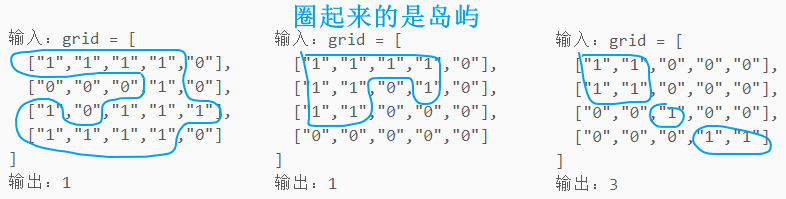
解答 & 代码
解法一:深度优先搜索
遍历矩阵,寻找值为 ‘1’ 的位置,岛屿计数 +1,再通过深度优先搜索,将属于该岛屿的所有 ‘1’ 都置零
设矩阵 M 行 N 列,则时间复杂度 O(MN),空间复杂度 O(MN)
在最坏情况下,整个网格均为陆地,深度优先搜索的深度达到 MN,即空间复杂度达到 O(MN)
class Solution {private:// 深度优先搜索void dfs(vector<vector<char>>& grid, int row, int col){// 递归结束条件:超出数组边界 or 当前位置的值为 '0'if(row < 0 || row >= grid.size() ||col < 0 || col >= grid[0].size() ||grid[row][col] == '0')return;// 将当前位置的值置为 '1',代表已经遍历过(属于已经计数过的岛屿)grid[row][col] = '0';// 递归搜索上、下、左、右dfs(grid, row - 1, col);dfs(grid, row + 1, col);dfs(grid, row, col - 1);dfs(grid, row, col + 1);}public:int numIslands(vector<vector<char>>& grid) {int rows = grid.size(); // 行数if(rows == 0)return 0;int cols = grid[0].size(); // 列数if(cols == 0)return 0;int islandsCnt = 0; // 岛屿数量for(int i = 0; i < rows; ++i){for(int j = 0; j < cols; ++j){if(grid[i][j] == '1') // 遍历矩阵寻找 '1',作为根节点{++islandsCnt; // 岛屿数 +1dfs(grid, i, j); // 深度优先搜索,将属于这个岛屿的所有 '1' 置零}}}return islandsCnt;}};
执行结果: ``` 执行结果:通过
执行用时:20 ms, 在所有 C++ 提交中击败了 48.99% 的用户 内存消耗:9.3 MB, 在所有 C++ 提交中击败了 59.28% 的用户
改进:在深度优先搜索的时候,探索上、下、左、右时,先进行判断是否需要递归,而不是等遍历到该位置时在判定是否符合递归结束条件;递归前先直接将相应位置置零```cppclass Solution {private:// 深度优先搜索void dfs(vector<vector<char>>& grid, int row, int col){int rows = grid.size();int cols = grid[0].size();// 递归搜索上、下、左、右if(row - 1 >= 0 && grid[row - 1][col] == '1') // 事先判断该方向是否需要递归{grid[row - 1][col] = '0'; // 直接先置零,而不是等递归到该位置再置零dfs(grid, row - 1, col);}if(row + 1 < rows && grid[row + 1][col] == '1'){grid[row + 1][col] = '0';dfs(grid, row + 1, col);}if(col - 1 >= 0 && grid[row][col - 1] == '1'){grid[row][col - 1] = '0';dfs(grid, row, col - 1);}if(col + 1 < cols && grid[row][col + 1] == '1'){grid[row][col + 1] = '0';dfs(grid, row, col + 1);}}public:int numIslands(vector<vector<char>>& grid) {int rows = grid.size(); // 行数if(rows == 0)return 0;int cols = grid[0].size(); // 列数if(cols == 0)return 0;int islandsCnt = 0; // 岛屿数量for(int i = 0; i < rows; ++i){for(int j = 0; j < cols; ++j){if(grid[i][j] == '1') // 遍历矩阵寻找 '1',作为根节点{++islandsCnt; // 岛屿数 +1grid[i][j] = '0'; // 直接先置零,而不是等深度优先搜索递归到该位置再置零dfs(grid, i, j); // 深度优先搜索,将属于这个岛屿的所有 '1' 置零}}}return islandsCnt;}};
执行结果:
执行结果:通过

执行用时:12 ms, 在所有 C++ 提交中击败了 98.34% 的用户
内存消耗:9.2 MB, 在所有 C++ 提交中击败了 75.09% 的用户
解法二:广度优先搜索
和解法一思路相同,只不过将深度优先搜索替换成了广度优先搜索
思路:遍历矩阵,寻找值为 ‘1’ 的位置,岛屿计数 +1,再通过广度优先搜索,将属于该岛屿的所有 ‘1’ 都置零
设矩阵 M 行 N 列,则时间复杂度 O(MN),空间复杂度 O(min(M, N))
在最坏情况下,整个网格均为陆地,队列的大小可以达到 min(M, N),即空间复杂度达到 O(min(M, N)) ?
class Solution {
public:
  int numIslands(vector<vector<char>>& grid) {
      int rows = grid.size();            // 行数
      if(rows == 0)
          return 0;
      int cols = grid[0].size();        // 列数
      if(cols == 0)
          return 0;

      int islandsCnt = 0;                // 岛屿数量
      for(int i = 0; i < rows; ++i)
      {
          for(int j = 0; j < cols; ++j)
          {
              if(grid[i][j] == '1')    // 遍历矩阵寻找 '1' ,作为根节点
              {
                  ++islandsCnt;        // 岛屿数 +1
                  grid[i][j] = '0';    // 注意先置 '0'

                  // 广度优先搜索,将属于这个岛屿的'1'都置为零
                  queue<vector<int>> idxQ;
                  idxQ.push(vector<int>{i, j});
                  while(!idxQ.empty())
                  {
                      vector<int> idx = idxQ.front();
                      idxQ.pop();
                      int row = idx[0];
                      int col = idx[1];
                      // grid[row][col] = '0';    // 注意不要在这里才置零
                      if(row - 1 >= 0 && grid[row - 1][col] == '1')
                      {
                          idxQ.push(vector<int>{row - 1, col});
                          grid[row - 1][col] = '0';    // 加入队列前就置零,否则会重复搜索该节点,造成超时
                      }
                      if(row + 1 < rows && grid[row + 1][col] == '1')
                      {
                          idxQ.push(vector<int>{row + 1, col});
                          grid[row + 1][col] = '0';
                      }
                      if(col - 1 >= 0 && grid[row][col - 1] == '1')
                      {
                          idxQ.push(vector<int>{row, col - 1});
                          grid[row][col - 1] = '0';
                      }
                      if(col + 1 < cols && grid[row][col + 1] == '1')
                      {
                          idxQ.push(vector<int>{row, col + 1});
                          grid[row][col + 1] = '0';
                      }
                  }
              }
          }
      }

      return islandsCnt;
  }
};
执行结果: ``` 执行结果:通过
执行用时:48 ms, 在所有 C++ 提交中击败了 5.28% 的用户 内存消耗:13.1 MB, 在所有 C++ 提交中击败了 5.02% 的用户 ```

若有收获,就点个赞吧
0 人点赞


