1. [19 TPAMI] DeepIGeoS: A Deep Interactive Geodesic Framework for Medical Image Segmentation

视频讲解:1:07:00处开始
主要看点:
- 对scribble的编码;
- CRF-Net的改进(略);
- 一个评价指标(非本文提出)。
对Scribble的距离编码:
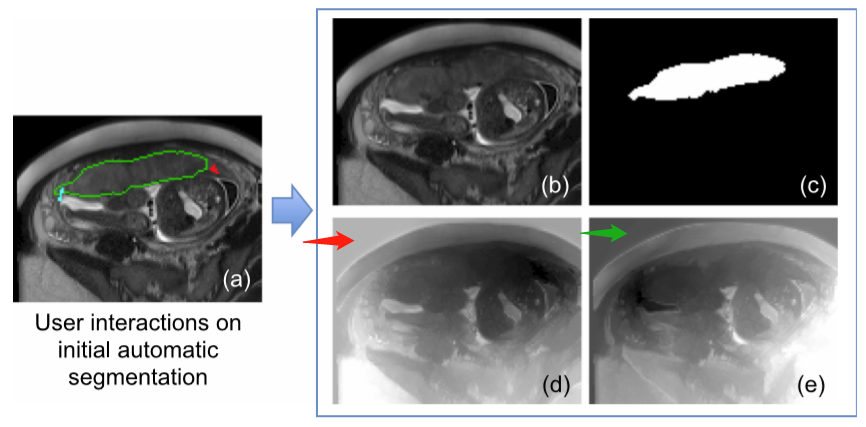
设![[19 TPAMI & 19 MICCAI] DeepIGeoS / Interactive Deep Editing - 图3](/uploads/projects/z_zhang@is/2e4c776594aefdbe07049e46a21a6d63.svg) 和
和![[19 TPAMI & 19 MICCAI] DeepIGeoS / Interactive Deep Editing - 图4](/uploads/projects/z_zhang@is/80ab4f11f66877d2769a97ff9ac12e36.svg) 为属于前景和背景,i为图像I中的一个像素,(d)和(e)是像素i到scribble和的geodesic distance。
为属于前景和背景,i为图像I中的一个像素,(d)和(e)是像素i到scribble和的geodesic distance。
由于geodesic distance利用了灰度信息,编码的意义会更好,下图有个直观的展示:
评价指标
![[19 TPAMI & 19 MICCAI] DeepIGeoS / Interactive Deep Editing - 图8](/uploads/projects/z_zhang@is/bb53dce6394f092901e72254bc58d8dd.svg)
其中![[19 TPAMI & 19 MICCAI] DeepIGeoS / Interactive Deep Editing - 图9](/uploads/projects/z_zhang@is/cf56833ef69718c05368df2e3dbd16b5.svg) 和是算法输出和GT的点集,
和是算法输出和GT的点集,![[19 TPAMI & 19 MICCAI] DeepIGeoS / Interactive Deep Editing - 图11](/uploads/projects/z_zhang@is/6d8a3a9d78a69465ff9fbbb0dff490a6.svg) 是i到的最短欧氏距离。
是i到的最短欧氏距离。
这个和IoU相比有什么好处呢?
2. [19 MICCAI] Interactive Deep Editing Framework for Medical Image Segmentation
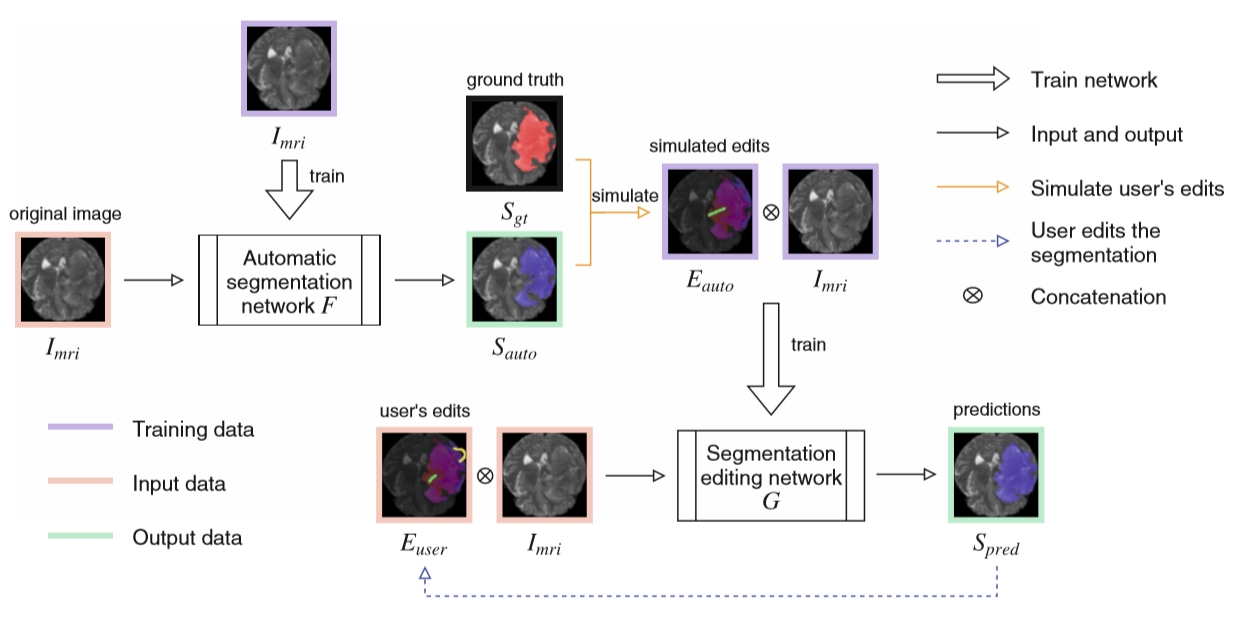
主要看点:
这个和上面那一篇的区别应该是:
- Refine的网络直接输出结果从用户交互和图像中预测结果;
- 提出了一个Adjustment tool,本质上是二值化的时候的阈值调节。
Adjustment tool
用户输入一个 scalar value,表示 将 mask 进行 expansion/shrinkage 的程度。

若有收获,就点个赞吧
0 人点赞


