Floyd算法介绍
和Dijkstra算法一样,弗洛伊德(Floyd)算法也是一种用于寻找给定的加权图中顶点间最短路径的算法。该算法名称以创始人之一、1978年图灵奖获得者、斯坦福大学计算机科学系教授罗伯特·弗洛伊德命名。
基本思想
通过Floyd计算图G=(V,E)中各个顶点的最短路径时,需要引入一个矩阵S,矩阵S中的元素a[i][j]表示顶点i(第i个顶点)到顶点j(第j个顶点)的距离。
假设图G中顶点个数为N,则需要对矩阵S进行N次更新。
初始时,矩阵S中顶点a[i][j]的距离为顶点i到顶点j的权值;如果i和j不相邻,则a[i][j]=∞。
接下来开始,对矩阵S进行N次更新。
第1次更新时,如果”a[i][j]的距离” > “a[i][0]+a[0][j]“(a[i][0]+a[0][j]表示”i与j之间经过第1个顶点的距离”),则更新a[i][j]为”a[i][0]+a[0][j]“。
同理,第k次更新时,如果”a[i][j]的距离” > “a[i][k]+a[k][j]“,则更新a[i][j]为”a[i][k]+a[k][j]“。更新N次之后,操作完成!
单纯的看上面的理论可能比较难以理解,下面通过实例来对该算法进行说明。
Floyd算法图解
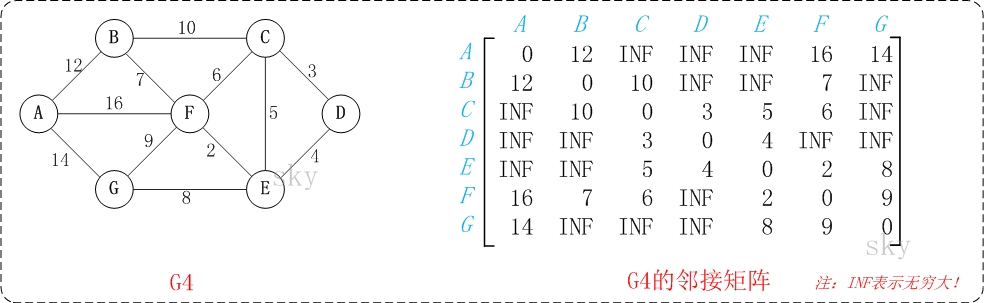
以上图G4为例,来对弗洛伊德进行算法演示。
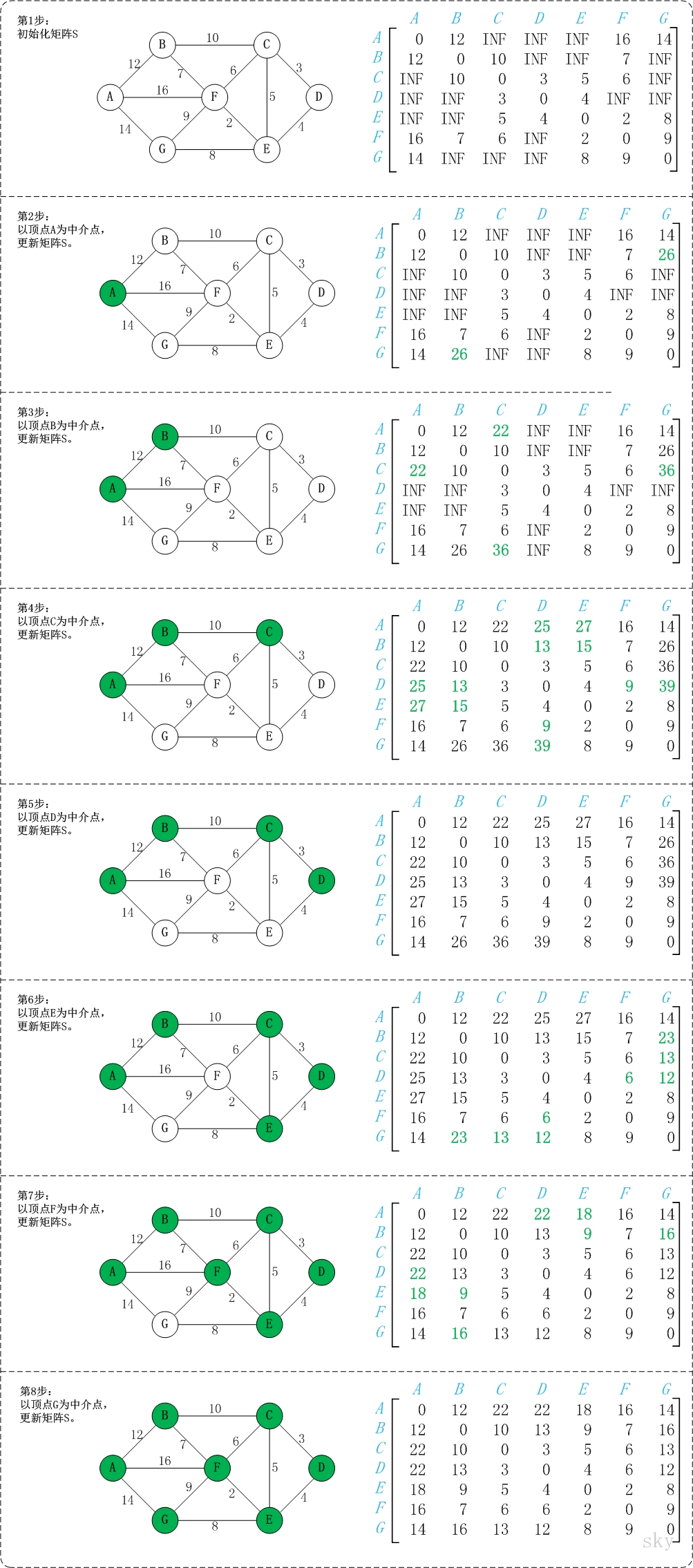
初始状态:S是记录各个顶点间最短路径的矩阵。
第1步:初始化S。
矩阵S中顶点a[i][j]的距离为顶点i到顶点j的权值;如果i和j不相邻,则a[i][j]=∞。实际上,就是将图的原始矩阵复制到S中。
注:a[i][j]表示矩阵S中顶点i(第i个顶点)到顶点j(第j个顶点)的距离。
第2步:以顶点A(第1个顶点)为中介点,若a[i][j] > a[i][0]+a[0][j],则设置a[i][j]=a[i][0]+a[0][j]。
以顶点a[1][6](即顶点B和顶点G之间的距离为例),上一步操作之后,a[1][6]=∞;而将A作为中介点时,(B,A)=12,(A,G)=14,因此B和G之间的距离可以更新为26。
同理,依次将顶点B,C,D,E,F,G作为中介点,并更新a[i][j]的大小。
Floyd算法的代码说明
以”邻接矩阵”为例对弗洛伊德算法进行说明,对于”邻接表”实现的图在后面会给出相应的源码。
// C++ Program for Floyd Warshall Algorithm#include <bits/stdc++.h>using namespace std;// Number of vertices in the graph#define V 4/* Define Infinite as a large enoughvalue.This value will be used forvertices not connected to each other */#define INF 99999// A function to print the solution matrixvoid printSolution(int dist[][V]);// Solves the all-pairs shortest path// problem using Floyd Warshall algorithmvoid floydWarshall(int graph[][V]){/* dist[][] will be the output matrixthat will finally have the shortestdistances between every pair of vertices */int dist[V][V], i, j, k;/* Initialize the solution matrix sameas input graph matrix. Or we can saythe initial values of shortest distancesare based on shortest paths consideringno intermediate vertex. */for (i = 0; i < V; i++)for (j = 0; j < V; j++)dist[i][j] = graph[i][j];/* Add all vertices one by one tothe set of intermediate vertices.---> Before start of an iteration,we have shortest distances between allpairs of vertices such that theshortest distances consider only thevertices in set {0, 1, 2, .. k-1} asintermediate vertices.----> After the end of an iteration,vertex no. k is added to the set ofintermediate vertices and the set becomes {0, 1, 2, ..k} */for (k = 0; k < V; k++) {// Pick all vertices as source one by onefor (i = 0; i < V; i++) {// Pick all vertices as destination for the// above picked sourcefor (j = 0; j < V; j++) {// If vertex k is on the shortest path from// i to j, then update the value of// dist[i][j]if (dist[i][j] > (dist[i][k] + dist[k][j]))dist[i][j] = dist[i][k] + dist[k][j];}}}// Print the shortest distance matrixprintSolution(dist);}/* A utility function to print solution */void printSolution(int dist[][V]){cout << "The following matrix shows the shortest ""distances"" between every pair of vertices \n";for (int i = 0; i < V; i++) {for (int j = 0; j < V; j++) {if (dist[i][j] == INF)cout << "INF"<< " ";elsecout << dist[i][j] << " ";}cout << endl;}}// Driver codeint main(){/* Let us create the following weighted graph10(0)------->(3)| /|\5 | || | 1\|/ |(1)------->(2)3 */int graph[V][V] = { { 0, 5, INF, 10 },{ INF, 0, 3, INF },{ INF, INF, 0, 1 },{ INF, INF, INF, 0 } };// Print the solutionfloydWarshall(graph);return 0;}// This code is contributed by Mythri J L
最大距离说明
标准 Dijkstra 算法是计算最短路径的,但你有想过为什么 Dijkstra 算法不允许存在负权重边么?
因为 Dijkstra 计算最短路径的正确性依赖一个前提:路径中每增加一条边,路径的总权重就会增加。
如果你想计算最长路径,路径中每增加一条边,路径的总权重就会减少,要是能够满足这个条件,也可以用 Dijkstra 算法。
同理,Floyd算法同样求最长路径,只需要改成
if(dist[i][j]<dist[i][k]+dist[k][j])
{
    dist[i][j]=dist[i][k]+dist[k][j];
}

若有收获,就点个赞吧
0 人点赞


