- pragma GCC optimize(2)
#include#include#include #include#include#include#include
using namespace std;
typedef long long ll;
const int maxn = 2005;//边长只到2000 - pragma GCC optimize(3)#include
using namespace std;
typedef unsigned long long ll;int cnt = 2; - pragma GCC optimize(2)
#include#include#include #include#include #include#include#include
using namespace std;
typedef long long ll;
const int maxn = 8e7 + 7;const ll mod = 1ll << 32;
int a[5000000],cnt;int v[maxn];
void getprime() {
智算之道复赛补题
Sunday, August 16, 2020
10:59 AM
智算之道复赛补题
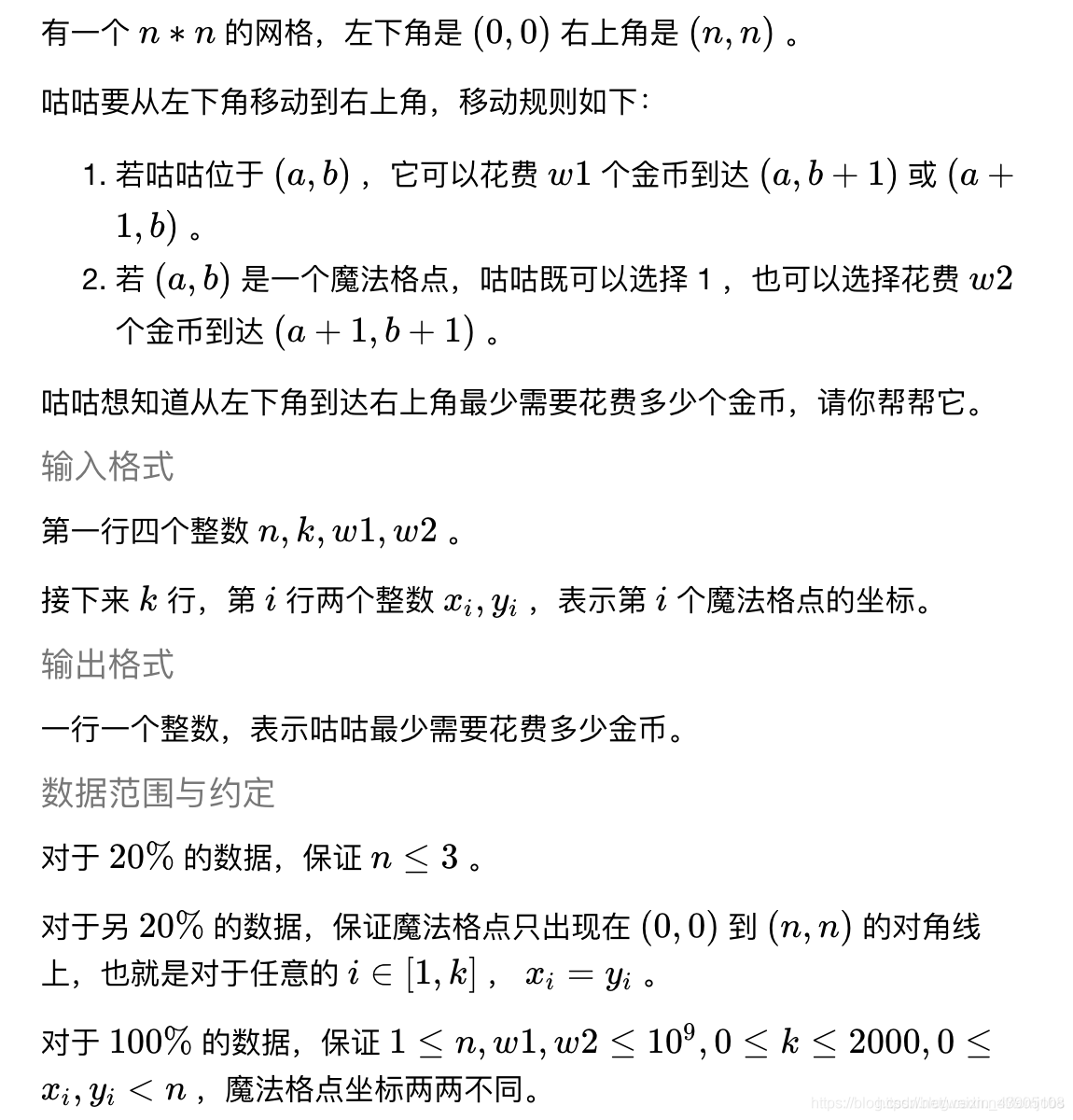
第二题 网格
![有 一 个 “ * “ 的 网 格 , 左 下 角 是 ( 0 , 0 ) 右 上 角 是 咕 咕 要 从 左 下 角 移 动 到 右 上 角 , 移 动 规 则 如 下 : 1 . 若 咕 咕 位 于 (), b) , 它 可 以 花 费 WI 个 金 币 到 达 (a,b + 1 ) 或 (a + 2 . 若 (), b) 是 一 个 魔 法 格 点 , 咕 咕 既 可 以 选 择 1 , 也 可 以 选 择 花 费 2 个 金 币 到 达 ( a + 1 , b + 1 ) 。 咕 咕 想 知 道 从 左 下 角 到 达 右 上 角 最 少 需 要 花 费 多 少 个 金 币 , 请 你 帮 帮 它 。 输 入 格 式 第 一 行 四 个 整 数 1 , w2 。 接 下 来 行 , 第 犭 行 两 个 整 数 , , 表 示 第 犭 个 魔 法 格 点 的 坐 标 。 输 出 格 式 一 行 一 个 整 数 , 表 示 咕 咕 最 少 需 要 花 费 多 少 金 币 。 数 据 范 围 与 约 定 对 于 20 % 的 数 据 , 保 证 “ 孓 3 。 对 于 另 20 % 的 数 据 , 保 证 魔 法 格 点 只 出 现 在 ( 0 , 0 ) 到 ( 的 对 角 线 上 , 也 就 是 对 于 任 意 的 犭 e 1 , 一 。 对 于 100 % 的 数 据 , 保 证 1 孓 “ , WI , 2 < 109 , 0 < 左 孓 2000 , 0 孓 , 坊 < “ , 魔 法 格 点 坐 标 两 两 不 同 。
比赛的时候知道是dp,恨得牙痒痒,就是做不出,再加上那个数字大得令人发指,感觉根本存不下,就没有继续怼着做,玻璃心太容易被劝退了,这样可不行噢~⛽
换一种思维,我们不需要用一个棋盘那么大的二维数组去存到底是不是魔法点,我们直接用结构体数组记录下魔法点的下标不就好了?你看k的范围只在[0,2000]呢,不要害怕,你存不下不是计算机的问题而是你思维方式的问题,换一种思路让它能存下不就好了?🙆
而且我们只需要初始化为根本不理会魔法点,然后用dp滚一遍魔法点取到最小就行了,记得用n封口,不然就到不了终点辣~还有就是把魔法点从小到大排序(排序要注意a.x!=b.x就改成a.x
①不能熟练运用数据结构去存下我要的数据,容易被大数字吓到,就不敢动手了;
②dp不熟,按理说这是很简单的贪心,但是就是打死也做不出说明不够烂熟于心。
pragma GCC optimize(2)
#include#include#include #include#include #include#include
using namespace std;
typedef long long ll;
const int maxn = 2005;//边长只到2000
using namespace std;
typedef long long ll;
const int maxn = 2005;//边长只到2000
ll f[maxn];int n,k,w1,w2;
struct node
{
int x,y;}a[maxn];
bool cmp(node a , node b){//升序
if(a.x != b.x) return a.x < b.x;//不等于才要排撒
return a.y < b.y;}
void solve(){
scanf(“%d%d%d%d”, &n,&k,&w1,&w2);
for (int i = 1; i <= k;
;//封口
for (int i = 1; i <= k; ++i)
f[i] = 1ll (a[i].x + a[i].y) w1;//不走魔法路径
for (int i = 2; i <= k; ++i)
{
for (int j = 1; j < i; ++j)
{
if(a[j].x < a[i].x && a[j].y < a[i].y){//严格小于
int num = a[i].x - a[j].x + a[i].y - a[j].y - 2;//从一个魔法点到另一个魔法点直走的路程
f[i] = min(f[i], f[j] + 1ll num w1 + w2);
}
}
}
printf(“%lld\n”, f[k]);}
int main(int argc, char const argv[]){
solve();
return 0;}
*第三题 有向无环图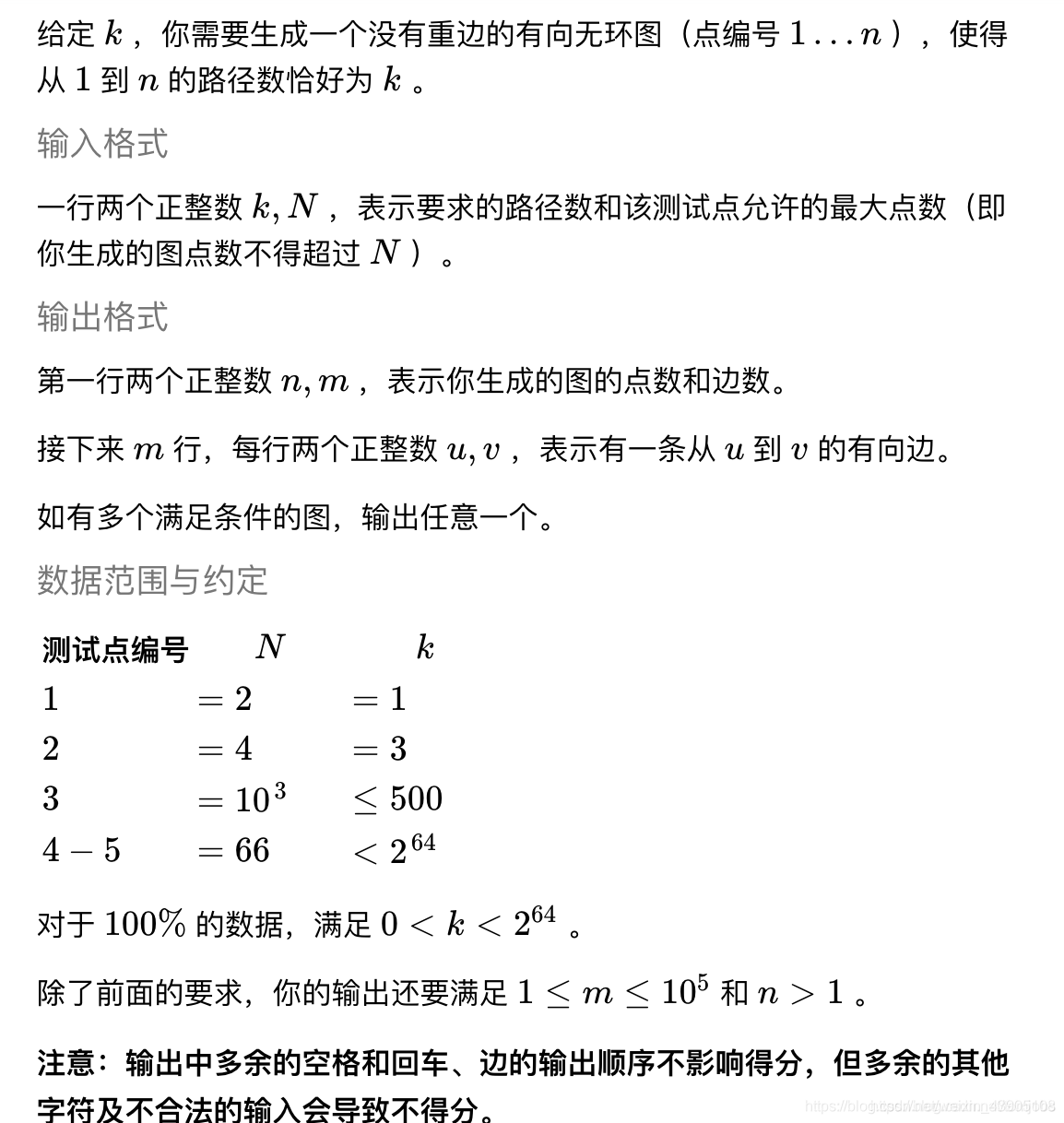
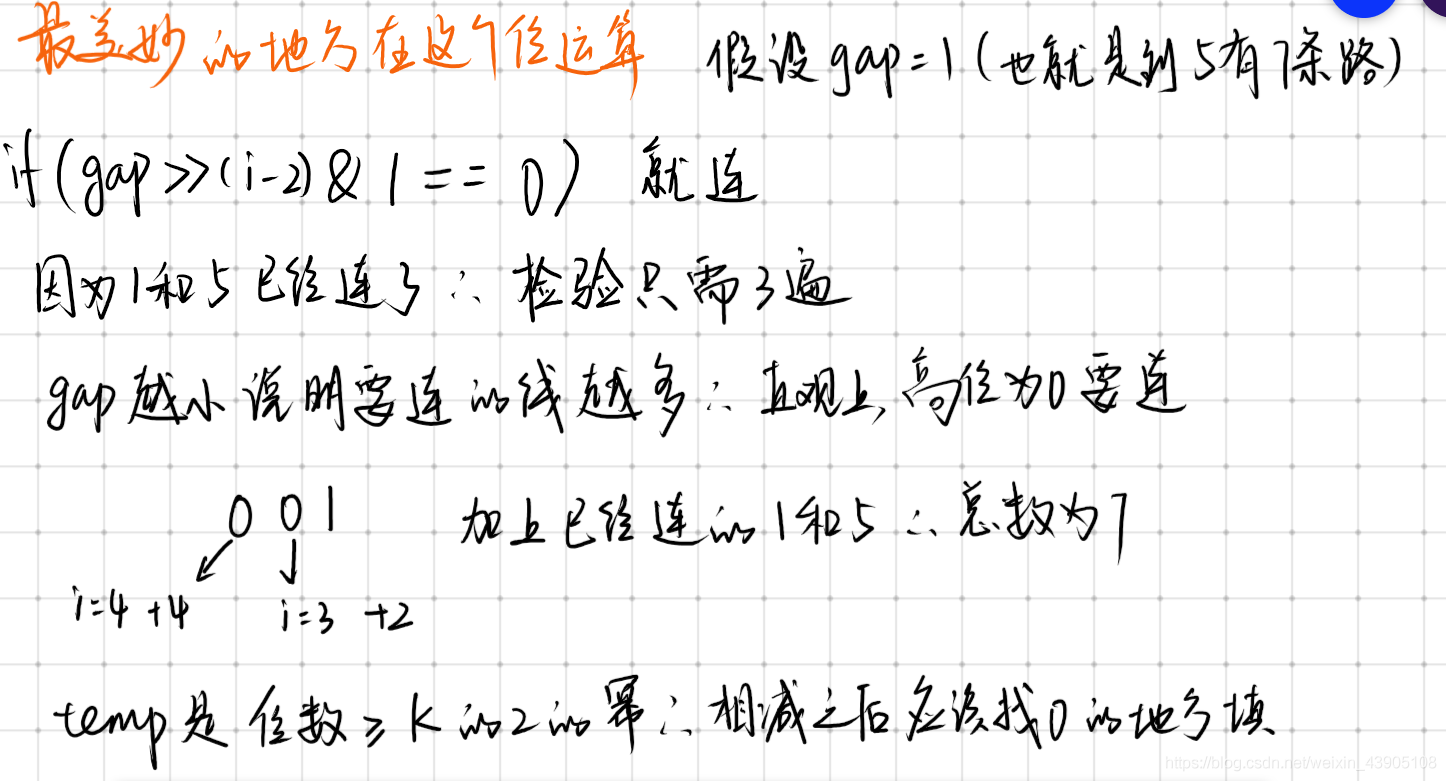
研究了一下午,我也发现了聚聚发现的规律!只不过我一直想着怎么从>=路径数的那个2的幂去减掉路径,而没有想到从<=路径数的那个2的幂去增加路径😔是我思维太局限了,而且聚聚求点数的方法也比我简单,唉太菜了。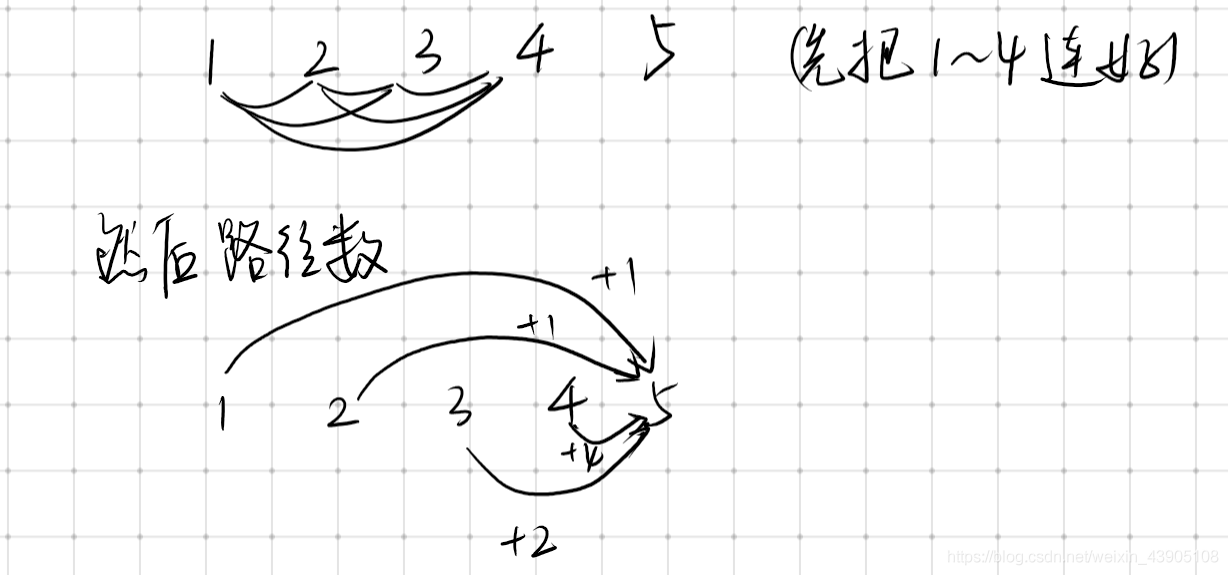
pragma GCC optimize(3)#include using namespace std;
typedef unsigned long long ll;int cnt = 2;
typedef unsigned long long ll;int cnt = 2;
ll n,m,p;struct No{
int x,y;};
vectorres;
int main(){
ll K,N;scanf(“%llu%llu”,&K,&N);
ll temp = 1;
while(temp
cnt++;//点数
}//temp是>=K的2的幂
for(int i=1;i
ll tempx = temp - K;
for(int i=1;i
else if((tempx>>(i-2)&1)==0) res.push_back(No{i,cnt});//这波位运算太美妙了!
//要是转化成二进制之后最低位是0,就连2和cnt,要是倒数第二位是0,就连3和cnt
}
printf(“%d %d\n”,cnt,res.size());
int sz = res.size();
for(int i=0;i
}
return 0;}
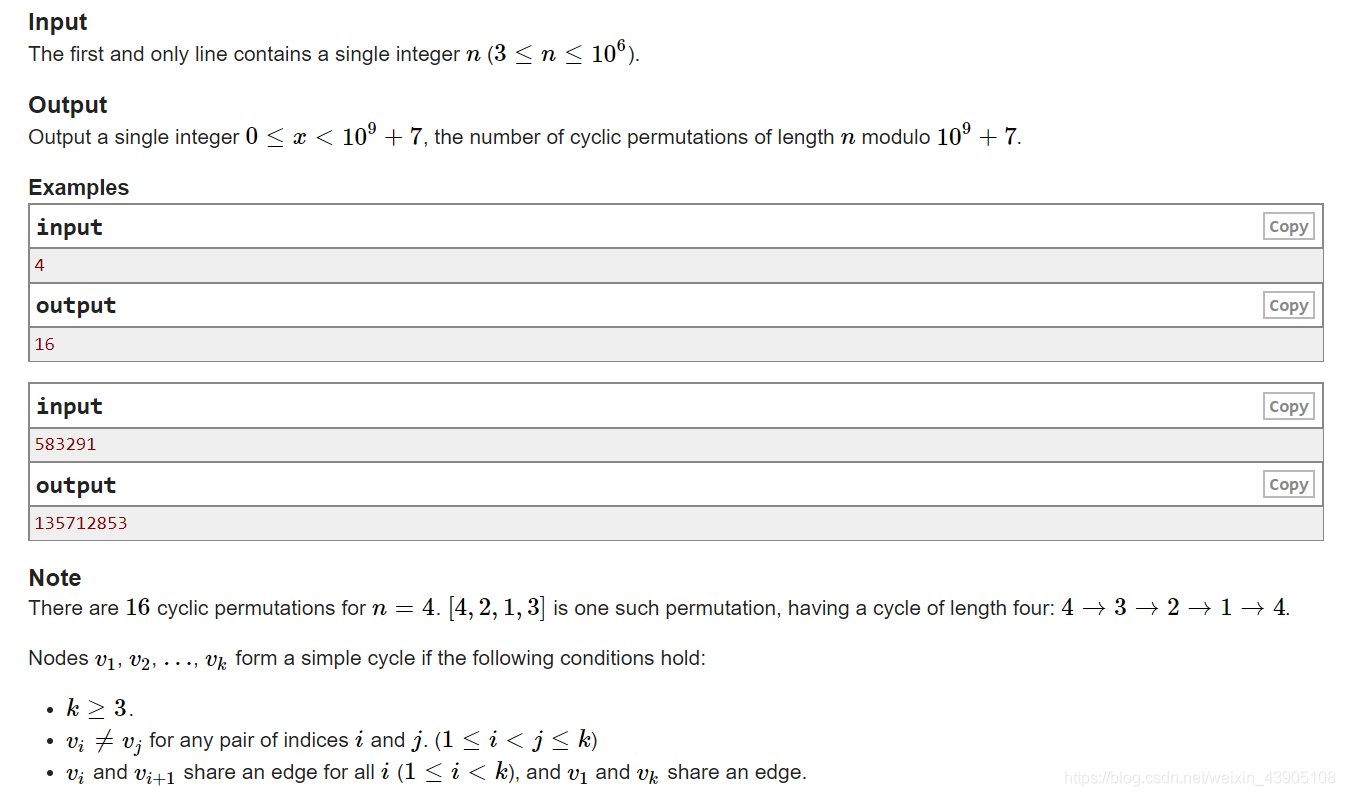
说到这个有向无环图我想到了昨天夜场的C题就是一道无向有环图,![C. Cyclic Permutations time limit per test: 1 second memory limit per test: 256 megabytes input: standard input output: standard output A permutation of length n is an array consisting of n distinct integers from 1 to n in arbitrary order. For example, [2, 3, 1, 5, 4] is a permutation, but [1, 2, 2] is not a permutation (2 appears twice in the array) and [1, 3, 4] is also not a permutation (n = 3 but there is 4 in the array). Consider a permutation p of length n, we build a graph of size n using it as follows: • For every 1 < i < n, find the largestj such that I < j < i and pj > Pi, and add an undirected edge between node i and node j • For every 1 < i < n, find the smallest j such that i < j < n and pj > Pi, and add an undirected edge between node i and node j In cases where no such j exists, we make no edges. Also, note that we make edges between the corresponding indices, not the values at those indices. For clarity, consider as an example n = 4, and p [3, 1, 4, 2]; here, the edges of the graph are (1, 3), (2, 1), (2, 3), (4, 3). A permutation p is cyclic if the graph built using p has at least one simple cycle. Given n, find the number of cyclic permutations of length n. Since the number may be very large, output it modulo 109 + 7. Please refer to the Notes section for the formal definition of a simple cycle](/uploads/projects/wsbo@ekqhd3/a150a26c34620f98806210a2b3077f73.png)
![Input The first and only line contains a single integer n (3 < n < 106). Output Output a single integer 0 < x < 109 + 7, the number of cyclic permutations of length n modulo 109 + 7. Examples input 4 output 16 input 583291 output 135712853 Note Copy Copy Copy Copy There are 16 cyclic permutations forn 4. [4, 2, 1, 3] is one such permutation, having a cycle of length four: 4 —+ 3 —+ 2 1 4. Nodes VI, 1-‘2, , Uk form a simple cycle if the following conditions hold: # q
题目大意:
给你一个n,形成一个数列包括1~n共n个数,然后对于这n个数的每一个下标i,如果能找到最大的下标j(j
分析:
我们可以发现无论左右都是要找一个数大于当前该数,左边找的话要下标尽量大,右边找的话要下标尽量小。分析可得,最大的一个数的位置很重要,因为最大的数在左右两边都找不到与之成环的元素,那么用这个最大数阻断最后一个数与前面数的连接即可。也就是让最后一个数只能找最大数连接,然后最大数又无法与其他数连接,就隔离开了最后一个数从而断掉了这个环。怎么让最后一个数只能找最大数连接呢?把最大数放在最后一个数前面一个也就是倒数第二个即可(因为往左找需要下标尽量大,而最后一个数只能往左找)
举个栗子:
[2,3,4,1]
我们可以形成(1,2) (2,3) (最大的元素4这里啥也形不成) (3,4)
于是(1,2) (2,3)可以成环,但漏掉了4,所以断掉了环。
怎么算呢?n个数排列共有n!种方法,我们要断掉环可以把数组想象成双向队列,元素1、2…(n-1)可以从首或者尾入队,但是最大元素n位置固定,只能在倒数第二个,所以有2^(n-1)种方法,所以,
你以为到这里就结束了吗?不,取模的时候还要小心,因为指数比阶乘的收敛速度快,所以不能直接ans%mod得结果,而是要(ans%mod+mod)%mod才可以避免出现负数,因为反正mod%mod=0嘛,所以+mod不影响结果,但是避免了负数的出现。
#include
const int mod=1e9+7;int n;long long ans=1,x=1;
int main(){
cin>>n;
for(int i=1;i<=n;i++) ans=ansi%mod;
for(int i=1;i<n;i++) x=x2%mod;
cout<<((ans-x)%mod+mod)%mod<
1
2
3
4
5
6
7
8
9
10
11
12
13
14
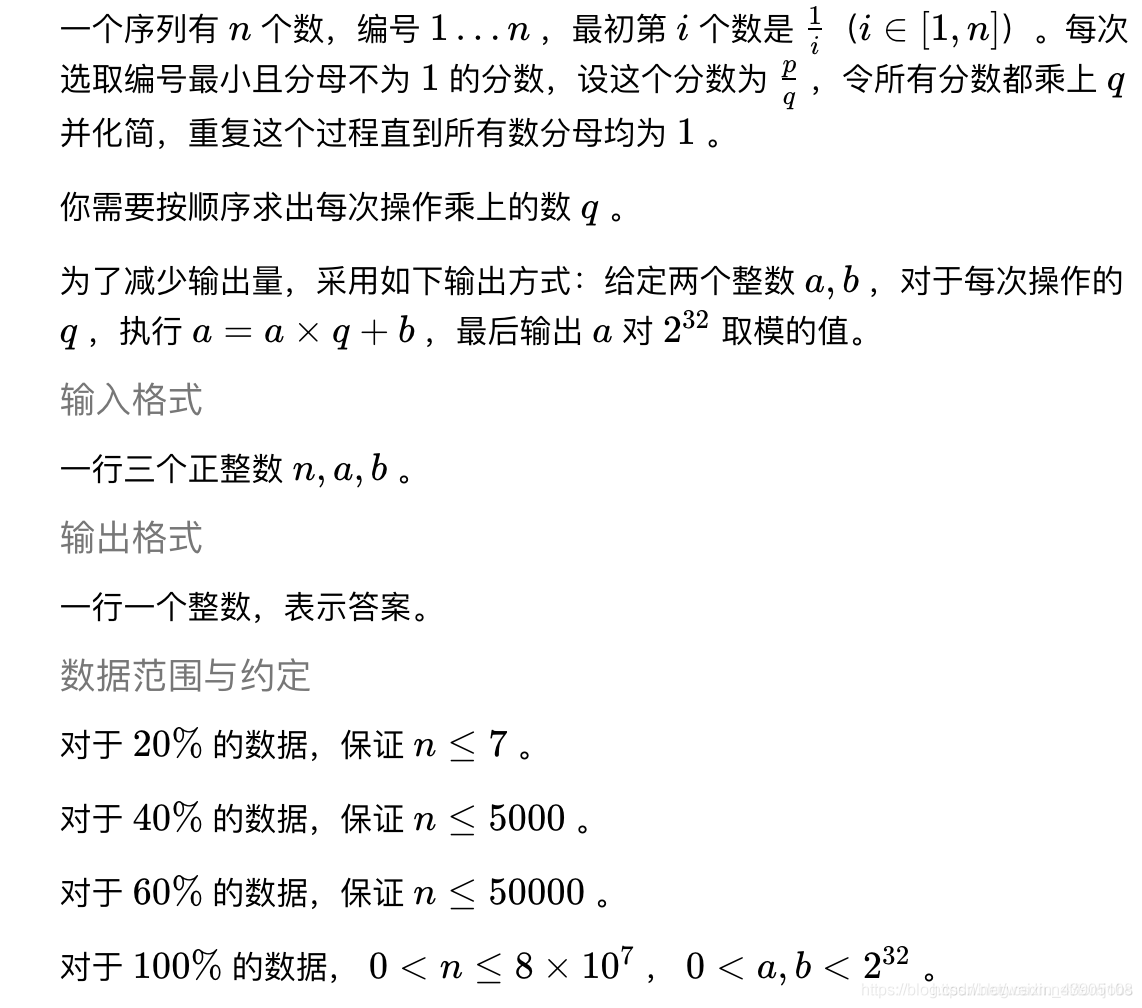
第四题 分数

模板如下:
void getprime() {
for(int i = 2;i < maxn;i++) {
if(v[i] == 0) {//是质数
v[i] = i;a[
) {
v[i * a[j]] = 1;//标记为合数
if(i % a[j] == 0)break;//要是到了最小质因子就退出循环
}
}}
1
2
3
4
5
6
7
8
9
10
11
为什么可以用欧拉筛呢?
因为每个数要么就是质数 要么就是最小质因子的幂 要么就是不同的质因子的乘积(但是这个已经被前面的消去了
pragma GCC optimize(2)
#include#include#include #include#include #include #include#include
using namespace std;
typedef long long ll;
const int maxn = 8e7 + 7;const ll mod = 1ll << 32;
int a[5000000],cnt;int v[maxn];
void getprime() {
using namespace std;
typedef long long ll;
const int maxn = 8e7 + 7;const ll mod = 1ll << 32;
int a[5000000],cnt;int v[maxn];
void getprime() {
for(int i = 2;i < maxn;i++) {
if(v[i] == 0) {//是质数
v[i] = i;a[
) {
v[i a[j]] = 1;//标记为合数
if(i % a[j] == 0)break;//要是到了最小质因子就退出循环
}
}}
ll qpow(ll x,ll n) {
ll res = 1;
while(n) {
if(n & 1) res = res x % mod;
x = x x % mod;
n >>= 1;
}
return res;}
ll gcd(ll n,ll m) {
return m == 0 ? n : gcd(m,n % m);//最大公约数}
int main() {
getprime();//筛出所有素数存在a数组中
ll n,A,B;scanf(“%lld%lld%lld”,&n,&A,&B);
for(int i = 2;i <= n;i++) {
v[i] = 0;//提前置零
}
for(int i = 1;i <= cnt;i++) {
ll now = a[i];
while(now <= n) {
v[now] = i;//记录当前祖宗素数的下标(祖宗是指的底数)
now = now a[i];
}//所有素数的素数倍
}
for(int i = 2;i <= n;i++) {
if(v[i]) {//合数已被消去,没有鸡喙进入循环
A = (A * a[v[i]] % mod + B) % mod;
}
}
printf(“%lld\n”,A);
return 0;}
1
2
3
4
5
6
7
8
9
10
11
12
13
14
15
16
17
18
19
20
21
22
23
24
25
26
27
28
29
30
31
32
33
34
35
36
37
38
39
40
41
42
43
44
45
46
47
48
49
50
51
52
53
54
55
56
57
58
59
60
61
62
63
64
65
66
67
68
69
70
![Vli\]z0 1 2 亻 b 7 7 7](/uploads/projects/wsbo@ekqhd3/83634f5b2ee7b00be700f28fda37c5e9.png)
已使用 Microsoft OneNote 2016 创建。

若有收获,就点个赞吧
0 人点赞