Title
Wide & Deep Learning for Recommender Systems
Summary
Present Wide & Deep learning framework to combine the strengths of wide linear model’s memorization and deep neural networks’ generalization.
Research Objective
Present the Wide & Deep learning framework to achieve both memorization and generalization in one model, by jointly training a linear model component and a neural network component.
Problem Statement
- liner models with cross-product feature transformation
- pros
- can memorize “exception rules” with fewer parameters (generalize well and make less relevant recommendations)
- cons
- do not generalize to query-item feature paris that have not appeared in the training data
- need manual feature engineering
- pros
- emdedding based models e.g., factorization machines, deep neural networks
- pros
- can generalize to previously unseen query-item feature paris by learning a low-dimensional dense embedding vector for each query and item feature, with less burden of feature engineering
- cons
- dense embeddings will lead to nonzero predictions for all query-item pairs, and thus can over-generalize and make less relevant recommendations
- pros
Method(s)
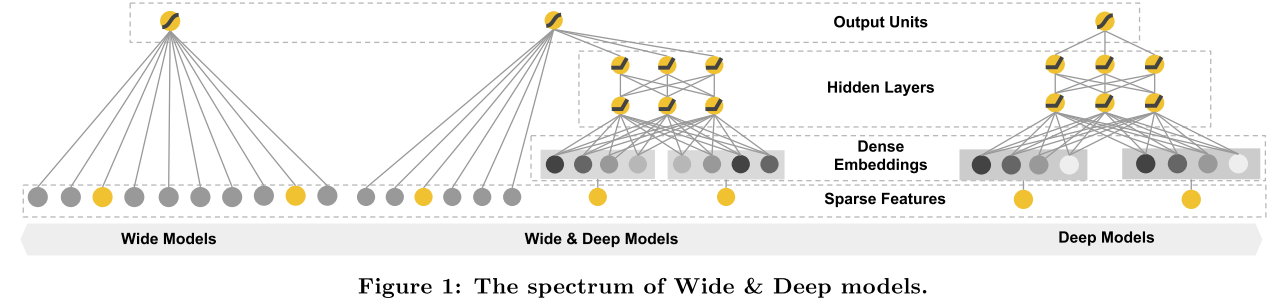
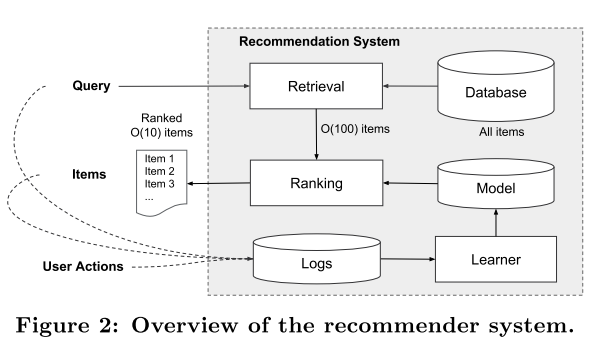
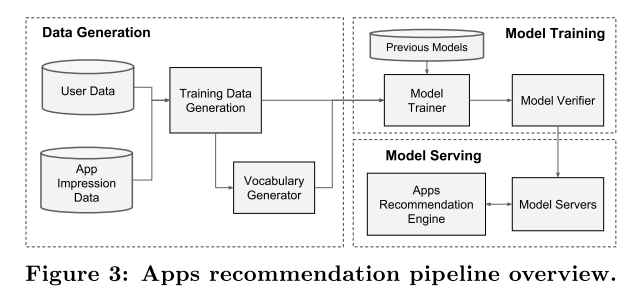
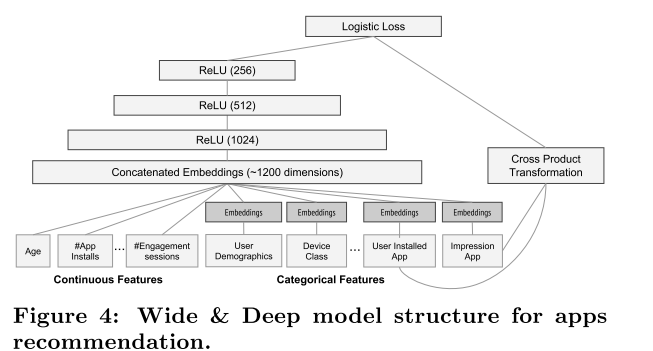
The Wide Component
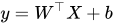
where x is a vector of d features. One of the most important transformations is the cross-product transformation.cross-product transformation
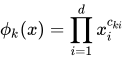 where
where  is a boolean variable that is
  if the i-th feature is part of the k-th transformation
  , and
, and  otherwise.
For binary features, a cross-product transformation (e.g.,
“AND(gender=female, language=en)”) is if and only if the
constituent features (“gender=female” and “language=en”)
are all , and otherwise.
otherwise.
For binary features, a cross-product transformation (e.g.,
“AND(gender=female, language=en)”) is if and only if the
constituent features (“gender=female” and “language=en”)
are all , and otherwise.The Deep Component
High-dimensional categorical features are first converted into a low-dimensional and dense real-valued vector, usually on the order of  to
to  .
.
- Joint Training
For a logistic regression, the model predictions is
where  is the binary class label,
  is cross product transformations of the original features
  ,
,  is the neural network’s final activation.
Evaluation
- Data Generation
Continues real-valued features are normalized to  by mapping a feature value to its cumulative distribution function
  , divided into
  quantiles. The normalized value is
  for values in the i-th quantiles.
- App Acquisition
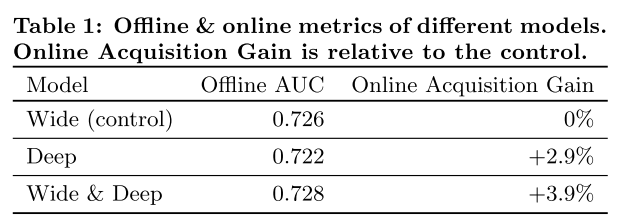
- Serving Performance
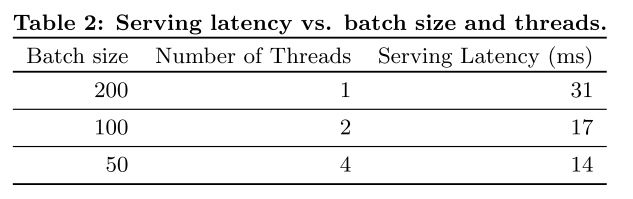
Conclusion
Memorization and generalization are both important for
recommender systems.
Wide linear models can effectively memorize sparse feature interactions using cross-product feature transformations, while deep neural networks can generalize to previously unseen feature interactions through low-dimensional embeddings.
Notes(optional)
Reference(optional)

若有收获,就点个赞吧
0 人点赞


