Yalta agreement 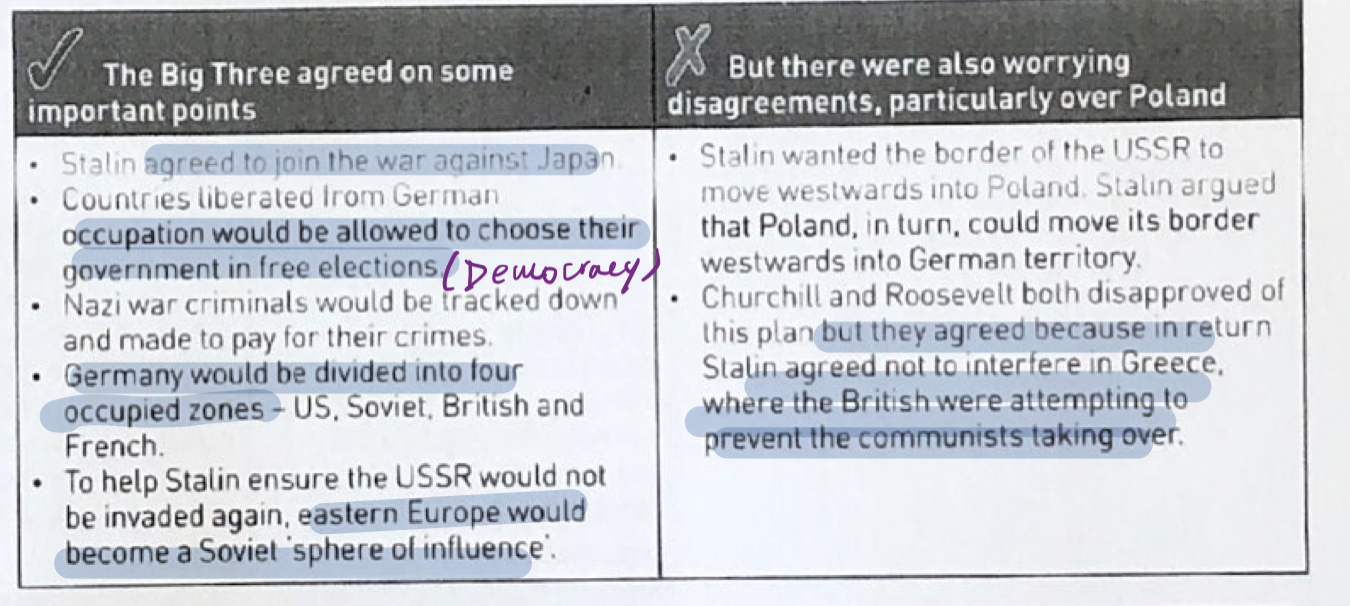
Potsdam agreement 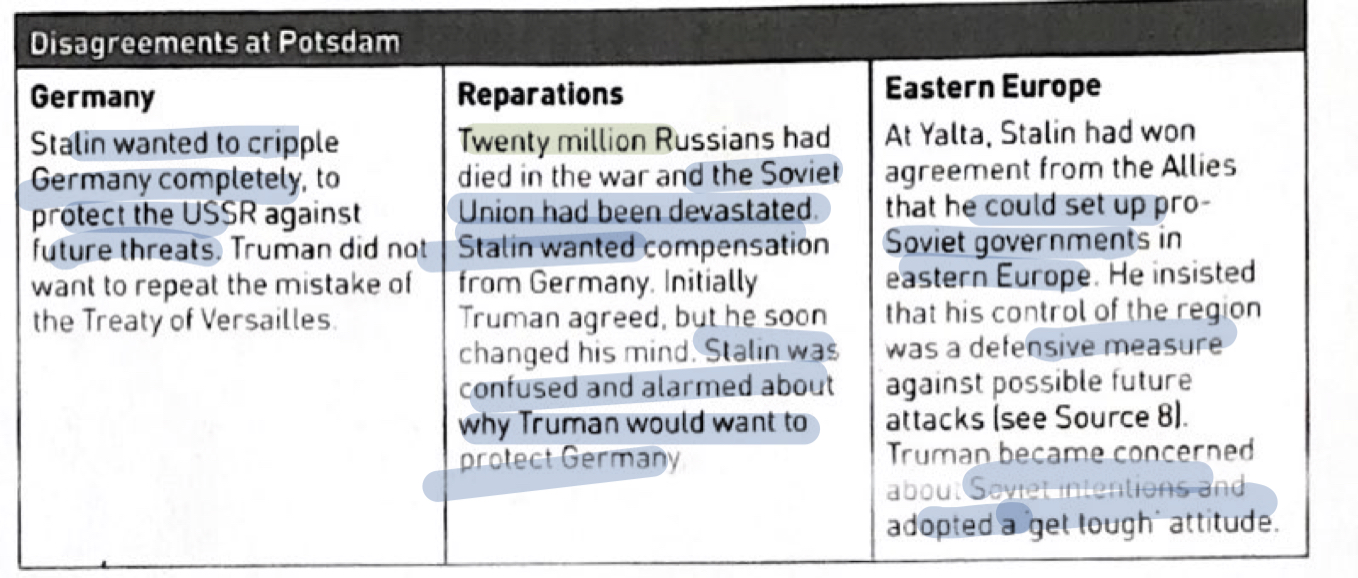
Iron Curtain speech March 1946
- seen by many as the beginning of the Cold war
Containment
- trying to stop the spread of communism
Marshall aid - industrial reconstruction to not let Europe fall into the hands of communism
brief timeline:
Yalta -> WW2 ends -> SU communist gov. in Poland by force -> Potsdam conference -> SU’s increasing grip of eastern Europe -> Truman Doctrine & Marshall Plan ->
Morgenthau Plan - Germany into agricultural country
June 1948 - May 1949: Berlin blockade and Berlin airlift
- April 1949 - NATO (North Atlantic Treaty Organization)
- Warsaw pact
MAD
- mutually assured destruction
Traditional views
late 1940s - early 1960s
Figures:
- George F. Kennan
- Thomas Bailey
Herbert Feis
Thomas Bailey
- SU wanted world revolution
- background & influential (Bianca), main theories + schools of thought (A), evaluation + quote (T)
- main theory:
- difficult to negotiate w/ Russia <-> ideological contradictions
- ~ Kennan: insecurity & ‘Asian’ influence
- historical struggle between the Westerners and the Slavophiles
- many anti-Western ideals
- aliken communists to Nazis
- to take over the world
- ~ corresponding to the communist views for world revolution
- Stalin: to conquer the world!
- partially corroborated by expansion of influence into southern and eastern Europe
- difficult to negotiate w/ Russia <-> ideological contradictions
- George Kennan
- SU needed a threatening enemy to convince SU people that Stalin’s dictatorship is needed
- SU provoke US
- SU needed a threatening enemy to convince SU people that Stalin’s dictatorship is needed
- Herbert Feis
- SU to spread worldwide communism
academic self-censoring
- no one dared speak of the critical views
SU
- spies and infiltrations
1945 - public doesn’t know the foreign policy decisions
Red Scare, 1920s, 1940s, early 1950s (exploited by Joseph McCarthy)
- academic censorship and arrests of communists
US & SU historians’ lack of access to US and SU sources
opposition views:
- William Appleman Williams
- SU on the defense; US aggressive
Basis of Containment
- Truman Doctrine
- political and military support
- Marshall Plan
- economic support
US views of itself:
- Defensive in nature
- Aid (post-war reconstruction & protect those under threats)
- prevent spread of the devil communism
- Do the right thing
orthodox people
figures:
- William Appleman Williams
- Denna Fleming
- Christopher Lasch
US ‘Open Door’ economic policy
- Marshall Plan
- stopped another Great Depression
- Bretton Woods; IMF, World bank
- IMF - macro
- World bank - micro
- halted the spread of communism in Europe
- stopped another Great Depression
- only for those states agreed to US-style democracy and capitalism
- Free market
- neocolonialism
- except sovereignty was respected
- globalization
- financial elites in complete control of the lower classes
- if lower class demands higher wages then move production to other regions
- high point of US living standards
- during Eisenhower
against the Orthodox historians:
- US overestimation of the SU
- only justifying US policy
US supported coups
- in Domican Republic and Guatemala
- paradox: support for dictators in other regions
- Cuba
- Iran
- South Vietnam
US superiority
- military
- nuclear weapons
- more aerial and naval power
- air force stronger
- navies stronger
- aircraft carriers
- CIA
- spying
- satellite - collecting info.
- technological driven intelligence
- economic
- US virtually intact from WW2 & prospered from armament productions
- diversified economy
- SU relied on primary market & primary products (lower weight on trade)
- political
- alliance system
- NATO effective vs. Warsaw Pact ineffective
- Warsaw pact’s countries unwilling to aid the SU
SU collecting info
- secret spies / people
- people w/ communist sympathies
- nuclear secret
- Klaus Fuchs & Rosenbergs (German communist in the Manhattan project + couple providing nuclear secret)
anti-Semitism of US to SU
- many communists Jewish
- Hollywood blackmail list
South America didn’t get anything from the Marshall Plan
blame of Truman
- poor at foreign policy
- rejected what is agreed at Yalta
- only wanted Black and White
- get tough attitude reduced possibilities of reconciliation
decolonization
- US not to spread its ideologies but to gain what it wants
- e.g. oil & collaboration w/ Saudi Arabia
- Middle East
- British & French gov. influenced replaced by firms’ influence
- India
- division due to religion (Hunduism & Islamism)
- East Pakistan - Bangledash
- ethnic clensing <-> segregation based on religion
- South Africa
- US ally
- racial segregation (apartheid)
William Appleman Williams
- first revisionist
- US to imprint its image and way of gov. to the whole world
revisionist people
- academics
- about 20 years younger
contexts
- Cuban revolution
- Williams - US more aggressive, empire-building power
- Vietnam war
- US supported corrupt regime in Vietnam
- distrust in the US public
- embargo against Cuba
- invasion of the Dominican Republic
popular opinions divided
- old vs. youth
Lynne Viola
- orthodox historians to seek support in political careers
- no SU archive = no evidence to go against traditionalist views
Post-revisionist view
early 1970s - 1989
Figure
- John Lewis Gaddis
- Ernest May
- Melvyn Leffler
John Lewis Gaddis
- SU largely responsible, particularly Stalin
- US policies based on misunderstanding and overreactions
- SU overreactions back
- Cold War was evitable
- Cold war - result of fear, confusion, and misunderstanding on both sides
contexts
- trend to reinterpret all history
- thawing of the Cold War
- Richard Nixon & successors: détente policy
- Strategic Arms Limitation Treaty (SALT) 1972
new Cold War historians
after collapse of the SU and Soviet archives ready
no agreement

若有收获,就点个赞吧
0 人点赞


