# Kubernetes CNI Cilium# 时间:20210901-[20:00-22:00]# 主题:Cilium# 文档:https://www.yuque.com/docs/share/dcadbddb-59df-4cbd-bb4b-f72581cfc7e3?# 《20210901-Cilium基础架构》# 作业:Cilium Overview
# FAQ:
All In Cilium
plumbers_2020_cilium_load_balancer.pdf
Cilium Overvie
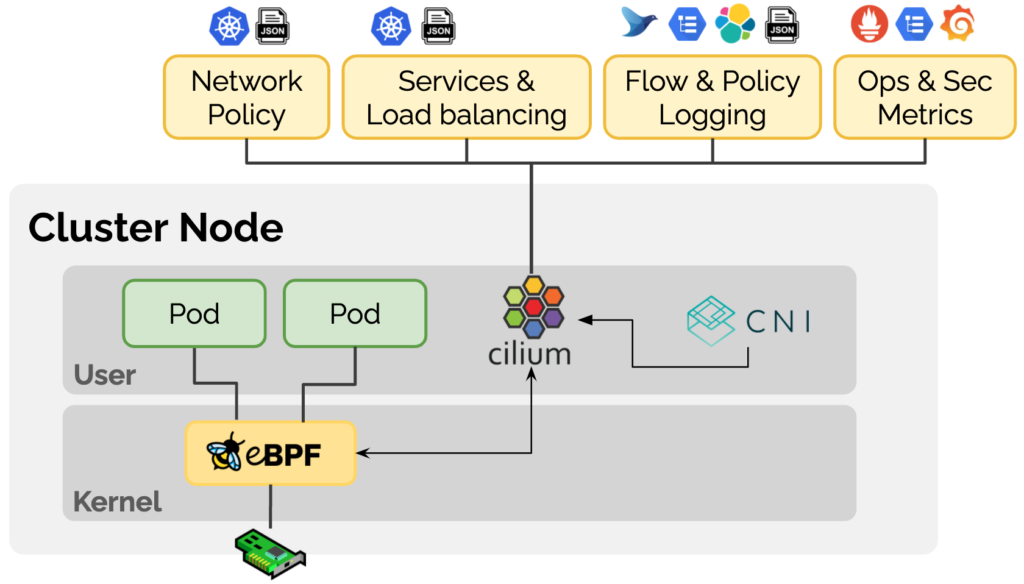
Cilium作为一款Kubernetes CNI插件,从一开始就是为大规模和高度动态的容器环境而设计,并且带来了API级别感知的网络安全管理功能,通过使用基于Linux内核特性的新技术——BPF,提供了基于service/pod/container作为标识,而非传统的IP地址,来定义和加强容器和Pod之间网络层、应用层的安全策略。因此,Cilium不仅将安全控制与寻址解耦来简化在高度动态环境中应用安全性策略,而且提供传统网络第3层、4层隔离功能,以及基于http层上隔离控制,来提供更强的安全性隔离。另外,由于BPF可以动态地插入控制Linux系统的程序,实现了强大的安全可视化功能,而且这些变化是不需要更新应用代码或重启应用服务本身就可以生效,因为BPF是运行在系统内核中的。
Cilium Architecture
Installation Using Kubeadm
# https://docs.cilium.io/en/v1.10/gettingstarted/k8s-install-kubeadm/ -----> If you are interested in using Cilium’s kube-proxy replacement, please follow the Kubernetes Without kube-proxy guide and skip this one.------> # https://docs.cilium.io/en/v1.10/gettingstarted/kubeproxy-free/#kubeproxy-free# 所以参考此安装方式去安装:[without kube-proxy]# NOTE:Cilium’s kube-proxy replacement depends on the Host-Reachable Services feature, therefore a v4.19.57, v5.1.16, v5.2.0 or more recent Linux kernel is required. Linux kernels v5.3 and v5.8 add additional features that Cilium can use to further optimize the kube-proxy replacement implementation.Note that v5.0.y kernels do not have the fix required to run the kube-proxy replacement since at this point in time the v5.0.y stable kernel is end-of-life (EOL) and not maintained anymore on kernel.org. For individual distribution maintained kernels, the situation could differ. Therefore, please check with your distribution.# Quick Start:1.# kubeadm init without kube-proxy:$ kubeadm init --skip-phases=addon/kube-proxy # 建议使用此方式# <><>For existing installations with kube-proxy running as a DaemonSet, remove it by using the following commands below. Careful: Be aware that this will break existing service connections. It will also stop service related traffic until the Cilium replacement has been installed:<><>$ kubectl -n kube-system delete ds kube-proxy$ # Delete the configmap as well to avoid kube-proxy being reinstalled during a kubeadm upgrade (works only for K8s 1.19 and newer)$ kubectl -n kube-system delete cm kube-proxy$ # Run on each node:$ iptables-restore <(iptables-save | grep -v KUBE)2.install HELM3(HELM 2 is not support now.)$ wget https://get.helm.sh/helm-v3.6.3-linux-amd64.tar.gz$ tar -xzvf helm-v3.6.3-linux-amd64.tar.gz$ mv linux-amd64/helm /usr/local/bin/$ helm list3.Add Cilium repo:$ helm repo add cilium https://helm.cilium.io/4.Generate the Cilium Template:helm template cilium cilium/cilium --version 1.10.3 \--namespace kube-system \--set kubeProxyReplacement=strict \--set k8sServiceHost=REPLACE_WITH_API_SERVER_IP \--set k8sServicePort=REPLACE_WITH_API_SERVER_PORThelm template cilium cilium/cilium --version 1.10 --namespace kube-system --set kubeProxyReplacement=strict --set k8sServiceHost=192.168.2.21 --set k8sServicePort=6443 > vxlan.yaml在这个vxlan.yaml文件中我们需要修改部分参数,以适配后期的Debug:4.1.# If you want to run cilium in debug mode change this value to truedebug: "true"debug-verbose: "datapath"4.2.# If you want cilium monitor to aggregate tracing for packets, set this level# to "low", "medium", or "maximum". The higher the level, the less packets# that will be seen in monitor output.monitor-aggregation: none4.3.# Encapsulation mode for communication between nodes# Possible values:# - disabled# - vxlan (default)# - genevetunnel: vxlan4.4.# wait-bpf-mount makes init container wait until bpf filesystem is mountedwait-bpf-mount: "true"#Mount bpf as a service:cat <<EOF | sudo tee /etc/systemd/system/sys-fs-bpf.mount[Unit]Description=Cilium BPF mountsDocumentation=https://docs.cilium.io/DefaultDependencies=noBefore=local-fs.target umount.targetAfter=swap.target[Mount]What=bpffsWhere=/sys/fs/bpfType=bpfOptions=rw,nosuid,nodev,noexec,relatime,mode=700[Install]WantedBy=multi-user.targetEOFsystemctl enable sys-fs-bpf.mountsystemctl restart sys-fs-bpf.mountmount | grep "/sys/fs/bpf"#none on /sys/fs/bpf type bpf (rw,nosuid,nodev,noexec,relatime,mode=700)4.5.auto-direct-node-routes: "false"# Each individual node is made aware of all pod IPs of all other nodes and routes are inserted into the Linux kernel routing table to represent this. If all nodes share a single L2 network, then this can be taken care of by enabling the option auto-direct-node-routes: true. Otherwise, an additional system component such as a BGP daemon must be run to distribute the routes. See the guide Using kube-router to run BGP on how to achieve this using the kube-router project.5.verify:[root@k8s-1 ~]# kubectl get pods -o wide -nkube-system | grep ciliumcilium-575rw 1/1 Running 0 47h 192.168.2.22 k8s-2 <none> <none>cilium-operator-6c8777f4fc-bbjgt 1/1 Running 0 47h 192.168.2.21 k8s-1 <none> <none>cilium-operator-6c8777f4fc-kbx5m 1/1 Running 0 47h 192.168.2.22 k8s-2 <none> <none>cilium-s6vsd 1/1 Running 0 47h 192.168.2.21 k8s-1 <none> <none>[root@k8s-1 ~]## kubectl exec -it -n kube-system cilium-575rw -- cilium status | grep KubeProxyReplacementKubeProxyReplacement: Strict [ens33 192.168.2.22 (Direct Routing)]# (Note), in above Helm configuration, the kubeProxyReplacement has been set to strict mode. This means that the Cilium agent will bail out in case the underlying Linux kernel support is missing.# Cilium’s eBPF kube-proxy replacement is supported in direct routing as well as in tunneling mode.5.2: cilium status$ kubectl exec -it -n kube-system cilium-575rw -- cilium status --verbose6.Deploy a demo to verify:As a optional next step, we deploy nginx pods, create a new NodePort service and validate that Cilium installed the service correctly.The following yaml is used for the backend pods:apiVersion: apps/v1kind: Deploymentmetadata:name: my-nginxspec:selector:matchLabels:run: my-nginxreplicas: 2template:metadata:labels:run: my-nginxspec:containers:- name: my-nginximage: nginxports:- containerPort: 80# expose a service:$ kubectl expose deployment my-nginx --type=NodePort --port=80$ kubectl get svc my-nginxNAME TYPE CLUSTER-IP EXTERNAL-IP PORT(S) AGEmy-nginx NodePort 10.104.239.135 <none> 80:31940/TCP 24m# check the service by cilium service list$ kubectl exec -it -n kube-system cilium-575rw -- cilium service list5 192.168.2.22:30359 NodePort 1 => 10.0.1.144:802 => 10.0.1.181:80# we also can check the host ns's iptables:$ iptables-save | grep KUBE-SVC[root@k8s-2 ~]# iptables-save | grep KUBE-SVC[root@k8s-2 ~]# empty line
Cilium IPAM
Enable Cluster-pool IPAM modeSetup Cilium for Kubernetes using helm with the options: --set ipam.mode=cluster-pool.Depending if you are using IPv4 and / or IPv6, you might want to adjust the podCIDR allocated for your cluster’s pods with the options:--set ipam.operator.clusterPoolIPv4PodCIDR=<IPv4CIDR>--set ipam.operator.clusterPoolIPv6PodCIDR=<IPv6CIDR>To adjust the CIDR size that should be allocated for each node you can use the following options:--set ipam.operator.clusterPoolIPv4MaskSize=<IPv4MaskSize>--set ipam.operator.clusterPoolIPv6MaskSize=<IPv6MaskSize>Deploy Cilium and Cilium-Operator. Cilium will automatically wait until the podCIDR is allocated for its node by Cilium Operator.1.Validate that Cilium has started up correctly$ cilium status --all-addressesKVStore: Ok etcd: 1/1 connected, has-quorum=true: https://192.168.33.11:2379 - 3.3.12 (Leader)[...]IPAM: IPv4: 2/256 allocated,Allocated addresses:10.0.0.1 (router)10.0.0.3 (health)2.Validate the spec.ipam.podCIDRs section:$ kubectl get cn k8s1 -o yamlapiVersion: cilium.io/v2kind: CiliumNodemetadata:name: k8s1[...]spec:ipam:podCIDRs:- 10.0.0.0/24
All in CNI
Packet_Walks_In_Kubernetes-v4.pdf
Parameter in Cilium Template
<!-- This file was autogenerated via cilium-agent --cmdref, do not edit manually-->## cilium-agentRun the cilium agent
cilium-agent [flags]
### Options
--agent-health-port int TCP port for agent health status API (default 9876)--agent-labels strings Additional labels to identify this agent--allocator-list-timeout duration Timeout for listing allocator state before exiting (default 3m0s)--allow-icmp-frag-needed Allow ICMP Fragmentation Needed type packets for purposes like TCP Path MTU. (default true)--allow-localhost string Policy when to allow local stack to reach local endpoints { auto | always | policy } (default "auto")--annotate-k8s-node Annotate Kubernetes node (default true)--api-rate-limit map API rate limiting configuration (example: --rate-limit endpoint-create=rate-limit:10/m,rate-burst:2) (default map[])--arping-refresh-period duration Period for remote node ARP entry refresh (set 0 to disable) (default 5m0s)--auto-create-cilium-node-resource Automatically create CiliumNode resource for own node on startup (default true)--auto-direct-node-routes Enable automatic L2 routing between nodes--bgp-announce-lb-ip Announces service IPs of type LoadBalancer via BGP--bgp-config-path string Path to file containing the BGP configuration (default "/var/lib/cilium/bgp/config.yaml")--bpf-ct-global-any-max int Maximum number of entries in non-TCP CT table (default 262144)--bpf-ct-global-tcp-max int Maximum number of entries in TCP CT table (default 524288)--bpf-ct-timeout-regular-any duration Timeout for entries in non-TCP CT table (default 1m0s)--bpf-ct-timeout-regular-tcp duration Timeout for established entries in TCP CT table (default 6h0m0s)--bpf-ct-timeout-regular-tcp-fin duration Teardown timeout for entries in TCP CT table (default 10s)--bpf-ct-timeout-regular-tcp-syn duration Establishment timeout for entries in TCP CT table (default 1m0s)--bpf-ct-timeout-service-any duration Timeout for service entries in non-TCP CT table (default 1m0s)--bpf-ct-timeout-service-tcp duration Timeout for established service entries in TCP CT table (default 6h0m0s)--bpf-fragments-map-max int Maximum number of entries in fragments tracking map (default 8192)--bpf-lb-acceleration string BPF load balancing acceleration via XDP ("native", "disabled") (default "disabled")--bpf-lb-algorithm string BPF load balancing algorithm ("random", "maglev") (default "random")--bpf-lb-bypass-fib-lookup Enable FIB lookup bypass optimization for nodeport reverse NAT handling (default true)--bpf-lb-dev-ip-addr-inherit string Device name which IP addr is inherited by devices running LB BPF program (--devices)--bpf-lb-dsr-dispatch string BPF load balancing DSR dispatch method ("opt", "ipip") (default "opt")--bpf-lb-dsr-l4-xlate string BPF load balancing DSR L4 DNAT method for IPIP ("frontend", "backend") (default "frontend")--bpf-lb-external-clusterip Enable external access to ClusterIP services (default false)--bpf-lb-maglev-hash-seed string Maglev cluster-wide hash seed (base64 encoded) (default "JLfvgnHc2kaSUFaI")--bpf-lb-maglev-table-size uint Maglev per service backend table size (parameter M) (default 16381)--bpf-lb-map-max int Maximum number of entries in Cilium BPF lbmap (default 65536)--bpf-lb-mode string BPF load balancing mode ("snat", "dsr", "hybrid") (default "snat")--bpf-lb-rss-ipv4-src-cidr string BPF load balancing RSS outer source IPv4 CIDR prefix for IPIP--bpf-lb-rss-ipv6-src-cidr string BPF load balancing RSS outer source IPv6 CIDR prefix for IPIP--bpf-map-dynamic-size-ratio float Ratio (0.0-1.0) of total system memory to use for dynamic sizing of CT, NAT and policy BPF maps. Set to 0.0 to disable dynamic BPF map sizing (default: 0.0)--bpf-nat-global-max int Maximum number of entries for the global BPF NAT table (default 524288)--bpf-neigh-global-max int Maximum number of entries for the global BPF neighbor table (default 524288)--bpf-policy-map-max int Maximum number of entries in endpoint policy map (per endpoint) (default 16384)--bpf-root string Path to BPF filesystem--bpf-sock-rev-map-max int Maximum number of entries for the SockRevNAT BPF map (default 262144)--certificates-directory string Root directory to find certificates specified in L7 TLS policy enforcement (default "/var/run/cilium/certs")--cgroup-root string Path to Cgroup2 filesystem--cluster-id int Unique identifier of the cluster--cluster-name string Name of the cluster (default "default")--clustermesh-config string Path to the ClusterMesh configuration directory--config string Configuration file (default "$HOME/ciliumd.yaml")--config-dir string Configuration directory that contains a file for each option--conntrack-gc-interval duration Overwrite the connection-tracking garbage collection interval--crd-wait-timeout duration Cilium will exit if CRDs are not available within this duration upon startup (default 5m0s)--datapath-mode string Datapath mode name (default "veth")
-D, —debug Enable debugging mode —debug-verbose strings List of enabled verbose debug groups —devices strings List of devices facing cluster/external network (used for BPF NodePort, BPF masquerading and host firewall); supports ‘+’ as wildcard in device name, e.g. ‘eth+’ —direct-routing-device string Device name used to connect nodes in direct routing mode (required only by BPF NodePort; if empty, automatically set to a device with k8s InternalIP/ExternalIP or with a default route) —disable-cnp-status-updates Do not send CNP NodeStatus updates to the Kubernetes api-server (recommended to run with “cnp-node-status-gc-interval=0” in cilium-operator) —disable-conntrack Disable connection tracking —disable-endpoint-crd Disable use of CiliumEndpoint CRD —disable-iptables-feeder-rules strings Chains to ignore when installing feeder rules. —dns-max-ips-per-restored-rule int Maximum number of IPs to maintain for each restored DNS rule (default 1000) —egress-masquerade-interfaces string Limit egress masquerading to interface selector —egress-multi-home-ip-rule-compat Offset routing table IDs under ENI IPAM mode to avoid collisions with reserved table IDs. If false, the offset is performed (new scheme), otherwise, the old scheme stays in-place. —enable-auto-protect-node-port-range Append NodePort range to net.ipv4.ip_local_reserved_ports if it overlaps with ephemeral port range (net.ipv4.ip_local_port_range) (default true) —enable-bandwidth-manager Enable BPF bandwidth manager —enable-bpf-clock-probe Enable BPF clock source probing for more efficient tick retrieval —enable-bpf-masquerade Masquerade packets from endpoints leaving the host with BPF instead of iptables —enable-bpf-tproxy Enable BPF-based proxy redirection, if support available —enable-custom-calls Enable tail call hooks for custom eBPF programs —enable-egress-gateway Enable egress gateway —enable-endpoint-health-checking Enable connectivity health checking between virtual endpoints (default true) —enable-endpoint-routes Use per endpoint routes instead of routing via cilium_host —enable-external-ips Enable k8s service externalIPs feature (requires enabling enable-node-port) (default true) —enable-health-check-nodeport Enables a healthcheck nodePort server for NodePort services with ‘healthCheckNodePort’ being set (default true) —enable-health-checking Enable connectivity health checking (default true) —enable-host-firewall Enable host network policies (beta when using kube-proxy) —enable-host-legacy-routing Enable the legacy host forwarding model which does not bypass upper stack in host namespace —enable-host-port Enable k8s hostPort mapping feature (requires enabling enable-node-port) (default true) —enable-host-reachable-services Enable reachability of services for host applications —enable-hubble Enable hubble server —enable-hubble-recorder-api Enable the Hubble recorder API (default true) —enable-identity-mark Enable setting identity mark for local traffic (default true) —enable-ip-masq-agent Enable BPF ip-masq-agent —enable-ipsec Enable IPSec support —enable-ipv4 Enable IPv4 support (default true) —enable-ipv4-fragment-tracking Enable IPv4 fragments tracking for L4-based lookups (default true) —enable-ipv4-masquerade Masquerade IPv4 traffic from endpoints leaving the host (default true) —enable-ipv6 Enable IPv6 support (default true) —enable-ipv6-masquerade Masquerade IPv6 traffic from endpoints leaving the host (default true) —enable-ipv6-ndp Enable IPv6 NDP support —enable-k8s-api-discovery Enable discovery of Kubernetes API groups and resources with the discovery API —enable-k8s-endpoint-slice Enables k8s EndpointSlice feature in Cilium if the k8s cluster supports it (default true) —enable-k8s-event-handover Enable k8s event handover to kvstore for improved scalability —enable-l2-neigh-discovery Enables L2 neighbor discovery used by kube-proxy-replacement and IPsec (default true) —enable-l7-proxy Enable L7 proxy for L7 policy enforcement (default true) —enable-local-node-route Enable installation of the route which points the allocation prefix of the local node (default true) —enable-local-redirect-policy Enable Local Redirect Policy —enable-monitor Enable the monitor unix domain socket server (default true) —enable-node-port Enable NodePort type services by Cilium —enable-policy string Enable policy enforcement (default “default”) —enable-recorder Enable BPF datapath pcap recorder —enable-remote-node-identity Enable use of remote node identity —enable-session-affinity Enable support for service session affinity —enable-svc-source-range-check Enable check of service source ranges (currently, only for LoadBalancer) (default true) —enable-tracing Enable tracing while determining policy (debugging) —enable-well-known-identities Enable well-known identities for known Kubernetes components (default true) —enable-wireguard Enable wireguard —enable-xt-socket-fallback Enable fallback for missing xt_socket module (default true) —encrypt-interface string Transparent encryption interface —encrypt-node Enables encrypting traffic from non-Cilium pods and host networking —endpoint-interface-name-prefix string Prefix of interface name shared by all endpoints (default “lxc+”) —endpoint-queue-size int size of EventQueue per-endpoint (default 25) —endpoint-status strings Enable additional CiliumEndpoint status features (controllers,health,log,policy,state) —envoy-log string Path to a separate Envoy log file, if any —exclude-local-address strings Exclude CIDR from being recognized as local address —fixed-identity-mapping map Key-value for the fixed identity mapping which allows to use reserved label for fixed identities (default map[]) —force-local-policy-eval-at-source Force policy evaluation of all local communication at the source endpoint (default true) —gops-port int Port for gops server to listen on (default 9890) -h, —help help for cilium-agent —host-reachable-services-protos strings Only enable reachability of services for host applications for specific protocols (default [tcp,udp]) —http-idle-timeout uint Time after which a non-gRPC HTTP stream is considered failed unless traffic in the stream has been processed (in seconds); defaults to 0 (unlimited) —http-max-grpc-timeout uint Time after which a forwarded gRPC request is considered failed unless completed (in seconds). A “grpc-timeout” header may override this with a shorter value; defaults to 0 (unlimited) —http-normalize-path Use Envoy HTTP path normalization options, which currently includes RFC 3986 path normalization, Envoy merge slashes option, and unescaping and redirecting for paths that contain escaped slashes. These are necessary to keep path based access control functional, and should not interfere with normal operation. Set this to false only with caution. (default true) —http-request-timeout uint Time after which a forwarded HTTP request is considered failed unless completed (in seconds); Use 0 for unlimited (default 3600) —http-retry-count uint Number of retries performed after a forwarded request attempt fails (default 3) —http-retry-timeout uint Time after which a forwarded but uncompleted request is retried (connection failures are retried immediately); defaults to 0 (never) —hubble-disable-tls Allow Hubble server to run on the given listen address without TLS. —hubble-event-buffer-capacity int Capacity of Hubble events buffer. The provided value must be one less than an integer power of two and no larger than 65535 (ie: 1, 3, …, 2047, 4095, …, 65535) (default 4095) —hubble-event-queue-size int Buffer size of the channel to receive monitor events. —hubble-export-file-compress Compress rotated Hubble export files. —hubble-export-file-max-backups int Number of rotated Hubble export files to keep. (default 5) —hubble-export-file-max-size-mb int Size in MB at which to rotate Hubble export file. (default 10) —hubble-export-file-path string Filepath to write Hubble events to. —hubble-listen-address string An additional address for Hubble server to listen to, e.g. “:4244” —hubble-metrics strings List of Hubble metrics to enable. —hubble-metrics-server string Address to serve Hubble metrics on. —hubble-recorder-sink-queue-size int Queue size of each Hubble recorder sink (default 1024) —hubble-recorder-storage-path string Directory in which pcap files created via the Hubble Recorder API are stored (default “/var/run/cilium/pcaps”) —hubble-socket-path string Set hubble’s socket path to listen for connections (default “/var/run/cilium/hubble.sock”) —hubble-tls-cert-file string Path to the public key file for the Hubble server. The file must contain PEM encoded data. —hubble-tls-client-ca-files strings Paths to one or more public key files of client CA certificates to use for TLS with mutual authentication (mTLS). The files must contain PEM encoded data. When provided, this option effectively enables mTLS. —hubble-tls-key-file string Path to the private key file for the Hubble server. The file must contain PEM encoded data. —identity-allocation-mode string Method to use for identity allocation (default “kvstore”) —identity-change-grace-period duration Time to wait before using new identity on endpoint identity change (default 5s) —install-iptables-rules Install base iptables rules for cilium to mainly interact with kube-proxy (and masquerading) (default true) —install-no-conntrack-iptables-rules Install Iptables rules to skip netfilter connection tracking on all pod traffic. This option is only effective when Cilium is running in direct routing and full KPR mode. Moreover, this option cannot be enabled when Cilium is running in a managed Kubernetes environment or in a chained CNI setup. —ip-allocation-timeout duration Time after which an incomplete CIDR allocation is considered failed (default 2m0s) —ip-masq-agent-config-path string ip-masq-agent configuration file path (default “/etc/config/ip-masq-agent”) —ipam string Backend to use for IPAM (default “cluster-pool”) —ipsec-key-file string Path to IPSec key file —iptables-lock-timeout duration Time to pass to each iptables invocation to wait for xtables lock acquisition (default 5s) —iptables-random-fully Set iptables flag random-fully on masquerading rules —ipv4-native-routing-cidr string Allows to explicitly specify the IPv4 CIDR for native routing. This value corresponds to the configured cluster-cidr. —ipv4-node string IPv4 address of node (default “auto”) —ipv4-pod-subnets strings List of IPv4 pod subnets to preconfigure for encryption —ipv4-range string Per-node IPv4 endpoint prefix, e.g. 10.16.0.0/16 (default “auto”) —ipv4-service-loopback-address string IPv4 address for service loopback SNAT (default “169.254.42.1”) —ipv4-service-range string Kubernetes IPv4 services CIDR if not inside cluster prefix (default “auto”) —ipv6-cluster-alloc-cidr string IPv6 /64 CIDR used to allocate per node endpoint /96 CIDR (default “f00d::/64”) —ipv6-mcast-device string Device that joins a Solicited-Node multicast group for IPv6 —ipv6-node string IPv6 address of node (default “auto”) —ipv6-pod-subnets strings List of IPv6 pod subnets to preconfigure for encryption —ipv6-range string Per-node IPv6 endpoint prefix, e.g. fd02:1:1::/96 (default “auto”) —ipv6-service-range string Kubernetes IPv6 services CIDR if not inside cluster prefix (default “auto”) —ipvlan-master-device string Device facing external network acting as ipvlan master (default “undefined”) —join-cluster Join a Cilium cluster via kvstore registration —k8s-api-server string Kubernetes API server URL —k8s-heartbeat-timeout duration Configures the timeout for api-server heartbeat, set to 0 to disable (default 30s) —k8s-kubeconfig-path string Absolute path of the kubernetes kubeconfig file —k8s-namespace string Name of the Kubernetes namespace in which Cilium is deployed in —k8s-require-ipv4-pod-cidr Require IPv4 PodCIDR to be specified in node resource —k8s-require-ipv6-pod-cidr Require IPv6 PodCIDR to be specified in node resource —k8s-service-proxy-name string Value of K8s service-proxy-name label for which Cilium handles the services (empty = all services without service.kubernetes.io/service-proxy-name label) —k8s-watcher-endpoint-selector string K8s endpoint watcher will watch for these k8s endpoints (default “metadata.name!=kube-scheduler,metadata.name!=kube-controller-manager,metadata.name!=etcd-operator,metadata.name!=gcp-controller-manager”) —keep-config When restoring state, keeps containers’ configuration in place —kube-proxy-replacement string auto-enable available features for kube-proxy replacement (“probe”), or enable only selected features (will panic if any selected feature cannot be enabled) (“partial”) or enable all features (will panic if any feature cannot be enabled) (“strict”), or completely disable it (ignores any selected feature) (“disabled”) (default “partial”) —kube-proxy-replacement-healthz-bind-address string The IP address with port for kube-proxy replacement health check server to serve on (set to ‘0.0.0.0:10256’ for all IPv4 interfaces and ‘[::]:10256’ for all IPv6 interfaces). Set empty to disable. —kvstore string Key-value store type —kvstore-connectivity-timeout duration Time after which an incomplete kvstore operation is considered failed (default 2m0s) —kvstore-max-consecutive-quorum-errors int Max acceptable kvstore consecutive quorum errors before the agent assumes permanent failure (default 2) —kvstore-opt map Key-value store options (default map[]) —kvstore-periodic-sync duration Periodic KVstore synchronization interval (default 5m0s) —label-prefix-file string Valid label prefixes file path —labels strings List of label prefixes used to determine identity of an endpoint —lib-dir string Directory path to store runtime build environment (default “/var/lib/cilium”) —local-router-ipv4 string Link-local IPv4 used for Cilium’s router devices —local-router-ipv6 string Link-local IPv6 used for Cilium’s router devices —log-driver strings Logging endpoints to use for example syslog —log-opt map Log driver options for cilium-agent, configmap example for syslog driver: {“syslog.level”:”info”,”syslog.facility”:”local5”,”syslog.tag”:”cilium-agent”} (default map[]) —log-system-load Enable periodic logging of system load —metrics strings Metrics that should be enabled or disabled from the default metric list. (+metric_foo to enable metric_foo , -metric_bar to disable metric_bar) —monitor-aggregation string Level of monitor aggregation for traces from the datapath (default “None”) —monitor-aggregation-flags strings TCP flags that trigger monitor reports when monitor aggregation is enabled (default [syn,fin,rst]) —monitor-aggregation-interval duration Monitor report interval when monitor aggregation is enabled (default 5s) —monitor-queue-size int Size of the event queue when reading monitor events —mtu int Overwrite auto-detected MTU of underlying network —nat46-range string IPv6 prefix to map IPv4 addresses to (default “0:0:0:0:0:FFFF::/96”) —node-port-bind-protection Reject application bind(2) requests to service ports in the NodePort range (default true) —node-port-range strings Set the min/max NodePort port range (default [30000,32767]) —policy-audit-mode Enable policy audit (non-drop) mode —policy-queue-size int size of queues for policy-related events (default 100) —pprof Enable serving the pprof debugging API —pprof-port int Port that the pprof listens on (default 6060) —preallocate-bpf-maps Enable BPF map pre-allocation (default true) —prefilter-device string Device facing external network for XDP prefiltering (default “undefined”) —prefilter-mode string Prefilter mode via XDP (“native”, “generic”) (default “native”) —prepend-iptables-chains Prepend custom iptables chains instead of appending (default true) —prometheus-serve-addr string IP:Port on which to serve prometheus metrics (pass “:Port” to bind on all interfaces, “” is off) —proxy-connect-timeout uint Time after which a TCP connect attempt is considered failed unless completed (in seconds) (default 1) —proxy-prometheus-port int Port to serve Envoy metrics on. Default 0 (disabled). —read-cni-conf string Read to the CNI configuration at specified path to extract per node configuration —restore Restores state, if possible, from previous daemon (default true) —sidecar-istio-proxy-image string Regular expression matching compatible Istio sidecar istio-proxy container image names (default “cilium/istio_proxy”) —single-cluster-route Use a single cluster route instead of per node routes —socket-path string Sets daemon’s socket path to listen for connections (default “/var/run/cilium/cilium.sock”) —sockops-enable Enable sockops when kernel supported —state-dir string Directory path to store runtime state (default “/var/run/cilium”) —tofqdns-dns-reject-response-code string DNS response code for rejecting DNS requests, available options are ‘[nameError refused]’ (default “refused”) —tofqdns-enable-dns-compression Allow the DNS proxy to compress responses to endpoints that are larger than 512 Bytes or the EDNS0 option, if present (default true) —tofqdns-endpoint-max-ip-per-hostname int Maximum number of IPs to maintain per FQDN name for each endpoint (default 50) —tofqdns-idle-connection-grace-period duration Time during which idle but previously active connections with expired DNS lookups are still considered alive (default 0s) —tofqdns-max-deferred-connection-deletes int Maximum number of IPs to retain for expired DNS lookups with still-active connections (default 10000) —tofqdns-min-ttl int The minimum time, in seconds, to use DNS data for toFQDNs policies. (default 3600 ) —tofqdns-pre-cache string DNS cache data at this path is preloaded on agent startup —tofqdns-proxy-port int Global port on which the in-agent DNS proxy should listen. Default 0 is a OS-assigned port. —tofqdns-proxy-response-max-delay duration The maximum time the DNS proxy holds an allowed DNS response before sending it along. Responses are sent as soon as the datapath is updated with the new IP information. (default 100ms) —trace-payloadlen int Length of payload to capture when tracing (default 128) -t, —tunnel string Tunnel mode {vxlan, geneve, disabled} (default “vxlan” for the “veth” datapath mode) —version Print version information —vlan-bpf-bypass ints List of explicitly allowed VLAN IDs, ‘0’ id will allow all VLAN IDs —write-cni-conf-when-ready string Write the CNI configuration as specified via —read-cni-conf to path when agent is ready

若有收获,就点个赞吧
0 人点赞


