1 string容器
1.1 string基本概念
本质:string是C++风格的字符串,而string本质上是一个类
string和char * 区别:
- char * 是一个指针
- string是一个类,类内部封装了char,管理这个字符串,是一个char型的容器。
特点:
string 类内部封装了很多成员方法例如:查找find,拷贝copy,删除delete 替换replace,插入insert
string管理char*所分配的内存,不用担心复制越界和取值越界等,由类内部进行负责
1.2 string构造函数
构造函数原型:
string(); //创建一个空的字符串 例如: string str;string(const char* s); //使用字符串s初始化string(const string& str); //使用一个string对象初始化另一个string对象string(int n, char c); //使用n个字符c初始化
示例:
#include <string>//string构造void test01(){string s1; //创建空字符串,调用无参构造函数cout << "str1 = " << s1 << endl;const char* str = "hello world";string s2(str); //把c_string转换成了stringcout << "str2 = " << s2 << endl;string s3(s2); //调用拷贝构造函数cout << "str3 = " << s3 << endl;string s4(10, 'a');cout << "str3 = " << s3 << endl;}int main() {test01();return 0;}/* 输出结果str1 =str2 = hello worldstr3 = hello worldstr3 = hello world*/
总结:string的多种构造方式没有可比性,灵活使用即可
1.3 string赋值操作
函数原型:
string& operator=(const char* s); //char*类型字符串 赋值给当前的字符串string& operator=(const string &s); //把字符串s赋给当前的字符串string& operator=(char c); //字符赋值给当前的字符串string& assign(const char *s); //把字符串s赋给当前的字符串string& assign(const char *s, int n); //把字符串s的前n个字符赋给当前的字符串string& assign(const string &s); //把字符串s赋给当前字符串string& assign(int n, char c); //用n个字符c赋给当前字符串
示例:
//赋值void test01(){string str1;str1 = "hello world";cout << "str1 = " << str1 << endl;string str2;str2 = str1;cout << "str2 = " << str2 << endl;string str3;str3 = 'a';cout << "str3 = " << str3 << endl;string str4;str4.assign("hello c++");cout << "str4 = " << str4 << endl;string str5;str5.assign("hello c++",5);cout << "str5 = " << str5 << endl;string str6;str6.assign(str5);cout << "str6 = " << str6 << endl;string str7;str7.assign(5, 'x');cout << "str7 = " << str7 << endl;}int main() {test01();return 0;}/* 输出结果str1 = hello worldstr2 = hello worldstr3 = astr4 = hello c++str5 = hellostr6 = hellostr7 = xxxxx*/
string的赋值方式很多,operator= 这种方式是比较实用的
1.4 string字符串拼接
实现在字符串末尾拼接字符串
函数原型:
string& operator+=(const char* str); //重载+=操作符string& operator+=(const char c); //重载+=操作符string& operator+=(const string& str); //重载+=操作符string& append(const char *s); //把字符串s连接到当前字符串结尾string& append(const char *s, int n); //把字符串s的前n个字符连接到当前字符串结尾string& append(const string &s); //同operator+=(const string& str)string& append(const string &s, int pos, int n);//字符串s中从pos开始的n个字符连接到字符串结尾
示例:
//字符串拼接void test01(){string str1 = "我";str1 += "爱玩游戏";cout << "str1 = " << str1 << endl;str1 += ':';cout << "str1 = " << str1 << endl;string str2 = "LOL DNF";str1 += str2;cout << "str1 = " << str1 << endl;string str3 = "I";str3.append(" love ");str3.append("game abcde", 4);//str3.append(str2);str3.append(str2, 4, 3); // 从下标4位置开始 ,截取3个字符,拼接到字符串末尾cout << "str3 = " << str3 << endl;}int main() {test01();return 0;}/* 输出结果str1 = 我爱玩游戏str1 = 我爱玩游戏:str1 = 我爱玩游戏:LOL DNFstr3 = I love gameDNF*/
字符串拼接的重载版本很多,初学阶段记住几种即可
1.5 string查找和替换
- find查找是从左往后,rfind从右往左
- find找到字符串后返回查找的第一个字符位置,找不到返回-1
- replace在替换时,要指定从哪个位置起,多少个字符,替换成什么样的字符串
功能描述:
- 查找:查找指定字符串是否存在
- 替换:在指定的位置替换字符串
函数原型:
int find(const string& str, int pos = 0) const; //查找str第一次出现位置,从pos开始查找int find(const char* s, int pos = 0) const; //查找s第一次出现位置,从pos开始查找int find(const char* s, int pos, int n) const; //从pos位置查找s的前n个字符第一次位置int find(const char c, int pos = 0) const; //查找字符c第一次出现位置int rfind(const string& str, int pos = npos) const; //查找str最后一次位置,从pos开始查找int rfind(const char* s, int pos = npos) const; //查找s最后一次出现位置,从pos开始查找int rfind(const char* s, int pos, int n) const; //从pos查找s的前n个字符最后一次位置int rfind(const char c, int pos = 0) const; //查找字符c最后一次出现位置string& replace(int pos, int n, const string& str); //替换从pos开始n个字符为字符串strstring& replace(int pos, int n,const char* s); //替换从pos开始的n个字符为字符串s
示例:
#include <iostream>#include <string>using namespace std;//查找和替换void test01(){//查找string str1 = "abcdefgde";int pos = str1.find("de");if (pos == -1){cout << "未找到" << endl;}else{cout << "pos = " << pos << endl;}pos = str1.rfind("de");cout << "pos = " << pos << endl;}void test02(){//替换string str1 = "abcdefgde";str1.replace(1, 3, "1111");cout << "str1 = " << str1 << endl;}int main() {test01();test02();return 0;}/* 输出结果pos = 3pos = 7str1 = a1111efgde*/
1.6 string字符串比较
比较方式:
- 字符串比较是按字符的ASCII码进行对比
= return 0> return 1< return -1 - 字符串对比主要是用于比较两个字符串是否相等,判断谁大谁小的意义并不是很大
函数原型:
int compare(const string &s) const; //与字符串s比较
int compare(const char *s) const; //与字符串s比较
示例:
//字符串比较
void test01()
{

    string s1 = "hello";
    string s2 = "aello";

    int ret = s1.compare(s2);

    if (ret == 0) {
        cout << "s1 等于 s2" << endl;
    }
    else if (ret > 0)
    {
        cout << "s1 大于 s2" << endl;
    }
    else
    {
        cout << "s1 小于 s2" << endl;
    }

}

int main() {

    test01();

    return 0;
}
/* 输出结果
s1 大于 s2
*/
1.7 string字符存取
string字符串中单个字符存取有两种方式,利用 [ ] 或 at
char& operator[](int n); //通过[]方式取字符
char& at(int n); //通过at方法获取字符
示例:
void test01()
{
    string str = "hello world";

    for (int i = 0; i < str.size(); i++)
    {
        cout << str[i] << " ";
    }
    cout << endl;

    for (int i = 0; i < str.size(); i++)
    {
        cout << str.at(i) << " ";
    }
    cout << endl;


    //字符修改
    str[0] = 'x';
    str.at(1) = 'x';
    cout << str << endl;

}

int main() {

    test01();

    return 0;
}
/* 输出结果
h e l l o   w o r l d
h e l l o   w o r l d
xxllo world
*/
1.8 string插入和删除
插入和删除的起始下标都是从0开始
函数原型:
string& insert(int pos, const char* s); //插入字符串
string& insert(int pos, const string& str); //插入字符串
string& insert(int pos, int n, char c); //在指定位置插入n个字符c

string& erase(int pos, int n = npos); //删除从Pos开始的n个字符
示例:
#include<iostream>
using namespace std;

//字符串插入和删除
void test01()
{
    string str = "hello";
    str.insert(1, "111");
    cout << str << endl;

    str.erase(1, 3);  //从1号位置开始3个字符
    cout << str << endl;
}

int main() {

    test01();

    system("pause");

    return 0;
}
/* 输出结果
h111ello
hello
*/
2 vector容器
2.1 vector基本概念
vector数据结构和数组非常相似,也称为单端数组
vector与普通数组区别:
不同之处在于数组是静态空间,而vector可以动态扩展
动态扩展:
- 并不是在原空间之后续接新空间,而是找更大的内存空间,然后将原数据拷贝新空间,释放原空间
- vector容器的迭代器是支持随机访问的迭代器
2.2 vector构造函数
vector的多种构造方式没有可比性,灵活使用即可
函数原型:
vector<T> v; //采用模板实现类实现,默认构造函数
vector(v.begin(), v.end()); //将v[begin(), end())区间中的元素拷贝给本身。
vector(n, elem); //构造函数将n个elem拷贝给本身。
vector(const vector &vec); //拷贝构造函数。
示例:
#include <vector>

void printVector(vector<int>& v) {

    for (vector<int>::iterator it = v.begin(); it != v.end(); it++) {
        cout << *it << " ";
    }
    cout << endl;
}

void test01()
{
    vector<int> v1; //无参构造
    for (int i = 0; i < 10; i++)
    {
        v1.push_back(i);
    }
    printVector(v1);

    vector<int> v2(v1.begin(), v1.end());
    printVector(v2);

    vector<int> v3(10, 100);
    printVector(v3);

    vector<int> v4(v3);
    printVector(v4);
}

int main() {

    test01();

    return 0;
}
/* 输出结果

*/
/* 输出结果
0 1 2 3 4 5 6 7 8 9
0 1 2 3 4 5 6 7 8 9
100 100 100 100 100 100 100 100 100 100
100 100 100 100 100 100 100 100 100 100
*/
2.3 vector赋值操作
vector赋值方式比较简单,使用operator=,或者assign都可以
函数原型:
vector& operator=(const vector &vec);//重载等号操作符

assign(beg, end); //将[beg, end)区间中的数据拷贝赋值给本身。
assign(n, elem); //将n个elem拷贝赋值给本身。
示例:
#include <iostream>
#include <string>
using namespace std;

#include <vector>

void printVector(vector<int>& v) {

    for (vector<int>::iterator it = v.begin(); it != v.end(); it++) {
        cout << *it << " ";
    }
    cout << endl;
}

//赋值操作
void test01()
{
    vector<int> v1; //无参构造
    for (int i = 0; i < 10; i++)
    {
        v1.push_back(i);
    }
    printVector(v1);

    vector<int>v2;
    v2 = v1;
    printVector(v2);

    vector<int>v3;
    v3.assign(v1.begin(), v1.end());
    printVector(v3);

    vector<int>v4;
    v4.assign(10, 100);
    printVector(v4);
}

int main() {

    test01();

    return 0;
}

/* 输出结果
0 1 2 3 4 5 6 7 8 9
0 1 2 3 4 5 6 7 8 9
0 1 2 3 4 5 6 7 8 9
100 100 100 100 100 100 100 100 100 100
*/
2.4 vector容量和大小
函数原型:
empty(); //判断容器是否为空
capacity(); //容器的容量
size(); //返回容器中元素的个数
resize(int num); //重新指定容器的长度为num,若容器变长,则以默认值填充新位置。
                 //如果容器变短,则末尾超出容器长度的元素被删除。
resize(int num, elem); //重新指定容器的长度为num,若容器变长,则以elem值填充新位置。
                       //如果容器变短,则末尾超出容器长度的元素被删除
总结:
- 判断是否为空 — empty
- 返回元素个数 — size
- 返回容器容量 — capacity
- 重新指定大小 — resize
示例:
#include <iostream>
#include <string>
using namespace std;

#include <vector>

void printVector(vector<int>& v) {

    for (vector<int>::iterator it = v.begin(); it != v.end(); it++) {
        cout << *it << " ";
    }
    cout << endl;
}

void test01()
{
    vector<int> v1;
    for (int i = 0; i < 10; i++)
    {
        v1.push_back(i);
    }
    printVector(v1);
    if (v1.empty())
    {
        cout << "v1为空" << endl;
    }
    else
    {
        cout << "v1不为空" << endl;
        cout << "v1的容量 = " << v1.capacity() << endl;
        cout << "v1的大小 = " << v1.size() << endl;
    }

    //resize 重新指定大小 ,若指定的更大,默认用0填充新位置,可以利用重载版本替换默认填充
    v1.resize(15, 10);
    printVector(v1);

    //resize 重新指定大小 ,若指定的更小,超出部分元素被删除
    v1.resize(5);
    printVector(v1);
}

int main() {
    test01();
    return 0;
}

/* 输出结果
0 1 2 3 4 5 6 7 8 9
v1不为空
v1的容量 = 13
v1的大小 = 10
0 1 2 3 4 5 6 7 8 9 10 10 10 10 10
0 1 2 3 4
*/
2.5 vector插入和删除
函数原型:
push_back(ele); //尾部插入元素ele
pop_back(); //删除最后一个元素
insert(const_iterator pos, ele); //迭代器指向位置pos插入元素ele
insert(const_iterator pos, int count,ele);//迭代器指向位置pos插入count个元素ele
erase(const_iterator pos); //删除迭代器指向的元素
erase(const_iterator start, const_iterator end);//删除迭代器从start到end之间的元素
clear(); //删除容器中所有元素
总结:
- 尾插 — push_back
- 尾删 — pop_back
- 插入 — insert (位置迭代器)
- 删除 — erase (位置迭代器)
- 清空 — clear
示例:
#include <iostream>
#include <string>
using namespace std;

#include <vector>

void printVector(vector<int>& v) {
    for (vector<int>::iterator it = v.begin(); it != v.end(); it++) {
        cout << *it << " ";
    }
    cout << endl;
}

//插入和删除
void test01()
{
    vector<int> v1;
    //尾插
    v1.push_back(10);
    v1.push_back(20);
    v1.push_back(30);
    v1.push_back(40);
    v1.push_back(50);
    printVector(v1);
    //尾删
    v1.pop_back();
    printVector(v1);
    //插入
    v1.insert(v1.begin(), 100);
    printVector(v1);

    v1.insert(v1.begin(), 2, 1000);
    printVector(v1);

    //删除
    v1.erase(v1.begin());
    printVector(v1);

    //清空
    v1.erase(v1.begin(), v1.end());
    v1.clear();
    printVector(v1);
}

int main() {
    test01();
    return 0;
}

/* 输出结果
10 20 30 40 50
10 20 30 40
100 10 20 30 40
1000 1000 100 10 20 30 40
1000 100 10 20 30 40
*/
2.6 vector数据存取
总结:
- 除了用迭代器获取vector容器中元素,[ ]和at也可以
- front返回容器第一个元素
- back返回容器最后一个元素
函数原型:
at(int idx); //返回索引idx所指的数据
operator[]; //返回索引idx所指的数据
front(); //返回容器中第一个数据元素
back(); //返回容器中最后一个数据元素
示例:
#include <iostream>
#include <string>
using namespace std;

#include <vector>

void test01()
{
    vector<int>v1;
    for (int i = 0; i < 10; i++)
    {
        v1.push_back(i);
    }

    for (int i = 0; i < v1.size(); i++)
    {
        cout << v1[i] << " ";
    }
    cout << endl;

    for (int i = 0; i < v1.size(); i++)
    {
        cout << v1.at(i) << " ";
    }
    cout << endl;

    cout << "v1的第一个元素为: " << v1.front() << endl;
    cout << "v1的最后一个元素为: " << v1.back() << endl;
}

int main() {

    test01();

    return 0;
}

/* 输出结果
0 1 2 3 4 5 6 7 8 9
0 1 2 3 4 5 6 7 8 9
v1的第一个元素为: 0
v1的最后一个元素为: 9
*/
2.7 vector互换容器
swap可以使两个容器互换,可以达到实用的收缩内存效果
函数原型:
swap(vec); // 将vec与本身的元素互换
示例:
#include <iostream>
#include <string>
using namespace std;

#include <vector>

void printVector(vector<int>& v) {

    for (vector<int>::iterator it = v.begin(); it != v.end(); it++) {
        cout << *it << " ";
    }
    cout << endl;
}

void test01()
{
    vector<int>v1;
    for (int i = 0; i < 10; i++)
    {
        v1.push_back(i);
    }
    printVector(v1);

    vector<int>v2;
    for (int i = 10; i > 0; i--)
    {
        v2.push_back(i);
    }
    printVector(v2);

    //互换容器
    cout << "互换后" << endl;
    v1.swap(v2);
    printVector(v1);
    printVector(v2);
}

void test02()
{
    vector<int> v;
    for (int i = 0; i < 100000; i++) {
        v.push_back(i);
    }

    cout << "v的容量为:" << v.capacity() << endl;
    cout << "v的大小为:" << v.size() << endl;

    v.resize(3);

    cout << "v的容量为:" << v.capacity() << endl;
    cout << "v的大小为:" << v.size() << endl;

    //收缩内存
    vector<int>(v).swap(v); //匿名对象

    cout << "v的容量为:" << v.capacity() << endl;
    cout << "v的大小为:" << v.size() << endl;
}

int main() {

    test01();
    test02();

    return 0;
}

/* 输出结果
0 1 2 3 4 5 6 7 8 9
10 9 8 7 6 5 4 3 2 1
互换后
10 9 8 7 6 5 4 3 2 1
0 1 2 3 4 5 6 7 8 9
v的容量为:138255
v的大小为:100000
v的容量为:138255
v的大小为:3
v的容量为:3
v的大小为:3
*/
3 deque容器
3.1 deque容器基本概念
双端数组,可以对头端进行插入删除操作 , eque容器的迭代器也是支持随机访问的
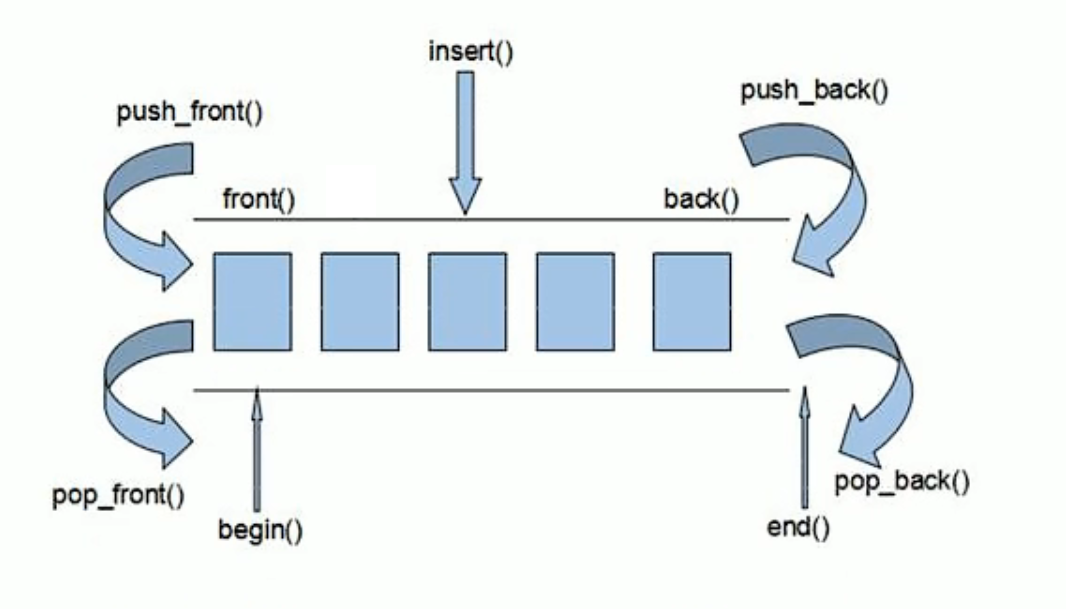
deque与vector区别:
- vector对于头部的插入删除效率低,数据量越大,效率越低
- deque相对而言,对头部的插入删除速度回比vector快
- vector访问元素时的速度会比deque快,这和两者内部实现有关
deque内部工作原理:
deque内部有个中控器,维护每段缓冲区中的内容,缓冲区中存放真实数据
中控器维护的是每个缓冲区的地址,使得使用deque时像一片连续的内存空间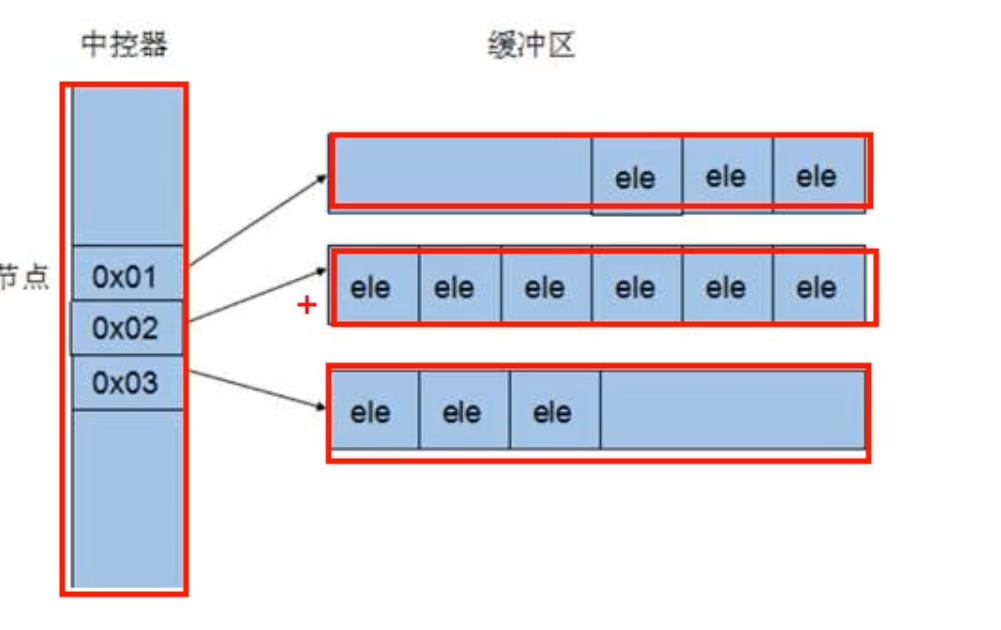
3.2 deque构造函数
deque容器和vector容器的构造方式几乎一致,灵活使用即可
函数原型:
deque<T> deqT; //默认构造形式
deque(beg, end); //构造函数将[beg, end)区间中的元素拷贝给本身。
deque(n, elem); //构造函数将n个elem拷贝给本身。
deque(const deque &deq); //拷贝构造函数
示例:
#include <iostream>
#include <string>
using namespace std;

#include <deque>

void printDeque(const deque<int>& d)
{
    for (deque<int>::const_iterator it = d.begin(); it != d.end(); it++) {
        cout << *it << " ";

    }
    cout << endl;
}
//deque构造
void test01() {

    deque<int> d1; //无参构造函数
    for (int i = 0; i < 10; i++)
    {
        d1.push_back(i);
    }
    printDeque(d1);
    deque<int> d2(d1.begin(), d1.end());
    printDeque(d2);

    deque<int>d3(10, 100);
    printDeque(d3);

    deque<int>d4 = d3;
    printDeque(d4);
}

int main() {

    test01();

    return 0;
}

/* 输出结果
0 1 2 3 4 5 6 7 8 9
0 1 2 3 4 5 6 7 8 9
100 100 100 100 100 100 100 100 100 100
100 100 100 100 100 100 100 100 100 100
*/
3.3 deque赋值操作
函数原型:
deque& operator=(const deque &deq); //重载等号操作符
assign(beg, end); //将[beg, end)区间中的数据拷贝赋值给本身。
assign(n, elem); //将n个elem拷贝赋值给本身。
示例:
#include <iostream>
#include <string>
using namespace std;

#include <deque>

void printDeque(const deque<int>& d)
{
    for (deque<int>::const_iterator it = d.begin(); it != d.end(); it++) {
        cout << *it << " ";

    }
    cout << endl;
}
//赋值操作
void test01()
{
    deque<int> d1;
    for (int i = 0; i < 10; i++)
    {
        d1.push_back(i);
    }
    printDeque(d1);

    deque<int>d2;
    d2 = d1;
    printDeque(d2);

    deque<int>d3;
    d3.assign(d1.begin(), d1.end());
    printDeque(d3);

    deque<int>d4;
    d4.assign(10, 100);
    printDeque(d4);

}

int main() {

    test01();

    return 0;
}

/* 输出结果
0 1 2 3 4 5 6 7 8 9
0 1 2 3 4 5 6 7 8 9
0 1 2 3 4 5 6 7 8 9
100 100 100 100 100 100 100 100 100 100
*/
3.4 deque大小操作
总结:
- deque没有容量的概念
- 判断是否为空 — empty
- 返回元素个数 — size
- 重新指定个数 — resize
函数原型:
deque.empty(); //判断容器是否为空
deque.size(); //返回容器中元素的个数
deque.resize(num); //重新指定容器的长度为num,若容器变长,则以默认值填充新位置。
                   //如果容器变短,则末尾超出容器长度的元素被删除。
deque.resize(num, elem); //重新指定容器的长度为num,若容器变长,则以elem值填充新位置。
                         //如果容器变短,则末尾超出容器长度的元素被删除。
示例:
#include <iostream>
#include <string>
using namespace std;

#include <deque>

void printDeque(const deque<int>& d)
{
    for (deque<int>::const_iterator it = d.begin(); it != d.end(); it++) {
        cout << *it << " ";

    }
    cout << endl;
}

//大小操作
void test01()
{
    deque<int> d1;
    for (int i = 0; i < 10; i++)
    {
        d1.push_back(i);
    }
    printDeque(d1);

    //判断容器是否为空
    if (d1.empty()) {
        cout << "d1为空!" << endl;
    }
    else {
        cout << "d1不为空!" << endl;
        //统计大小
        cout << "d1的大小为:" << d1.size() << endl;
    }

    //重新指定大小
    d1.resize(15, 1);
    printDeque(d1);

    d1.resize(5);
    printDeque(d1);
}

int main() {

    test01();

    return 0;
}

/* 输出结果
0 1 2 3 4 5 6 7 8 9
d1不为空!
d1的大小为:10
0 1 2 3 4 5 6 7 8 9 1 1 1 1 1
0 1 2 3 4
*/
3.5 deque 插入和删除
函数原型:
// 两端插入操作:
push_back(elem); //在容器尾部添加一个数据
push_front(elem); //在容器头部插入一个数据
pop_back(); //删除容器最后一个数据
pop_front(); //删除容器第一个数据

// 指定位置操作:
insert(pos,elem); //在pos位置插入一个elem元素的拷贝,返回新数据的位置。
insert(pos,n,elem); //在pos位置插入n个elem数据,无返回值。
insert(pos,beg,end); //在pos位置插入[beg,end)区间的数据,无返回值。
clear(); //清空容器的所有数据
erase(beg,end); //删除[beg,end)区间的数据,返回下一个数据的位置。
erase(pos); //删除pos位置的数据,返回下一个数据的位置。
示例:
#include <iostream>
#include <string>
using namespace std;

#include <deque>

void printDeque(const deque<int>& d)
{
    for (deque<int>::const_iterator it = d.begin(); it != d.end(); it++) {
        cout << *it << " ";

    }
    cout << endl;
}
//两端操作
void test01()
{
    deque<int> d;
    //尾插
    d.push_back(10);
    d.push_back(20);
    //头插
    d.push_front(100);
    d.push_front(200);

    printDeque(d);

    //尾删
    d.pop_back();
    //头删
    d.pop_front();
    printDeque(d);
}

//插入
void test02()
{
    deque<int> d;
    d.push_back(10);
    d.push_back(20);
    d.push_front(100);
    d.push_front(200);
    printDeque(d);

    d.insert(d.begin(), 1000);
    printDeque(d);

    d.insert(d.begin(), 2, 10000);
    printDeque(d);

    deque<int>d2;
    d2.push_back(1);
    d2.push_back(2);
    d2.push_back(3);

    d.insert(d.begin(), d2.begin(), d2.end());
    printDeque(d);

}

//删除
void test03()
{
    deque<int> d;
    d.push_back(10);
    d.push_back(20);
    d.push_front(100);
    d.push_front(200);
    printDeque(d);

    d.erase(d.begin());
    printDeque(d);

    d.erase(d.begin(), d.end());
    d.clear();
    printDeque(d);
}

int main() {
    cout << "<---- test01() ----> " << endl;
    test01();
    cout << "<---- test02() ----> " << endl;
    test02();
    cout << "<---- test03() ----> " << endl;
    test03();

    return 0;
}

/* 输出结果
<---- test01() ---->
200 100 10 20
100 10
<---- test02() ---->
200 100 10 20
1000 200 100 10 20
10000 10000 1000 200 100 10 20
1 2 3 10000 10000 1000 200 100 10 20
<---- test03() ---->
200 100 10 20
100 10 20
*/
3.6 deque 数据存取
函数原型:
at(int idx); //返回索引idx所指的数据
operator[]; //返回索引idx所指的数据
front(); //返回容器中第一个数据元素
back(); //返回容器中最后一个数据元素
示例:
#include <iostream>
#include <string>
using namespace std;

#include <deque>

void printDeque(const deque<int>& d)
{
    for (deque<int>::const_iterator it = d.begin(); it != d.end(); it++) {
        cout << *it << " ";

    }
    cout << endl;
}

//数据存取
void test01()
{

    deque<int> d;
    d.push_back(10);
    d.push_back(20);
    d.push_front(100);
    d.push_front(200);

    for (int i = 0; i < d.size(); i++) {
        cout << d[i] << " ";
    }
    cout << endl;


    for (int i = 0; i < d.size(); i++) {
        cout << d.at(i) << " ";
    }
    cout << endl;

    cout << "front:" << d.front() << endl;

    cout << "back:" << d.back() << endl;

}

int main() {

    test01();

    return 0;
}

/* 输出结果
200 100 10 20
200 100 10 20
front:200
back:20
*/
3.7 deque 排序
功能描述:
利用算法实现对deque容器进行排序
算法:
sort(iterator beg, iterator end) //对beg和end区间内元素进行排序
示例:
#include <iostream>
#include <string>
using namespace std;

#include <deque>
#include <algorithm>

void printDeque(const deque<int>& d)
{
    for (deque<int>::const_iterator it = d.begin(); it != d.end(); it++) {
        cout << *it << " ";

    }
    cout << endl;
}

void test01()
{

    deque<int> d;
    d.push_back(10);
    d.push_back(20);
    d.push_front(100);
    d.push_front(200);

    printDeque(d);
    sort(d.begin(), d.end());
    printDeque(d);

}

int main() {

    test01();

    return 0;
}

/* 输出结果
200 100 10 20
10 20 100 200
*/
4 案例-评委打分
4.1 案例描述
有5名选手:选手ABCDE,10个评委分别对每一名选手打分,去除最高分,去除评委中最低分,取平均分。
4.2 实现步骤
- 创建五名选手,放到vector中
- 遍历vector容器,取出来每一个选手,执行for循环,可以把10个评分打分存到deque容器中
- sort算法对deque容器中分数排序,去除最高和最低分
- deque容器遍历一遍,累加总分
- 获取平均分
4.3 示例代码
#include <iostream>
#include <string>
#include <vector>
#include <deque>
#include <algorithm>

using namespace std;

//选手类
class Person
{
public:
    Person(string name, int score)
    {
        this->m_Name = name;
        this->m_Score = score;
    }

    string m_Name; //姓名
    int m_Score;  //平均分
};

void createPerson(vector<Person>& v)
{
    string nameSeed = "ABCDE";
    for (int i = 0; i < 5; i++)
    {
        string name = "选手";
        name += nameSeed[i];

        int score = 0;

        Person p(name, score);

        //将创建的person对象 放入到容器中
        v.push_back(p);
    }
}

//打分
void setScore(vector<Person>& v)
{
    for (vector<Person>::iterator it = v.begin(); it != v.end(); it++)
    {
        //将评委的分数 放入到deque容器中
        deque<int>d;
        for (int i = 0; i < 10; i++)
        {
            int score = rand() % 41 + 60;  // 60 ~ 100
            d.push_back(score);
        }

        //cout << "选手: " << it->m_Name << " 打分: " << endl;
        //for (deque<int>::iterator dit = d.begin(); dit != d.end(); dit++)
        //{
        //    cout << *dit << " ";
        //}
        //cout << endl;

        //排序
        sort(d.begin(), d.end());

        //去除最高和最低分
        d.pop_back();
        d.pop_front();

        //取平均分
        int sum = 0;
        for (deque<int>::iterator dit = d.begin(); dit != d.end(); dit++)
        {
            sum += *dit; //累加每个评委的分数
        }

        int avg = sum / d.size();

        //将平均分 赋值给选手身上
        it->m_Score = avg;
    }

}

void showScore(vector<Person>& v)
{
    for (vector<Person>::iterator it = v.begin(); it != v.end(); it++)
    {
        cout << "姓名: " << it->m_Name << " 平均分: " << it->m_Score << endl;
    }
}

int main() {

    //随机数种子
    srand((unsigned int)time(NULL));

    //1、创建5名选手
    vector<Person>v;  //存放选手容器
    createPerson(v);

    //测试
    //for (vector<Person>::iterator it = v.begin(); it != v.end(); it++)
    //{
    //    cout << "姓名: " << (*it).m_Name << " 分数: " << (*it).m_Score << endl;
    //}

    //2、给5名选手打分
    setScore(v);

    //3、显示最后得分
    showScore(v);
    return 0;
}

/* 输出结果
姓名: 选手A 平均分: 79
姓名: 选手B 平均分: 82
姓名: 选手C 平均分: 78
姓名: 选手D 平均分: 81
姓名: 选手E 平均分: 79
*/
5 stack容器
5.1 stack 基本概念
概念:stack是一种先进后出(First In Last Out,FILO)的数据结构,它只有一个出口
栈中只有顶端的元素才可以被外界使用,因此栈不允许有遍历行为
栈中压入数据称为 — 入栈push
栈中弹出数据称为 — 出栈pop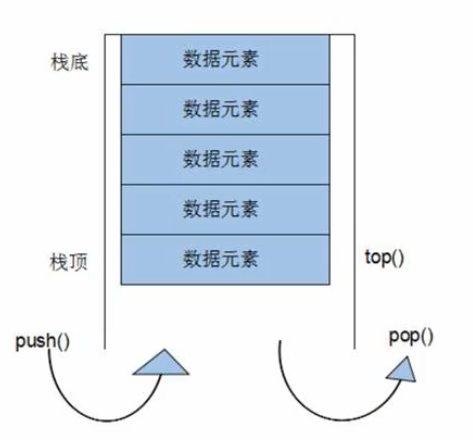
5.2 stack 常用接口
函数原型:
//构造函数:
stack<T> stk; //stack采用模板类实现, stack对象的默认构造形式
stack(const stack &stk); //拷贝构造函数

//赋值操作:
stack& operator=(const stack &stk); //重载等号操作符

//数据存取:
push(elem); //向栈顶添加元素
pop(); //从栈顶移除第一个元素
top(); //返回栈顶元素

//大小操作:
empty(); //判断堆栈是否为空
size(); //返回栈的大小
示例:
#include <iostream>
#include <string>
#include <stack>
using namespace std;

//栈容器常用接口
void test01()
{
    //创建栈容器 栈容器必须符合先进后出
    stack<int> s;

    //向栈中添加元素,叫做 压栈 入栈
    s.push(10);
    s.push(20);
    s.push(30);

    while (!s.empty()) {
        //输出栈顶元素
        cout << "栈顶元素为: " << s.top() << endl;
        //弹出栈顶元素
        s.pop();
    }
    cout << "栈的大小为:" << s.size() << endl;

}

int main() {

    test01();

    return 0;
}


/* 输出结果
栈顶元素为: 30
栈顶元素为: 20
栈顶元素为: 10
栈的大小为:0
*/
6 queue容器
6.1 queue 基本概念
概念:Queue是一种先进先出(First In First Out,FIFO)的数据结构,它有两个出口
队列容器允许从一端新增元素,从另一端移除元素
队列中只有队头和队尾才可以被外界使用,因此队列不允许有遍历行为
队列中进数据称为 — 入队push
队列中出数据称为 — 出队pop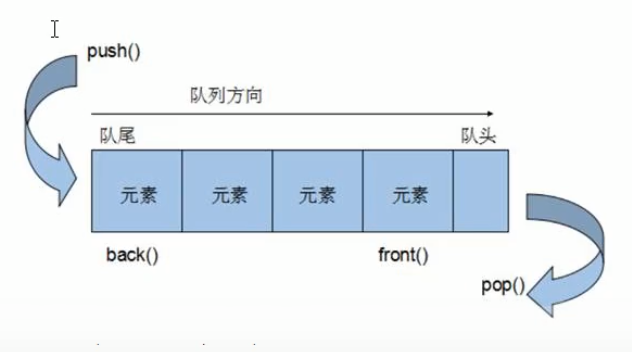
6.2 queue 常用接口
函数原型:
//构造函数:
queue<T> que; //queue采用模板类实现,queue对象的默认构造形式
queue(const queue &que); //拷贝构造函数

//赋值操作:
queue& operator=(const queue &que); //重载等号操作符

//数据存取:
push(elem); //往队尾添加元素
pop(); //从队头移除第一个元素
back(); //返回最后一个元素
front(); //返回第一个元素

//大小操作:
empty(); //判断堆栈是否为空
size(); //返回栈的大小
示例:
#include <iostream>
#include <queue>
#include <string>
using namespace std;
class Person
{
public:
    Person(string name, int age)
    {
        this->m_Name = name;
        this->m_Age = age;
    }

    string m_Name;
    int m_Age;
};

void test01() {

    //创建队列
    queue<Person> q;

    //准备数据
    Person p1("唐僧", 30);
    Person p2("孙悟空", 1000);
    Person p3("猪八戒", 900);
    Person p4("沙僧", 800);

    //向队列中添加元素  入队操作
    q.push(p1);
    q.push(p2);
    q.push(p3);
    q.push(p4);

    //队列不提供迭代器,更不支持随机访问
    while (!q.empty()) {
        //输出队头元素
        cout << "队头元素-- 姓名: " << q.front().m_Name
            << " 年龄: " << q.front().m_Age << endl;

        cout << "队尾元素-- 姓名: " << q.back().m_Name
            << " 年龄: " << q.back().m_Age << endl;

        cout << endl;
        //弹出队头元素
        q.pop();
    }

    cout << "队列大小为:" << q.size() << endl;
}

int main() {

    test01();
    return 0;
}

/* 输出结果
队头元素-- 姓名: 唐僧 年龄: 30
队尾元素-- 姓名: 沙僧 年龄: 800

队头元素-- 姓名: 孙悟空 年龄: 1000
队尾元素-- 姓名: 沙僧 年龄: 800

队头元素-- 姓名: 猪八戒 年龄: 900
队尾元素-- 姓名: 沙僧 年龄: 800

队头元素-- 姓名: 沙僧 年龄: 800
队尾元素-- 姓名: 沙僧 年龄: 800
*/
7 list容器
7.1 list基本概念
链表(list)是一种物理存储单元上非连续的存储结构,数据元素的逻辑顺序是通过链表中的指针链接实现的
链表的组成:链表由一系列结点组成
结点的组成:一个是存储数据元素的数据域,另一个是存储下一个结点地址的指针域
STL中的链表是一个双向循环链表
由于链表的存储方式并不是连续的内存空间,因此链表list中的迭代器只支持前移和后移,属于双向迭代器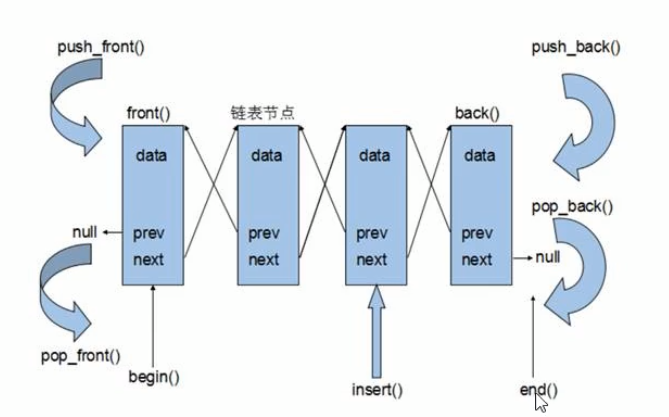
list的优缺点:
list的优点:
- 采用动态存储分配,不会造成内存浪费和溢出
- 链表执行插入和删除操作十分方便,修改指针即可,不需要移动大量元素
list的缺点:
- 链表灵活,但是空间(指针域) 和 时间(遍历)额外耗费较大
List有一个重要的性质,插入操作和删除操作都不会造成原有list迭代器的失效,这在vector是不成立的。
总结:STL中List和vector是两个最常被使用的容器,各有优缺点
7.2 list构造函数
函数原型:
list<T> lst; //list采用采用模板类实现,对象的默认构造形式:
list(beg,end); //构造函数将[beg, end)区间中的元素拷贝给本身。
list(n,elem); //构造函数将n个elem拷贝给本身。
list(const list &lst); //拷贝构造函数。
示例:
#include <iostream>
#include <string>
using namespace std;
#include <list>

void printList(const list<int>& L) {
    for (list<int>::const_iterator it = L.begin(); it != L.end(); it++) {
        cout << *it << " ";
    }
    cout << endl;
}

void test01()
{
    list<int>L1;
    L1.push_back(10);
    L1.push_back(20);
    L1.push_back(30);
    L1.push_back(40);

    printList(L1);

    list<int>L2(L1.begin(), L1.end());
    printList(L2);

    list<int>L3(L2);
    printList(L3);

    list<int>L4(10, 1000);
    printList(L4);
}

int main() {

    test01();

    return 0;
}

/* 输出结果
10 20 30 40
10 20 30 40
10 20 30 40
1000 1000 1000 1000 1000 1000 1000 1000 1000 1000
*/
7.3 list 赋值和交换
给list容器进行赋值,以及交换list容器
函数原型:
assign(beg, end); //将[beg, end)区间中的数据拷贝赋值给本身。
assign(n, elem); //将n个elem拷贝赋值给本身。
list& operator=(const list &lst); //重载等号操作符
swap(lst); //将lst与本身的元素互换。
示例:
#include <iostream>
#include <string>
using namespace std;
#include <list>


void printList(const list<int>& L) {

    for (list<int>::const_iterator it = L.begin(); it != L.end(); it++) {
        cout << *it << " ";
    }
    cout << endl;
}

//赋值和交换
void test01()
{
    list<int>L1;
    L1.push_back(10);
    L1.push_back(20);
    L1.push_back(30);
    L1.push_back(40);
    printList(L1);

    //赋值
    list<int>L2;
    L2 = L1;
    printList(L2);

    list<int>L3;
    L3.assign(L2.begin(), L2.end());
    printList(L3);

    list<int>L4;
    L4.assign(10, 100);
    printList(L4);

}

//交换
void test02()
{

    list<int>L1;
    L1.push_back(10);
    L1.push_back(20);
    L1.push_back(30);
    L1.push_back(40);

    list<int>L2;
    L2.assign(10, 100);

    cout << "交换前: " << endl;
    printList(L1);
    printList(L2);

    cout << endl;

    L1.swap(L2);

    cout << "交换后: " << endl;
    printList(L1);
    printList(L2);

}

int main() {
    test01();
    test02();
    return 0;
}

/* 输出结果
10 20 30 40
10 20 30 40
10 20 30 40
100 100 100 100 100 100 100 100 100 100
交换前:
10 20 30 40
100 100 100 100 100 100 100 100 100 100

交换后:
100 100 100 100 100 100 100 100 100 100
10 20 30 40
*/
7.4 list 大小操作
函数原型:
size(); //返回容器中元素的个数
empty(); //判断容器是否为空
resize(num); //重新指定容器的长度为num,若容器变长,则以默认值填充新位置。
             //如果容器变短,则末尾超出容器长度的元素被删除。
resize(num, elem); //重新指定容器的长度为num,若容器变长,则以elem值填充新位置。
                   //如果容器变短,则末尾超出容器长度的元素被删除。
示例:
#include <iostream>
#include <string>
using namespace std;
#include <list>

void printList(const list<int>& L) {

    for (list<int>::const_iterator it = L.begin(); it != L.end(); it++) {
        cout << *it << " ";
    }
    cout << endl;
}

//大小操作
void test01()
{
    list<int>L1;
    L1.push_back(10);
    L1.push_back(20);
    L1.push_back(30);
    L1.push_back(40);

    if (L1.empty())
    {
        cout << "L1为空" << endl;
    }
    else
    {
        cout << "L1不为空" << endl;
        cout << "L1的大小为: " << L1.size() << endl;
    }

    //重新指定大小
    L1.resize(10);
    printList(L1);

    L1.resize(2);
    printList(L1);
}

int main() {
    test01();
    return 0;
}

/* 输出结果
L1不为空
L1的大小为: 4
10 20 30 40 0 0 0 0 0 0
10 20
*/
7.5 list 插入和删除
函数原型:
push_back(elem);//在容器尾部加入一个元素
pop_back();//删除容器中最后一个元素
push_front(elem);//在容器开头插入一个元素
pop_front();//从容器开头移除第一个元素

insert(pos,elem);//在pos位置插elem元素的拷贝,返回新数据的位置。
insert(pos,n,elem);//在pos位置插入n个elem数据,无返回值。
insert(pos,beg,end);//在pos位置插入[beg,end)区间的数据,无返回值。

clear();//移除容器的所有数据
erase(beg,end);//删除[beg,end)区间的数据,返回下一个数据的位置。
erase(pos);//删除pos位置的数据,返回下一个数据的位置。
remove(elem);//删除容器中所有与elem值匹配的元素。
示例:
#include <iostream>
#include <string>
using namespace std;
#include <list>

void printList(const list<int>& L) {

    for (list<int>::const_iterator it = L.begin(); it != L.end(); it++) {
        cout << *it << " ";
    }
    cout << endl;
}

//插入和删除
void test01()
{
    list<int> L;
    //尾插
    L.push_back(10);
    L.push_back(20);
    L.push_back(30);
    //头插
    L.push_front(100);
    L.push_front(200);
    L.push_front(300);

    printList(L);

    //尾删
    L.pop_back();
    printList(L);

    //头删
    L.pop_front();
    printList(L);

    //插入
    list<int>::iterator it = L.begin();
    L.insert(++it, 1000);
    printList(L);

    //删除
    it = L.begin();
    L.erase(++it);
    printList(L);

    //移除
    L.push_back(10000);
    L.push_back(10000);
    L.push_back(10000);
    printList(L);
    L.remove(10000);
    printList(L);

    //清空
    L.clear();
    printList(L);
}

int main() {

    test01();
    return 0;
}

/* 输出结果
300 200 100 10 20 30
300 200 100 10 20
200 100 10 20
200 1000 100 10 20
200 100 10 20
200 100 10 20 10000 10000 10000
200 100 10 20
*/
7.6 list 数据存取
函数原型:
front(); //返回第一个元素。
back(); //返回最后一个元素。
示例:
#include <iostream>
#include <string>
using namespace std;
#include <list>

//数据存取
void test01()
{
    list<int>L1;
    L1.push_back(10);
    L1.push_back(20);
    L1.push_back(30);
    L1.push_back(40);


    //cout << L1.at(0) << endl;//错误 不支持at访问数据
    //cout << L1[0] << endl; //错误  不支持[]方式访问数据
    cout << "第一个元素为: " << L1.front() << endl;
    cout << "最后一个元素为: " << L1.back() << endl;

    //list容器的迭代器是双向迭代器,不支持随机访问
    list<int>::iterator it = L1.begin();
    //it = it + 1;//错误,不可以跳跃访问,即使是+1
}

int main() {

    test01();

    return 0;
}

/* 输出结果
第一个元素为: 10
最后一个元素为: 40
*/
7.7 list 反转和排序
函数原型:
reverse(); //反转链表
sort(); //链表排序
示例:
#include <iostream>
#include <list>
using namespace std;
void printList(const list<int>& L) {

    for (list<int>::const_iterator it = L.begin(); it != L.end(); it++) {
        cout << *it << " ";
    }
    cout << endl;
}

bool myCompare(int val1, int val2)
{
    return val1 > val2;
}

//反转和排序
void test01()
{
    list<int> L;
    L.push_back(90);
    L.push_back(30);
    L.push_back(20);
    L.push_back(70);
    printList(L);

    //反转容器的元素
    L.reverse();
    printList(L);

    //排序
    L.sort(); //默认的排序规则 从小到大
    printList(L);

    L.sort(myCompare); //指定规则,从大到小
    printList(L);
}

int main() {

    test01();

    return 0;
}
/* 输出结果
90 30 20 70
70 20 30 90
20 30 70 90
90 70 30 20
*/
7.8 排序案例
案例描述:将Person自定义数据类型进行排序,Person中属性有姓名、年龄、身高
排序规则:按照年龄进行升序,如果年龄相同按照身高进行降序
示例:
#include <iostream>
#include <list>
using namespace std;
#include <string>

class Person {
public:
    Person(string name, int age, int height) {
        m_Name = name;
        m_Age = age;
        m_Height = height;
    }

public:
    string m_Name;  //姓名
    int m_Age;      //年龄
    int m_Height;   //身高
};


bool ComparePerson(Person& p1, Person& p2) {

    if (p1.m_Age == p2.m_Age) {
        return p1.m_Height > p2.m_Height;
    }
    else
    {
        return  p1.m_Age < p2.m_Age;
    }

}

void test01() {

    list<Person> L;

    Person p1("刘备", 35, 175);
    Person p2("曹操", 45, 180);
    Person p3("孙权", 40, 170);
    Person p4("赵云", 25, 190);
    Person p5("张飞", 35, 160);
    Person p6("关羽", 35, 200);

    L.push_back(p1);
    L.push_back(p2);
    L.push_back(p3);
    L.push_back(p4);
    L.push_back(p5);
    L.push_back(p6);

    for (list<Person>::iterator it = L.begin(); it != L.end(); it++) {
        cout << "姓名: " << it->m_Name << " 年龄: " << it->m_Age
            << " 身高: " << it->m_Height << endl;
    }

    cout << "---------------------------------" << endl;
    L.sort(ComparePerson); //排序

    for (list<Person>::iterator it = L.begin(); it != L.end(); it++) {
        cout << "姓名: " << it->m_Name << " 年龄: " << it->m_Age
            << " 身高: " << it->m_Height << endl;
    }
}

int main() {

    test01();

    return 0;
}
/* 输出结果
姓名: 刘备 年龄: 35 身高: 175
姓名: 曹操 年龄: 45 身高: 180
姓名: 孙权 年龄: 40 身高: 170
姓名: 赵云 年龄: 25 身高: 190
姓名: 张飞 年龄: 35 身高: 160
姓名: 关羽 年龄: 35 身高: 200
---------------------------------
姓名: 赵云 年龄: 25 身高: 190
姓名: 关羽 年龄: 35 身高: 200
姓名: 刘备 年龄: 35 身高: 175
姓名: 张飞 年龄: 35 身高: 160
姓名: 孙权 年龄: 40 身高: 170
姓名: 曹操 年龄: 45 身高: 180
*/
8 set/ multiset 容器
8.1 set基本概念
简介:
- 所有元素都会在插入时自动被排序
本质:
- set/multiset属于关联式容器,底层结构是用二叉树实现。
set和multiset区别:
- set不允许容器中有重复的元素
- multiset允许容器中有重复的元素
8.2 set构造和赋值
函数原型:
//构造:
set<T> st; //默认构造函数:
set(const set &st); //拷贝构造函数

//赋值:
set& operator=(const set &st); //重载等号操作符
示例:
#include <iostream>
#include <list>
using namespace std;
#include <set>

void printSet(set<int>& s)
{
    for (set<int>::iterator it = s.begin(); it != s.end(); it++)
    {
        cout << *it << " ";
    }
    cout << endl;
}

//构造和赋值
void test01()
{
    set<int> s1;

    s1.insert(10);
    s1.insert(30);
    s1.insert(20);
    s1.insert(40);
    printSet(s1);

    //拷贝构造
    set<int>s2(s1);
    printSet(s2);

    //赋值
    set<int>s3;
    s3 = s2;
    printSet(s3);
}

int main() {

    test01();

    return 0;
}
/* 输出结果
10 20 30 40
10 20 30 40
10 20 30 40
*/
8.3 set大小和交换
函数原型:
size(); //返回容器中元素的数目
empty(); //判断容器是否为空
swap(st); //交换两个集合容器
示例:
#include <iostream>
using namespace std;
#include <set>

void printSet(set<int>& s)
{
    for (set<int>::iterator it = s.begin(); it != s.end(); it++)
    {
        cout << *it << " ";
    }
    cout << endl;
}

//大小
void test01()
{
    set<int> s1;

    s1.insert(10);
    s1.insert(30);
    s1.insert(20);
    s1.insert(40);

    if (s1.empty())
    {
        cout << "s1为空" << endl;
    }
    else
    {
        cout << "s1不为空" << endl;
        cout << "s1的大小为: " << s1.size() << endl;
    }

}

//交换
void test02()
{
    set<int> s1;

    s1.insert(10);
    s1.insert(30);
    s1.insert(20);
    s1.insert(40);

    set<int> s2;

    s2.insert(100);
    s2.insert(300);
    s2.insert(200);
    s2.insert(400);

    cout << "交换前" << endl;
    printSet(s1);
    printSet(s2);
    cout << endl;

    cout << "交换后" << endl;
    s1.swap(s2);
    printSet(s1);
    printSet(s2);
}

int main() {
    test01();
    test02();
    return 0;
}

/* 输出结果
s1不为空
s1的大小为: 4
交换前
10 20 30 40
100 200 300 400

交换后
100 200 300 400
10 20 30 40
*/
8.4 set插入和删除
函数原型:
insert(elem); //在容器中插入元素。
clear(); //清除所有元素
erase(pos); //删除pos迭代器所指的元素,返回下一个元素的迭代器。
erase(beg, end); //删除区间[beg,end)的所有元素 ,返回下一个元素的迭代器。
erase(elem); //删除容器中值为elem的元素。
示例:
#include <iostream>
using namespace std;
#include <set>

void printSet(set<int>& s)
{
    for (set<int>::iterator it = s.begin(); it != s.end(); it++)
    {
        cout << *it << " ";
    }
    cout << endl;
}

//插入和删除
void test01()
{
    set<int> s1;
    //插入
    s1.insert(10);
    s1.insert(30);
    s1.insert(20);
    s1.insert(40);
    printSet(s1);

    //删除
    s1.erase(s1.begin());
    printSet(s1);

    s1.erase(30);
    printSet(s1);

    //清空
    //s1.erase(s1.begin(), s1.end());
    s1.clear();
    printSet(s1);
}

int main() {

    test01();
    return 0;
}

/* 输出结果
10 20 30 40
20 30 40
20 40
*/
8.5 set查找和统计
函数原型:
find(key); //查找key是否存在,若存在,返回该键的元素的迭代器;若不存在,返回set.end();
count(key); //统计key的元素个数,对于set,结果为0或者1
示例:
#include <iostream>
using namespace std;
#include <set>

//查找和统计
void test01()
{
    set<int> s1;
    //插入
    s1.insert(10);
    s1.insert(30);
    s1.insert(20);
    s1.insert(40);

    //查找
    set<int>::iterator pos = s1.find(30);

    if (pos != s1.end())
    {
        cout << "找到了元素 : " << *pos << endl;
    }
    else
    {
        cout << "未找到元素" << endl;
    }

    //统计
    int num = s1.count(30);
    cout << "num = " << num << endl;
}

int main() {

    test01();
    return 0;
}

/* 输出结果
找到了元素 : 30
num = 1
*/
8.6 set和multiset区别
区别:
- set不可以插入重复数据,而multiset可以
- set插入数据的同时会返回插入结果,表示插入是否成功
- multiset不会检测数据,因此可以插入重复数据
总结:
- 如果不允许插入重复数据可以利用set
- 如果需要插入重复数据利用multiset
示例:
#include <iostream>
using namespace std;
#include <set>

//set和multiset区别
void test01()
{
    set<int> s;
    pair<set<int>::iterator, bool>  ret = s.insert(10);
    if (ret.second) {
        cout << "第一次插入成功!" << endl;
    }
    else {
        cout << "第一次插入失败!" << endl;
    }

    ret = s.insert(10);
    if (ret.second) {
        cout << "第二次插入成功!" << endl;
    }
    else {
        cout << "第二次插入失败!" << endl;
    }

    //multiset
    multiset<int> ms;
    ms.insert(10);
    ms.insert(10);

    for (multiset<int>::iterator it = ms.begin(); it != ms.end(); it++) {
        cout << *it << " ";
    }
    cout << endl;
}

int main() {

    test01();
    return 0;
}

/* 输出结果
第一次插入成功!
第二次插入失败!
10 10
*/
8.7 set容器排序
利用仿函数,可以改变排序规则
示例一 : set存放内置数据类型
#include <iostream>
using namespace std;
#include <string>

#include <set>

class MyCompare
{
public:
    bool operator()(int v1, int v2) const {
        // 此处VC要求必须用const修饰
        return v1 > v2;
    }
};
void test01()
{
    set<int> s1;
    s1.insert(10);
    s1.insert(40);
    s1.insert(20);
    s1.insert(30);
    s1.insert(50);

    //默认从小到大
    for (set<int>::iterator it = s1.begin(); it != s1.end(); it++) {
        cout << *it << " ";
    }
    cout << endl;

    //指定排序规则
    set<int, MyCompare> s2;
    s2.insert(10);
    s2.insert(40);
    s2.insert(20);
    s2.insert(30);
    s2.insert(50);

    for (set<int, MyCompare>::iterator it = s2.begin(); it != s2.end(); it++) {
        cout << *it << " ";
    }
    cout << endl;
}

int main() {

    test01();
    return 0;
}

/* 输出结果
10 20 30 40 50
50 40 30 20 10
*/
示例二 set存放自定义数据类型
#include <iostream>
using namespace std;

#include <set>
#include <string>

class Person
{
public:
    Person(string name, int age)
    {
        this->m_Name = name;
        this->m_Age = age;
    }

    string m_Name;
    int m_Age;

};
class comparePerson
{
public:
    bool operator()(const Person& p1, const Person& p2) const
        // 此处VC要求必须用const修饰
    {
        //按照年龄进行排序  降序
        return p1.m_Age > p2.m_Age;
    }
};

void test01()
{
    set<Person, comparePerson> s;

    Person p1("刘备", 23);
    Person p2("关羽", 27);
    Person p3("张飞", 25);
    Person p4("赵云", 21);

    s.insert(p1);
    s.insert(p2);
    s.insert(p3);
    s.insert(p4);

    for (set<Person, comparePerson>::iterator it = s.begin(); it != s.end(); it++)
    {
        cout << "姓名: " << it->m_Name << " 年龄: " << it->m_Age << endl;
    }
}
int main() {

    test01();
    return 0;
}
/* 输出结果
姓名: 关羽 年龄: 27
姓名: 张飞 年龄: 25
姓名: 刘备 年龄: 23
姓名: 赵云 年龄: 21
*/
9 pair对组
9.1 pair对组创建
功能描述:
- 成对出现的数据,利用对组可以返回两个数据
队组在
函数原型:
// 两种创建方式:
pair<type, type> p ( value1, value2 );
pair<type, type> p = make_pair( value1, value2 );
示例:
#include <iostream>
using namespace std;
#include <string>

//对组创建
void test01()
{
    pair<string, int> p(string("Tom"), 20);
    cout << "姓名: " << p.first << " 年龄: " << p.second << endl;

    pair<string, int> p2 = make_pair("Jerry", 10);
    cout << "姓名: " << p2.first << " 年龄: " << p2.second << endl;
}

int main() {

    test01();

    return 0;
}
/* 输出结果
姓名: Tom 年龄: 20
姓名: Jerry 年龄: 10
*/
10 map/ multimap容器
10.1 map基本概念
简介:
- map中所有元素都是pair
- pair中第一个元素为key(键值),起到索引作用,第二个元素为value(实值)
- 所有元素都会根据元素的键值自动排序
本质:
- map/multimap属于关联式容器,底层结构是用二叉树实现。
优点:
- 可以根key值快速找到value值
map和multimap区别:
- map不允许容器中有重复key值元素
- multimap允许容器中有重复key值元素
10.2 map构造和赋值
函数原型:
//构造:
map<T1, T2> mp; //map默认构造函数:
map(const map &mp); //拷贝构造函数

//赋值:
map& operator=(const map &mp); //重载等号操作符
示例:
#include <iostream>
using namespace std;

#include <map>

void printMap(map<int, int>& m)
{
    for (map<int, int>::iterator it = m.begin(); it != m.end(); it++)
    {
        cout << "key = " << it->first << " value = " << it->second << endl;
    }
    cout << endl;
}

void test01()
{
    map<int, int>m; //默认构造
    m.insert(pair<int, int>(1, 10));
    m.insert(pair<int, int>(2, 20));
    m.insert(pair<int, int>(3, 30));
    printMap(m);

    map<int, int>m2(m); //拷贝构造
    printMap(m2);

    map<int, int>m3;
    m3 = m2; //赋值
    printMap(m3);
}

int main() {

    test01();

    return 0;
}
/* 输出结果
key = 1 value = 10
key = 2 value = 20
key = 3 value = 30

key = 1 value = 10
key = 2 value = 20
key = 3 value = 30

key = 1 value = 10
key = 2 value = 20
key = 3 value = 30
*/
10.3 map大小和交换
函数原型:
size(); //返回容器中元素的数目
empty(); //判断容器是否为空
swap(st); //交换两个集合容器
示例:
#include <iostream>
using namespace std;

#include <map>

void printMap(map<int, int>& m)
{
    for (map<int, int>::iterator it = m.begin(); it != m.end(); it++)
    {
        cout << "key = " << it->first << " value = " << it->second << endl;
    }
    cout << endl;
}

void test01()
{
    map<int, int>m;
    m.insert(pair<int, int>(1, 10));
    m.insert(pair<int, int>(2, 20));
    m.insert(pair<int, int>(3, 30));

    if (m.empty())
    {
        cout << "m为空" << endl;
    }
    else
    {
        cout << "m不为空" << endl;
        cout << "m的大小为: " << m.size() << endl;
    }
}


//交换
void test02()
{
    map<int, int>m;
    m.insert(pair<int, int>(1, 10));
    m.insert(pair<int, int>(2, 20));
    m.insert(pair<int, int>(3, 30));

    map<int, int>m2;
    m2.insert(pair<int, int>(4, 100));
    m2.insert(pair<int, int>(5, 200));
    m2.insert(pair<int, int>(6, 300));

    cout << "交换前" << endl;
    printMap(m);
    printMap(m2);

    cout << "交换后" << endl;
    m.swap(m2);
    printMap(m);
    printMap(m2);
}

int main() {

    test01();

    test02();

    return 0;
}

/* 输出结果
m不为空
m的大小为: 3
交换前
key = 1 value = 10
key = 2 value = 20
key = 3 value = 30

key = 4 value = 100
key = 5 value = 200
key = 6 value = 300

交换后
key = 4 value = 100
key = 5 value = 200
key = 6 value = 300

key = 1 value = 10
key = 2 value = 20
key = 3 value = 30
*/
10.4 map插入和删除
函数原型:
insert(elem); //在容器中插入元素。
clear(); //清除所有元素
erase(pos); //删除pos迭代器所指的元素,返回下一个元素的迭代器。
erase(beg, end); //删除区间[beg,end)的所有元素 ,返回下一个元素的迭代器。
erase(key); //删除容器中值为key的元素。
示例:
#include <iostream>
using namespace std;

#include <map>

void printMap(map<int, int>& m)
{
    for (map<int, int>::iterator it = m.begin(); it != m.end(); it++)
    {
        cout << "key = " << it->first << " value = " << it->second << endl;
    }
    cout << endl;
}

void test01()
{
    //插入
    map<int, int> m;
    //第一种插入方式
    m.insert(pair<int, int>(1, 10));
    //第二种插入方式
    m.insert(make_pair(2, 20));
    //第三种插入方式
    m.insert(map<int, int>::value_type(3, 30));
    //第四种插入方式
    m[4] = 40;
    printMap(m);

    //删除
    m.erase(m.begin());
    printMap(m);

    m.erase(3);
    printMap(m);

    //清空
    m.erase(m.begin(), m.end());
    m.clear();
    printMap(m);
}

int main() {

    test01();

    return 0;
}
/* 输出结果
key = 1 value = 10
key = 2 value = 20
key = 3 value = 30
key = 4 value = 40

key = 2 value = 20
key = 3 value = 30
key = 4 value = 40

key = 2 value = 20
key = 4 value = 40
*/
10.5 map查找和统计
函数原型:
find(key); //查找key是否存在,若存在,返回该键的元素的迭代器;若不存在,返回set.end();
count(key); //统计key的元素个数
示例:
#include <iostream>
using namespace std;
#include <map>

//查找和统计
void test01()
{
    map<int, int>m;
    m.insert(pair<int, int>(1, 10));
    m.insert(pair<int, int>(2, 20));
    m.insert(pair<int, int>(3, 30));

    //查找
    map<int, int>::iterator pos = m.find(3);

    if (pos != m.end())
    {
        cout << "找到了元素 key = " << (*pos).first << " value = " << (*pos).second << endl;
    }
    else
    {
        cout << "未找到元素" << endl;
    }

    //统计
    int num = m.count(3);
    cout << "num = " << num << endl;
}

int main() {

    test01();

    return 0;
}
/* 输出结果
找到了元素 key = 3 value = 30
num = 1
*/
10.6 map容器排序
map容器默认排序规则为 按照key值进行 从小到大排序,掌握如何改变排序规则
利用仿函数,可以改变排序规则
总结:
- 利用仿函数可以指定map容器的排序规则
- 对于自定义数据类型,map必须要指定排序规则,同set容器
示例:
#include <iostream>
using namespace std;

#include <map>

class MyCompare {
public:
    bool operator()(int v1, int v2) const {
        return v1 > v2;
    }
};

void test01()
{
    //默认从小到大排序
    //利用仿函数实现从大到小排序
    map<int, int, MyCompare> m;

    m.insert(make_pair(1, 50));
    m.insert(make_pair(2, 40));
    m.insert(make_pair(3, 30));
    m.insert(make_pair(4, 20));
    m.insert(make_pair(5, 10));

    for (map<int, int, MyCompare>::iterator it = m.begin(); it != m.end(); it++) {
        cout << "key:" << it->first << " value:" << it->second << endl;
    }
}
int main() {

    test01();

    return 0;
}
/* 输出结果
key:5 value:10
key:4 value:20
key:3 value:30
key:2 value:40
key:1 value:50
*/
11 案例-员工分组
11.1 案例描述
- 公司今天招聘了10个员工(ABCDEFGHIJ),10名员工进入公司之后,需要指派员工在那个部门工作
- 员工信息有: 姓名 工资组成;部门分为:策划、美术、研发
- 随机给10名员工分配部门和工资
- 通过multimap进行信息的插入 key(部门编号) value(员工)
- 分部门显示员工信息
11.2 实现步骤
- 创建10名员工,放到vector中
- 遍历vector容器,取出每个员工,进行随机分组
- 分组后,将员工部门编号作为key,具体员工作为value,放入到multimap容器中
- 分部门显示员工信息
11.3 示例代码
#include<iostream>
using namespace std;
#include <vector>
#include <string>
#include <map>
#include <ctime>

/*
- 公司今天招聘了10个员工(ABCDEFGHIJ),10名员工进入公司之后,需要指派员工在那个部门工作
- 员工信息有: 姓名  工资组成;部门分为:策划、美术、研发
- 随机给10名员工分配部门和工资
- 通过multimap进行信息的插入  key(部门编号) value(员工)
- 分部门显示员工信息
*/

#define CEHUA  0
#define MEISHU 1
#define YANFA  2

class Worker
{
public:
    string m_Name;
    int m_Salary;
};

void createWorker(vector<Worker>& v)
{
    string nameSeed = "ABCDEFGHIJ";
    for (int i = 0; i < 10; i++)
    {
        Worker worker;
        worker.m_Name = "员工";
        worker.m_Name += nameSeed[i];

        worker.m_Salary = rand() % 10000 + 10000; // 10000 ~ 19999
        //将员工放入到容器中
        v.push_back(worker);
    }
}

//员工分组
void setGroup(vector<Worker>& v, multimap<int, Worker>& m)
{
    for (vector<Worker>::iterator it = v.begin(); it != v.end(); it++)
    {
        //产生随机部门编号
        int deptId = rand() % 3; // 0 1 2

        //将员工插入到分组中
        //key部门编号,value具体员工
        m.insert(make_pair(deptId, *it));
    }
}

void showWorkerByGourp(multimap<int, Worker>& m)
{
    // 0  A  B  C   1  D  E   2  F G ...
    cout << "策划部门:" << endl;

    multimap<int, Worker>::iterator pos = m.find(CEHUA);
    int count = m.count(CEHUA); // 统计具体人数
    int index = 0;
    for (; pos != m.end() && index < count; pos++, index++)
    {
        cout << "姓名: " << pos->second.m_Name << " 工资: " << pos->second.m_Salary << endl;
    }

    cout << "----------------------" << endl;
    cout << "美术部门: " << endl;
    pos = m.find(MEISHU);
    count = m.count(MEISHU); // 统计具体人数
    index = 0;
    for (; pos != m.end() && index < count; pos++, index++)
    {
        cout << "姓名: " << pos->second.m_Name << " 工资: " << pos->second.m_Salary << endl;
    }

    cout << "----------------------" << endl;
    cout << "研发部门: " << endl;
    pos = m.find(YANFA);
    count = m.count(YANFA); // 统计具体人数
    index = 0;
    for (; pos != m.end() && index < count; pos++, index++)
    {
        cout << "姓名: " << pos->second.m_Name << " 工资: " << pos->second.m_Salary << endl;
    }

}

int main() {

    srand((unsigned int)time(NULL));

    //1、创建员工
    vector<Worker>vWorker;
    createWorker(vWorker);

    //2、员工分组
    multimap<int, Worker>mWorker;
    setGroup(vWorker, mWorker);


    //3、分组显示员工
    showWorkerByGourp(mWorker);

    //测试
        //for (vector<Worker>::iterator it = vWorker.begin(); it != vWorker.end(); it++)
        //{
        //    cout << "姓名: " << it->m_Name << " 工资: " << it->m_Salary << endl;
        //}

    return 0;
}
/* 输出结果
策划部门:
姓名: 员工A 工资: 10779
姓名: 员工B 工资: 12742
姓名: 员工D 工资: 19150
姓名: 员工E 工资: 10619
姓名: 员工G 工资: 11762
姓名: 员工H 工资: 16826
----------------------
美术部门:
姓名: 员工I 工资: 13989
----------------------
研发部门:
姓名: 员工C 工资: 15969
姓名: 员工F 工资: 15849
姓名: 员工J 工资: 11659
*/

若有收获,就点个赞吧
0 人点赞


