1 如何看待线性方程
例如求解如下线性方程: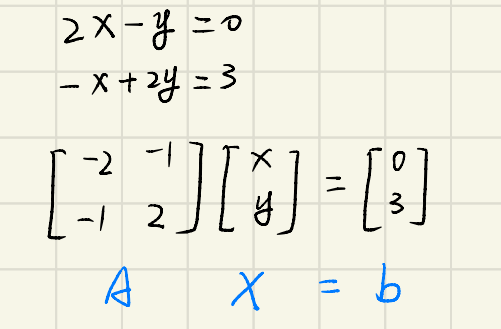
我们有两种看待方式,行图像(Row Picture)与列图像(Column Picture)。
- Row Picture
就是中学学的,看作是两条直线的交点: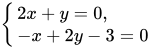

最终得到解就是交点坐标 
- Column Picture
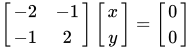
这是重中之重,是理解线性代数后面部分的基石。看作两个列向量的线性组合(linear combination of columns)。转变成求解:

求出来
x=1,y=2

【求解线性方程问题】
Can I solve  for every b?
==>
Do linear combinations of the columns of  fill 3-D space?
2 矩阵乘法、初等矩阵与消元
2.1 Matrix multiplication 矩阵乘法
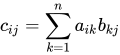
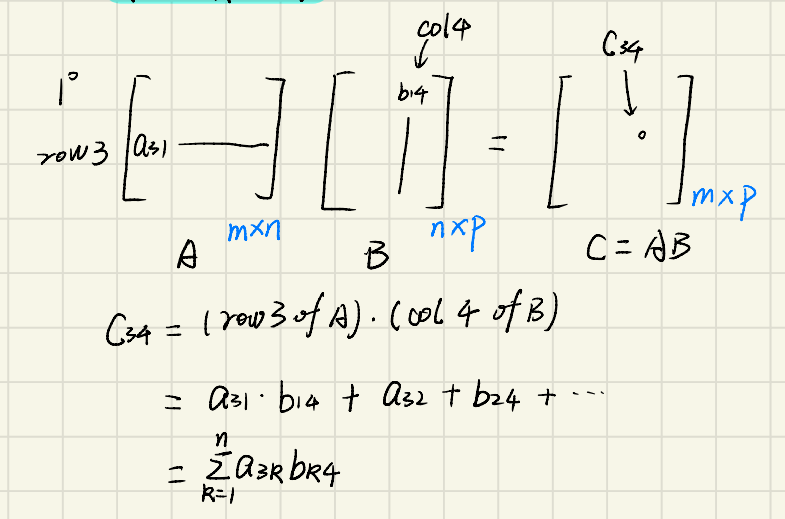
一共有四种计算矩阵乘法的方式。假设现在要求:

【第一种】 的一行乘以
的一行乘以  一列
一列
这是国内大学课本里面教的,也是最难用的!!
【第二种】 中的每一个列向量,都是
  所有列向量的线性组合
将  和
和  写成列向量的形式:
进而有: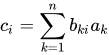 ,
,

【第三种】 中的每一个行向量,都是
  所有行向量的线性组合
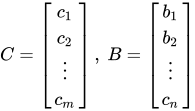
 ,
,
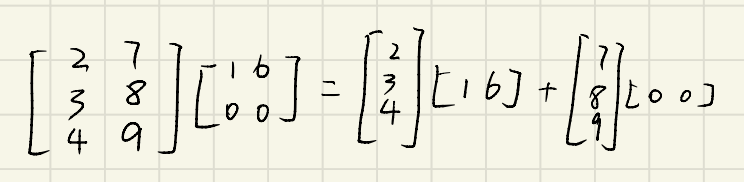
【第四种】
第二种和第三种适合理解,而这一种最适合计算!
2.2 Elementary matrix & Elimination 初等矩阵与消元
考虑求解如下的线性方程
求解过程如下: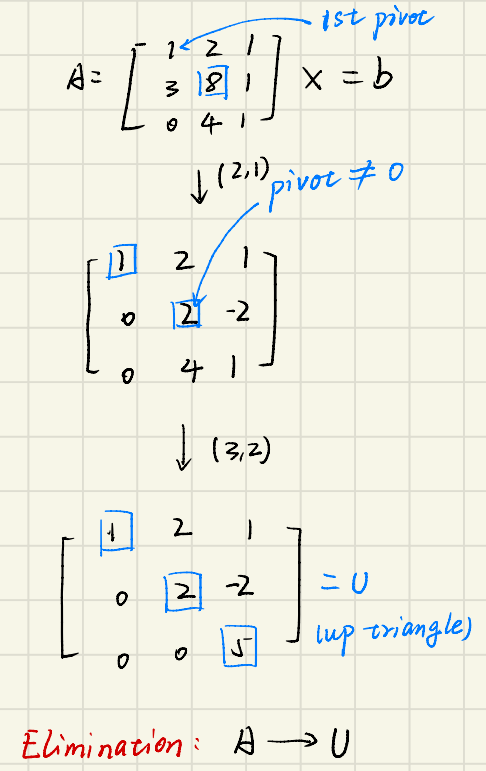
消元的结果是将矩阵  转换成了上三角矩阵(upper triangular matrix)
 。
。
上面的第一步对  矩阵的第二行进行操作
  ,在图中使用
  进行标识。其效果等效于使用一个初等矩阵
  乘以矩阵
乘以矩阵  :
:
这一点可以通过第三种矩阵乘法来解释:将矩阵  的三个行向量分别用
  来表示,消元后的结果矩阵的第二个行向量
  是
是  的线性组合,组合方式由初等矩阵
  的第二行决定,即:

初等矩阵就是由单位阵(identity matrix)经过一次变换得到的矩阵,初等变换包括三种:
- 交换矩阵中某两行(列)的位置
- 用一个非零常数 k 乘以矩阵的某一行(列)
- 将矩阵的某一行(列)乘以常数k后加到另一行(列)上去
所以初等矩阵的逆矩阵也很好求,把对应的操作元变成相反数就可以。比如上面的  :
:
3 Inverse 逆矩阵
Invertible matrix 可逆矩阵(nonsingular matrix 非奇异矩阵)首先一定是方阵。
Invertible: we can solve  only when
  。也就是说
。也就是说  的列向量线性无关。
逆否命题 non-invertible: we can find  that
that  。证明如下: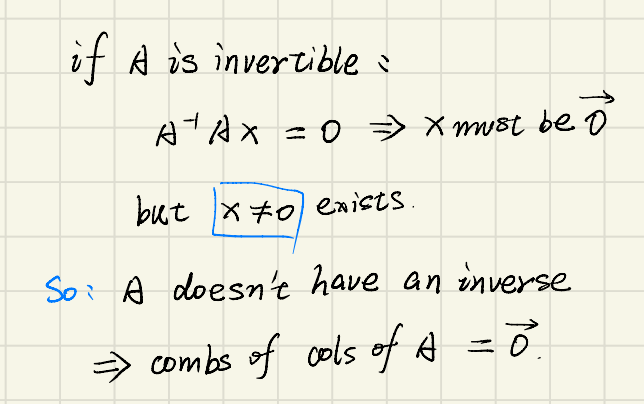
【逆矩阵的求法】Gauss-Jordan 法
Augmented matrix 增广矩阵。
方法正确性验证如下:
4 Factorization into A=LU LU分解
通过高斯消元法,我们将  中的矩阵
中的矩阵  转换成了一个上三角阵(upper diagonal),比如:


可以转化成
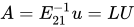
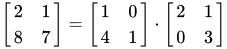
因为初等变换阵的逆矩阵很好求,如果是乘数,则直接在相应位置求相反数就可以(可参考 2.2 节)。
假设这其中没有初等阵是用来交换两行的,则我们可以轻松的求出  矩阵,比如
矩阵,比如


而
我们发现  矩阵其实就是以前
  和
和  中的乘数取了一个相反数。当然,这是在没有初等阵是用来交换两行的这个前提之下的。可以发现,
 是一个下三角矩阵(lower diagonal)。
5 Solving Ax=b 解线性方程组 Ax=b
5.1 Solving Ax=0 解 Ax=0
假设  矩阵为:
矩阵为: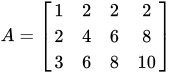
用解方程的高斯消元法,逐步迭代,有:
最后一步我们总会得到一个上三角矩阵  ,被称为 echelon 阶梯矩阵,当然按照正常解方程的步骤应该还有一步是把矩阵
  中的主元(pivot),尽可能都化成 1,但是这里为了简单表示就少了这一步。在上三角矩阵
  中,有两列
中,有两列  有 pivot,而
  这两列没有 pivot,所以
  代表的列被称为 povit columns,相应
  两个变量被称为 pivot variables,而
  被称为 free variables.
在矩阵中有一个非常重要的概念叫秩 (Rank), ,等于 pivot variable 的数量。上例中,
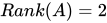 。
。
回到解方程,在大学学的线性代数中,我们可以让 free variables 任意取值,然后随之确定 pivot variables,这
样就确定了方程的解。
在一个  的矩阵中,
的矩阵中, 代表:
代表:
- 我们有
 个 free variables
 - 在
 这个方程中,只有
  个独立的方程组(有用的)
所以解  的步骤:
的步骤:
- 消元(elimination)
- 找到 free variables (顺便可以找到 pivot variables)
- 为 free variables 选择相互独立的组合(
 ),并且解出对应的 pivot variables,一共有
  个,记为
个,记为 
- 最后使用任意变量
 做一个线性组合就得到了最终的解:
在上例中,
 ,一共有 2 两个 free variables
  ,所以分别做两个独立的组合:令
  以及
以及  ,这样可以求解出两个特解
  ,最后得出
,最后得出  的解为
的解为  ,其中
,其中  是任意实数。
上面
实际上长成了矩阵
的 nullspace,上面为 free variables 选取相互独立的组合,就是为了解出来的特解
是相互独立的,这样再进行线性组合得到
,就长成了矩阵
的 nullspace。
由所有特解组成的矩阵  就是作为矩阵
  的 nullspace 矩阵,里面的向量就是 nullspace 的基底。而确定了空间的基地,就相当于确定了整个空间:

最后  的解可以写成这样:

其中  是
是  的矩阵,
的矩阵, 是用来组合
是用来组合  个基底的
个基底的  维向量,而且
  是
是  任意的向量,因为
  ,即
,即  矩阵乘以任何一个特解
  都等于零。
都等于零。
由此还可以看出,矩阵 A 的 nullspace 是  中的一个
中的一个  维子空间。
维子空间。
Reduced row echelon form: pivot 位置的元素为 1,pivot 位置上下元素全都是 0,也就是我们从初中开始解方程组的形式
通过  矩阵可以快速求出 nullspace 矩阵
  :
:
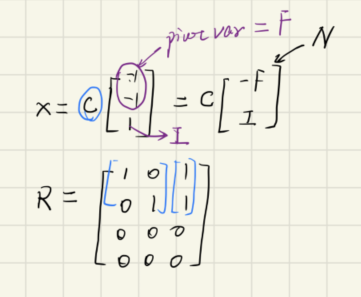
5.2 Solving Ax=b 解 Ax=b
还是用上面的  矩阵:
矩阵:
上图最后一步得到的增广矩阵中,如果  ,则方程组有解,否则无解,因为
  ,等式右边必须是
  。
。
如果  有解(solvability),则需要满足以下任意一个条件(实际上是对
  向量的条件):
 在矩阵
在矩阵  的列空间
的列空间  中
中- 如果在
 的 reduced echelon form 矩阵
  中某几行的元素全都是
  ,那么算出来的增广矩阵中
  向量一侧的那一个元素也必须是
 的解
的解  ,即特解 + 通解。

对于  ,当
,当  取不同值时的解的情况(假设秩
  ),首先进行讨论:
1. 列满秩( ):解为 1 个或 0 个,如果有解
  ,解为特解且唯一
- nullspace
 中只有零向量,没有 free variables
  的列空间正好是
  中的一个
中的一个  维空间,所以如果向量
  在
在  中则有解,否则无解
- 行满秩(
 ):一定有解,一个或无数个
- 行满秩(
 长成了
长成了  ,所以向量
,所以向量  一定在
一定在  中
中- 如果
 ,则一定存在 free variables,此时有无数个解
 矩阵
矩阵  可逆:对于任何
  有且仅有一个解
综上( 代表
代表  矩阵的 reduced row echelon):
- 当
 时,
时, ,有且仅有一个解
 - 当
 时,
时, ,有一个解或无解
 - 当
 时,
时, ,有无数个解
 - 当
 时,
时, ,无解或有无数个解
6 投影矩阵与最小二乘
6.1 Projection 投影与投影矩阵
为什么我们需要投影?—-  可能没有解,但我们可以将
  投影到
投影到  的列空间
的列空间  上,求解
上,求解  来近似求解线性方程。
首先考虑投影到一维空间(一条直线)的情况,将向量  投影到
投影到  上。
上。
最终  在
在  向量上的投影为
  。所以我们定义在投影到一维空间的投影矩阵(projection matrix)

投影矩阵有如下性质: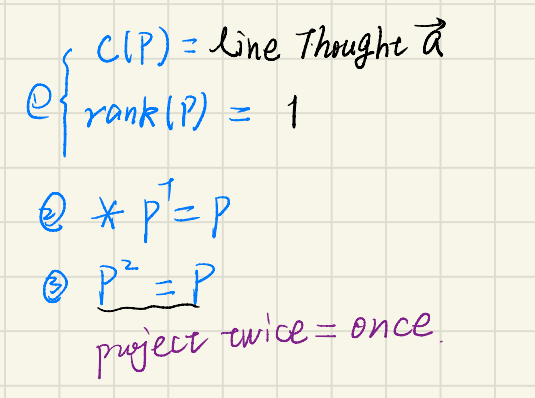
代表矩阵
的 column space.
随后考虑投影到二维空间(一个平面)的情况,将向量  投影到
投影到  形成的平面上。

得到 projection matrix 投影矩阵:
6.2 Least Square 最小二乘
最小二乘的思想:找到一条直线来拟合数据点,使得所有点到直线的距离平方和最小,比如:
最小化目标函数为:
当然,求解这个问题可以直接用求偏导等于零来计算:


得到:
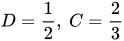
还有就是投影的思想,的出来的  表达式跟上面的一样。最后求出来:
7 正交矩阵与 Gram-Schmidt 标准正交化
7.1 Orthogonal Matrix Q 正交矩阵
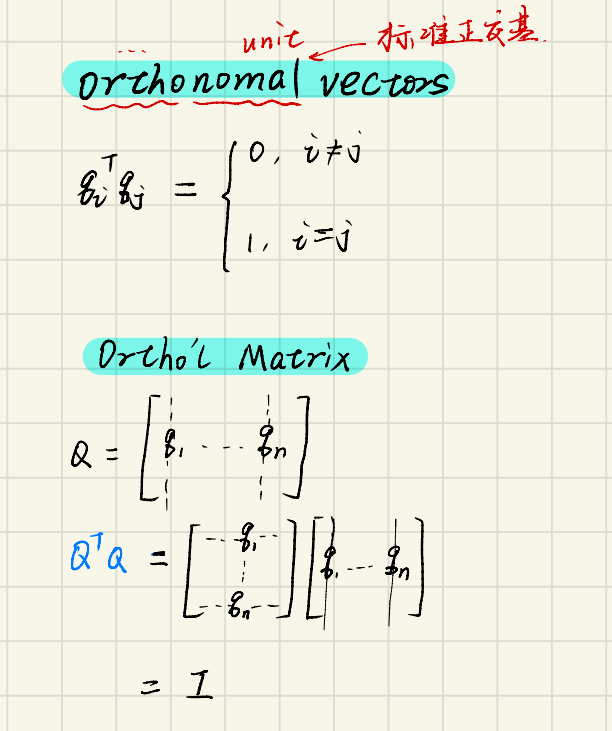
正交矩阵重要的性质: %22%20aria-hidden%3D%22true%22%3E%0A%20%3Cuse%20xlink%3Ahref%3D%22%23E1-MJMATHI-51%22%20x%3D%220%22%20y%3D%220%22%3E%3C%2Fuse%3E%0A%20%3Cuse%20transform%3D%22scale(0.707)%22%20xlink%3Ahref%3D%22%23E1-MJMATHI-54%22%20x%3D%221119%22%20y%3D%22583%22%3E%3C%2Fuse%3E%0A%20%3Cuse%20xlink%3Ahref%3D%22%23E1-MJMATHI-51%22%20x%3D%221389%22%20y%3D%220%22%3E%3C%2Fuse%3E%0A%20%3Cuse%20xlink%3Ahref%3D%22%23E1-MJMAIN-3D%22%20x%3D%222458%22%20y%3D%220%22%3E%3C%2Fuse%3E%0A%20%3Cuse%20xlink%3Ahref%3D%22%23E1-MJMATHI-49%22%20x%3D%223515%22%20y%3D%220%22%3E%3C%2Fuse%3E%0A%3C%2Fg%3E%0A%3C%2Fsvg%3E#card=math&code=Q%5ET%20Q%20%3D%20I&id=qBj1Y)
同时,如果  是方阵,则
是方阵,则 
如果将  投影到正交矩阵的列空间
  中,则:
中,则:
得到的结果就是,向量  的每一个分量
  ,其实就是点
  在坐标轴
在坐标轴  上的坐标:
上的坐标:

7.2 Gram-Schmidt 标准正交化
先正交化,然后再标准化。
前者就是投影,后者就是向量除以模长
首先是两个向量标准正交化的步骤:
上图我们最终想要求的是与向量
垂直的分量

最后推广到三个向量:
8 行列式、性质与计算公式
8.1 Determinant & Properties 行列式及其性质
Determinant 行列式的表示:
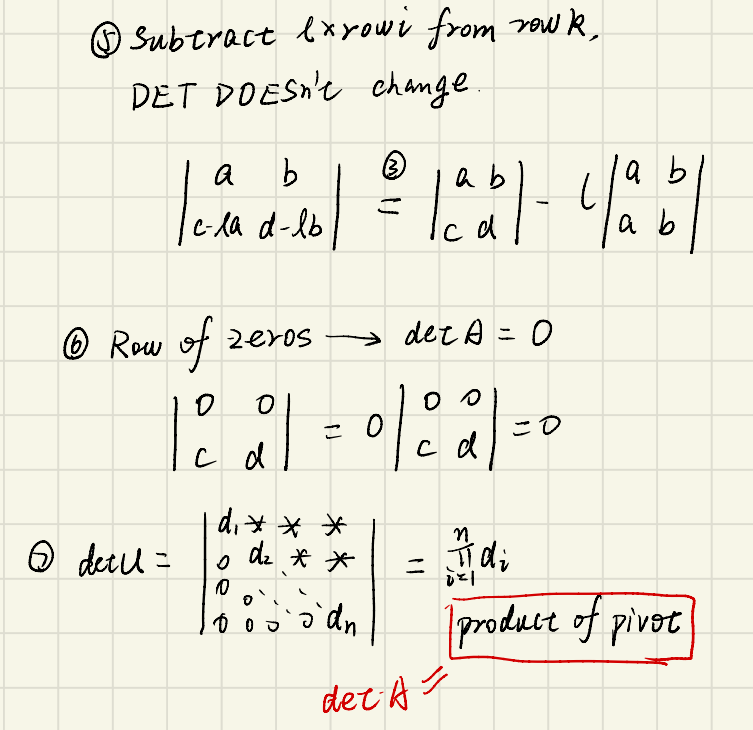
行列式的 10 条性质:3 条定义 + 7 条定理(由定义推出来的)


8.2 Formula for detA 行列式计算公式
使用上述 10 条性质推到公式!!!
首先是二阶矩阵的行列式:
经过分解,我们将原始的行列式拆成了 4 个行列式的和。
然后是三阶矩阵的行列式:
这里我们拆成了 33 个行列式的和
计算公式如下:
依次从每一行选择一个元素,各个元素的列不重复。
一旦上面选择的某一个元素为 0,那它代表的行列式就等于 0(因为有一列全零)。
8.3 Cofactors 代数余子式

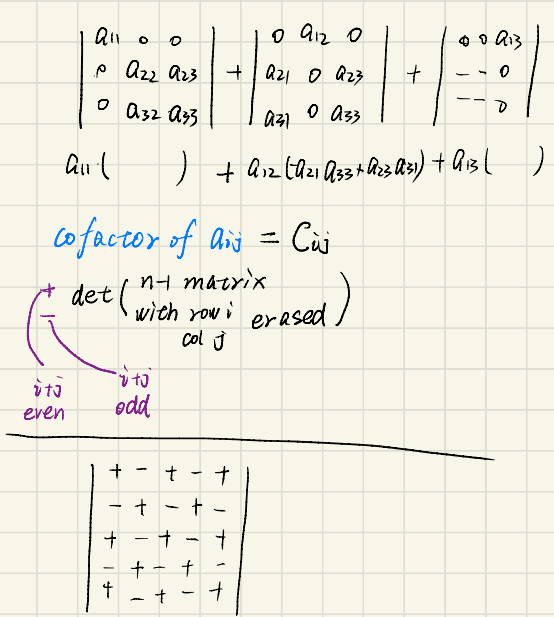
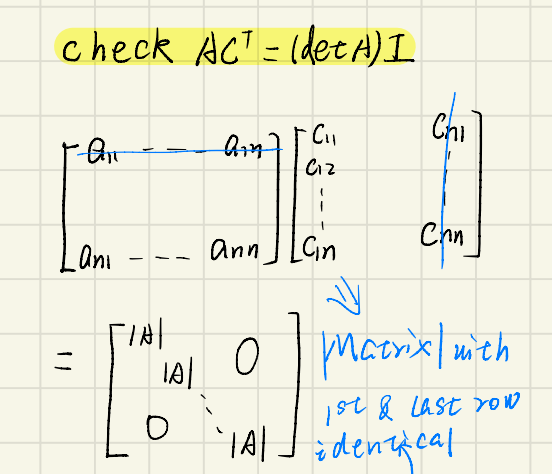
使用伴随矩阵求逆矩阵:
9 Eigen value & vector 特征值与特征向量

- 使用矩阵乘以该矩阵的 eigen vector,其结果与原来的向量平行,只是进行了缩放操作
#pivots = #independent cols = **#λ's = #different eigen vectors**- 所以如果找到一组 eigen vector 组成的基底,将其他向量用该基底进行表示,就能使用上面矩阵幂次来大大简化计算
特征值与特征向量的计算:

矩阵的 trace 迹、特征值的积:

10 对角化与矩阵 A 的幂
10.1 DIagonalization 对角化

既然有特征值,那
**A**一定是一个方阵。
其中  为
为  的
的 n 个独立的特征向量组成的矩阵。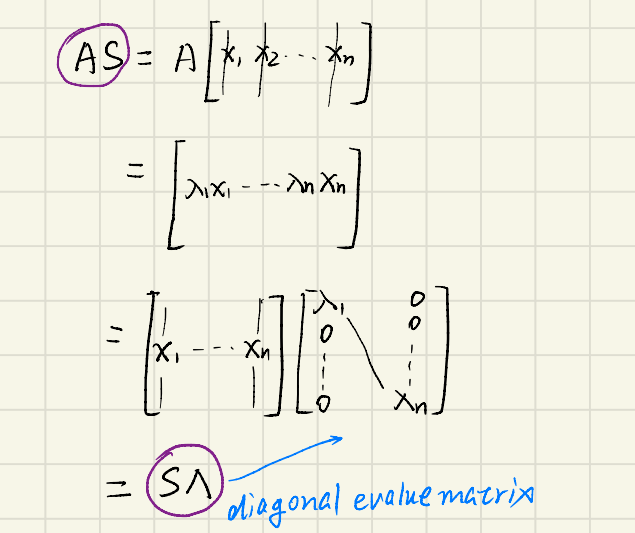
最终推出:
只要保证  的
的 **n** 个特征值不同,即可保证有 **n** 个独立的特征向量。
10.2 Power of A 矩阵 A 的幂
从  很容易得到
很容易得到  :
:

进而对于给定  以及等式
以及等式  ,我们有
,我们有

如果想求  的值,首先将
  的特征向量
的特征向量  看作一组基底,然后用这组基底表示
  :
:

那么
这个式子很有用:如果  ,则它代表的这一项
  。
。
比如计算斐波那契数列增长的速度: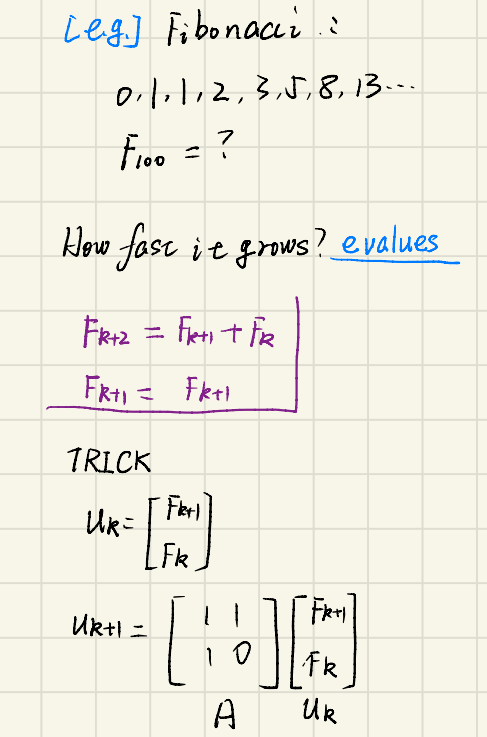

11 Markov matrix
- 所有的元素

- 每一列元素和都是


性质:
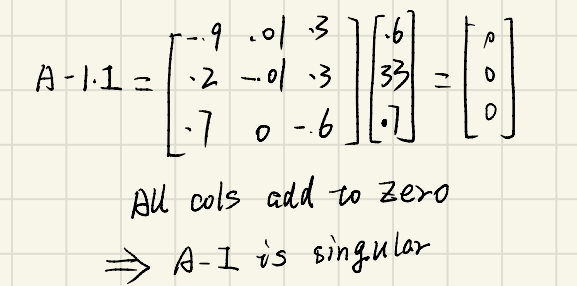
 是一个特征值,其余所有的
  均
均 
- 所以根据 9.2 节 Power of A,
 最终会达到一个稳定状态。
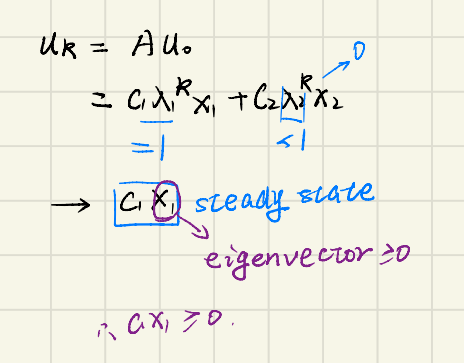
实例: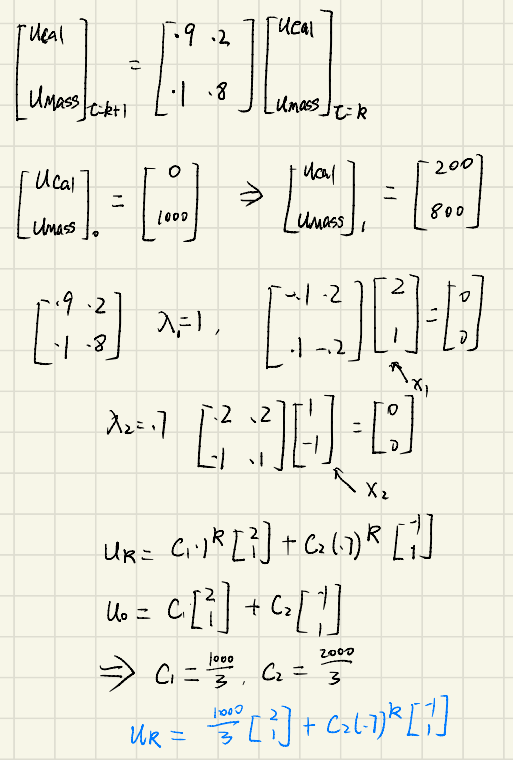
12 SVD 奇异值分解
Singular Value Decomposition.
其中  都是正交矩阵。
思想:设 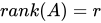 ,
,
分别是矩阵  的 row space
  和 column space
  的正交基向量组成的基底。希望通过
  完成:
完成:
即

如何求解三个矩阵?
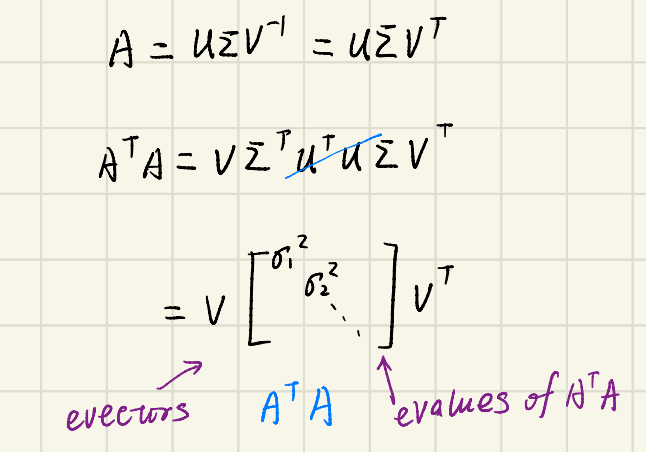
首先求  :
:

然后求  :
:
13 Linear transformation & their matrices 线性变换
线性性:
向量的各个分量、一个点坐标的意义;只有确定了基底,坐标才有意义:
进一步,

其中  的各列,其实就是
  轴的单位向量。
线性变换,相当于变化坐标轴(也就是基底),而点的坐标保持不变。比如二维空间中逆时针旋转  的旋转矩阵:
看下图:
可以看到, 在新坐标系
在新坐标系  中的坐标还是
  。假设变换后的
  轴和
轴和  轴的单位向量为
  ,那么在新的坐标系下依旧有:
而新的  轴和
轴和  轴的单位向量,在原
  坐标系下的坐标为:
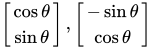
OK,点到为止。
线性变换,线性说的是一件什么事:假如我们用函数  代表线性变换,则线性变换有如下性质:

所以有:
即对  和
和  的线性组合进行线性变换,其结果等于先进行线性变换,再进行线性组合。
结合上面旋转矩阵的例子,有点意思。这里  就可以理解为两个基向量,组成一组基底;而
  则是向量在原基底
  和新基底
和新基底  中的坐标,没有发生变化!!

若有收获,就点个赞吧
0 人点赞


