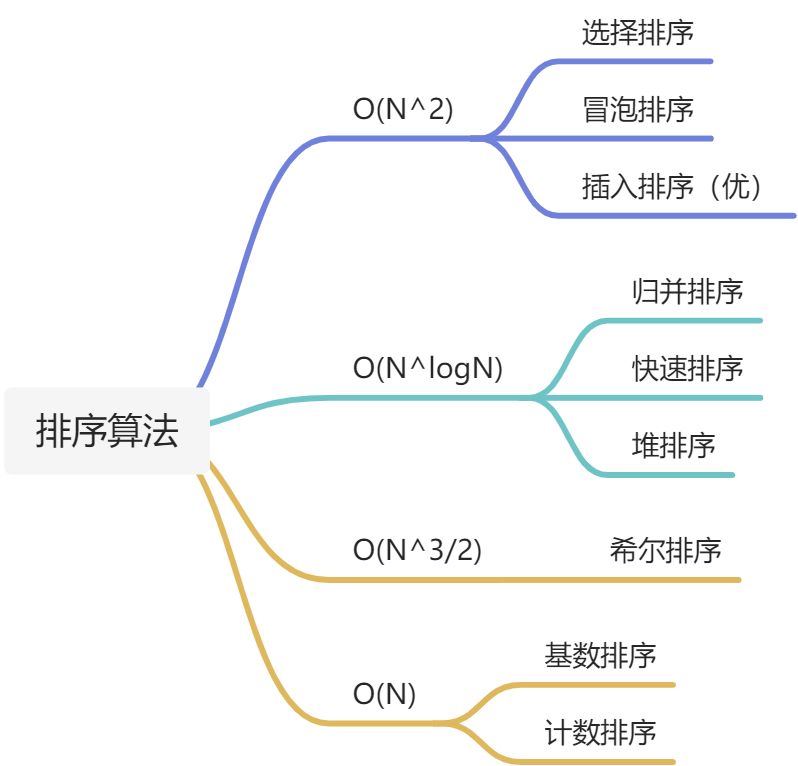
概述
| 排序方法 | 时间复杂度 | 空间复杂度 | 稳定性 |
|---|---|---|---|
| 选择排序 | O(N^2) | O(1) | × |
| 冒泡排序 | O(N^2) | O(1) | √ |
| 插入排序 | O(N^2) | O(1) | √ |
| 归并排序 | O(N^logN) | O(N) | √ |
| 随机快排 | O(N^logN) | O(logN) | × |
| 堆排序 | O(N^logN) | O(1) | × |
| 希尔排序 | O(N^3/2) | O(1) | × |
| 基数排序 | O(N) | O(M) | √ |
| 计数排序 | O(N) | O(N) | √ |
- 不基于比较的排序,对样本数据有严格要求,不易改写
- 基于比较的排序,只要规定好两个样本怎么比大小就可以直接复用
- 基于比较的排序,时间复杂度的极限是O(N^logN)
- 时间复杂度O(N^logN)、空间复杂度低于O(N)、且稳定的基于比较的排序是不存在的
- 为了绝对的速度选快排,为了省空间选堆排,为了稳定选归并排序
常见的坑:
1、归并排序的额外空间复杂度可以变成O(1),使用“归并排序内部缓存法”,但是将变得不再稳定。如果是这样,可直接使用堆排序。
2、“原地归并排序”不需要了解,会让时间复杂度变成O(N^2)。如果是这样,可直接使用冒泡或者插入排序。
3、快速排序稳定性改进,“01 stable sort”,但是会对样本数据要求更多。如果是这样,可直接使用基数排序。
4、在整形数组中,请把奇数放在数组左边,偶数放在数组右边,要求所有奇数之间原始的相对顺序不变,所有偶数之间原始相对顺序不变,时间复杂度做到O(N),空间复杂度做到O(1)。该问题使用快速排序,但快速排序partition过程无法做到稳定性。除非整形数组中元素严格要求,才能做到。
选择排序
从左往右遍历数组,将i和i+1位置的数进行比较,每次遍历的范围-1,每次遍历可以确定最后一个位置上的数。
public class SelectionSort implements InplaceSort {@Overridepublic void sort(int[] values) {SelectionSort.selectionSort(values);}public static void selectionSort(int[] array) {if (array == null) return;final int N = array.length;for (int i = 0; i < N; i++) {// Find the index beyond i with a lower value than iint swapIndex = i;for (int j = i + 1; j < N; j++) {if (array[j] < array[swapIndex]) {swapIndex = j;}}swap(array, i, swapIndex);}}private static void swap(int[] ar, int i, int j) {int tmp = ar[i];ar[i] = ar[j];ar[j] = tmp;}public static void main(String[] args) {InplaceSort sorter = new SelectionSort();int[] array = {10, 4, 6, 8, 13, 2, 3};sorter.sort(array);// Prints:// [2, 3, 4, 6, 8, 10, 13]System.out.println(java.util.Arrays.toString(array));}}
冒泡排序
从右往左遍历数组,在内循环中从左往右遍历,比较相邻的两个数并根据大小做交换。
public class BubbleSort implements InplaceSort {@Overridepublic void sort(int[] values) {BubbleSort.bubbleSort(values);}// Sort the array using bubble sort. The idea behind// bubble sort is to look for adjacent indexes which// are out of place and interchange their elements// until the entire array is sorted.private static void bubbleSort(int[] ar) {if (ar == null) {return;}boolean sorted;do {sorted = true;for (int i = 1; i < ar.length; i++) {if (ar[i] < ar[i - 1]) {swap(ar, i - 1, i);sorted = false;}}} while (!sorted);}private static void swap(int[] ar, int i, int j) {int tmp = ar[i];ar[i] = ar[j];ar[j] = tmp;}public static void main(String[] args) {int[] array = {10, 4, 6, 8, 13, 2, 3};BubbleSort sorter = new BubbleSort();sorter.sort(array);// Prints:// [2, 3, 4, 6, 8, 10, 13]System.out.println(java.util.Arrays.toString(array));}}
插入排序
从左往右遍历数组,根据要求进行比较,当发现需要交换位置时,依次往左比较交换直到不需要交换,再向右继续比较。保证0~i位置左边的数有序。
public class InsertionSort implements InplaceSort {@Overridepublic void sort(int[] values) {InsertionSort.insertionSort(values);}// Sort the given array using insertion sort. The idea behind// insertion sort is that at the array is already sorted from// [0, i] and you want to add the element at position i+1, so// you 'insert' it at the appropriate location.private static void insertionSort(int[] ar) {if (ar == null) {return;}for (int i = 1; i < ar.length; i++) {for (int j = i; j > 0 && ar[j] < ar[j - 1]; j--) {swap(ar, j - 1, j);}}}private static void swap(int[] ar, int i, int j) {int tmp = ar[i];ar[i] = ar[j];ar[j] = tmp;}public static void main(String[] args) {InplaceSort sorter = new InsertionSort();int[] array = {10, 4, 6, 8, 13, 2, 3};sorter.sort(array);// Prints:// [2, 3, 4, 6, 8, 10, 13]System.out.println(java.util.Arrays.toString(array));}}
归并排序
整体就是一个递归,左边排好序、右边排好序、让整体有序。
public class MergeSort implements InplaceSort {@Overridepublic void sort(int[] values) {int[] sortedValues = MergeSort.mergesort(values);for (int i = 0; i < values.length; i++) {values[i] = sortedValues[i];}}public static int[] mergesort(int[] ar) {// Base case is when a single element (which is already sorted)int n = ar.length;if (n <= 1) return ar;// Split array into two parts and recursively sort themint[] left = mergesort(Arrays.copyOfRange(ar, 0, n / 2));int[] right = mergesort(Arrays.copyOfRange(ar, n / 2, n));// Combine the two arrays into one larger arrayreturn merge(left, right);}// Merge two sorted arrays into a larger sorted arrayprivate static int[] merge(int[] ar1, int[] ar2) {int n1 = ar1.length, n2 = ar2.length;int n = n1 + n2, i1 = 0, i2 = 0;int[] ar = new int[n];for (int i = 0; i < n; i++) {if (i1 == n1) {ar[i] = ar2[i2++];} else if (i2 == n2) {ar[i] = ar1[i1++];} else {if (ar1[i1] < ar2[i2]) {ar[i] = ar1[i1++];} else {ar[i] = ar2[i2++];}}}return ar;}public static void main(String[] args) {int[] array = {10, 4, 6, 4, 8, -13, 2, 3};array = MergeSort.mergesort(array);// Prints:// [-13, 2, 3, 4, 4, 6, 8, 10]System.out.println(java.util.Arrays.toString(array));}}
快速排序
public class QuickSelect {

  public Integer quickSelect(int[] ar, int k) {
    if (ar == null) return null;
    if (k > ar.length) return null;
    if (k < 1) return null;
    return quickSelect(ar, k, 0, ar.length - 1);
  }

  // Sort interval [lo, hi] inplace recursively, returns value when splitPoint == k - 1
  private static Integer quickSelect(int[] ar, int k, int lo, int hi) {
    int index = k - 1;
    if (lo < hi) {
      int splitPoint = partition(ar, lo, hi);
      if (splitPoint == index) {
        return ar[splitPoint];
      } else if (splitPoint > index) {
        return quickSelect(ar, k, lo, splitPoint);
      }
      return quickSelect(ar, k, splitPoint + 1, hi);
    }
    return ar[lo];
  }

  // Performs Hoare partition algorithm for quick select, taken from QuickSelect implementation
  private static int partition(int[] ar, int lo, int hi) {
    int pivot = ar[lo];
    int i = lo - 1, j = hi + 1;
    while (true) {
      do {
        i++;
      } while (ar[i] < pivot);
      do {
        j--;
      } while (ar[j] > pivot);
      if (i < j) swap(ar, i, j);
      else return j;
    }
  }

  // Swap two elements
  private static void swap(int[] ar, int i, int j) {
    int tmp = ar[i];
    ar[i] = ar[j];
    ar[j] = tmp;
  }

  public static void main(String[] args) {
    QuickSelect quickSelect = new QuickSelect();
    int[] array = {-10, 4, 6, 4, 8, -13, 1, 3};
    int kthLargestElement = quickSelect.quickSelect(array, 3);
    // Prints: 1
    System.out.println(kthLargestElement);
  }
}
堆排序
public class Heapsort implements InplaceSort {

  @Override
  public void sort(int[] values) {
    Heapsort.heapsort(values);
  }

  private static void heapsort(int[] ar) {
    if (ar == null) return;
    int n = ar.length;

    // Heapify, converts array into binary heap O(n), see:
    // http://www.cs.umd.edu/~meesh/351/mount/lectures/lect14-heapsort-analysis-part.pdf
    for (int i = Math.max(0, (n / 2) - 1); i >= 0; i--) {
      sink(ar, n, i);
    }

    // Sorting bit
    for (int i = n - 1; i >= 0; i--) {
      swap(ar, 0, i);
      sink(ar, i, 0);
    }
  }

  private static void sink(int[] ar, int n, int i) {
    while (true) {
      int left = 2 * i + 1; // Left  node
      int right = 2 * i + 2; // Right node
      int largest = i;

      // Right child is larger than parent
      if (right < n && ar[right] > ar[largest]) largest = right;

      // Left child is larger than parent
      if (left < n && ar[left] > ar[largest]) largest = left;

      // Move down the tree following the largest node
      if (largest != i) {
        swap(ar, largest, i);
        i = largest;
      } else break;
    }
  }

  private static void swap(int[] ar, int i, int j) {
    int tmp = ar[i];
    ar[i] = ar[j];
    ar[j] = tmp;
  }

  /* TESTING */

  public static void main(String[] args) {
    Heapsort sorter = new Heapsort();
    int[] array = {10, 4, 6, 4, 8, -13, 2, 3};
    sorter.sort(array);
    // Prints:
    // [-13, 2, 3, 4, 4, 6, 8, 10]
    System.out.println(java.util.Arrays.toString(array));
  }
}
希尔排序
public class ShellSort {
    public static void main(String []args){
        int []arr ={1,4,2,7,9,8,3,6};
        sort(arr);
        System.out.println(Arrays.toString(arr));
        int []arr1 ={1,4,2,7,9,8,3,6};
        sort1(arr1);
        System.out.println(Arrays.toString(arr1));
    }

    /**
     * 希尔排序 针对有序序列在插入时采用交换法
     * @param arr
     */
    public static void sort(int []arr){
        //增量gap,并逐步缩小增量
       for(int gap=arr.length/2;gap>0;gap/=2){
           //从第gap个元素,逐个对其所在组进行直接插入排序操作
           for(int i=gap;i<arr.length;i++){
               int j = i;
               while(j-gap>=0 && arr[j]<arr[j-gap]){
                   //插入排序采用交换法
                   swap(arr,j,j-gap);
                   j-=gap;
               }
           }
       }
    }

    /**
     * 希尔排序 针对有序序列在插入时采用移动法。
     * @param arr
     */
    public static void sort1(int []arr){
        //增量gap,并逐步缩小增量
        for(int gap=arr.length/2;gap>0;gap/=2){
            //从第gap个元素,逐个对其所在组进行直接插入排序操作
            for(int i=gap;i<arr.length;i++){
                int j = i;
                int temp = arr[j];
                if(arr[j]<arr[j-gap]){
                    while(j-gap>=0 && temp<arr[j-gap]){
                        //移动法
                        arr[j] = arr[j-gap];
                        j-=gap;
                    }
                    arr[j] = temp;
                }
            }
        }
    }
    /**
     * 交换数组元素
     * @param arr
     * @param a
     * @param b
     */
    public static void swap(int []arr,int a,int b){
        arr[a] = arr[a]+arr[b];
        arr[b] = arr[a]-arr[b];
        arr[a] = arr[a]-arr[b];
    }
}
桶排序
public class BucketSort implements InplaceSort {

  @Override
  public void sort(int[] values) {
    int minValue = Integer.MAX_VALUE;
    int maxValue = Integer.MIN_VALUE;
    for (int i = 0; i < values.length; i++) {
      if (values[i] < minValue) minValue = values[i];
      if (values[i] > maxValue) maxValue = values[i];
    }
    BucketSort.bucketSort(values, minValue, maxValue);
  }

  // Performs a bucket sort of an array in which all the elements are
  // bounded in the range [minValue, maxValue]. For bucket sort to give linear
  // performance the elements need to be uniformly distributed
  private static void bucketSort(int[] ar, int minValue, int maxValue) {
    if (ar == null || ar.length == 0 || minValue == maxValue) return;

    // N is number elements and M is the range of values
    final int N = ar.length, M = maxValue - minValue + 1, numBuckets = M / N + 1;
    List<List<Integer>> buckets = new ArrayList<>(numBuckets);
    for (int i = 0; i < numBuckets; i++) buckets.add(new ArrayList<>());

    // Place each element in a bucket
    for (int i = 0; i < N; i++) {
      int bi = (ar[i] - minValue) / M;
      List<Integer> bucket = buckets.get(bi);
      bucket.add(ar[i]);
    }

    // Sort buckets and stitch together answer
    for (int bi = 0, j = 0; bi < numBuckets; bi++) {
      List<Integer> bucket = buckets.get(bi);
      if (bucket != null) {
        Collections.sort(bucket);
        for (int k = 0; k < bucket.size(); k++) {
          ar[j++] = bucket.get(k);
        }
      }
    }
  }

  public static void main(String[] args) {
    BucketSort sorter = new BucketSort();

    int[] array = {10, 4, 6, 8, 13, 2, 3};
    sorter.sort(array);
    // Prints:
    // [2, 3, 4, 6, 8, 10, 13]
    System.out.println(java.util.Arrays.toString(array));

    array = new int[] {10, 10, 10, 10, 10};
    sorter.sort(array);
    // Prints:
    // [10, 10, 10, 10, 10]
    System.out.println(java.util.Arrays.toString(array));
  }
}
基数排序
public class RadixSort implements InplaceSort {

  @Override
  public void sort(int[] values) {
    RadixSort.radixSort(values);
  }

  static int getMax(int[] array) {
    int max = array[0];
    for (int i = 0; i < array.length; i++) {
      if (array[i] > max) {
        max = array[i];
      }
    }
    return max;
  }

  static int calculateNumberOfDigits(int number) {
    return (int) Math.log10(number) + 1;
  }

  // Requires all numbers to be greater than or equal to 1
  public static void radixSort(int[] numbers) {
    if (numbers == null || numbers.length <= 1) {
      return;
    }
    int maximum = getMax(numbers);
    int numberOfDigits = calculateNumberOfDigits(maximum);
    int placeValue = 1;
    while (numberOfDigits-- > 0) {
      countSort(numbers, placeValue);
      placeValue *= 10;
    }
  }

  private static void countSort(int[] numbers, int placeValue) {
    int range = 10;

    int[] frequency = new int[range];
    int[] sortedValues = new int[numbers.length];

    for (int i = 0; i < numbers.length; i++) {
      int digit = (numbers[i] / placeValue) % range;
      frequency[digit]++;
    }

    for (int i = 1; i < range; i++) {
      frequency[i] += frequency[i - 1];
    }

    for (int i = numbers.length - 1; i >= 0; i--) {
      int digit = (numbers[i] / placeValue) % range;
      sortedValues[frequency[digit] - 1] = numbers[i];
      frequency[digit]--;
    }

    System.arraycopy(sortedValues, 0, numbers, 0, numbers.length);
  }

  public static void main(String[] args) {
    InplaceSort sorter = new RadixSort();
    int[] numbers = {387, 468, 134, 123, 68, 221, 769, 37, 7, 890, 1, 587};
    sorter.sort(numbers);
    // Prints:
    // [1, 7, 37, 68, 123, 134, 221, 387, 468, 587, 769, 890]
    System.out.println(java.util.Arrays.toString(numbers));
  }
}
计数排序
public class CountingSort implements InplaceSort {

  @Override
  public void sort(int[] values) {
    int minValue = Integer.MAX_VALUE;
    int maxValue = Integer.MIN_VALUE;
    for (int i = 0; i < values.length; i++) {
      if (values[i] < minValue) minValue = values[i];
      if (values[i] > maxValue) maxValue = values[i];
    }
    CountingSort.countingSort(values, minValue, maxValue);
  }

  // Sorts values in the range of [minVal, maxVal] in O(n+maxVal-maxVal)
  private static void countingSort(int[] ar, int minVal, int maxVal) {
    int sz = maxVal - minVal + 1;
    int[] b = new int[sz];
    for (int i = 0; i < ar.length; i++) b[ar[i] - minVal]++;
    for (int i = 0, k = 0; i < sz; i++) {
      while (b[i]-- > 0) ar[k++] = i + minVal;
    }
  }

  public static void main(String[] args) {
    CountingSort sorter = new CountingSort();
    int[] nums = {+4, -10, +0, +6, +1, -5, -5, +1, +1, -2, 0, +6, +8, -7, +10};
    sorter.sort(nums);

    // Prints:
    // [-10, -7, -5, -5, -2, 0, 0, 1, 1, 1, 4, 6, 6, 8, 10]
    System.out.println(java.util.Arrays.toString(nums));
  }
}

若有收获,就点个赞吧
0 人点赞


