https://leetcode.cn/problems/divide-two-integers/
法一:位运算
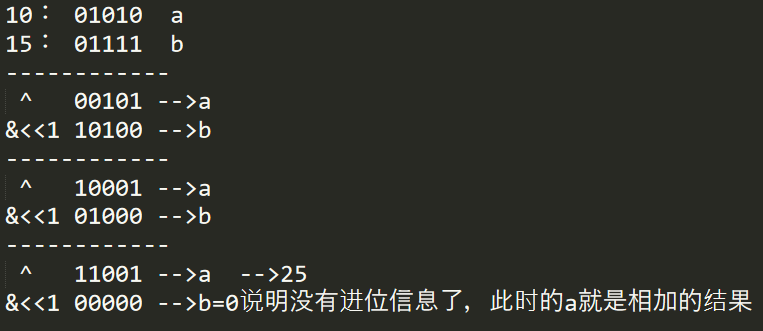
- 加法
- ^ 无进位相加
- & << 1 进位相加
- 将第一步和第二步加起来
- 例子1:

- 例子2:
public static int add(int a, int b) {int sum = a;while (b != 0) {sum = a ^ b;b = (a & b) << 1;a = sum;}return sum;}
- 乘法
- 流程
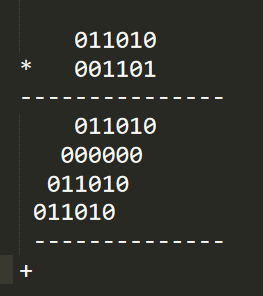
- 原始的a ,b不变
- a << 0 , b >> 0
- a << 1, b >> 1
- a << 2, b>>2
public static int multi(int a, int b) {int res = 0;while (b != 0) {if ((b & 1) != 0) {res = add(res, a);}a <<= 1;b >>>= 1;}return res;}
- 流程
除法: 如果a是系统最小, b不是系统最小,怎么算? 1.先把a+1 ,然后去除b ——> 得到值A
2. a - (A * b) = 值B3. B / b + A
除法:
- 先把数都转成正的,来除比较稳
- 所以除的流程是什么呢?
- 比如a/b
- 准备一个变量
- 先让 b往左移动x位,直到不能再移(最接近a) 记作T, 然后在上面那个变量对象x位置写上1
- 然后 a’ = a - T
- 然后再让b往左移动去够a’ , 继续上面那个流程
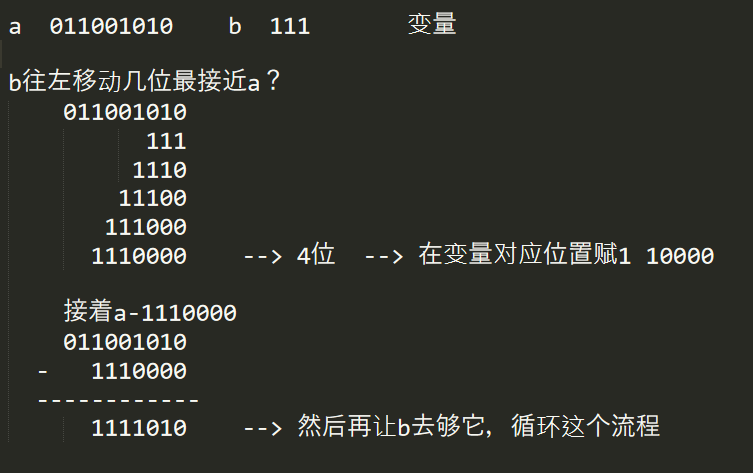
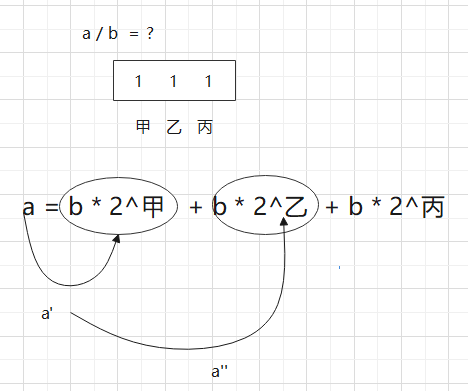
- 为啥是这个流程呢?看下面两个图

 ```java
public static int minus(int a, int b) {
return add(a, negNum(b));
}
// 求相反数
private static int negNum(int n) {
return add(~n, 1);
}
```java
public static int minus(int a, int b) {
return add(a, negNum(b));
}
// 求相反数
private static int negNum(int n) {
return add(~n, 1);
}
public static int div(int a, int b) { int x = a < 0 ? negNum(a) : a; int y = b < 0 ? negNum(b) : b; int res = 0; for (int i = 31; i > -1; i = minus(i, 1)) { if (x >> i >= y) { res |= (1 << i); x = minus(x, y << i); } } return (a < 0) ^ (b < 0) ? negNum(res) : res; }
public static int divide(int dividend, int divisor) { if (divisor == Integer.MIN_VALUE) { return dividend == Integer.MIN_VALUE ? 1 : 0; } // 除数不是系统最小 if (dividend == Integer.MIN_VALUE) { if (divisor == -1) { return Integer.MAX_VALUE; } int res = div(add(dividend, 1), divisor); return add(res, div(minus(dividend, multi(res, divisor)), divisor)); } // 两个都不是系统最小 return div(dividend, divisor); }
- 总代码```javapublic static int add(int a, int b) {int sum = a;while (b != 0) {sum = a ^ b;b = (a & b) << 1;a = sum;}return sum;}public static int multi(int a, int b) {int res = 0;while (b != 0) {if ((b & 1) != 0) {res = add(res, a);}a <<= 1;b >>>= 1;}return res;}public static int minus(int a, int b) {return add(a, negNum(b));}private static int negNum(int n) {return add(~n, 1);}public static int div(int a, int b) {int x = a < 0 ? negNum(a) : a;int y = b < 0 ? negNum(b) : b;int res = 0;for (int i = 31; i > -1; i = minus(i, 1)) {if (x >> i >= y) {res |= (1 << i);x = minus(x, y << i);}}return (a < 0) ^ (b < 0) ? negNum(res) : res;}public static int divide(int dividend, int divisor) {if (divisor == Integer.MIN_VALUE) {return dividend == Integer.MIN_VALUE ? 1 : 0;}// 除数不是系统最小if (dividend == Integer.MIN_VALUE) {if (divisor == -1) {return Integer.MAX_VALUE;}int res = div(add(dividend, 1), divisor);return add(res, div(minus(dividend, multi(res, divisor)), divisor));}// 两个都不是系统最小return div(dividend, divisor);}
法二:递归
- 每次除数翻倍增加,指数级逼近被除数
```java
public static int divide1(int dividend, int divisor) {
if (dividend == 0 ) return 0;
if (dividend == Integer.MIN_VALUE && divisor == -1) return Integer.MAX_VALUE;
int isNeg = 1;
if ((dividend > 0 && divisor < 0) || (dividend < 0 && divisor > 0)) {
} dividend = dividend > 0 ? -dividend : dividend; divisor = divisor > 0 ? -divisor : divisor; return isNeg == -1 ? -div1(dividend, divisor) : div1(dividend, divisor);isNeg = -1;
}
// a, b都是负数 private static int div1(int a, int b) { if (a >= b) return a > b ? 0 : 1; int count = 1; int res = 0; int tb = b; // 每次除数和结果都翻倍,指数级逼近,比较快 // tb < 0 防止溢出 while (a <= tb && tb < 0) { a -= tb; res += count; tb += tb; count += count; } return res + div1(a, b); }
```

若有收获,就点个赞吧
0 人点赞


