- 1. 数组中重复的数字
- 2. 二维数组中的查找
- 3. 替换空格
- 4. 从尾到头打印链表
- 5. 双栈实现队列
- 6. 斐波那契数列
- 7. 青蛙跳台问题
- 8. 旋转数组的最小数字
- 9. 矩阵中的路径
- 10.机器人的运动范围
- 11.剪绳子I
- 12.剪绳子II
- 13.二进制数中1的个数
- 14. 数值的整数次方
- 15. 打印从1到最大的n位数
- 16. 删除链表的节点
- 17.调整数组顺序使奇数位于偶数前面
- 18. 链表的倒数第k个节点
- 19.反转链表
- 20.合并两个排序链表
- 21.二叉树的镜像
- 22.对称的二叉树
- 23.顺时针打印矩阵
- 24.包含min函数的栈
- 25.栈的压入、弹出序列
- 26.从上到下打印二叉树
- 27.从上到下打印二叉树2
- 28.数组中出现次数超过一半的数字
- 29.复杂链表的复制
- 30.连续子数组的最大和
- 31.数字数列中某一位数字
- 32.把数字翻译成字符串
- 33.礼物的最大价值
1. 数组中重复的数字
找出数组中重复的数字。
在一个长度为 n 的数组 nums 里的所有数字都在 0~n-1 的范围内。数组中某些数字是重复的,但不知道有几个数字重复了,也不知道每个数字重复了几次。请找出数组中任意一个重复的数字。
示例 1:输入:[2, 3, 1, 0, 2, 5, 3]输出:2 或 3
// class Solution {
//     public int findRepeatNumber(int[] nums) {
//         // 使用set装配数字,判断下一个数字是否已经存在
//         // 1. 存在,则返回该数字;
//         // 2. 不存在,则放入set;
//         Set<Integer> set = new HashSet<Integer>();
//         for(int i : nums){
//             if(!set.contains(i)){
//                 set.add(i);
//             }else{
//                 return i;
//             }
//         }
//         return -1;
//     }
// }

class Solution {
    public int findRepeatNumber(int[] nums) {
        // 在一个长度为 n 的数组 nums 里的所有数字都在 0~n-1 的范围内
        // 表示索引与数字值为一对多关系
        // 遍历数组,判断值大小的索引处是否有相同的数存在,将每个数值与数值对应的索引位置的数进行交换
        // 保证数值与索引都一一对应,当发现有值对应的索引处已经存在该数,那么直接返回
        for(int i=0;i<nums.length;){
            if(nums[i]==i){
                i++;
                continue;
            }
            if(nums[i]==nums[nums[i]]){
                return nums[i];
            }
            int temp = nums[nums[i]];
            nums[nums[i]] = nums[i];
            nums[i] = temp;

        }
        return -1;
    }
}
2. 二维数组中的查找
在一个 n * m 的二维数组中,每一行都按照从左到右递增的顺序排序,每一列都按照从上到下递增的顺序排序。请完成一个高效的函数,输入这样的一个二维数组和一个整数,判断数组中是否含有该整数。
示例:

现有矩阵 matrix 如下:

[
  [1,   4,  7, 11, 15],
  [2,   5,  8, 12, 19],
  [3,   6,  9, 16, 22],
  [10, 13, 14, 17, 24],
  [18, 21, 23, 26, 30]
]
给定 target = 5,返回 true。

给定 target = 20,返回 false。
class Solution {
    public boolean findNumberIn2DArray(int[][] matrix, int target) {

        /**
            思路:
                1. 从右上方或者左下方为起始位置;
                2. 不停的判断目标值与对应位置的值的关系,然后进行索引位置移动;
                3. 最终在对角位置停止;
         */
         // 从左下方开始
         int i = matrix.length-1;
         int j = 0;
         while(i>=0 && j<matrix[0].length){
             if(target<matrix[i][j]){
                 i--;
             }else if(target>matrix[i][j]){
                 j++;
             }else{
                 return true;
             }
         }
         return false;
    }
}
3. 替换空格
请实现一个函数,把字符串 s 中的每个空格替换成”%20”。
示例 1:

输入:s = "We are happy."
输出:"We%20are%20happy."


限制:

0 <= s 的长度 <= 10000
class Solution {
    public String replaceSpace(String s) {
        StringBuilder sb = new StringBuilder("");
        char[] chs = s.toCharArray();
        for(char c : chs){
            if(c==' '){
                sb.append("%20");
            }else{
                sb.append(c);
            }
        }
        return sb.toString();
    }
}
4. 从尾到头打印链表
输入一个链表的头节点,从尾到头反过来返回每个节点的值(用数组返回)。
示例 1: 输入:head = [1,3,2] 输出:[2,3,1] 限制: 0 <= 链表长度 <= 10000
class Solution {
    public int[] reversePrint(ListNode head) {
        /**
            头插法:
         */
        ListNode newHead = new ListNode();
        ListNode cur = head;
        int total = 0;
        while(cur!=null){
            ListNode newNode = new ListNode(cur.val);
            newNode.next = newHead.next;
            newHead.next = newNode;
            cur = cur.next;
            total++;
        }
        int[] res = new int[total];
        int index = 0;
        ListNode temp = newHead.next;
        while(temp!=null){
            res[index++] = temp.val;
            temp = temp.next;
        }
        return res;

    }
}
5. 双栈实现队列
用两个栈实现一个队列。队列的声明如下,请实现它的两个函数 appendTail 和 deleteHead ,分别完成在队列尾部插入整数和在队列头部删除整数的功能。(若队列中没有元素,deleteHead 操作返回 -1 )
示例 1: 输入: ["CQueue","appendTail","deleteHead","deleteHead"] [[],[3],[],[]] 输出:[null,null,3,-1] 示例 2: 输入: ["CQueue","deleteHead","appendTail","appendTail","deleteHead","deleteHead"] [[],[],[5],[2],[],[]] 输出:[null,-1,null,null,5,2] 提示: 1 <= values <= 10000 最多会对 appendTail、deleteHead 进行 10000 次调用
class CQueue {

    Stack<Integer> A;
    Stack<Integer> B;
    public CQueue() {
        A = new Stack<>();
        B = new Stack<>();
    }

    public void appendTail(int value) {
        A.push(value);
    }

    public int deleteHead() {
        if(B.isEmpty()){
           while(!A.isEmpty()){
               B.push(A.pop());
           }
        }
        if(B.isEmpty()){
            return -1;
        }
        return B.pop();
    }
}
6. 斐波那契数列
写一个函数,输入 n ,求斐波那契(Fibonacci)数列的第 n 项(即 F(N))。斐波那契数列的定义如下:
F(0) = 0, F(1) = 1 F(N) = F(N - 1) + F(N - 2), 其中 N > 1.
斐波那契数列由 0 和 1 开始,之后的斐波那契数就是由之前的两数相加而得出。
答案需要取模 1e9+7(1000000007),如计算初始结果为:1000000008,请返回 1。
示例 1: 输入:n = 2 输出:1 示例 2: 输入:n = 5 输出:5 提示: 0 <= n <= 100
class Solution {
    public int fib(int n) {
        int a=0,b=1,sum;
        for(int i=0;i<n;i++){
            sum = (a+b)%1000000007;
            a = b;
            b = sum;
        }
        return a;
    }
}
7. 青蛙跳台问题
一只青蛙一次可以跳上1级台阶,也可以跳上2级台阶。求该青蛙跳上一个 n 级的台阶总共有多少种跳法。
答案需要取模 1e9+7(1000000007),如计算初始结果为:1000000008,请返回 1。
示例 1: 输入:n = 2 输出:2 示例 2: 输入:n = 7 输出:21 示例 3: 输入:n = 0 输出:1 提示: 0 <= n <= 100
class Solution {
    public int numWays(int n) {
        int a = 0,b = 1,sum = 1;
        for(int i=0;i<n;i++){
            sum = (a+b)%1000000007;
            a = b;
            b = sum;
        }
        return sum;
    }
}
8. 旋转数组的最小数字
把一个数组最开始的若干个元素搬到数组的末尾,我们称之为数组的旋转。
给你一个可能存在 重复 元素值的数组 numbers ,它原来是一个升序排列的数组,并按上述情形进行了一次旋转。请返回旋转数组的最小元素。例如,数组 [3,4,5,1,2] 为 [1,2,3,4,5] 的一次旋转,该数组的最小值为1。
示例 1: 输入:[3,4,5,1,2] 输出:1 示例 2: 输入:[2,2,2,0,1] 输出:0
class Solution {
    public int minArray(int[] numbers) {
        /**
            遍历数组,比较相邻两个值大小关系,
                如果大于等于,则继续遍历;
                如果小于,则直接返回当前值;
         */
        int min = numbers[0];
        for(int i=1;i<numbers.length;i++){
            if(numbers[i]>=numbers[i-1]){
                continue;
            }else{
                min = numbers[i];
                break;
            }
        }
        return min;
    }
}
9. 矩阵中的路径
给定一个 m x n 二维字符网格 board 和一个字符串单词 word 。如果 word 存在于网格中,返回 true ;否则,返回 false 。
单词必须按照字母顺序,通过相邻的单元格内的字母构成,其中“相邻”单元格是那些水平相邻或垂直相邻的单元格。同一个单元格内的字母不允许被重复使用。
例如,在下面的 3×4 的矩阵中包含单词 “ABCCED”(单词中的字母已标出)。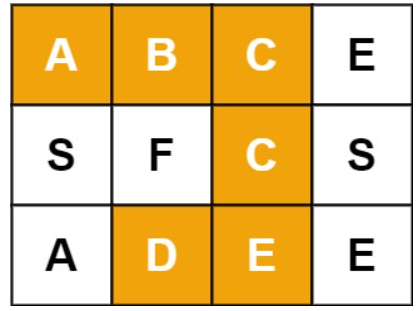
示例 1: 输入:board = [["A","B","C","E"],["S","F","C","S"],["A","D","E","E"]], word = "ABCCED" 输出:true 示例 2: 输入:board = [["a","b"],["c","d"]], word = "abcd" 输出:false 提示: 1 <= board.length <= 200 1 <= board[i].length <= 200 board 和 word 仅由大小写英文字母组成
class Solution {
    public boolean exist(char[][] board, String word) {
        for(int i=0;i<board.length;i++){
            for(int j=0;j<board[0].length;j++){
                if(board[i][j] ==word.charAt(0)){
                    if(func(i,j,board,word,0)==true){
                        return true;
                    }
                }
            }
        }
        return false;
    }

    public boolean func(int i,int j,char[][] board, String word,int index){
        if(index==word.length()){
            return true;
        }else if(i>=0 && i<board.length && j>=0 && j<board[0].length && board[i][j]==word.charAt(index) && board[i][j]!='0'){
            char temp = board[i][j];
            board[i][j] = '0';
            boolean res = func(i,j+1,board,word,index+1)||func(i+1,j,board,word,index+1)||func(i-1,j,board,word,index+1)||func(i,j-1,board,word,index+1);
            board[i][j] = temp;
            return res;
        }else{
            return false;
        }
    }
}
- 回溯
- 该题比较特殊,需要找到每一个可能的作为第一个单词的第一个字母,然后进行搜索;
10.机器人的运动范围
地上有一个m行n列的方格,从坐标 [0,0] 到坐标 [m-1,n-1] 。一个机器人从坐标 [0, 0] 的格子开始移动,它每次可以向左、右、上、下移动一格(不能移动到方格外),也不能进入行坐标和列坐标的数位之和大于k的格子。例如,当k为18时,机器人能够进入方格 [35, 37] ,因为3+5+3+7=18。但它不能进入方格 [35, 38],因为3+5+3+8=19。请问该机器人能够到达多少个格子? ```java 示例 1:
输入:m = 2, n = 3, k = 1 输出:3 示例 2:
输入:m = 3, n = 1, k = 0 输出:1
提示:
1 <= n,m <= 100 0 <= k <= 20
```java
class Solution {
    int count = 0;
    int m=0,n=0;
    byte[][] isOk;
    public int movingCount(int m, int n, int k) {
        isOk = new byte[m][n];
        this.m = m;
        this.n = n;
        fun2(0,0,k);
        /** 如果需要查看所有矩阵中所有解
        for(int i=10;i<m;i+=10){
            fun2(i,0,k);
        }
        for(int j=10;j<n;j+=10){
            fun2(0,j,k);
        }
        for(int i=10,j=10;i<m && j<n;i+=10,j+=10){
            fun2(i,j,k);
        }
         */

        return count;
    }

    // 递归搜索
    public void fun2(int i,int j,int k){
        if(!(i>=0 && i<m && j>=0 && j<n && fun1(i)+fun1(j)<=k && isOk[i][j]==0)){
            return;
        }
        count++;
        isOk[i][j] = 1;

        fun2(i+1,j,k);
        fun2(i,j+1,k);
    }

    // 计算多位数的数字和
    public int fun1(int n){
        return n%10+n/10;
    }
}
- 机器人每次只能走一步,因此部分位置是满足条件的解,但是机器人不可达;
11.剪绳子I
给你一根长度为 n 的绳子,请把绳子剪成整数长度的 m 段(m、n都是整数,n>1并且m>1),每段绳子的长度记为 k[0],k[1]…k[m-1] 。请问 k[0]k[1]…*k[m-1] 可能的最大乘积是多少?例如,当绳子的长度是8时,我们把它剪成长度分别为2、3、3的三段,此时得到的最大乘积是18。 ```latex 示例 1:
输入: 2 输出: 1 解释: 2 = 1 + 1, 1 × 1 = 1 示例 2:
输入: 10 输出: 36 解释: 10 = 3 + 3 + 4, 3 × 3 × 4 = 36 提示:
2 <= n <= 58
```java
class Solution {
    public int cuttingRope(int n) {
        /**
            根据客观规律,尽量剪成长度为3的段,得到的结果最优;
            当最后一段是3+1时,那么就剪成两端2;
         */
        int a = n%3;
        int b = n/3;
        if(n==2){
            return 1;
        }else if(n==3){
            return 2;
        }
        if(b>0){
            if(a==1){
                return 4*power(3,(b-1));
            }else if(a==2){
                return 2*power(3,b);
            }
        }
        return power(3,b);
    }
    public int power(int i,int j){
        int res = 1;
        for(int k=0;k<j;k++){
            res*=i;
        }
        return res;
    }
}

// 对于2^n这样的数进行取模,可以使用位运算提高效率
// m%(2^n) == m&(2^n-1)
12.剪绳子II
给你一根长度为 n 的绳子,请把绳子剪成整数长度的 m 段(m、n都是整数,n>1并且m>1),每段绳子的长度记为 k[0],k[1]…k[m - 1] 。请问 k[0]k[1]…*k[m - 1] 可能的最大乘积是多少?例如,当绳子的长度是8时,我们把它剪成长度分别为2、3、3的三段,此时得到的最大乘积是18。
答案需要取模 1e9+7(1000000007),如计算初始结果为:1000000008,请返回 1。
示例 1: 输入: 2 输出: 1 解释: 2 = 1 + 1, 1 × 1 = 1 示例 2: 输入: 10 输出: 36 解释: 10 = 3 + 3 + 4, 3 × 3 × 4 = 36
class Solution {
    public int cuttingRope(int n) {
        if(n==2){
            return 1;
        }else if(n==3){
            return 2;
        }
        int a = n/3;
        int b = n%3;
        long res = 0;
        if(b==0){
            res =power(3,a);
        }else if(b==1){
            res = power(3,a-1)*4;
        }else if(b==2){
            res = power(3,a)*2;
        }
        return (int)(res%1000000007);
    }

    public long power(int m,int n){
        long res = 1;
        for(int i=0;i<n;i++){
            res*=m;
            res = res%1000000007;
        }
        return res;
    }
}
13.二进制数中1的个数
编写一个函数,输入是一个无符号整数(以二进制串的形式),返回其二进制表达式中数字位数为 ‘1’ 的个数。
示例 1: 输入:n = 11 (控制台输入 00000000000000000000000000001011) 输出:3 解释:输入的二进制串 00000000000000000000000000001011 中,共有三位为 '1'。 示例 2: 输入:n = 128 (控制台输入 00000000000000000000000010000000) 输出:1 解释:输入的二进制串 00000000000000000000000010000000 中,共有一位为 '1'。 示例 3: 输入:n = 4294967293 (控制台输入 11111111111111111111111111111101,部分语言中 n = -3) 输出:31 解释:输入的二进制串 11111111111111111111111111111101 中,共有 31 位为 '1'。
public class Solution {
    // you need to treat n as an unsigned value
    public int hammingWeight(int n) {
        int count = 0;
        while(n!=0){
            if((n&1)==1){
                count++;
            }
            n = n>>>1;
        }
        return count;
    }
}
14. 数值的整数次方
实现 pow(x, n) ,即计算 x 的 n 次幂函数(即,xn)。不得使用库函数,同时不需要考虑大数问题。
示例 1: 输入:x = 2.00000, n = 10 输出:1024.00000 示例 2: 输入:x = 2.10000, n = 3 输出:9.26100 示例 3: 输入:x = 2.00000, n = -2 输出:0.25000 解释:2-2 = 1/22 = 1/4 = 0.25
class Solution {
    public double myPow(double x, int n) {
        if(x==0){
            return 0;
        }else if(x==1){
            return 1;
        }
        long b = n;
        if(b<0){
            b = -b;
            x = 1.0/x;
        }
        double res = 1;
        while(b>0){
            if((b&1)==1){
                res *= x;
            }
            x*=x;
            b>>=1;
        }
        return res;
    }
}

输入: n = 1 输出: [1,2,3,4,5,6,7,8,9]
说明:
用返回一个整数列表来代替打印 n 为正整数
```java
class Solution {
    public int[] printNumbers(int n) {
        int m = fun(n);
        int[] res = new int[m];
        for(int i=0;i<m;i++){
            res[i] = i+1;
        }
        return res;
    }
    public int fun(int n){
        return (int)Math.pow(10,n)-1;
    }
}
16. 删除链表的节点
给定单向链表的头指针和一个要删除的节点的值,定义一个函数删除该节点。
返回删除后的链表的头节点。
注意:此题对比原题有改动
示例 1: 输入: head = [4,5,1,9], val = 5 输出: [4,1,9] 解释: 给定你链表中值为 5 的第二个节点,那么在调用了你的函数之后,该链表应变为 4 -> 1 -> 9. 示例 2: 输入: head = [4,5,1,9], val = 1 输出: [4,5,9] 解释: 给定你链表中值为 1 的第三个节点,那么在调用了你的函数之后,该链表应变为 4 -> 5 -> 9.
class Solution {
    public ListNode deleteNode(ListNode head, int val) {
        ListNode res = head;
        ListNode temp = head;
        if(temp.val==val){
            return head.next;
        }
        while(temp!=null){
            if(temp.next.val==val){
                temp.next = temp.next.next;
                return res;
            }
            temp = temp.next;
        }
        return res;
    }
}
17.调整数组顺序使奇数位于偶数前面
输入一个整数数组,实现一个函数来调整该数组中数字的顺序,使得所有奇数在数组的前半部分,所有偶数在数组的后半部分。
示例:

输入:nums = [1,2,3,4]
输出:[1,3,2,4]
注:[3,1,2,4] 也是正确的答案之一。
前后指针:
class Solution {
    public int[] exchange(int[] nums) {
        int i = 0;
        int j = nums.length-1;
        while(i<j){
            while(i<j && (nums[i]&1)==1){
                i++;
            }
            while(i<j && (nums[j]&1)==0){
                j--;
            }
            int temp = nums[i];
            nums[i] = nums[j];
            nums[j] = temp;
        }
        return nums;
    }
}
顺序双指针:
class Solution {
    public int[] exchange(int[] nums) {
        // 双指针
        for(int i=0;i<nums.length;i++){
            if((nums[i]&1)==0){// 找到了第一个偶数
                for(int j=i;j<nums.length;j++){
                    if((nums[j]&1)==1){// 找一个基数与之交换位置
                        int temp = nums[i];
                        nums[i] = nums[j];
                        nums[j] = temp;
                        break;
                    }
                    if(j==nums.length-1){
                        return nums;
                    }
                }
            }
        }
        return nums;
    }
}
18. 链表的倒数第k个节点
输入一个链表,输出该链表中倒数第k个节点。为了符合大多数人的习惯,本题从1开始计数,即链表的尾节点是倒数第1个节点。
例如,一个链表有 6 个节点,从头节点开始,它们的值依次是 1、2、3、4、5、6。这个链表的倒数第 3 个节点是值为 4 的节点。
示例: 给定一个链表: 1->2->3->4->5, 和 k = 2. 返回链表 4->5.
class Solution {
    public ListNode getKthFromEnd(ListNode head, int k) {
        // 双指针
        ListNode poninter1 = head;
        ListNode poninter2 = head;
        for(int i=0;i<k;i++){
            poninter1 = poninter1.next;
        }
        while(poninter1!=null){
            poninter1 = poninter1.next;
            poninter2 = poninter2.next;
        }
        return poninter2;
    }
}
19.反转链表
定义一个函数,输入一个链表的头节点,反转该链表并输出反转后链表的头节点。
示例: 输入: 1->2->3->4->5->NULL 输出: 5->4->3->2->1->NULL
class Solution {
    public ListNode reverseList(ListNode head) {
        // 头插法
        ListNode res = new ListNode();
        ListNode temp = head;
        while(temp!=null){
            ListNode newNode = new ListNode(temp.val);
            newNode.next = res.next;
            res.next = newNode;
            temp = temp.next;
        }
        return res.next;
    }
}
20.合并两个排序链表
输入两个递增排序的链表,合并这两个链表并使新链表中的节点仍然是递增排序的。
示例1: 输入:1->2->4, 1->3->4 输出:1->1->2->3->4->4 限制: 0 <= 链表长度 <= 1000
class Solution {
    public ListNode mergeTwoLists(ListNode l1, ListNode l2) {
        ListNode res = new ListNode();
        ListNode temp = res;
        while(l1!=null && l2!=null){
            if(l1.val <= l2.val){
                temp.next = new ListNode(l1.val);
                l1 = l1.next;
            }else{
                temp.next = new ListNode(l2.val);
                l2 = l2.next;
            }
            temp = temp.next;
        }
        if(l1==null){
            while(l2!=null){
                temp.next = new ListNode(l2.val);
                temp = temp.next;
                l2 = l2.next;
            }
        }
        if(l2==null){
            while(l1!=null){
                temp.next = new ListNode(l1.val);
                temp = temp.next;
                l1 = l1.next;
            }
        }
        return res.next;
    }
}
21.二叉树的镜像
请完成一个函数,输入一个二叉树,该函数输出它的镜像。
例如输入: 4 / \ 2 7 / \ / \ 1 3 6 9 镜像输出: 4 / \ 7 2 / \ / \ 9 6 3 1 示例 1: 输入:root = [4,2,7,1,3,6,9] 输出:[4,7,2,9,6,3,1]
class Solution {
    public TreeNode mirrorTree(TreeNode root) {
        fun(root);
        return root;
    }
    public void fun(TreeNode root){
        if(root==null) return;
        TreeNode temp = root.left;
        root.left = root.right;
        root.right = temp;
        fun(root.left);
        fun(root.right);
    }
}
22.对称的二叉树
请实现一个函数,用来判断一棵二叉树是不是对称的。如果一棵二叉树和它的镜像一样,那么它是对称的。
例如,二叉树 [1,2,2,3,4,4,3] 是对称的。 1 / \ 2 2 / \ / \ 3 4 4 3 但是下面这个 [1,2,2,null,3,null,3] 则不是镜像对称的: 1 / \ 2 2 \ \ 3 3 示例 1: 输入:root = [1,2,2,3,4,4,3] 输出:true 示例 2: 输入:root = [1,2,2,null,3,null,3] 输出:false
class Solution {
    public boolean isSymmetric(TreeNode root) {
        if(root==null){
            return true;
        }else{
            return fun(root.left,root.right);
        }
    }
    public boolean fun(TreeNode left,TreeNode right){
        if(left==null && right==null){
            return true;
        }else if(left==null || right==null){
            return false;
        }else{
            if(left.val == right.val){
                return fun(left.left,right.right)&&fun(left.right,right.left);
            }
        }
        return false;
    }
}
23.顺时针打印矩阵
输入一个矩阵,按照从外向里以顺时针的顺序依次打印出每一个数字。
示例 1: 输入:matrix = [[1,2,3],[4,5,6],[7,8,9]] 输出:[1,2,3,6,9,8,7,4,5] 示例 2: 输入:matrix = [[1,2,3,4],[5,6,7,8],[9,10,11,12]] 输出:[1,2,3,4,8,12,11,10,9,5,6,7]
class Solution {
    int[] res;
    int index = 0;
    public int[] spiralOrder(int[][] matrix) {
        if(matrix.length==0){
            return new int[]{};
        }
        res = new int[matrix.length*matrix[0].length];
        fun(matrix,0,0,1);
        return res;
    }
    public void fun(int[][] matrix,int i,int j,int k){
        if(i>=0 && i<matrix.length && j>=0 && j<matrix[0].length && matrix[i][j]!=-8){
            res[index++] = matrix[i][j];
            matrix[i][j] = -8;
            if(k==1){
                fun(matrix,i,j+1,1);
                fun(matrix,i+1,j,2);
            }else if(k==2){
                fun(matrix,i+1,j,2);
                fun(matrix,i,j-1,3);
            }else if(k==3){
                fun(matrix,i,j-1,3);
                fun(matrix,i-1,j,4);
            }else{
                fun(matrix,i-1,j,4);
                fun(matrix,i,j+1,1);
            }
        }
    }
}
24.包含min函数的栈
定义栈的数据结构,请在该类型中实现一个能够得到栈的最小元素的 min 函数在该栈中,调用 min、push 及 pop 的时间复杂度都是 O(1)。
示例: MinStack minStack = new MinStack(); minStack.push(-2); minStack.push(0); minStack.push(-3); minStack.min(); --> 返回 -3. minStack.pop(); minStack.top(); --> 返回 0. minStack.min(); --> 返回 -2.
class MinStack {

    int[] stack1 = new int[10000];
    int[] stack2 = new int[10000];
    int index1 = -1;
    int index2 = -1;
    int min = 0;

    /** initialize your data structure here. */
    public MinStack() {

    }

    public void push(int x) {
        stack1[++index1] = x;
        if(index2==-1||x<=min){
            min = x;
            stack2[++index2] = x;
        }
    }

    public void pop() {
        if(index1==-1){
            return;
        }
        if(stack1[index1]==stack2[index2]){
            index2--;
            if(index2!=-1){
                min = stack2[index2];
            }
        }
        index1--;
    }

    public int top() {
        return stack1[index1];
    }

    public int min() {
        return stack2[index2];
    }
}
25.栈的压入、弹出序列
输入两个整数序列,第一个序列表示栈的压入顺序,请判断第二个序列是否为该栈的弹出顺序。假设压入栈的所有数字均不相等。例如,序列 {1,2,3,4,5} 是某栈的压栈序列,序列 {4,5,3,2,1} 是该压栈序列对应的一个弹出序列,但 {4,3,5,1,2} 就不可能是该压栈序列的弹出序列。
示例 1:

输入:pushed = [1,2,3,4,5], popped = [4,5,3,2,1]
输出:true
解释:我们可以按以下顺序执行:
push(1), push(2), push(3), push(4), pop() -> 4,
push(5), pop() -> 5, pop() -> 3, pop() -> 2, pop() -> 1
示例 2:

输入:pushed = [1,2,3,4,5], popped = [4,3,5,1,2]
输出:false
解释:1 不能在 2 之前弹出。
class Solution {
    public boolean validateStackSequences(int[] pushed, int[] popped) {
        // 设置一个栈来模拟
        Stack<Integer> stack = new Stack<>();
        int i = 0;
        int j = 0;
        for(;i<pushed.length;i++){
            stack.push(pushed[i]);
            while(j<popped.length && !stack.isEmpty() && stack.peek()==popped[j]){
                stack.pop();
                j++;
            }

        }
        if(j>=popped.length){
            return true;
        }else{
            return false;
        }
    }
}
class Solution {
    public boolean validateStackSequences(int[] pushed, int[] popped) {
        // 设置一个栈来模拟
        Stack<Integer> stack = new Stack<>();
        int i = 0;
        for(int n : pushed){
            stack.push(n);
            while(!stack.isEmpty() && stack.peek()==popped[i]){
                stack.pop();
                i++;
            }

        }
        return stack.isEmpty();
    }
}
26.从上到下打印二叉树
层序遍历
从上到下按层打印二叉树,同一层的节点按从左到右的顺序打印,每一层打印到一行。
例如: 给定二叉树: [3,9,20,null,null,15,7], 3 / \ 9 20 / \ 15 7 返回其层次遍历结果: [ [3], [9,20], [15,7] ]
/**
 * Definition for a binary tree node.
 * public class TreeNode {
 *     int val;
 *     TreeNode left;
 *     TreeNode right;
 *     TreeNode(int x) { val = x; }
 * }
 */
class Solution {
    Queue<TreeNode> queue = new LinkedList<>();
    List<List<Integer>> res = new ArrayList<>();
    public List<List<Integer>> levelOrder(TreeNode root) {
        if(root!=null){
            queue.add(root);
            queue.add(new TreeNode(Integer.MAX_VALUE));
        }
        List<Integer> list = new ArrayList<>();
        while(!queue.isEmpty()){
            TreeNode temp = queue.poll();
            if(temp.val==Integer.MAX_VALUE){
                res.add(list);
                list = new ArrayList<>();
                if(queue.isEmpty()){
                    break;
                }
                queue.add(new TreeNode(Integer.MAX_VALUE));
                continue;
            }
            list.add(temp.val);
            if(temp.left!=null){
                queue.add(temp.left);
            }
            if(temp.right!=null){
                queue.add(temp.right);
            }
        }
        return res;
    }
}
关于队列中每一层标记的优秀解法:获取队列的大小size;
class Solution {
    public List<List<Integer>> levelOrder(TreeNode root) {
        Queue<TreeNode> queue = new LinkedList<>();
        List<List<Integer>> res = new ArrayList<>();
        if(root!=null){
            queue.add(root);
        }
        while(!queue.isEmpty()){
            int size = queue.size();
            List<Integer> list = new ArrayList<>();
            for(int i=0;i<size;i++){
                TreeNode temp = queue.poll();
                list.add(temp.val);
                if(temp.left!=null){
                queue.add(temp.left);
                }
                if(temp.right!=null){
                    queue.add(temp.right);
                }
            }
            res.add(list);
        }
        return res;
    }
}
27.从上到下打印二叉树2
请实现一个函数按照之字形顺序打印二叉树,即第一行按照从左到右的顺序打印,第二层按照从右到左的顺序打印,第三行再按照从左到右的顺序打印,其他行以此类推。
例如: 给定二叉树: [3,9,20,null,null,15,7], 3 / \ 9 20 / \ 15 7 返回其层次遍历结果: [ [3], [20,9], [15,7] ]
class Solution {
    public List<List<Integer>> levelOrder(TreeNode root) {
        List<List<Integer>> res = new ArrayList<>();
        Queue<TreeNode> queue = new LinkedList<>();
        if(root!=null){
            queue.add(root);
        }
        while(!queue.isEmpty()){
            int size = queue.size();
            LinkedList<Integer> list = new LinkedList<>();
            for(int i=0;i<size;i++){
                TreeNode temp = queue.poll();
                if(res.size()%2==0){
                    list.addLast(temp.val);
                }else{
                    list.addFirst(temp.val);
                }
                if(temp.left!=null){
                    queue.add(temp.left);
                }
                if(temp.right!=null){
                    queue.add(temp.right);
                }
            }
            res.add(list);
        }
        return res;
    }
}
28.数组中出现次数超过一半的数字
数组中有一个数字出现的次数超过数组长度的一半,请找出这个数字。
你可以假设数组是非空的,并且给定的数组总是存在多数元素。
示例 1: 输入: [1, 2, 3, 2, 2, 2, 5, 4, 2] 输出: 2
class Solution {
    public int majorityElement(int[] nums) {
        /**
        1. 使用Hash来计数统计重复值的个数,然后遍历哈希表,比较值是否大于数组长度的一半;
        2. 排序,由于该众数超过了数组长度的一半,所以排序后数组中最中间位置必然是该众数;
        3. 摩尔投票法,众数超过数组元素个数的一半,所以可以让不同的数相互抵消,最终留下的必然是众数;
         */
        // 摩尔投票法
        int x = 0,vote = 0;
        for(int num : nums){
            if(vote==0){
                x = num;
            }
            vote += num==x?1:-1;
        }
        return x;
    }
}
29.复杂链表的复制
请实现 copyRandomList 函数,复制一个复杂链表。在复杂链表中,每个节点除了有一个 next 指针指向下一个节点,还有一个 random 指针指向链表中的任意节点或者 null。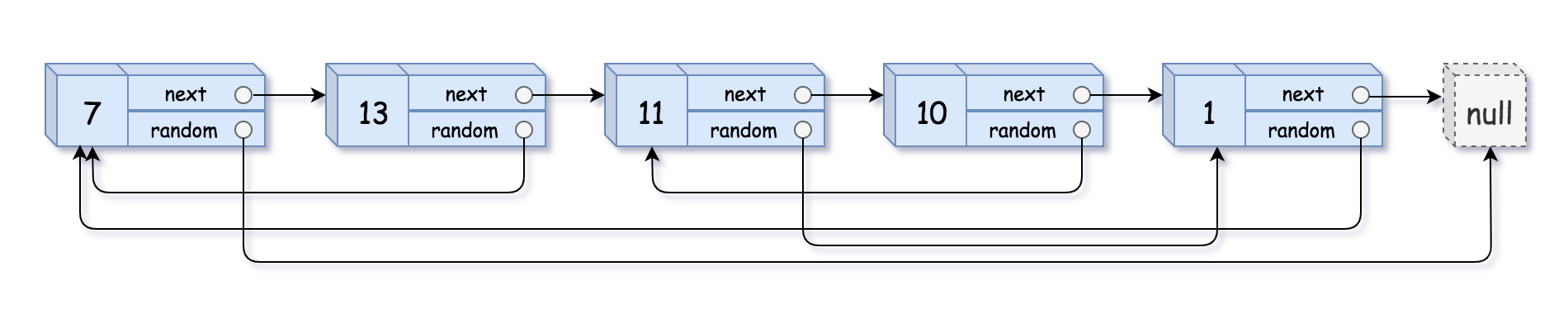

示例 1: 输入:head = [[7,null],[13,0],[11,4],[10,2],[1,0]] 输出:[[7,null],[13,0],[11,4],[10,2],[1,0]] 示例 2: 输入:head = [[1,1],[2,1]] 输出:[[1,1],[2,1]]
/*
// Definition for a Node.
class Node {
    int val;
    Node next;
    Node random;

    public Node(int val) {
        this.val = val;
        this.next = null;
        this.random = null;
    }
}
*/
class Solution {
    public Node copyRandomList(Node head) {
        if(head == null) return null;
        // 添加到hash中
        Node cur = head;
        Map<Node,Node> map = new HashMap<>();
        while(cur!=null){
            map.put(cur,new Node(cur.val));
            cur = cur.next;
        }
        cur = head;
        Node res = map.get(cur);
        Node temp = res;
        while(cur!=null){
            temp.next = map.get(cur.next);
            temp.random = map.get(cur.random);
            cur = cur.next;
            temp = temp.next;
        }
        return res;
    }
}
30.连续子数组的最大和
输入一个整型数组,数组中的一个或连续多个整数组成一个子数组。求所有子数组的和的最大值。
要求时间复杂度为O(n)。
示例1: 输入: nums = [-2,1,-3,4,-1,2,1,-5,4] 输出: 6 解释: 连续子数组 [4,-1,2,1] 的和最大,为 6。
class Solution {
    public int maxSubArray(int[] nums) {
        int res = nums[0];
        for(int i=1;i<nums.length;i++){
            nums[i] += Math.max(nums[i-1],0);
            res = Math.max(res,nums[i]);
        }
        return res;
    }
}
31.数字数列中某一位数字
数字以0123456789101112131415…的格式序列化到一个字符序列中。在这个序列中,第5位(从下标0开始计数)是5,第13位是1,第19位是4,等等。
请写一个函数,求任意第n位对应的数字。
示例 1: 输入:n = 3 输出:3 示例 2: 输入:n = 11 输出:0
class Solution {
    public int findNthDigit(int n) {
        if(n<10){
            return n;
        }
        long x = 10;
        long y = 2;
        long sum = n-9;
        while(true){
            long temp = (x*10-x)*y;
            if(sum<temp){
                long a = (sum-1)%y;
                long b = (sum-1)/y;
                String s = ""+(x+b);
                char c = s.charAt((int)a);
                return c-'0';
            }
            x*=10;
            y++;
            sum -= temp;
        }
    }
}


/**
9   90      900     9000
9   180     2700    36000


 */
32.把数字翻译成字符串
给定一个数字,我们按照如下规则把它翻译为字符串:0 翻译成 “a” ,1 翻译成 “b”,……,11 翻译成 “l”,……,25 翻译成 “z”。一个数字可能有多个翻译。请编程实现一个函数,用来计算一个数字有多少种不同的翻译方法。
示例 1: 输入: 12258 输出: 5 解释: 12258有5种不同的翻译,分别是"bccfi", "bwfi", "bczi", "mcfi"和"mzi" 提示: 0 <= num < 231
class Solution {
    public int translateNum(int num) {
        String s = num+"";
        int a = 1, b = 1;
        int length = s.length();
        for(int i = 0;i<length-1;i++){
            String temp = s.substring(i,i+2);
            int c = temp.compareTo("10")>=0 && temp.compareTo("25")<=0 ? a+b : b;
            a = b;
            b = c;
        }
        return b;
    }
}
33.礼物的最大价值
在一个 m*n 的棋盘的每一格都放有一个礼物,每个礼物都有一定的价值(价值大于 0)。你可以从棋盘的左上角开始拿格子里的礼物,并每次向右或者向下移动一格、直到到达棋盘的右下角。给定一个棋盘及其上面的礼物的价值,请计算你最多能拿到多少价值的礼物?
示例 1: 输入: [ [1,3,1], [1,5,1], [4,2,1] ] 输出: 12 解释: 路径 1→3→5→2→1 可以拿到最多价值的礼物
class Solution {
    public int maxValue(int[][] grid) {
        // 动态规划
        int a = 0,b = 0;
        for(int i=0;i<grid.length;i++){
            for(int j=0;j<grid[0].length;j++){
                if(i-1<0){
                    a = 0;
                }else{
                    a = grid[i-1][j];
                }
                if(j-1<0){
                    b = 0;
                }else{
                    b = grid[i][j-1];
                }
                grid[i][j]+=Math.max(a,b);
            }
        }
        return grid[grid.length-1][grid[0].length-1];
    }
}

若有收获,就点个赞吧
0 人点赞


