二叉树节点结构
public class Node<V> {V value;Node<V> left;Node<V> right;public Node(V value) {this.value = value;}}
工具类
import java.util.HashMap;import java.util.Map;public class TreeGenerator {/*** 根据传入数组按照层级生成一棵树*/public static Node getTree(int[] arr) {if (arr == null || arr.length == 0) return null;Map<Integer, Node> map = new HashMap<>();for (int i = 0; i < arr.length; i++) {map.put(i, new Node(arr[i]));}for (int i = 1; i < arr.length; i++) {// 父节点int index = (i - 1) / 2;Node node = map.get(index);if (node.left == null) {node.left = map.get(i);} else {node.right = map.get(i);}}return map.get(0);}}
遍历
递归实现
使用递归实现二叉树的前序、中序、后序遍历
public class RecursionTraversal {

    public static void preorder(Node tree) {
        if (tree == null) return;
        System.out.print(tree.value + "\t");
        preorder(tree.left);
        preorder(tree.right);
    }

    public static void middleOrder(Node tree) {
        if (tree == null) return;
        middleOrder(tree.left);
        System.out.print(tree.value + "\t");
        middleOrder(tree.right);
    }

    public static void postorder(Node tree) {
        if (tree == null) return;
        postorder(tree.left);
        postorder(tree.right);
        System.out.print(tree.value + "\t");
    }

    public static void main(String[] args) {
        Node tree = TreeGenerator.getTree(new int[]{1, 2, 3, 4, 5, 6});
        preorder(tree);
        System.out.println();
        middleOrder(tree);
        System.out.println();
        postorder(tree);
    }
}
非递归实现
使用非递归实现二叉树的前序、中序、后序遍历
思路:使用栈结构
前序遍历步骤:
- 将当前节点压栈并打印当前节点 value 后弹出
- 按照先右子节点后左子节点的顺序压栈
- 打印顶端节点 value 并弹出,重复第 2 步
中序遍历步骤:
- 将当前节点已经当前节点的所有左子节点依次压入栈
- 弹出顶部节点,并打印 value
- 将弹出节点的右子树执行 第 1 步
后续遍历:使用两个栈,分别为 stack 和 stackHead
- 当前节点压入 stack 中
- stack 顶部节点弹出,并压入 stackHead 中
- stackHead 顶部节点弹出,将该节点的左右子节点压入 stack 中,循环第 1 步,直到 stack 栈为空
- 弹出 stackHead 栈中的所有节点并打印 value ```java import java.util.Stack;
public class NotRecursionTraversal {
public static void preorder(Node tree) {
    if (tree == null) return;

    Stack<Node> stack = new Stack<>();
    stack.push(tree);

    while (!stack.empty()) {
        Node node = stack.pop();
        System.out.print(node.value + "\t");
        if (node.right != null) stack.push(node.right);
        if (node.left != null) stack.push(node.left);
    }
}

public static void middleOrder(Node tree) {
    if (tree == null) return;

    Stack<Node> stack = new Stack<>();
    Node cur = tree;
    while (!stack.empty() || cur != null) {
        if (cur != null) {
            stack.push(cur);
            cur = cur.left;
        } else {
            cur = stack.pop();
            System.out.print(cur.value + "\t");
            cur = cur.right;
        }
    }
}

public static void postorder(Node tree) {
    if (tree == null) return;

    Stack<Node> stack = new Stack<>();
    Stack<Node> stackHead = new Stack<>();

    stack.push(tree);
    while (!stack.empty()) {
        Node cur = stack.pop();
        stackHead.push(cur);
        if (cur.left != null) stack.push(cur.left);
        if (cur.right != null) stack.push(cur.right);
    }

    while (!stackHead.empty()) {
        System.out.print(stackHead.pop().value + "\t");
    }
}

public static void main(String[] args) {
    Node tree = TreeGenerator.getTree(new int[]{1, 2, 3, 4, 5, 6});
    preorder(tree);
    System.out.println();
    middleOrder(tree);
    System.out.println();
    postorder(tree);
}
}
<a name="26HWR"></a>
## 宽度优先遍历

宽度优先遍历,可以叫做层序遍历,就是把二叉树逐层遍历。<br />思路:使用队列 queue,把当前节点放入 queue 中,弹出后依次把当前节点的左右子节点放入 queue 中,直到 queue 中所有元素弹出,就完成了遍历
```java
public static void traversal(Node head) {
    if (head == null) return;
    Queue<Node> queue = new LinkedList<>();
    queue.add(head);

    while (!queue.isEmpty()) {
        Node cur = queue.poll();
        System.out.print(cur.value + "\t");

        if (cur.left != null) queue.add(cur.left);
        if (cur.right != null) queue.add(cur.right);
    }
    System.out.println();
}
能否在得到一个二叉树的宽度?
思路:
需要的变量:
- 一个 map 记录每个节点对应的是在第几层的
- 一个记录当前遍历到第几层的
int level - 一个记录当前层级宽度的
int levelWidth - 一个记录最大宽度的
int maxWidth - 一个队列
步骤:
- 将头节点放入队列
- 开始遍历树
- 通过 map 获取当前节点是在第几层级 curLevel
- 如果 curLevel == level,说明该节点是当前遍历的层级,该层级节点数 +1, 即
levelWidth ++; - 如果 curLevel != level,说明一件开始遍历下一层级,当前层级宽度 levelWidth 已经统计完成,需要做的操作有
- 比较是否需要更新最大宽度
maxWidth = Math.max(maxWidth, levelWidth) - 当新的层级宽度置为 1,
levelWidth = 1 - 遍历层级加一,
level++
- 比较是否需要更新最大宽度
- 如果 curLevel == level,说明该节点是当前遍历的层级,该层级节点数 +1, 即
- 将当前节点的左右子节点放到队列中,并且存放到 map 中记录层级为下一层
以上过程可以获取到的有:
- 最大宽度
maxWidth - 最大深度
level - 每一层的宽度
level - 优先遍历(层序遍历) ```java import java.util.HashMap; import java.util.LinkedList; import java.util.Map; import java.util.Queue;
public class MaxWidth {
public static int getMaxWidth(Node head) {
    if (head == null) return 0;

    // 记录节点对应的层级
    Map<Node, Integer> map = new HashMap<>();
    // 当前遍历的层级
    int level = 1;
    // 当前层级的宽度
    int levelWidth = 0;
    // 最大宽度
    int maxWidth = 1;

    map.put(head, level);

    Queue<Node> queue = new LinkedList<>();
    queue.add(head);
    while (!queue.isEmpty()) {
        Node cur = queue.poll();
        System.out.print(cur.value + "\t");

        // 当前节点对应的层级
        Integer curLevel = map.get(cur);
        if (curLevel == level) {
            levelWidth++;
        } else {
            // 说明一件开始遍历下一层级,当前层级宽度 levelWidth 已经统计完成
            maxWidth = Math.max(maxWidth, levelWidth);
            levelWidth = 1;
            level++;
        }

        if (cur.left != null) {
            queue.add(cur.left);
            map.put(cur.left, level + 1);
        }
        if (cur.right != null) {
            queue.add(cur.right);
            map.put(cur.right, level + 1);
        }
    }
    System.out.println();
    return maxWidth;
}

public static void main(String[] args) {
    /**
     *              0
     *            /   \
     *          1      2
     *       /          \
     *      3            4
     *    /             / \
     *   6             5   8
     *    \
     *      7
     */
    Node head = new Node(0);

    Node node1 = new Node(1);
    Node node2 = new Node(2);
    Node node3 = new Node(3);
    Node node4 = new Node(4);
    Node node5 = new Node(5);
    Node node6 = new Node(6);
    Node node7 = new Node(7);
    Node node8 = new Node(8);

    head.left = node1;
    head.right = node2;
    node1.left = node3;
    node3.left = node6;
    node6.right = node7;
    node2.right = node4;
    node4.left = node5;
    node4.right = node8;

    System.out.println(getMaxWidth(head));
}
}
结果
0 1 2 3 4 6 5 8 7
3
也可以有更简单些的做法:直接对记录节点对应层级的哈希表进行统计,得到每层对应的节点数<br />虽然代码看起来多了,但是不用处理那么多的变量了
```java
public static int getMaxWidth(Node head) {
    if (head == null) return 0;

    // 记录节点对应的层级
    Map<Node, Integer> nodeLevelMap = new HashMap<>();

    int level = 1;
    nodeLevelMap.put(head, level);

    Queue<Node> queue = new LinkedList<>();
    queue.add(head);
    while (!queue.isEmpty()) {
        Node cur = queue.poll();

        // 当前节点对应的层级
        Integer curLevel = nodeLevelMap.get(cur);
        if (curLevel != level) {
            // 已经遍历到下一层
            level++;
        }

        if (cur.left != null) {
            queue.add(cur.left);
            nodeLevelMap.put(cur.left, level + 1);
        }
        if (cur.right != null) {
            queue.add(cur.right);
            nodeLevelMap.put(cur.right, level + 1);
        }
    }

    // 统计每个层级的节点数
    Map<Integer, Integer> levelCountMap = new HashMap<>();

    for (Map.Entry<Node, Integer> entry : nodeLevelMap.entrySet()) {
        Integer value = entry.getValue();
        if (!levelCountMap.containsKey(value)) {
            levelCountMap.put(value, 0);
        }
        levelCountMap.put(value, levelCountMap.get(value) + 1);
    }

    int maxWidth = -1;

    for (Map.Entry<Integer, Integer> entry : levelCountMap.entrySet()) {
        maxWidth = Math.max(maxWidth, entry.getValue());
    }

    return maxWidth;
}
不使用 map 的思路:
使用到的变量/容器:
- 一个队列
queue:用于层级遍历 int maxWidth:记录最大宽度int curWidth:当前层级宽度Node curEnd:当前层级最后一个节点Node nextEnd:下一层级最后一个节点
步骤:遍历树,在遍历中执行
- 弹出当前节点时,先将当前节点的左右子节点依次放入 queue 中,每放入一个子节点就将
nextEnd更新。(因为本层最后一个节点被弹出了后,下一层的最后一个节点一定是本层的某个子节点,也就是说nextEnd必定为下一层的最后一个节点) - 判断当前节点是否是本层的最后一个节点:
不是最后一个节点,本层宽度 curWidth ++
是最后一个节点,需要:
- 更新最大宽度
- 将本层最后一个节点
curEnd指向下一层最后一个节点nextEnd 重置
curWidth为 1public static int getMaxWidth(Node head) { if (head == null) return 0; // 最大宽度 int maxWidth = 1; // 当前层级最后一个节点 Node curEnd = head; // 下一层级最后一个节点 Node nextEnd = null; // 当前层级宽度 int curWidth = 1; Queue<Node> queue = new LinkedList<>(); queue.add(head); while (!queue.isEmpty()) { Node cur = queue.poll(); if (cur.left != null) { queue.add(cur.left); nextEnd = cur.left; } if (cur.right != null) { queue.add(cur.right); nextEnd = cur.right; } if (cur == curEnd) { // 已经遍历到当前层级最后一个 maxWidth = Math.max(maxWidth, curWidth); curEnd = nextEnd; curWidth = 1; } else { curWidth++; } } return maxWidth; }相关实现判断
判断一棵树是否是搜索二叉树?
搜索二叉树:左子节点的值全部小于父节点,右子节点的值全部大于父节点
思路:左 < 中 < 右 使用中序遍历来判断
判断一棵树是否是完全二叉树?
完全二叉树:若设二叉树的深度为 n,除第 n 层外,其它各层 (1~n-1) 的结点数都达到最大个数,第 n 层所有的结点都连续集中在最左边,这就是完全二叉树。
思路:
每层都是满的使用层级遍历,如果遇到以下情况就不是完全二叉树:
- 某个节点有右子节点没有左子节点
- 在满足 1 的条件下,如果遇到了第一个节点的子节点不全,那么后续的所有的节点都不会有子节点(这个节点在 n-1层,是最后一个有子节点的节点)
判断一棵树是否是满二叉树?
满二叉树:除最后一层无任何子节点外,每一层上的所有结点都有两个子结点的二叉树。
思路1:最大深度为 n,节点数为  个,获取最大深度和节点总数看是否符合条件
思路2:参考上面判断完全二叉树逻辑,在遍历每层时判断本层节点数量是否是上层的 2 倍
判断一棵树是否是平衡二叉树?
平衡二叉树:任意节点的子树的高度差都小于等于1
思路:
要满足是平衡二叉树就需要同时满足以下条件:
- 左子树是平衡二叉树
- 右子树是平衡二叉树
| 左树高度 - 右树高度 | <= 1
public class IsBalancedTree {
  public static boolean isBalancedTree(Node head) {
      return process(head).isBalanced;
  }

  /**
   * 返回数据结构
   */
  public static class ReturnType {
      // 是否平衡
      public boolean isBalanced;
      // 树高度
      public int height;

      public ReturnType(boolean isBalanced, int height) {
          this.isBalanced = isBalanced;
          this.height = height;
      }
  }

  public static ReturnType process(Node node) {
      if (node == null) return new ReturnType(true, 0);

      ReturnType leftData = process(node.left);
      ReturnType rightData = process(node.right);

      // 当前树高度
      int height = Math.max(leftData.height, rightData.height) + 1;
      // 是否是平衡树
      boolean isBalanced = leftData.isBalanced && rightData.isBalanced && Math.abs(leftData.height - rightData.height) <= 1;
      return new ReturnType(isBalanced, height);
  }
}
以上可以总结出二叉树DP(动态规划)的一些套路:如果可以分别向左右子树去要一些信息就能得出结论,统一可以以下的模板来解决
public class xxxClass {
  public static boolean isXXX(Node head) {
      return process(head).isXXX;
  }

  /**
   * 返回数据结构
   */
  public static class ReturnType {
      // 具体要想左右子树获取的信息

      public ReturnType(……) {
          // 全参构造
      }
  }

  public static ReturnType process(Node<Integer> node) {
      if (node == null) {
          // 这里看情况返回 null 或者 new ReturnType(……)
          return null;
      }
      ReturnType leftData = process(node.left);
      ReturnType rightData = process(node.right);

      // 根据 leftData 和 rightData 来获取当前节点信息

      return new ReturnType(……);
  }
}
例如上面判断一棵树是否是搜索二叉树也可以使用这个套路:
左子树是 BST 树
- 右子树是 BST 树
- 左子树的最大值 < 当前节点 && 右子树的最小值 > 当前节点
综上,向左右子树获取的信息有
- 树的最大值
- 树的最小值
当前树是否是搜索二叉树
public class IsBST {
  public static boolean isBST(Node head) {
      return process(head).isBST;
  }

  /**
   * 返回数据结构
   */
  public static class ReturnType {
      // 是否是搜索二叉树
      public boolean isBST;
      // 树最大值
      public int max;
      // 树最小值
      public int min;

      public ReturnType(boolean isBST, int max, int min) {
          this.isBST = isBST;
          this.max = max;
          this.min = min;
      }
  }

  public static ReturnType process(Node<Integer> node) {
      if (node == null) return null;

      ReturnType leftData = process(node.left);
      ReturnType rightData = process(node.right);

      int max = node.value;
      int min = node.value;
      if (leftData != null) {
          max = Math.max(max, leftData.max);
          min = Math.min(min, leftData.min);
      }
      if (rightData != null) {
          max = Math.max(max, rightData.max);
          min = Math.min(min, rightData.min);
      }

      // 是否是平衡树
      boolean isBST = true;
      if (leftData != null && (!leftData.isBST || leftData.max >= node.value)) {
          isBST = false;
      }
      if (rightData != null && (!rightData.isBST || rightData.min <= node.value)) {
          isBST = false;
      }

      return new ReturnType(isBST, max, min);
  }
}
公共祖先节点
给定两个二叉树的节点 nodeA 和 nodeB,找到他们的最低公共祖先节点
方法一:
- 遍历树,将所有节点和该节点的父节点保存到哈希表中
- 将哈希表中所有 nodeA 的父节点放到 set 中
- 遍历 nodeB 的所有父节点,如果在 set 中存在,该节点就是最低公共祖先节点 ```java import java.util.HashMap; import java.util.HashSet; import java.util.Set;
public class LowestAncestor {
public static Node lowestAncestor1(Node head, Node nodeA, Node nodeB) {
    HashMap<Node, Node> fatherMap = new HashMap<>();
    fatherMap.put(head, head);
    process(head, fatherMap);

    Set<Node> set = new HashSet<>();
    Node cur = nodeA;
    while (cur != fatherMap.get(cur)) {
        set.add(cur);
        cur = fatherMap.get(cur);
    }
    set.add(head);

    cur = nodeB;
    while (cur != fatherMap.get(cur)) {
        if (set.contains(cur)) return cur;
        cur = fatherMap.get(cur);
    }
    return head;
}

public static void process(Node head, HashMap<Node, Node> fatherMap) {
    if (head == null) return;

    fatherMap.put(head.left, head);
    fatherMap.put(head.right, head);

    process(head.left, fatherMap);
    process(head.right, fatherMap);
}

public static void main(String[] args) {

    /**
     *              a
     *            /   \
     *           b     c
     *          /
     *         e
     *       /   \
     *      j     f
     *          / \
     *         h   g
     */
    Node a = new Node("a");
    Node b = new Node("b");
    Node c = new Node("c");
    Node d = new Node("d");
    Node e = new Node("e");
    Node f = new Node("f");
    Node g = new Node("g");
    Node h = new Node("h");
    Node j = new Node("j");

    a.left = b;
    a.right = c;
    b.left = d;
    d.left = e;
    e.right = f;
    e.left = j;
    f.right = g;
    f.left = h;

    System.out.println(lowestAncestor1(a, d, g));
    System.out.println(lowestAncestor1(a, j, h));
}
}
方法二:这个思路画个图看会好点,不画图说不清,具体思路略……
```java
public static Node lowestAncestor(Node head, Node nodeA, Node nodeB) {
    if (head == null || head == nodeA || head == nodeB) {
        return head;
    }

    Node left = lowestAncestor(head.left, nodeA, nodeB);
    Node right = lowestAncestor(head.right, nodeA, nodeB);

    if (left != null && right != null) {
        return head;
    }

    return left != null ? left : right;
}
方法三:使用 DP 套路:如果某个节点的已经满足了既存在 nodeA 又存在 nodeB 就返回
public static Node lowestAncestor(Node head, Node nodeA, Node nodeB) {
    return process(head, nodeA, nodeB).node;
}

public static class ReturnType {
    boolean existA;
    boolean existB;

    Node node = null;

    public ReturnType(boolean existA, boolean existB) {
        this.existA = existA;
        this.existB = existB;
    }
}

public static ReturnType process(Node head, Node nodeA, Node nodeB) {
    if (head == null) {
        return new ReturnType(false, false);
    }

    ReturnType leftData = process(head.left, nodeA, nodeB);
    if (leftData.node != null) return leftData;

    ReturnType rightData = process(head.right, nodeA, nodeB);
    if (rightData.node != null) return rightData;

    boolean existA = leftData.existA || rightData.existA || head == nodeA;
    boolean existB = leftData.existB || rightData.existB || head == nodeB;

    if (existA && existB) {
        ReturnType returnType = new ReturnType(true, true);
        returnType.node = head;
        return returnType;
    }

    return new ReturnType(existA, existB);
}
后继节点
在二叉树中找到一个节点的后继节点
现有一种新的二叉树节点类型如下:
public class Node {
    int value;
    Node left;
    Node right;
    Node parent;

    public Node() {}

    public Node(int value) {
        this.value = value;
    }

    @Override
    public String toString() {
        return "Node{" +
                "value=" + value +
                '}';
    }
}
该结构比普通二叉树节点结构多了一个指向父节点的parent指针。
假设有一标 Node 类型的节点组成的二叉树,树中每个节点的 parent 指针都正确地指向自己的父节点,头节点的 parent 指向 null。
只给一个在二叉树中的某个节点 node,请实现返回 node 的后继节点的函数。
在二叉树的中序遍历的序列中,node 的下一个节点叫作 node 的后继节点。
思路:这里提供了父节点指针,也就不用中序遍历就可以找到后继节点,假设 node 和它的后继节点距离为 k,最少只需要 k 次就可以找到后继节点
- node 有右子树,后继为右子树上的最左子节点
node 无右子树,就向上找父节点,直到找到 node 是父节点的左子树,后继节点就是该父节点;如果 node 是整棵树的最右子节点那就会找到根节点,此时后继节点为 null
public class SeccessorNode {

  public static Node getSeccessorNode(Node node) {
      if (node == null) return null;

      if (node.right != null) {
          return getLeftMost(node.right);
      } else {
          Node parent = node.parent;
          while (parent != null && parent.left != null) {
              node = parent;
              parent = node.parent;
          }
          return parent;
      }
  }

  private static Node getLeftMost(Node node) {
      if (node == null) return null;
      while (node.left != null) {
          node = node.left;
      }
      return node;
  }
}
序列化和反序列化
内存里的一棵树如何变成字符串形式,又如何从字符串变成还原?
思路:按照统一顺序遍历,如前序遍历,然后用特殊的符号来表示一个值的结束以及 null,例如树: 1 / \ null 2 / \ 3 null / \ null null 用,表示一个值的结束,# 表示 null 字符串: 1,#,2,3,#,#,#,```java import java.util.LinkedList; import java.util.Queue;
public class SerializeTree {
static String str = "";

public static String serializeTree(Node head) {
    if (head != null) {
        str += head.value + ",";
        serializeTree(head.left);
        serializeTree(head.right);
    } else {
        str += "#,";
    }
    return str;
}

public static Node deserializeTree(String str) {
    if (str == null) return null;

    String[] strNodes = str.split(",");
    Queue<String> queue = new LinkedList<>();
    for (String s : strNodes) {
        queue.add(s);
    }
    return deserialize(queue);
}

private static Node deserialize(Queue<String> queue) {
    String str = queue.poll();
    if ("#".equals(str)) {
        return null;
    }

    Node head = new Node(Integer.parseInt(str));
    head.left = deserialize(queue);
    head.right = deserialize(queue);

    return head;
}

public static void main(String[] args) {
    /**
     *              1
     *         /   \
     *      null    2
     *             /     \
     *          3    null
     *          / \
     *      null null
     */
    Node node1 = new Node(1);
    Node node2 = new Node(2);
    Node node3 = new Node(3);

    node1.right = node2;
    node2.left = node3;
    String s = serializeTree(node1);
    System.out.println(s);
    Node head = deserializeTree(s);
    System.out.println();
}
}
<a name="5OKuT"></a>
# 折纸问题
请把一段纸条竖着放在桌子上,然后从纸条的下边向上方对折1次,压出折痕后展开。<br />此时折痕是凹下去的,即折痕突起的方向指向纸条的背面。<br />如果从纸条的下边向上方连续对折2次,压出折痕后展开,此时有三条折痕,从上到下依次是下折痕、下折痕和上折痕。<br />给定一个输入参数 N,代表纸条都从下边向上方连续对折 N 次。<br />请从上到下打印所有折痕的方向。<br />例如:
- N=1 时,打印:down
- N=2 时,打印:down down up
这个最好自己折一下纸,就会发现规律:<br />每次折纸都会出现在原先 down 的两侧会出现一个 down 和一个 up,并且左边为 down 右边为 up。即每次都会在当前节点下生成一个 down左子节点 up 右子节点<br />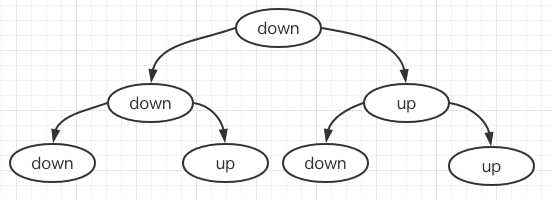
```java
public class PaperFolding {
public static void printAllFolds(int n) {
printProcess(1, n, true);
System.out.println();
}
private static void printProcess(int i, int n, boolean down) {
if (i > n) return;
printProcess(i + 1, n, true);
System.out.print((down ? "dwon" : "up") + "\t");
printProcess(i + 1, n, false);
}
public static void main(String[] args) {
printAllFolds(1);
printAllFolds(2);
printAllFolds(3);
printAllFolds(4);
}
}

若有收获,就点个赞吧
0 人点赞


