model.train()和model.eval()的区别主要在于Batch Normalization和Dropout两层
使用总结
模型中如果使用了Dropout去解决过拟合问题时,使用了这两个方法,会有不同的表现形式:
- 对于model.train()方法,dropout正常发挥作用,按照设置的概率随机丢弃神经元
-
方法部分源码
def train(self: T, mode: bool = True) -> T:r"""Sets the module in training mode.This has any effect only on certain modules. See documentations ofparticular modules for details of their behaviors in training/evaluationmode, if they are affected, e.g. :class:`Dropout`, :class:`BatchNorm`,etc.Args:mode (bool): whether to set training mode (``True``) or evaluationmode (``False``). Default: ``True``.Returns:Module: self"""if not isinstance(mode, bool):raise ValueError("training mode is expected to be boolean")self.training = modefor module in self.children():module.train(mode)return selfdef eval(self: T) -> T:r"""Sets the module in evaluation mode.This has any effect only on certain modules. See documentations ofparticular modules for details of their behaviors in training/evaluationmode, if they are affected, e.g. :class:`Dropout`, :class:`BatchNorm`,etc.This is equivalent with :meth:`self.train(False) <torch.nn.Module.train>`.See :ref:`locally-disable-grad-doc` for a comparison between`.eval()` and several similar mechanisms that may be confused with it.Returns:Module: self"""return self.train(False)
其中修改的self.training在dropout里面有用到,用于控制是否进行Dropout:
class Dropout(_DropoutNd):r"""During training, randomly zeroes some of the elements of the inputtensor with probability :attr:`p` using samples from a Bernoullidistribution. Each channel will be zeroed out independently on every forwardcall.This has proven to be an effective technique for regularization andpreventing the co-adaptation of neurons as described in the paper`Improving neural networks by preventing co-adaptation of featuredetectors`_ .Furthermore, the outputs are scaled by a factor of :math:`\frac{1}{1-p}` duringtraining. This means that during evaluation the module simply computes anidentity function.Args:p: probability of an element to be zeroed. Default: 0.5inplace: If set to ``True``, will do this operation in-place. Default: ``False``Shape:- Input: :math:`(*)`. Input can be of any shape- Output: :math:`(*)`. Output is of the same shape as inputExamples::>>> m = nn.Dropout(p=0.2)>>> input = torch.randn(20, 16)>>> output = m(input).. _Improving neural networks by preventing co-adaptation of featuredetectors: https://arxiv.org/abs/1207.0580"""def forward(self, input: Tensor) -> Tensor:return F.dropout(input, self.p, self.training, self.inplace)
Dropout介绍
dropout方法参数
torch.nn.functional.dropout
torch.nn.functional.dropout(input, p=0.5, training=False, inplace=False)
input:操作数据
p:每个神经元被丢弃的概率(注意,不会是简单的概率丢弃操作)
training:是否进行dropout操作,为True则进行Dropout操作,False则不进行
inplace:是否直接使用前面得到的一些参数进行运算,而不开辟新的空间torch.nn.Dropout
torch.nn.Dropout(input)
只需要指定input即可,其与参数直接使用self指定的参数
该方法通常搭配model.train()和model.eval()使用,通过这两个方法设置self.training可以指定训练使用dropout,测试不使用dropout
torch.nn.Dropout2d
torch.nn.Dropout2d(input)
针对彩色图像进行Dropout:Input: (N, C, H, W) 对应:(batch N,通道 C,高度 H,宽 W)
torch.nn.Dropout3d
torch.nn.Dropout3d(input)
针对彩色点云数据进行Dropout:Input: (N, C, D, H, W) 对应:(batch N,通道 C,深度 D,高度 H,宽 W)
dropout原理
总结
Vote作用
对于全连接神经网络而言,我们用相同的数据去训练5个不同的神经网络可能会得到多个不同的结果,我们可以通过一种vote机制来决定多票者胜出,因此相对而言提升了网络的精度与鲁棒性。同理,对于单个神经网络而言,如果我们将其进行分批,虽然不同的网络可能会产生不同程度的过拟合,但是将其公用一个损失函数,相当于对其同时进行了优化,取了平均,因此可以较为有效地防止过拟合的发生
减少神经元共适应性
减少神经元之间复杂的共适应性。当隐藏层神经元被随机删除之后,使得全连接网络具有了一定的稀疏化,从而有效地减轻了不同特征的协同效应。也就是说,有些特征可能会依赖于固定关系的隐含节点的共同作用,而通过Dropout的话,它强迫一个神经单元,和随机挑选出来的其他神经单元共同工作,达到好的效果。消除减弱了神经元节点间的联合适应性,增强了泛化能力
分析
首先,可以把dropout操作理解为模型平均化;我们每次进行dropout后,网络模型都可以看成是整个网络的自网络;(需要注意的是,如果采用dropout,训练时长会大大延长)
dropout会从原始的网络中找到一个更瘦的网络,如下右图所示: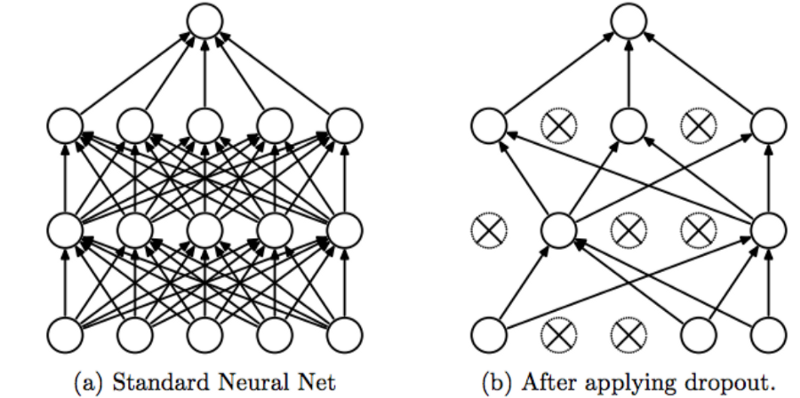
之前网络的计算公式为: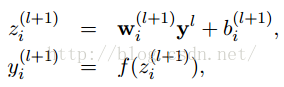
加入dropout后计算公式变为如下,其中Bernoulli函数表示根据概率p随机生成0或1: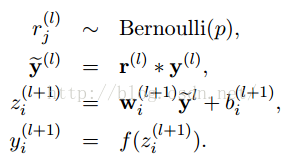
同时需要注意一点:在进行p概率屏蔽神经元后,还需要对余下的神经元进行rescale操作,即乘以1/p;如果在训练的时候没有对神经元进行rescale操作,那么就需要在测试的时候对权重进行rescale操作,即:
因为训练时,每个神经单源都会以概率p去除,而在测试阶段,每个神经元都是存在,所以权重参数w需要乘以p,成为 pw
那么,为什么dropout之后还要进行rescale呢?主要是为了维持训练和测试的以后期望的输出保持一致,通俗的理解如下图: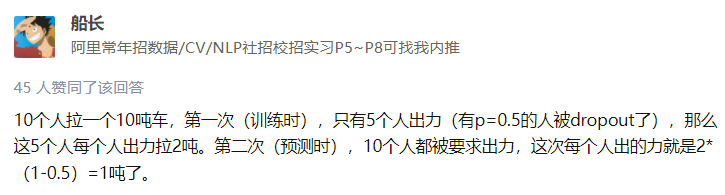
Inverted Dropout
传统的Dropout是在训练的时候以p概率随机丢弃神经元,并在测试的时候通过将所有的权重参数w乘以p以平衡参数
而Inverted Dropout将平衡参数的操作放在了训练阶段,使Dropout在测试阶段完全透明,减少了测试阶段的工作量
Inverted Dropout和传统的Dropout最终在解决过拟合问题上的思想还是一样的
相关论文
Understanding the Disharmony between Dropout and Batch Normalization by Variance Shift

WRN
Wide Residual Networks
降低网络的深度,增加了网络的深度
将残差块由:conv ->bn ->relu ->conv ->bn ->relu改为:conv ->bn ->relu ->dropout ->conv ->bn ->relu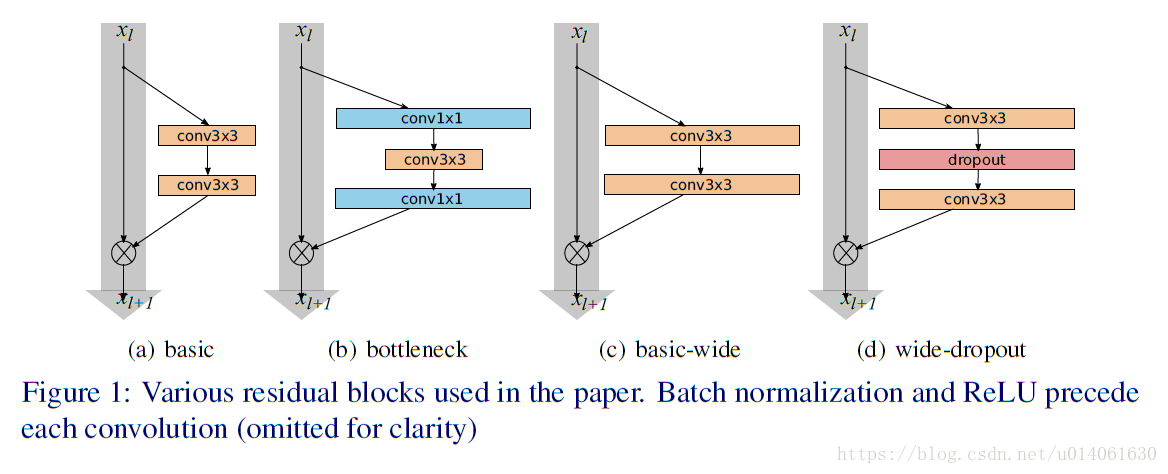
Don’t use dropout in convolutional networks
阅读地址
作者使用了五种卷积架构,分别对应:relu之前使用BN或者Dropout或者什么都不做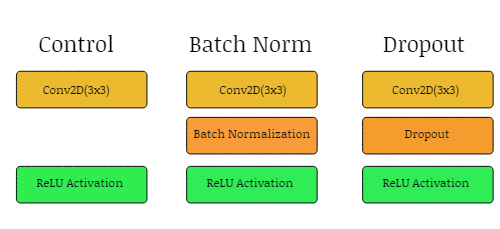
在Cifar100数据集上做测试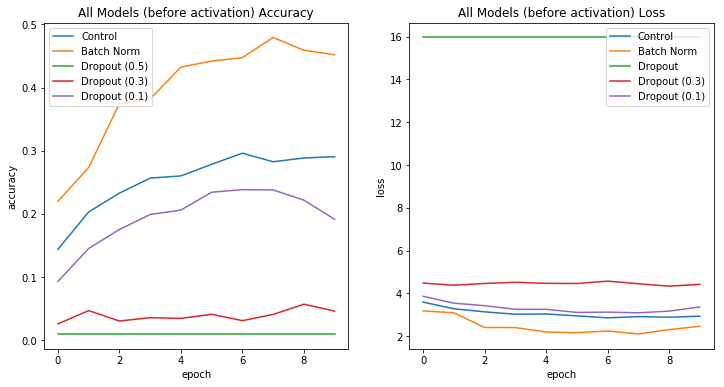
最终得出结论:
Only use dropout on fully-connected layers, and implement batch normalization between convolutions.(Dropout建议用于全连接层,BN建议用于卷积层)

若有收获,就点个赞吧
0 人点赞


