组合问题和分割问题都是收集树的叶子节点,而子集问题是找树的所有节点!
78. 子集
https://www.programmercarl.com/0078.%E5%AD%90%E9%9B%86.html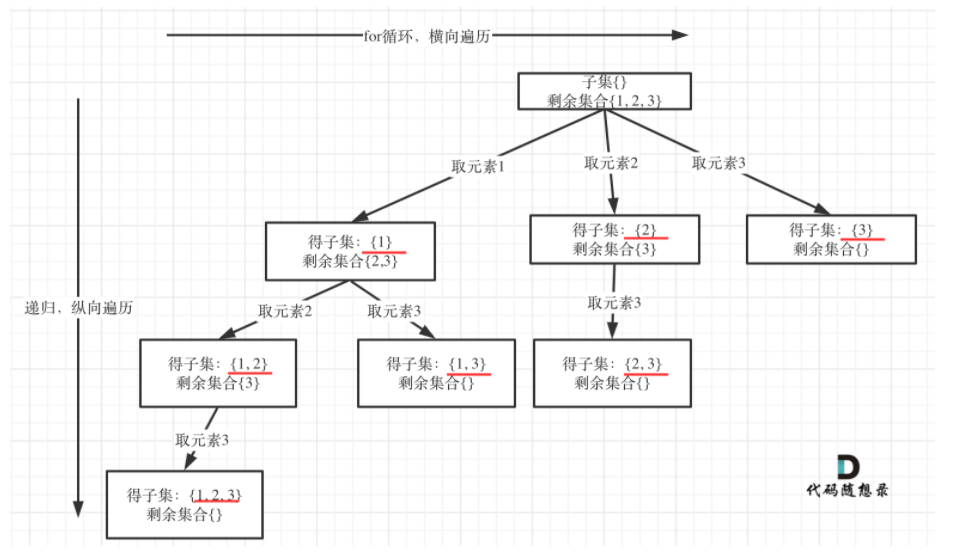 从图中红线部分,可以看出遍历这个树的时候,把所有节点都记录下来,就是要求的子集集合
求取子集问题,不需要任何剪枝!因为子集就是要遍历整棵树。
class Solution {List<List<Integer>> result = new ArrayList<>();// 存放符合条件结果的集合LinkedList<Integer> path = new LinkedList<>();// 用来存放符合条件结果public List<List<Integer>> subsets(int[] nums) {if (nums.length == 0){result.add(new ArrayList<>());return result;}subsetsHelper(nums, 0);return result;}private void subsetsHelper(int[] nums, int startIndex){result.add(new ArrayList<>(path));//「遍历这个树的时候,把所有节点都记录下来,就是要求的子集集合」。if (startIndex >= nums.length){ //终止条件可不加return;}for (int i = startIndex; i < nums.length; i++){path.add(nums[i]);subsetsHelper(nums, i + 1);path.removeLast();}}}
90. 子集 II
结合子集问题和组合问题中的去重数组即可完成
class Solution {
    List<List<Integer>> result = new ArrayList<>();
    List<Integer> path = new ArrayList<>();
    private void backTracking(int[] nums,int startIndex){
        result.add(new ArrayList<>(path));
        if (startIndex >= nums.length){
            return;
        }
        for (int i = startIndex; i < nums.length; i++) {
            if (i > startIndex && nums[i] == nums[i-1]){//去重
                continue;
            }
            path.add(nums[i]);
            backTracking(nums,i+1);
            path.remove(path.size() - 1);
        }
    }
    public List<List<Integer>> subsetsWithDup(int[] nums) {
        Arrays.sort(nums);
        backTracking(nums,0);
        return result;
    }
}
491. 递增子序列

class Solution {
    List<List<Integer>> result = new ArrayList<>();
    List<Integer> path = new ArrayList<>();

    private void backTracking(int[] nums, int startIndex) {
        if (path.size() > 1) {//因为题目要求递增子序列大小至少为2
            result.add(new ArrayList<>(path));
        }
        if (startIndex >= nums.length) {
            return;
        }
        int[] used = new int[201];
        for (int i = startIndex; i < nums.length; i++) {
            if (!path.isEmpty() && nums[i] < path.get(path.size() - 1) ||
                    (used[nums[i] + 100] == 1)){
                continue;
            }
            used[nums[i] + 100] = 1;
            path.add(nums[i]);
            backTracking(nums, i + 1);
            path.remove(path.size() - 1);
        }
    }

    public List<List<Integer>> findSubsequences(int[] nums) {
        backTracking(nums, 0);
        return result;
    }
}
//法二:使用map
class Solution {
    //结果集合
    List<List<Integer>> res = new ArrayList<>();
    //路径集合
    LinkedList<Integer> path = new LinkedList<>();
    public List<List<Integer>> findSubsequences(int[] nums) {
        getSubsequences(nums,0);
        return res;
    }
    private void getSubsequences( int[] nums, int start ) {
        if(path.size()>1 ){
            res.add( new ArrayList<>(path) );
            // 注意这里不要加return,要取树上的节点
        }
        HashMap<Integer,Integer> map = new HashMap<>();
        for(int i=start ;i < nums.length ;i++){
            if(!path.isEmpty() && nums[i]< path.getLast()){
                continue;
            }
            // 使用过了当前数字
            if ( map.getOrDefault( nums[i],0 ) >=1 ){
                continue;
            }
            map.put(nums[i],map.getOrDefault( nums[i],0 )+1);
            path.add( nums[i] );
            getSubsequences( nums,i+1 );
            path.removeLast();
        }
    }
}

若有收获,就点个赞吧
0 人点赞


