- Menu
- Functional components can only be created using a plain function
functionalattribute on single-file component (SFC)<template>andfunctionalcomponent option are deprecated- Async components now require defineAsyncComponent method to be created
- Component events should now be declared with the emits option
Menu
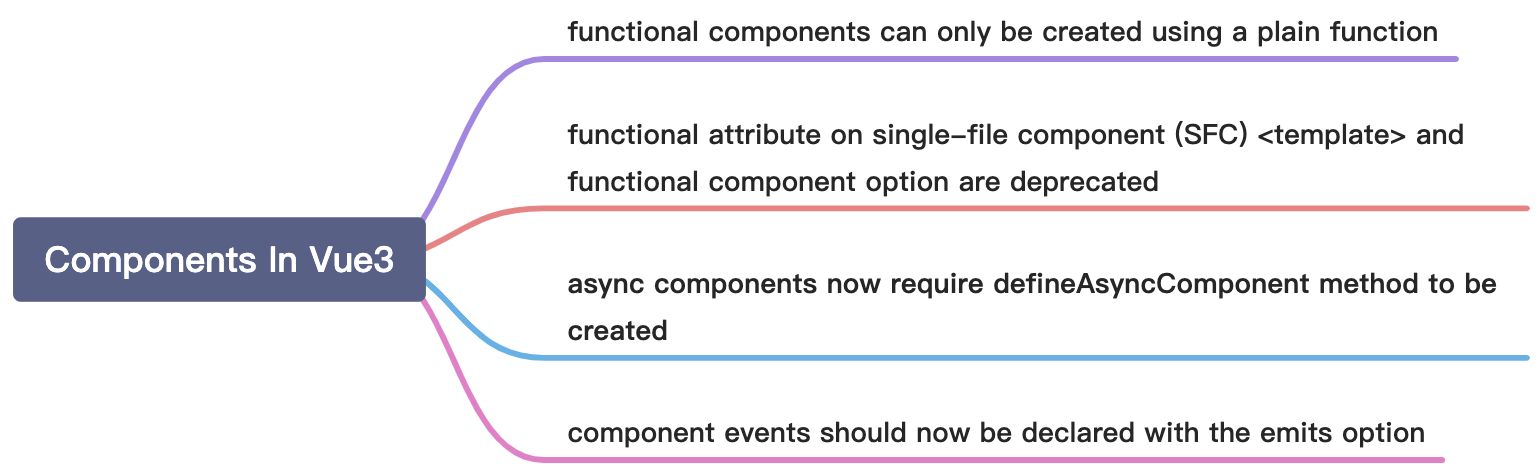
Functional components can only be created using a plain function
import { h } from 'vue'const DynamicHeading = (props, context) => {return h(`h${props.level}`, context.attrs, context.slots)}DynamicHeading.props = ['level']export default DynamicHeading
functional attribute on single-file component (SFC) <template> and functional component option are deprecated
In vue2, we may create a functional component like this:
export default {functional: true,props: ['level'],render(h, { props, data, children }) {return h(`h${props.level}`, data, children)}}
Now the syntax is converted to demo1.
functional attribute on single-file component (SFC) is also deprecated and you can write like this:
<template><componentv-bind:is="`h${$props.level}`"v-bind="$attrs"/></template><script>export default {props: ['level']}</script>
Async components now require defineAsyncComponent method to be created
In vue2, we difenite an async component like below:
const asyncPage = () => import('./NextPage.vue')// ORconst asyncPage = {component: () => import('./NextPage.vue'),delay: 200,timeout: 3000,error: ErrorComponent,loading: LoadingComponent}
Now in vue3, we write like this:
import { defineAsyncComponent } from 'vue'import ErrorComponent from './components/ErrorComponent.vue'import LoadingComponent from './components/LoadingComponent.vue'// Async component without optionsconst asyncPage = defineAsyncComponent(() => import('./NextPage.vue'))// Async component with optionsconst asyncPageWithOptions = defineAsyncComponent({loader: () => import('./NextPage.vue'),delay: 200,timeout: 3000,errorComponent: ErrorComponent,loadingComponent: LoadingComponent})
In addition, unlike 2.x, the loader function no longer receives the resolve and reject arguments and must always return a Promise.
// 2.x versionconst oldAsyncComponent = (resolve, reject) => {/* ... */}// 3.x versionconst asyncComponent = defineAsyncComponent(() =>new Promise((resolve, reject) => {/* ... */}))
Component events should now be declared with the emits option
Details can be see here: QuickStart 03 - Fragments And Emits Component Option

若有收获,就点个赞吧
0 人点赞


