9. Relations
9.1 Relations and Their Properties
A **binary relation**(二元关系)  from a set
  to a set
  is a subset of
  .
. 
Let  be sets. An
 **n-ary Relation** on these sets is a subset of  .
.  are called the
 **domains** of relation, and  is called the
 **degree** of the relation.
A **relation on the set**  is a relation form
  to
to  .
.
There are  binary relations on a set
  with
with  elements
9.2 Representing Relations
📋The Methods of Representing Relations
- List its all ordered pairs
- Using a set build notation / specification by predicates
- 2D table
- Connection matrix / zero-one matrix
- Directed graph / Digraph
📋2D table
🌰e.g.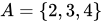 ,
,  ,
,  . Represent the relation
  using a
 **2D table**.
Solution:
| 2 | 3 | 4 | 5 | 6 | |
|---|---|---|---|---|---|
| 2 | × | × | × | ||
| 3 | × | × | |||
| 4 | × |
📋Connection Matrices
Let  be a relation from
  to
to  . An
. An 
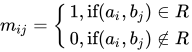
**connection matrix**  for
for  is defined by
  .
.
🌰e.g.
The connection matrix for the 2D table above is 
📋Directed graph / Digraph
A **directed graph**(有向图) or a **digraph**, consists of a set  of
of **vertices**(结点) together with a set  of ordered pairs of elements of
  called
 **edges**(or arcs). The vertices  is called the
 **initial vertices** and **terminal vertices** of the edge  .
.
🌰e.g. ,
,  . Show the relation with a directed graph.
9.3 n-ary Relations and Their Applications
📋 Properties of Binary Relations
- Reflexive
- Irreflexive
- Symmetric
- Antisymmetric
- Transitive
A relation  on a set
  is
is **reflexive**(自反) if  . In matrices representing reflexive relations, all the elements on the main diagonal of
  must be 1. In digraphs representing reflexive relations, there is a loop at every vertex.
A relation  on a set
  is
is **irreflexive**(反自反) if  . In matrices representing irreflexive relations, all the elements on the main diagonal of
  must be 0. In digraphs representing irreflexive relations, there is no loop at any vertex.
⚠️ A relation on a set can be neither reflexive nor irreflexive, for example,  .
.
A relation  on a set
  is
is **symmetric**(对称) if  . Matrices representing symmetric relations
  must be symmetric. In digraphs representing symmetric relations, if there is an arc
  there must be an arc
  .
.
A relation  on a set
  is
is **antisymmetric**(反对称) if  , or equivalently
  . In digraphs representing symmetric relations, if there is an arc
  connecting two different vertices, there can not be an arc
  .
.
⚠️ A relation on a set can be both symmetric and antisymmetric, for example,  again.
A relation  on a set
  is
is **transitive**(传递) if  . In matrices representing transitive relations,
  . In digraphs representing transitive relations, if there is an arc from
  to
to  and one from
  to
to  then there must be one from
  to
to  .
.
🌰 e.g.
Symmetric, Transitive ⇒ Reflexive?
Solution:
Since  and
and  is symmetric,
  . Since
  ,
,  and
and  is transitive,
  . But this is valid only for
  satisfying
  . It is still possible that
  when
when 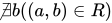 .
.
Since relations from  to
to  is a subset of
  , two relations from
  to
to  can be combined in any way two sets can be combined.
📋 Set Operations on Relations and Logical Operations of Matrices
We can solve the set operations on relations using exhaustive method, or logical operations of the matrices of the relations.
The Boolean Sum(布尔和) ∨: 
The Boolean Product(布尔积) ∧: 
The complement −: 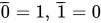
Let  ,
,  ,
,  ,
,  , the set operations of two relations are defined by




📋 Composition of Relations ,
,  , then the
 **composite**(复合) of  and
and  , denoted as
  , is
, is  .
.
To compute  , we can either use the definition directly or use the connection matrix.
🌰 e.g.
Solution:
(1) Using the definition directly
(2) Using the connection matrix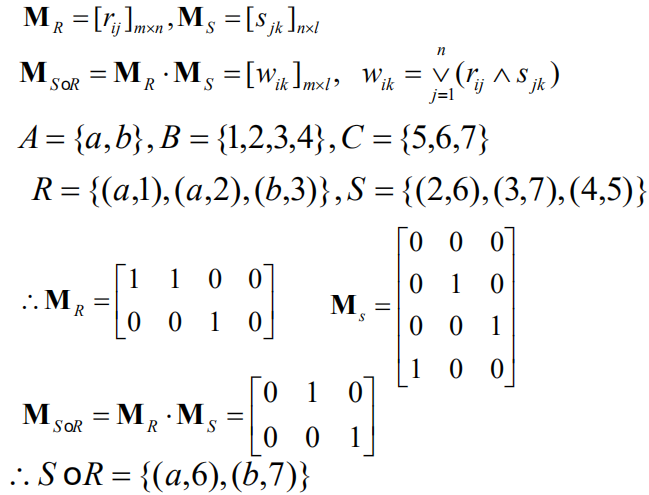
Let  be a relation on the set
  . The
. The **powers** are defined inductively by  are defined inductively by
  .
.
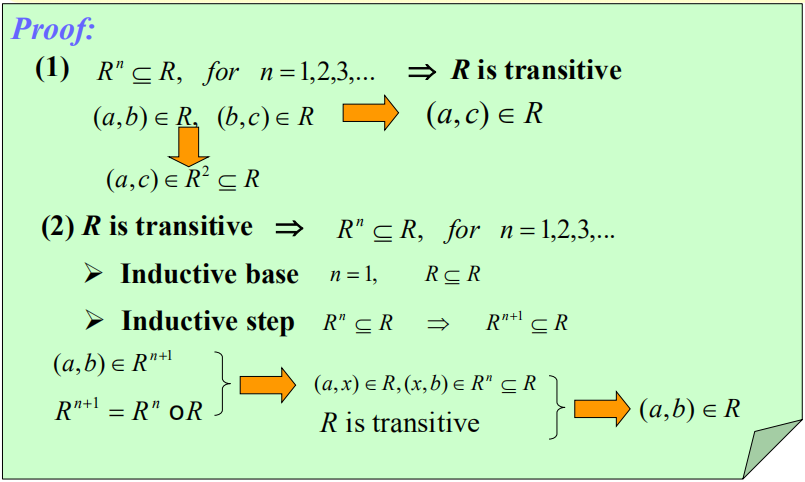
📋 The relation  on the set
  is transive if and only if
  , for
, for 
For a relation  , the
, the **inverse relation** from  to
to  is
is  .
.
📋 Methods to Get 
- Using the definition directly.
- Reverse all the arcs in the digraph representation of
 .
. - Take the transpose
 of the connection matrix
  of
of  .
.
📋 The Rroperties of Relation Operations
Suppose that  ,
,  are the relations from
  to
to  ,
,  is the relation from
  to
to  ,
,  is the relation from
  to
to  , then


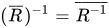





-
9.4 Closures of Relations
The
**closure**of a relation with respect to property
  is the relation
  with property
  containing
  such that
  is a subset of every relation with property
  containing
  . Which means,
  is the smallest relation with property
  containing
  .
.
📋Let be a relation on
  . The
. The **reflexive closure**of , denoted by
  , is
, is  , where
  is called the
 **diagnal relation**on .
.
Corollary: is a reflexive relation.
Given , to obtain its reflexive closure, we can:
 Add to
 all ordered pairs of the form
  with
with  , not already in
  .
.- Add loops to all vertices on the digraph representation of
 .
. - Put 1’s on the diagonal of the connection matrix of
 .
.

📋Let  be a relation on
  . The
. The **symmetric closure** of  , denoted by
  , is
, is  .
.
Proof:
Obviously  contains
  and is symmetric. Then we need to show it is the smallest symmetric relation which contains
  .
.
Suppose that  is a symmetric relation containing
  , then
Corollary:  is a symmetric relation.
Given  , to obtain its symmetric closure, we can:
- Add all ordered pairs of the form
 where
where  is in the relation, that are not already in
  .
. - Add an edge from
 to
to  whenever this edge is not already in directed graph but the edge from
  to
to  is.
is. 
Then we go on to the **transive closure**(传递闭包), denoted by  . It can not be computed so simply as the two kinds of closures above. Firstly we need to introduce some terminologies.
A **path** of **length**  in a digraph
  means a sequence of edges
  , denoted as
  . It is called a
 **cycle** or **circuit** if  .
.
The term “path” also applies to relations. We say there is a path of length  from
from  to
to  in
in  if
if  such that
  .
.
📋Let  be a relation on
  . There is a path of length
  from
from  to
to  if and only if
  .
.
Proof: Using MI.
The **connectivity relation** denoted by  , is the set of ordered pairs
  such that there is a path (in
  ) from
  to
to  :
:  .
.
📋 .
.
Proof:
Obviously  contains
  and is a transitive relation by its definition. Then we need to show that
  is the smallest transitive relation which contains
  .
.
Now suppose that  is any transitive relation which contains
  . We need to show
  contains
  .
.
Since  is transitive,
  is also transitive and
  . It follows that
  . If
. If  , then
  , because any path in
  is also a path in
  . So
. So  .
.
Corollary:  is transitive.
💡 In fact, we need only consider paths of length  or less, where
  is the cardinality of
  .
.
📋If  , then any path of length
  must contain a cycle.
Proof: Using the Pigeon Hole Principle.
📋If  ,
,  is a relation on
  , then
  .
.
Corollary: If  then
then  .
.
Corollary:  .
.
📋A Basic Procedure for Computing t(R)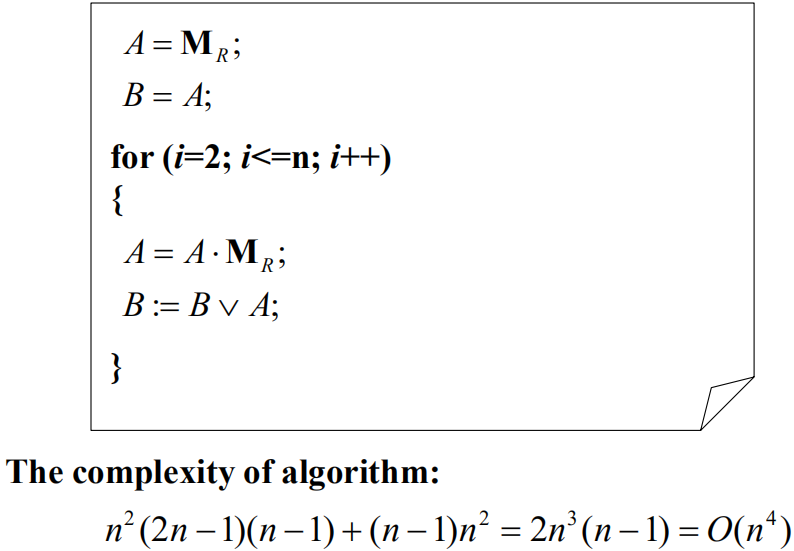
📋 Warshall’s Algorithm for Computing t(R)
别以为这个不会考!
If  is a path, its
 **interior vertices** are  , that is, all the vertices of the path that occur somewhere other than as the first and last vertices in the path. Warshall’s algorithm is based on the efficient construction of a sequence of zero–one matrices. These matrices are
  , where
  is the zero–one matrix of relation
  , and
, and  , where
  if there is a path from
  to
to  such that all the interior vertices of this path are in the set
  (the first
  vertices in the list) and is 0 otherwise. Note that
  , because the (i, j)th entry of
  is 1 if and only if there is a path from
  to
to  , with all interior vertices in the set
  .
.
We can compute  directly from
  : There is a path from vi to vj with no vertices other than v1, v2, … , vk as interior vertices if and only if either there is a path from
  to
to  with its interior vertices among the first
  vertices in the list, or there are paths from
  to
to  and from
  to
to  that have interior vertices only among the first
  vertices in the list. That is, either a path from
  to
to  already existed before
  was permitted as an interior vertex, or allowing
  as an interior vertex produces a path that goes from
  to
to  and then from
  to
to  .
.
The first type of path exists if and only if  , and the second type of path exists if
and only if both  and
and  are 1. Hence,
  whenever i, j and k are positive integers not exceeding n.
The complexity of Warshall’s algorithm is  .
.
9.5 Equivalence Relation
A relation  on a set
  is an
is an **equivalence relation**(等价关系) if  is reflexive, symmetric and transitive. If elements
  and
and  are related by an equivalence relation
  , then we say
  and
and  are equivalent, denoted by
  . In an equivalence relation
  , the set of all elements that are related to an element
  of
of  is called the
 **equivalence class**(等价类) of  , denoted by
  or
or  .
. 
Let  be a collection of subsets of
  . Then the collection forms a
 **partition**(分割) of  if and only if



denoted by  . 就是说这一系列 Ai 的无交并为 A。
📋 Let  be an equivalence relation on a set
  . The following statements are equivalent


📋 Let  be an equivalence relation on a set
  . Then the equivalence classes of
  form a partition of
  . Conversely, given a partition
  of the set
  , there is an equivalence relation
  that has the sets
  , as its equivalence classes.
In short, an equivalence relation on a set  ↔ a partition of
  .
.
📋 Congruence modulo  forms a partition of all integers.

🌰e.g. . Show that
  is an equivalence relation, and find its equivalence class.
Proof: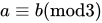 if and only if
  .
. is reflexive because
  . We can also show it is symmetric and transitive using the qualities of division.
The equivalence classes are  ,
,  and
and  .
.
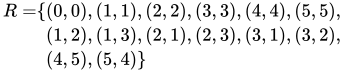
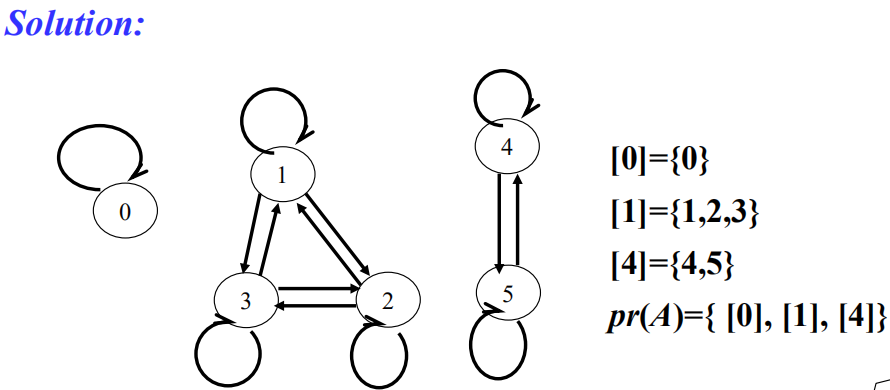
🌰e.g.
Find the partition of the set  from
from  .
.
📋 If  are equivalence relations on
  , then
  is also an equivalence relation on
  .
.
Proof:
- It is reflexive.
 , so
, so  .
. - It is symmetric. If
 , then
  and
and  , then
  and
and  , so
, so  .
. - It is transitive.
📋 If  are equivalence relations on
  , then
  is reflexive and symmetric relation on
  . Not necessarily transitive.
📋 If  are equivalence relations on
  , then
  is also an equivalence relation on
  .
.
9.6 Partial Orderings
Let  be a relation on
  . Then
  is a
is a **partial ordering**(偏序关系) or partial order if  is reflexive, antisymmetric and transitive, denoted by
  .
.  is called a partially ordered set or a
 **poset**(偏序集).
🌰e.g.


We use the notation  to represent the partial orderings including
  ,
,  and
and  .
.  is read as “
 is less than or equal to
  “.
“.  means
means  and
and  , read as “
 is less than
  “.
“.
The elements  and
and  of a poset
  are called
 **comparable** if either  or
or  . When
  and
and  are elements of
  such that neither
  nor
nor  ,
,  and
and  are called
 **incomparable**.
If  is a poset and every two elements of
  are comparable,
  is called a
 **totally ordered set**(全序集) or a **linearly ordered set**,  is called a
 **total order** or **linear order**. In this case  is called a
 **chain**(链). 想象一下,全序集中的所有元素都可比较大小,因此它们可以按照大小顺序排成一条链,像数轴那样。
🌰e.g. is a poset and is a chain.
  and
and  are posets but not totally ordered sets.
 is a
is a **well-ordered** set if it is a poset such that  is a total order and every nonempty subset of
  has a least element.
📋 The Principle of Well-Ordered Induction
Suppose that  is a well-ordered set. Then
 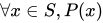 , if:
, if:
Inductive Step: for every  , if
, if  is true for all
  with
with  , then
  .
.
Proof:
Suppose it is not the case that  is true for all
  . Then there is an element
such that  is false. Consequently, the set
  is nonempty. Because
  is well-ordered, A has a least element
  . By the choice of
  as a least element of
  , we know that
  is true for all
  with
with  . This implies by the inductive step
  is true. This contradiction shows that
  must be true for all
  .
.
The **lexicographic order**  on
on  is defined as following: given two posets
  and
and  , we construct an induced partial order
  on
on  :
:  if
if  or
or  . The definition of lexicographic order extends naturally to multiple Cartesian products of partially ordered sets.
🌰e.g. Lexicographic Order of String
The string  is less than
  if and only if
  .
.
discredit ≺ discreet ≺ discrete ≺ discreteness ≺ discretion**Hasse diagram**(哈塞图) is a method used to represent a partial ordering clearly.
📋 To construct a Hasse diagram:
- Construct a digraph representation of the poset (A, R) so that all arcs point up (except the loops).
- Eliminate all loops.
- Eliminate all arcs that are redundant because of transitivity.
- Eliminate the arrows at the ends of arcs since everything points up.
🌰e.g. , and represent it using a Hasse diagram.

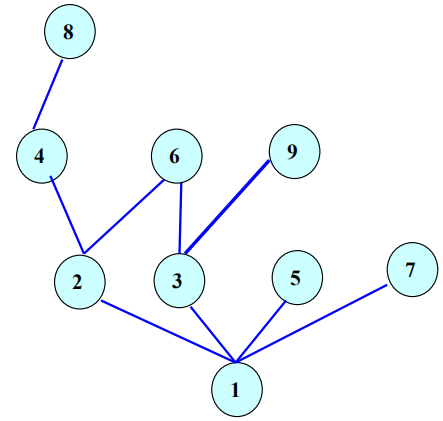
Let  be a poset.
  , if
, if  is a totally ordered set, then
  is called a
 **chain** of  .
.  is called the
 **length** of chain. Otherwise, if  , then
  is called an
 **antichain** of  .
.
Let  be a poset, then
  is a
is a **maximal element**(极大元) if there does not exist an element  in
in  such that
  . Similarly for a
 **minimal element**(极小元). Maximal and minimal elements are the “top” and “bottom” elements in the Hasse diagram.
⚠️ There can be more than one minimal and maximal element in a poset.
Let  be a poset. Then an element
  in
in  is a
is a **greatest element**(最大元) of  if
if  for every
  in
in  , and
, and  is a
is a **least element**(最小元) of  if
if  for every
  in
in  .
.
📋 The greatest and least element are unique when they exist.
Proof:
就是假设有两个最大元 / 最小元,然后证明它们必须是相等的,相当于只有一个。Suppose that  is a greatest element in
  . It follows that
  for every element in
  . Suppose that
  is also a greatest element in
  . It follows that
  for every element in
  . It implies that
  and
and  . That is
  .
.
Let  be a subset of
  in the poset
  . If there exists an element
  in
in  such that
  for all
  in
in  , then
  is called an
 **upper bound**(上界) of  . Similarly for
 **lower bounds**(下界).
⚠️ Mind the differences of “maximal element”, “greatest element” and “upper bound”. “极大元”只要能比较大小的都小于等于它就行,“最大元”要所有元素都能和它比大小且都小于等于它,“上界”甚至可以不在子集 里面但子集
里面但子集 里所有元素必须小于等于它。
If  is an upper bound for
  which is less than every other upper bounds, then it is the
 **least upper bound**(上确界), denoted by  . Similarly for the
 **greatest lower bound**(下确界),  .
.
A poset is called a **lattice** (格) if every pair of elements has a lub and a glb.![60U4NGIT8Z4~HJJEWWA]_1J.jpg](/uploads/projects/linguisty@zju_courses/36b7ecbf90aaa24d24ebb5ea77a1d624.jpeg "听说中文男足辱了北大中文系的系格")
🌰e.g. is not a lattice because there is no multiple of both 6 and 9 in these numbers. If we add 36 into these numbers then it will form a lattice.
📋 Every totally ordered set is a lattice.
⚙️ The Lattices Model of Information Flow
The Lattices Model can be used to represent different information flow policies. For example, the multilevel security policy:
Each pieces of information is assigned to a security class. Each security class is represented by a pair  , where
  is an authority level and
  is a category. Order security classes by specifying that
  iff
iff  . For example, the typical authority levels used in the U.S. government is A={ unclassified(0), confidential(1), secret(2), top secret(3) }. If C={ spies, moles, double agents }, then their are 2|C| = 8 different categories.
Information is permitted to flow from security classes  into
into  iff
iff  . Then the set of all security classes forms a lattice.
A total ordering  is said to be
 **compatible**(共生) with the partial ordering  if
if  whenever
  . Constructing a compatible total ordering from a partial ordering is called
 **topological sorting**(拓扑排序).
📋 Every finite nonempty poset  has at least one minimal element.
Proof:
Choose an element  of
of  . If
. If  is not minimal, then there is an element
  with
with  . If
. If  is not minimal, there is an element
  with
with  . Continue this process, so that if
  is not minimal, there is an element
  with
with  .
.
Since there are only finite number of elements in the poset, this process must end with a minimal element.
📋 According to this lemma, to sort a poset  :
:
Basic Step: Select a (any) minimal element and put it in the list. Delete it from  .
.
Inducive Step: Continue until all elements appear in the list and  is void.
🌰e.g.
Find a compatible total ordering for the poset  .
.
Solution:
Delete one minimal element in each step. If there are more than one minimal element in one step, just choose a random one. This produces the total ordering 1 ≺ 5 ≺ 2 ≺ 4 ≺ 20 ≺ 12.
⚙️ Topological sorting has an application to the scheduling of projects. The Hasse diagram means the order of completing a series of projects, where the less project need to be finished before the greater project is finished. By producing a total ordering, we can find a feasible order to finish all the projects.

若有收获,就点个赞吧
0 人点赞


