6. Counting
Counting problems arise throughout mathematics and computer science. In CS, we need to measure the time complexity of given algorithms, and know the number of passwords of a computer system and so on.
6.1 The Basics of Counting
6.1.1 Basic Counting Principles
**The Product Rule**
Suppose that a procedure can be broken down into two tasks. If there are  ways to do the first task and
  ways to do the second after the first task has been done, then there are
  ways to complete the procedure.
In terms of sets, if  are finite sets, then the number of elements in the Cartesian product of these sets is the product of the number of elements of each set. The task of choosing an element in the Cartesian product
  is done by choosing an element in
  , an element in
  , … , and an element in
  . By the product rule, it follows that
**The Sum Rule**
If a task can be done either in one of  ways or in one of
  ways, where none of the set of
  ways is the same as any of the set of
  ways, then there are
  ways to do the tasks.
In terms of sets,  where
where  for all
  .
.**The Subtraction Rule**
If a task can be done in either  ways or
  ways, then the number of ways to do the task in
  minus the number of ways to do the task that are common to the two different ways. The subtraction rule is also known as the principle of inclusion-exclusion.
**The Division Rule**
There are  ways to do a task if it can be done using a procedure that can be carried out in
  ways, and for every way
  , exactly
  of the
  ways correspond to way
  .
.
Restated in terms of sets: If the finite set  is the union of
  pairwise disjoint subsets each with
  elements, then
  .
.
In terms of functions: If  is a function from
  to
to  , where both are finite sets, and for every value
  there are exactly
  values
  such that
  , then
  .
.
🌰 e.g.
How many ways are there to seat four people around a circular table, where two seatings are considered the same when each person has the same left and right neighbor?
Solution:
Number the seats around the table from 1 to 4 proceeding clockwise. There are four ways to select the person for seat 1, three for seat 2, two for seat 3, and one way for seat 4. Thus there are 4! = 24 ways to order the four people. But since two seatings are the same when each person has the same left and right neighbor, for every choice for seat 1, we get the same seating. Therefore, by the division rule, there are 24/4 = 6 different seating arrangements.
6.1.2 Tree Diagrams
We can solve many counting problems through the use of tree diagrams, where a branch represents a possible choice and the leaves represent possible outcomes.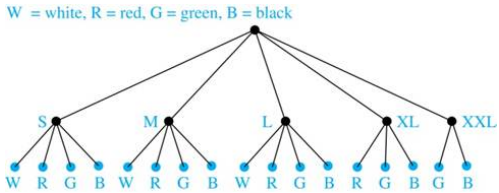
6.2 The Pigeonhole Principle
📋The Pigeonhole Principle (Also called Dirichlet Drawer Principle)
If  is a positive integer and
  or more objects are placed into
  boxes, then there is at least one box containing two or more of the objects.
Proof:
We use a proof by contraposition. Suppose none of the  boxes has more than one object. Then the total number of objects would be at most
  . This contradicts the statement that we have
  objects.
🌰e.g.
In a party of 2 or more people, there are 2 people with the same number of friends in the party, assuming you can’t be your own friend and that friendship is mutual.
Pigeons : the  people (with
  ).
).
Pigeonholes: the possible number of friends, i.e. the set 
🌰e.g.
Show that for every integer  there is a multiple of
  that has only 0s and 1s in its decimal expansion.
Solution:
Let  be a positive integer. Consider the
  integers 1, 11, 111, … , 11…1 (where the last has
  1s). There are
  possible remainders when an integer is divided by
  .
.
By the pigeonhole principle, when each of the  integers is divided by
  , at least two must have the same remainder. Subtract the smaller from the larger and the result is a multiple of
  that has only 0s and 1s in its decimal expansion.
📋The Generalized Pigeonhole Principle
If  objects are placed into
  boxes, then there is at least one box containing at least
  objects.
Proof:
Suppose that none of the boxes contains more than  objects. Then, the total number of objects is at most
  .
.
🌰e.g.
Show that among any  positive integers not exceeding
  there must be an integer that divides one of the other integers.
Solution: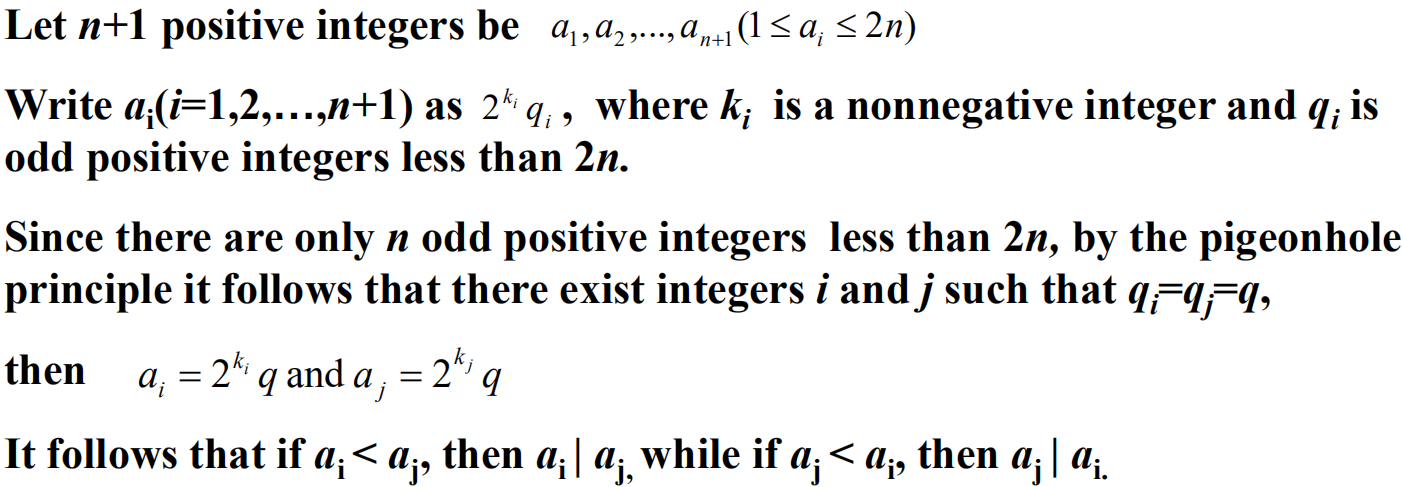
🌰e.g.
During 11 weeks football games will be held at least 1 game a day, but at most 12 games be arranged each week. Show that there must be a period of some number of consecutive days during which exactly 21 games must be played.
Solution:
Let xi be the number of football games helded on the i-th day.
Let  be
be  , where
Let  be
be , so
, so 
 ,
,
Since , there exist integers
 that
that 
So 
🌰e.g.
Every sequence of  distinct integers contains a subsequence of length
  that is either strictly increasing or strictly decreasing.
Proof: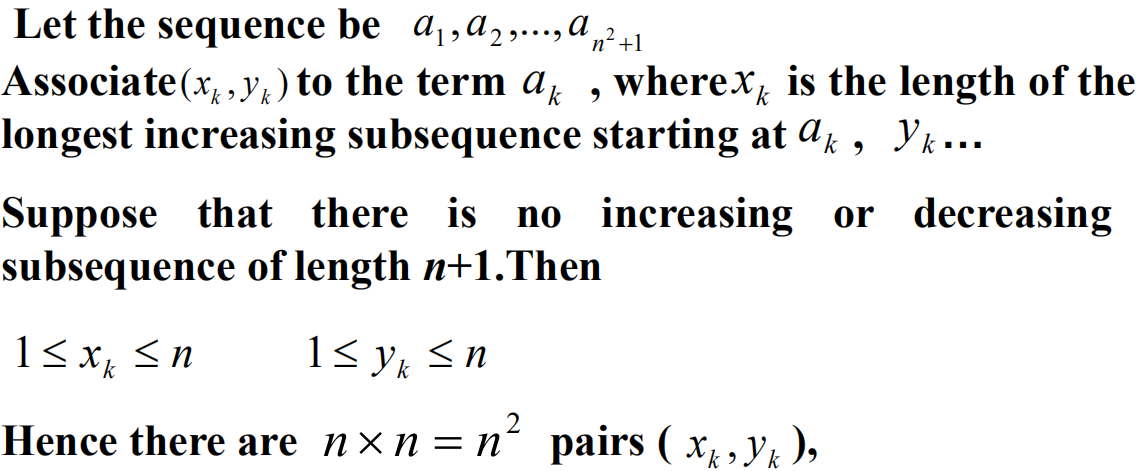

🌰e.g.
6.3 Permutations and Combinations
6.3.1 Basic Concepts
**Permutation** An ordered arrangement of the elements of a set.**r-Permutation** An ordered arrangement of  elements of a set
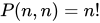
📋The number of r-permutations of a set with  distinct elements is
Specially,  ,
,  .
.**r-Combination** An unordered selection of  elements of a set. An r-combination is simply a subset of a set with
  elements.
📋The number of r-combination of a set with  elements, where
  is a positive integer and
  is an integer with
  , denoted by
 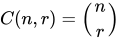 , equals to
📋Combination Corollary
Let  and
and  be nonnegative integers with
  . Then
6.3.2 Combinatorial Proof
A **combinatorial proof** of an identity:
**Double Counting Proofs**Uses counting arguments to prove that both sides of the identity count the same objects but in different ways.**Bijective Proofs**Show that there is a bijection between the sets of objects counted by the two sides of the identity.6.4 Binomial Coefficients
💡二项式定理也是高中就学了的。
A**binomial expression**is the sum of two terms, such as . (More generally, these
terms can be products of constants and variables.)
📋The Binomial Theorem
Let and
and  be varaibles, and let
  be a nonnegative integer. Then
 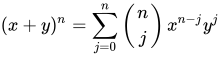 .
.
Proof:
We can use counting principles to find the coefficients in the expansion of . To form the term
  , it is necessary to choose
 s and
s and 
 s from the
  sums.
sums.
📋Corrolaries for the Binomial Theorem ,
, 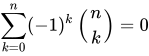 ,
, 
📋Pascal’s Identity
Let and
and  be positive integers with
  . Then
 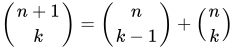 .
.
Proof:
We construct a subset of size form a set
  with
with  elements. The total will include:
All of the subsets from the set of size which do not contain the element
  ,
,  , plus the subsets of size
  with the element
  added
added  .
.
📋Pascal’s Triangle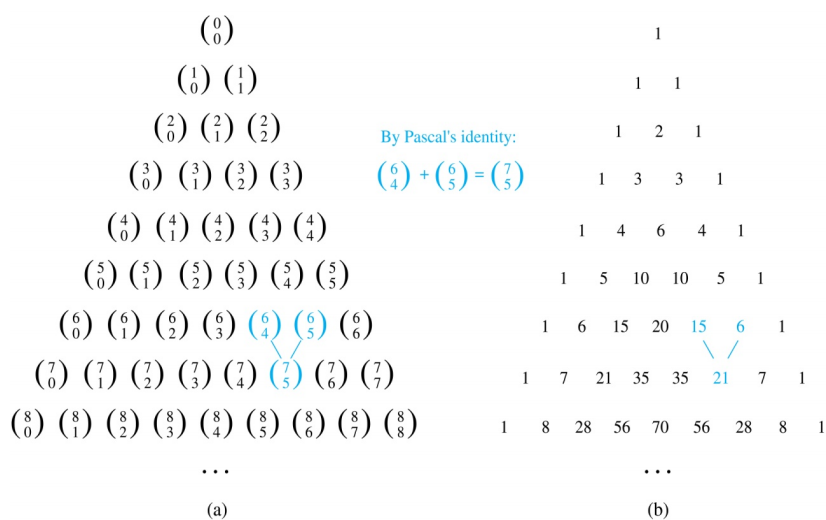
The nth row in the triangle consists of the binomial coefficients . By Pascal’s identity, adding two adjacent bionomial coefficients results is the binomial coefficient in the next row between these two coefficients.
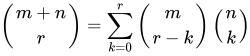
📋Vandermonde’s Identity
Let ,
,  and
and  be nonnegative integer with
  not exceeding either
  or
or  . Then
  .
.
📋If is a nonnegative integer. Then
  .
.
Proof:
We use Vandermonde’s Identity with to obtain
  .
.
📋Let and
and  be nonnegative integer with
  , then
 .
.
Proof:
The left-hand side counts the bit strings of length containing
  1s. We show that the right-hand side counts the same objects by considering the cases corresponding to the possible locations of the final 1 in a string with
  ones.
ones.
6.5 Generalized Permutations and Combinations
6.5.1 Permutations and Combinations with Repetition
📋The number of r-permutations of a set of objects with repetition allowed is
  .
.
📋There are r-combination from a set with
  elements when repetition of elements is allowed.
Proof:
- The
 bars are used to mark off
  different cells, with the ith cell contains a star for each time the ith element of the set occurs in the combination. For example, | | | | * means the first element occurs twice, the second element occurs once, the fourth element occurs once, and the fifth element occurs three times.
 - Each r-combination of a set with n elements when repetition is allowed can be represented by a list of
 bars and
  stars.
 - The number of such lists is
 .
.
🌰e.g.
How many solutions are there to the equation  where
where  is nonnegative integer?
Solution:
Since a solution of this equation corresponds to a way of selecting 16 items from a set with four element, such that  items of type one,
  items of type two,
  items of type three,
  items of type four are chosen.
Hence the number of solutions is  .
.
How about the number of solutions to  ?
?
Solution:
We can introduce an auxiliary variable  so that
  .
. .
.
6.5.2 Permutations with Indistinguishable Objects
📋The number of different permutations of  objects,
  , where there are
  indistinguishable objects of type 1, … ,and
  indistinguishable objects of type k, is
  .
.
Proof:
🌰e.g.
How many different strings can be made form the letters in MISSISSIPPI, using all the letters?
Solution: , so there are
  different strings.
6.5.3 Distributing Objects into Boxes
Many counting problems can be solved by counting the ways objects can be placed in boxes. The objects may be either different from each other (distinguishable) or identical (indistinguishable). The boxes may be labeled (distinguishable) or unlabeled (indistinguishable).
📋The number of ways to distribute  distinguishable objects into
  distinguishable boxes so that
  objects are place into box i, i=1,2,…,k, equals
  .
.
It can be proved by setting up a one-to-one correspondence between the permutations in the last theorem and the ways to distribute objects counted here.
🌰e.g.
How many ways are there to distribute hands of 5 cards to each of four players from the standard deck of 52 cards?
Solution:
It is typical problem that involves distributing distinguishable objects into distinguishable boxes.
The distinguishable objects are the 52 cards.
The five distinguishable boxes are the hands of the four players and the rest of the deck.
So there are 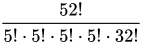 kinds of distribution.
📋There are  ways to place
  indistinguishable objects into
  distinguishable boxes.
Proof based on one-to-one correspondence between k-combinations from a set with n-elements when repetition is allowed and the ways to place  indistinguishable objects into
  distinguishable boxes.
📋Stirling Numbers(斯特林数) of the Second Kind , the number of ways to distribute
  distinguishable objects into
  indistinguishable boxes so that no boxes is empty.




 is the number of ways to partition the set with nelements into
  nonempty and disjoint subsets.
 is the number of ways to distribute
  distinguishable objects into
  distinguishable boxes so that no boxes is empty.
 is the number of ways to place
  distinguishable objects into
  indistinguishable boxes.
6.6 Generating Permutations and Combinations
**Lexicographic Ordering for Permutations**The permutation precedes the permutation of
  , if for some
  , with
  ,
,  , and
, and  .
.
📋Generating All the Permutations
- List the elements in lexicographic order.
- Find the least permutation.
- Find the next least permutation until the largest permutation is found.
🌰e.g.
Algorithm of producing the  permutations of the integers
  .
.
- Begin with the smallest permutation in lexicographic order, namely
 .
. - Produce the next largest permutation.
- Continue until all
 permutations have been found.
📋Generating All the Combinations
- A combination is just a subset, so we need to list all subsets of the finite set.
- Use bit strings of length
 to represent a subset of a set with
  elements. If the subset contains the ith element, then the ith bit of the string is 1; otherwise the ith bit is 0.
 - The
 bit strings can be listed in order of their increasing size as integers in their binary expansions.
8. Advanced Counting Techniques
8.1 Applications of Recurrence Relations
A**recurrence relation**for the sequence is an equation that express
  in terms of one or more of the previous terms of the sequence, namely,
  , for all integers
  with
with  , where
  is a nonnegative integers.
A**solution**of a recurrence relation is a sequence if its terms satisfy the recurrence relation. Normally, there are many sequences which satisfy a recurrence relation. We should distinguish them by initial conditions.
The**degree**of a recurrence relation is the number of initial conditions it needs to determine a specific sequence. For example, is a recurrence relation of degree 8.
💡Many relationships are most easily described using recurrence relations.
🌰e.g.
Find a recurrence relation for the number of bit strings of length that don’t have two consecutive 0s.
Solution:
Let denote the number of bit strings of length
  that don’t have two consecutive 0s.
Recurrence relation: .
.
Initial conditions: .
.
Note that satisfies the same recurrence relation as the Fibonacci sequence. Since
  and
and  , we conclude that
  .
.
⚙️ Recurrence relations play an important role in many aspects of the study of algorithms and their complexity.
- Dynamic programming algorithm
- An algorithm follows the dynamic programming paradigm when it recursively breaks down a problem into simpler overlapping subproblems, and computes the solution using the solutions of the subproblems.
- Recurrence relations are used to find the overall solution from the solutions of the subproblems.
- Divide-and-conquer algorithm
 where
where  are real numbers, and
  .
.**Linear**: The right-hand side is a sum of the previous terms of the sequence each multiplied by a
function of  .
.**Constant Coefficients**: The coefficients in the sum of the  s are constants, independent of
  .
.**Degree**:  is expressed in terms of the previous
  terms of the sequence. By strong induction, a sequence satisfying such a recurrence relation is uniquely determined by the recurrence relation and the
  initial conditions
  .
.**Homogeneous**: Because no terms occur that are not multiples of the  s. Otherwise
 **inhomogeneous** or **nonhomogeneous**.
📋 Solving Linear Homogeneous Recurrence Relation with Constant Coefficients
Two key ideas to find all their solutions:
- These recurrence relations have solutions of the form
 , where
  is a constant.

The last equation is called the **Characteristic Equation**, and the roots of the equation is called the **Characteristic Roots**. The sequence  with
with  where
where  is a solution if and only if
  is a characteristic root.
- A linear combination of two solutions of a linear homogeneous recurrence relation is also a solution.
Suppose that  and
and  are both solutions of this recurrence relation.
Then we have
and
Now suppose that  and
and  are real numbers. Then
This means that  is also a solution of the same linear homogeneous recurrence relation.
📋 The Degree 2 Case
Let  be real numbers. Suppose that
  has two distinct roots
  . Then the sequence
  is a solution of the recurrence relation
  if and only if
  for
for  , where
  are constants.
Proof:
Show that if  is a solution, then
  for some constant
  .
.
The initial conditions  hold. It will be shown that there are constants
  such that the sequence
  with
with  satisfies these same initial conditions. This requires that:
Hence, with these values for  , the sequence
  with
with  satisfies the two initial conditions. We know that
  and
and 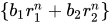 are both solutions of the recurrence relation and both satisfy the initial conditions when
  and
and  .
.
Because there is a unique solution of a linear homogeneous recurrence relation of degree two with two initial conditions, it follows that the two solutions are the same.
📋 The Solution of the Degree 2 Case when there is a Repeated Root
Let  be real numbers with
  . Suppose that
  has only one root
  . A sequence
  is a solution of the recurrence relation
  if and only if
  , where
  are constants.
📋 The General Case
Let  be real numbers. Suppose that the characteristic equation has
  distinct roots
  . Then a sequence
  is a solution of the recurrence relation
  if and only if
  for
for  where
where  are constants.
The coefficients  are found by enforcing the initial conditions.
📋 The General Case with Repeated Roots Allowed
Let  be real numbers. Suppose that the characteristic equation
  has
has  distinct roots with multiplicities
  , respectively, so that
  for
for  and
and  . Then a sequence
  is a solution of the recurrence relation
  if and only if
  for
for  where
where  are constants.
8.2.2 Linear Nonhomogeneous Recurrence Relation With Constant Coefficients
 , where
  are real number,
  is a function not identically zero depending only on
  .
.  is called the
 **associated homogeneous recurrence relation**. Solution to nonhomogeneous case is sum of solution to associated homogeneous recurrence system and a **particular solution** to the nonhomogeneous case.
📋 Solving Linear Nonhomogeneous Recurrence Relations with Constant Coefficients
Let  be a particular solution of the nonhomogeneous linear recurrence relation with constant coefficients
  . Then every solution is of the form
  , where
  is a solution of the associated homogeneous recurrence relation
  .
.
📋 Assume a linear nonhomogeneous recurrence equation with constant coefficients with the nonlinear part  of the form
  . If
. If  is not a root of the characteristic equation of the associated homogeneous recurrence equation, there is a particular solution of the form
  . If
. If  is a root of multiplicity
  , a particular solutions is of the form
  .
.
8.4 Generating Function
如果觉得不好理解可以看这篇文章:
The **generating function**(生成函数) for a finite sequence  of real numbers is the series
  .
.
The generating function for a infinite sequence  of real numbers is the infinite series
  .
.
📋 Let  ,
, 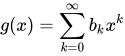 , then
 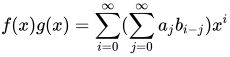 .
.
Proof:
🌰 e.g.
Suppose that the generating function of the sequence  is
is  . What is the generating function for the sequence
  ?
?
Solution:
So  . The generating function of
  is
is  .
.
So  .
.
📋 The Extended Binomial Coefficient
Let  be a real number and
  a nonnegative integer. Then the extended binomial coefficient is defined by
  .
.
📋 Let  be a real number with
  and let
  be a real number. Then
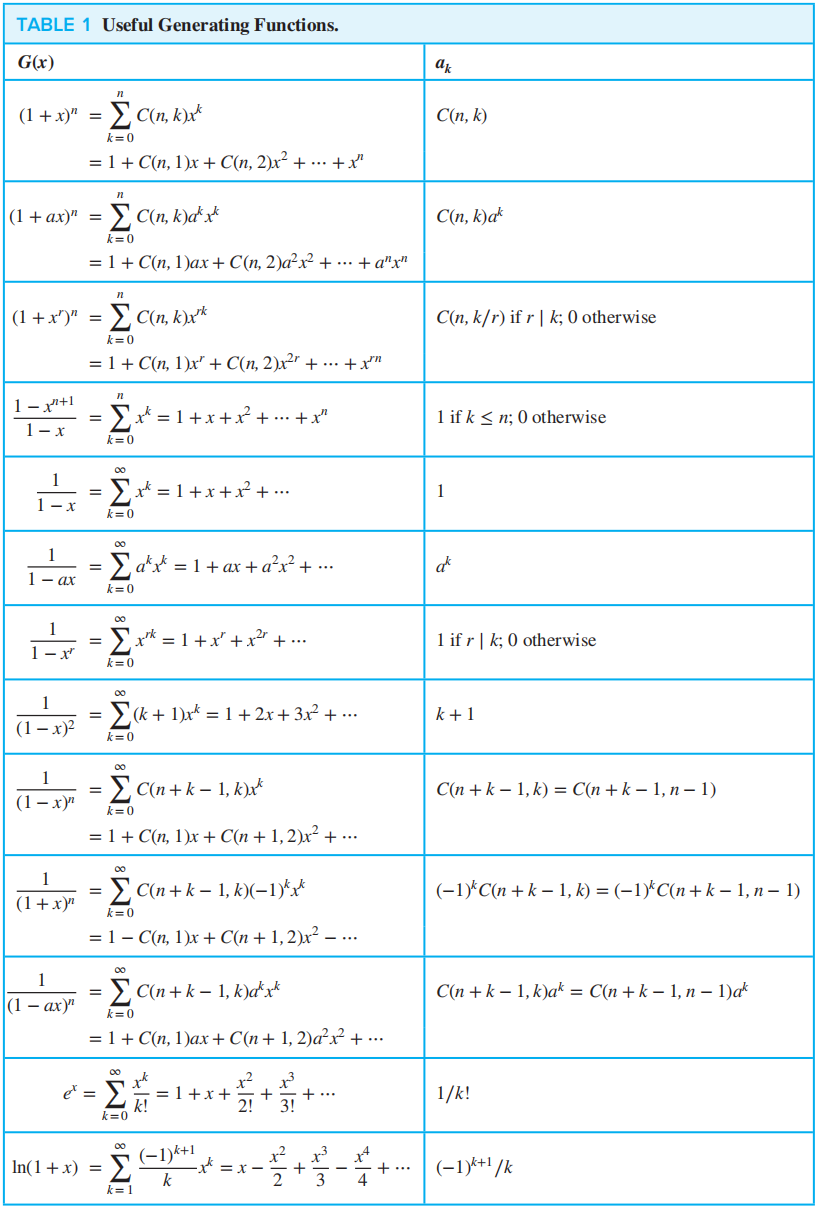
📋 Counting Problems Using Generating Functions
This method is shown in the following examples.
🌰 e.g.
Find the number of solutions of  , where
  ,
,  , and
, and  are nonnegative integers with
  ,
,  , and
, and  .
.
Solution:
The number of solutions with the indicated constraints is the coefficient of  in the expansion of
  . This follows because we obtain a term equal to
  in the product by picking a term in the first sum
  , a term in the second sum
  , and a term in the third sum
  , where
  . It is not hard to see that the coefficient of
  in this product is 3. Hence, there are three solutions.
🌰 e.g.
Use generating functions to find the number of r-combinations from a set with  elements when repetition of elements is allowed.
Solution:
Since there are  elements in the set, each can be selected zero times, one times and so on. It follows that
  .
.
the number of r-combinations from a set with  elements when repetition of elements is allowed, is the coefficient ar of
  in the expansion of
  . Since
  . Then the coefficient
  equals
  .
.
🌰 e.g.
Suppose that there are  red balls,
  blue balls, and
  white balls. How many ways to select
  balls from these balls?
Solution:
The coefficient  of
of  in the expansion of
  is the solution of this problem.
So 
 , so
, so  .
.
🌰 e.g.
Determine the number of ways to insert tokens worth $1,$2 and $5 into a vending machine to pay for an item that costs r dollars in both the case when the order in which the tokens are inserted does not matter and when the order does matter.
Solution:
(1) When the order in which the tokens are inserted does not matter:
The coefficient of  in the expansion of
  is the solution of this problem.
(2) When the order in which the tokens are inserted does matter:
The number of ways to insert exactly  tokens to produce a total of $r is the coefficient of
  in
in  . Since any number of tokens may be inserted, the number of ways to produce $r using $1,$2 and $5 tokens, is the coefficient of
  in
in  .
.
📋 Use Generating Function to Solve Recurrence Relations
This method is shown in the following examples.
🌰 e.g.
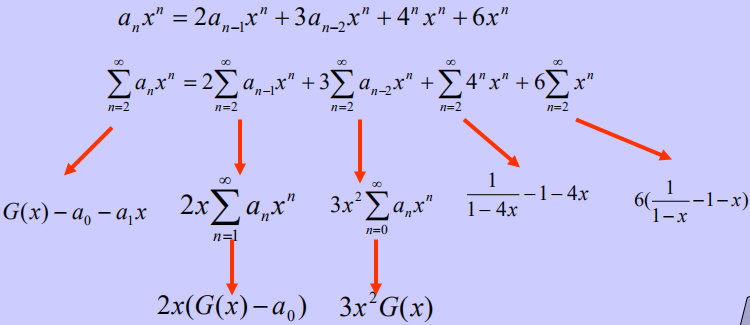
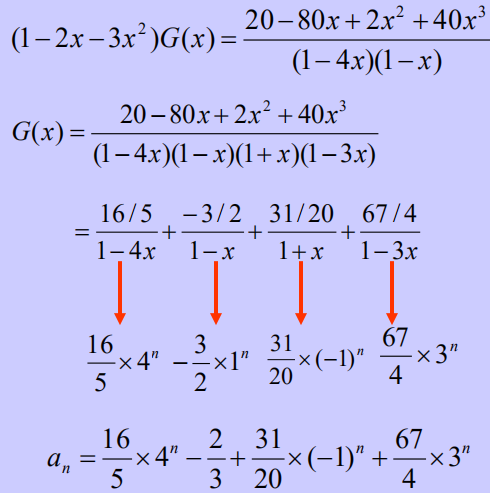
Use generating functions to solve the recurrence relation  with initial conditions
  .
.
Solution:
Multiply by  on both sides of
  .
.
8.5 Inclusion-Exclusion and Its Application
📋 The Formula for the Number of Elements in the Union of n Finite Sets
There are  terms in this formula.
Proof:
An element in the union is counted exactly once by the right-hand side of the equation.
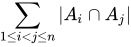
Suppose that  is an element of exactly
  of the sets
  where
where  . This element is counted
  times by
  ,
,  times by
  , …
, …
Thus it is counted exactly  .
.
📋 An Alternative Form of Inclusion-Exclusion
To solve problems that ask for the number of elements in a set that have none of  properties
  . Let
. Let  be the the subset containing the elements that have property
  . Let
. Let  be the number of elements with all properties
  . It follows that
  . Let
. Let  be the number of elements with none of the properties
  . From the inclusion-exclusion principle, we see that:
📋 The Sieve of Eratoshenes
A method to find the number of primes not exceeding a specified positive integer.
🌰 e.g.
Take 100 for example.
Solution:
A composite integer is divisible by a prime not exceeding its square root, so composite integer not exceeding 100 must have a prime factor not exceeding 10. Since the only primes less than 10 are 2,3,5,7, the primes not exceeding 100 are these four primes and the positive integers greater than 1 and not exceeding 100 that are divisible by none of 2,3,5,7.
Firstly, we pick out the composites divisible by 2 and change their color into grey. Then pick out the composites divisible by 3 from the rest numbers and so on. Then the black integers are the primes we want.
🌰 e.g.
Let  and
and  be positive integers with
  . Then, there are
  onto functions from a set with
  elements to a set with
  elements.
Proof:
Let  be the property that
  is not in the range of the function, respectively. A function is onto if and only if it has none of these properties.
**Derangement**: A derangement is a permutation of objects that leaves no object in the original position.
🌰 e.g.
21453 is a derangement of 12345 because no number is left in its original position.
📋 The number of derangements of a set with  elements can be calculated using inclusion-exclusion, and is
  .
.
Proof:
Let a permutation have property  if it fixes element
  . The number of derangements is the number of permutation having none of the properties
  for
for  , namely.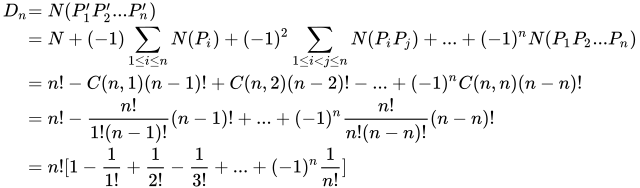

若有收获,就点个赞吧
0 人点赞


