前序
public List<Integer> preorderTraversal(TreeNode root) {List<Integer> result = new ArrayList<>();Deque<TreeNode> stack = new ArrayDeque<>();TreeNode p = root;while(!stack.isEmpty() || p != null) {if(p != null) {// 压栈时记录数据stack.push(p);result.add(p.val);// 埋头一直向左走p = p.left;} else {// 走到null节点,出栈TreeNode node = stack.pop();// 更新p指针指向右节点p = node.right;}}return result;}
- 每个节点会访问 3 次,前序遍历时就是当第一次访问该节点时就输出该节点的值。这个序就是指递归序。
- 前序遍历是一直埋头向左走,走到最后,再出栈,然后将指针 p 指向出栈的节点的右子树,再对右子树进行操作。
- 前序遍历主要思想是整棵树是可以被左边界的节点分解掉。
记住两个要点:
- 定义一个指针 p 指向 root。
- 一直向左走,入栈时添加节点值。
走到左子树尽头,弹出栈顶元素,将 p 指向刚弹出元素的右节点。继续循环步骤 1,直到栈空。
中序
class Solution {public List<Integer> inorderTraversal(TreeNode root) {List<Integer> res = new LinkedList<>();if (root == null) return res;Deque<TreeNode> stack = new ArrayDeque<>();TreeNode p = root;while (!stack.isEmpty() || p != null) {while (p != null) {stack.addLast(p);p = p.left;}TreeNode node = stack.pollLast();res.add(node.val);p = node.right;}return res;}}
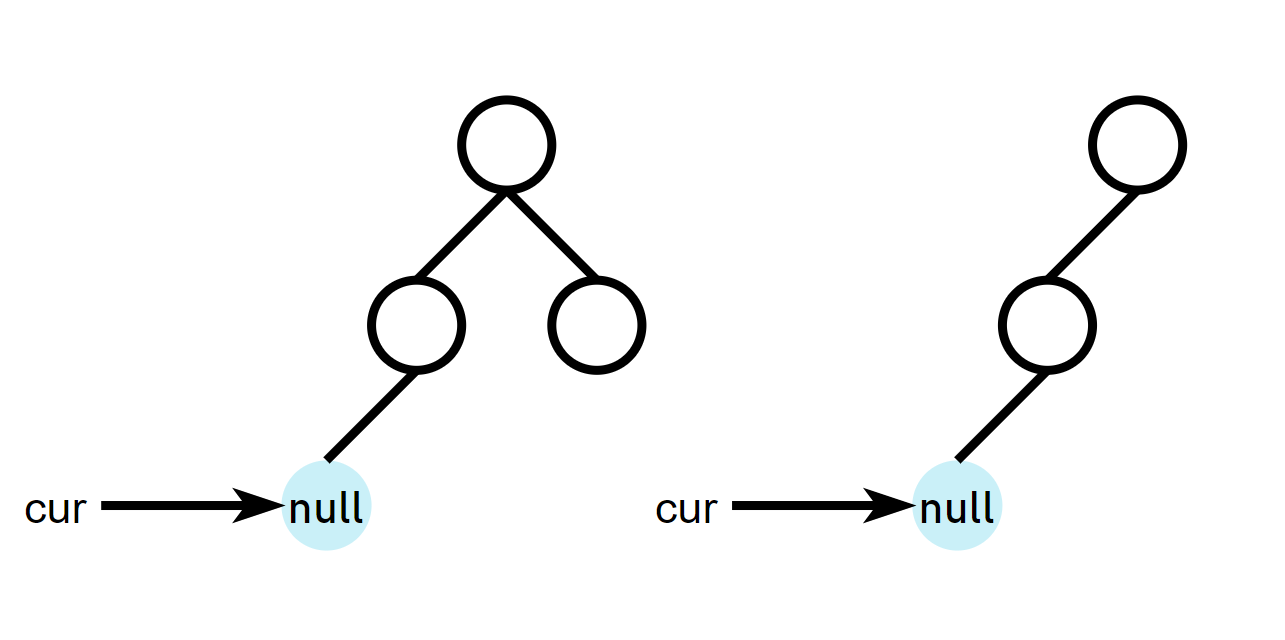
思路和前序是差不多的,关键在如下图所示,当指针遇到空节点时,需要进行栈弹出操作,对于中序,弹出操作则记录所弹出节点的数据,对于前序,则是在入栈时记录数据。
Morris
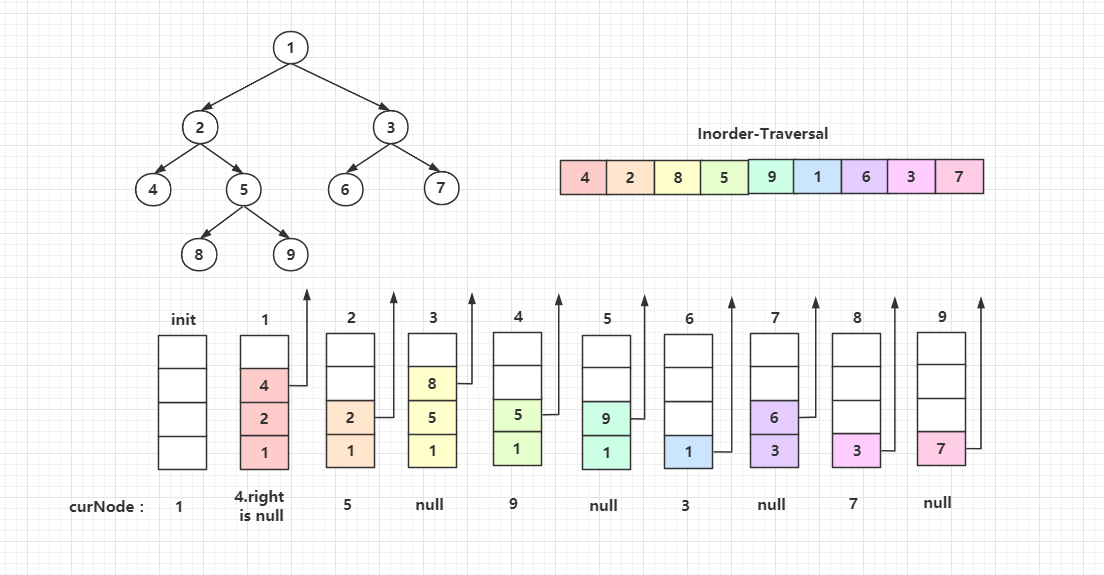
Morris 遍历算法是另一种遍历二叉树的方法,它能将非递归的中序遍历空间复杂度降为 O(1)O(1)。
Morris 遍历算法整体步骤如下(假设当前遍历到的节点为 xx):
如果 xx 无左孩子,先将 xx 的值加入答案数组,再访问 xx 的右孩子,即 x = x.\textit{right}x=x.right。
如果 xx 有左孩子,则找到 xx 左子树上最右的节点(即左子树中序遍历的最后一个节点,xx 在中序遍历中的前驱节点),我们记为 \textit{predecessor}predecessor。根据 \textit{predecessor}predecessor 的右孩子是否为空,进行如下操作。
如果 \textit{predecessor}predecessor 的右孩子为空,则将其右孩子指向 xx,然后访问 xx 的左孩子,即 x = x.\textit{left}x=x.left。
如果 \textit{predecessor}predecessor 的右孩子不为空,则此时其右孩子指向 xx,说明我们已经遍历完 xx 的左子树,我们将 \textit{predecessor}predecessor 的右孩子置空,将 xx 的值加入答案数组,然后访问 xx 的右孩子,即 x = x.\textit{right}x=x.right。
重复上述操作,直至访问完整棵树。
class Solution {public List<Integer> inorderTraversal(TreeNode root) {List<Integer> res = new ArrayList<Integer>();TreeNode predecessor = null;while (root != null) {if (root.left != null) {// predecessor 节点就是当前 root 节点向左走一步,然后一直向右走至无法走为止predecessor = root.left;while (predecessor.right != null && predecessor.right != root) {predecessor = predecessor.right;}// 让 predecessor 的右指针指向 root,继续遍历左子树if (predecessor.right == null) {predecessor.right = root;root = root.left;}// 说明左子树已经访问完了,我们需要断开链接else {res.add(root.val);predecessor.right = null;root = root.right;}}// 如果没有左孩子,则直接访问右孩子else {res.add(root.val);root = root.right;}}return res;}}
后序
public List<Integer> postorderTraversal(TreeNode root) {
    List<Integer> res = new LinkedList<>();
    if (root == null) return res;
    Deque<TreeNode> stack = new ArrayDeque<>();
    TreeNode p = root;
    TreeNode pLastVisit = null;
    // 一直走到最左边
    while (p != null) {
        stack.addLast(p);
        p = p.left;
    }

    while (!stack.isEmpty()) {
        p = stack.pollLast();
        // 判断是否需要输出根节点的值,
        // 输出根节点的值的前提是它的左、右子树都已经完成遍历
        if (p.right == null || p.right == pLastVisit) {
            res.add(p.val);
            // 修改最近一次经过的节点
            pLastVisit = p;
        } else {
            // 左子树刚被访问过,
            stack.addLast(p);
            p = p.right;
            while (p != null) {
                stack.addLast(p);
                p = p.left;
            }
        }
    }

    return res;
}
public class Solution {
    public List<Integer> postorderTraversal(TreeNode root) {
        Stack<TreeNode> s = new Stack();
        List<Integer> ans = new ArrayList<Integer>();
        TreeNode cur = root;

        while (cur != null || !s.empty()) {
            // 一直埋头向左走
            while (!isLeaf(cur)) {
                s.push(cur);
                cur = cur.left;
            }

            // 走不动了,左节点的值一定是最先加入的,它不会再被遍历
            if (cur != null) ans.add(cur.val);

            while (!s.empty() && cur == s.peek().right) {
                cur = s.pop();
                ans.add(cur.val);
            }

            if (s.empty()) cur = null; else cur = s.peek().right;
        }

        return ans;
    }

    private boolean isLeaf(TreeNode r) {
        if (r == null) return true;
        return r.left == null && r.right == null;
    }
}
后序遍历定义:先左子树、后右子树,再根节点,它的难点在于我们需要跳过根节点,因此需要判断上次访问的节点是位于左子树还是右子树:
- 位于左子树:需要跳过根节点,走到根节点的右子树,等遍历完右子树后再回到根节点。
- 位于右子树:直接访问根节点。
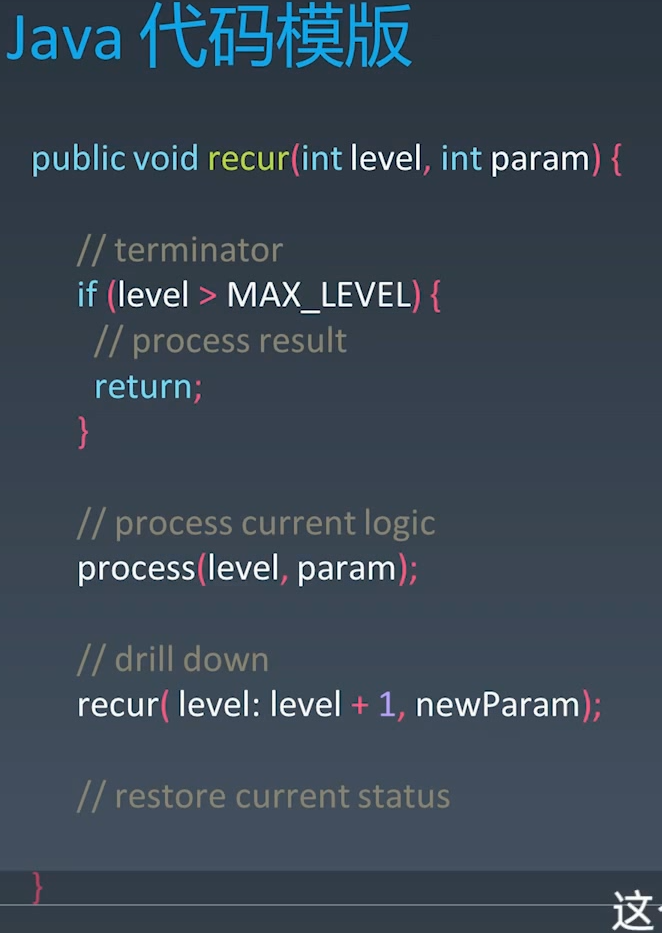
递归思维要点
- 不要人肉进行递归(最大误区)
- 找到最近最简方法,将其拆解成可重复解决的问题(重复子问题)
- 数学归纳法思维,

若有收获,就点个赞吧
0 人点赞


