What is Machine Learning?
An older definition
Arthur Samuel described it as :” the field of study that gives computers the ability to learn without being explicitly programmed.“
A more modern definition
A computer program is said to learn from experience E with respect to some class of tasks T and performance measure P, if its performance at tasks in T, as measured by P, improves with experience E.
Example: Playing checkers(跳棋)
E = the experience of playing many games of checkers
T = the task of playing checkers
P = the probability(可能性) that the program will win the next game
Supervised Learning
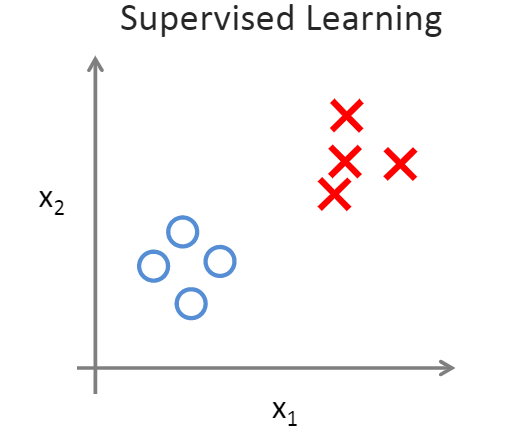
We are given a data set and already know what our correct output should look like(data have been labeled), having the idea that there is a relationship between the input and the output.
Supervised learning problems are categorized into regression and classification problems.
Regression
Tring to predict results within a continuous output, meaning that we are trying to map(映射) input variables to(到) some continuous functions.
Example: Given data about the size of houses on the real estate(房地产) market, try to predict their price.
Classification
Tring to predict results in a discrete(离散的) output. In other words, we are trying to map input variables into discrete categories.
Example: Given a patient with a tumor(肿瘤), we have to predict whether the tumor is malignant(恶性的) or benign(良性的).
Unsupervised Learning
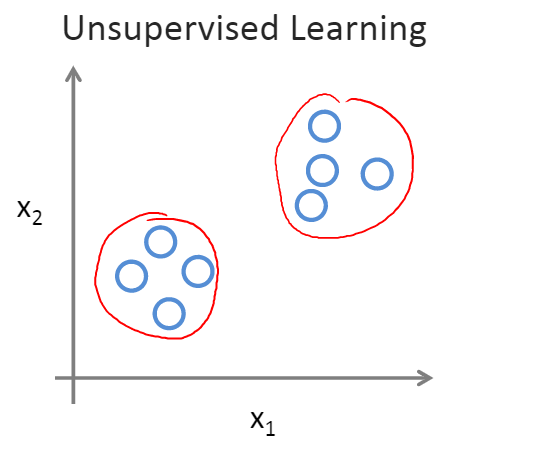
Unsupervised learning allows us to approach problems with little or no idea what our results should look like. We can derive this structure by clustering(聚集) the data based on the relationships among the variables in the data.
With unsupervised learning there is no feedback based on the prediction results.
Example:
Clustering: Take a collection of 1,000,000 different genes, and find a way to automatically group these genes into groups that are somehow similar or related by different variables, such as lifespan, location, roles, and so on.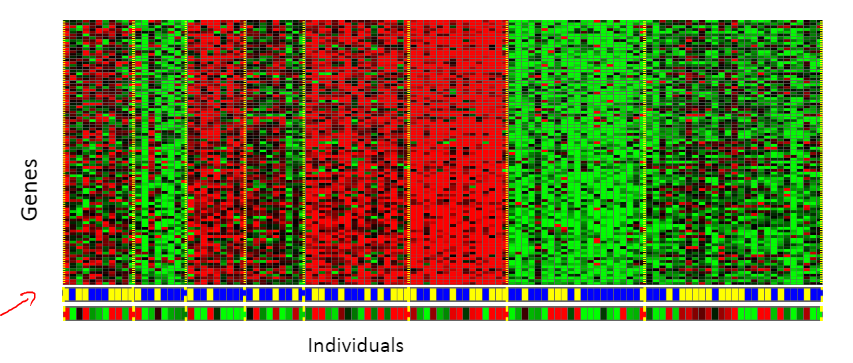
Non-clustering: The “Cocktail Party Algorithm”, allows you to find structure in a chaotic environment. (i.e. identifying individual voices and music from a mesh of sounds at a cocktail party).

若有收获,就点个赞吧
0 人点赞


