概念
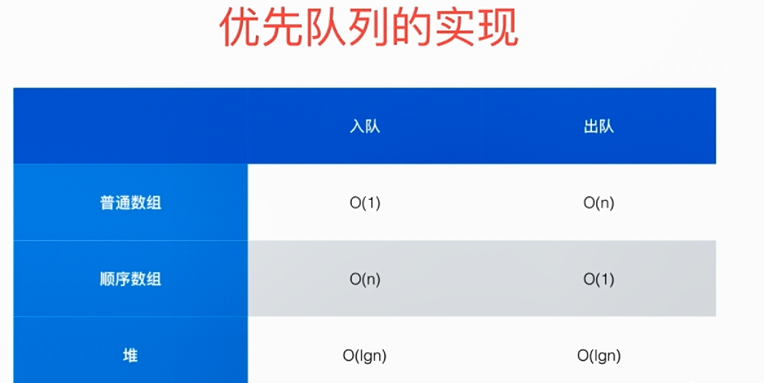
普通的队列是一种先进先出的数据结构,元素在队列尾追加,而从队列头删除。在优先队列中,元素被赋予优先级。当访问元素时,具有最高优先级的元素最先删除。
优先队列的实现
通常采用堆数据结构来实现。
堆的定义
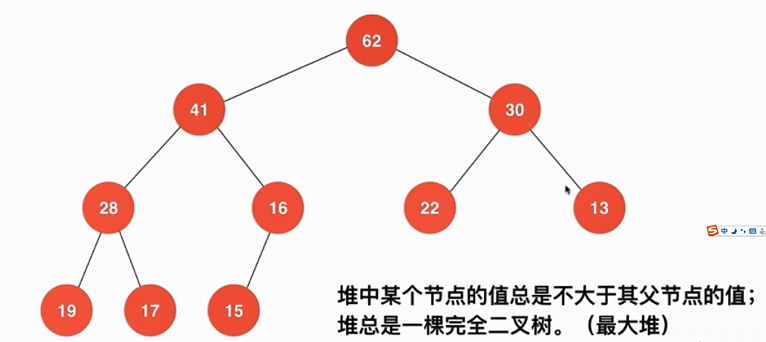
堆其实就是一棵完全二叉树(若设二叉树的深度为h,除第 h 层外,其它各层 (1~h-1) 的结点数都达到最大个数,第 h 层所有的结点都连续集中在最左边),
定义为:具有n个元素的序列(h1,h2,…hn),当且仅当满足(hi>=h2i,hi>=h2i+1)或(hi<=h2i,hi<=2i+1) (i=1,2,…,n/2)时称之为堆
堆排序
import randomimport timeclass MaxHeap(object):def __init__(self):self._data = []self._count = len(self._data)def size(self):return self._countdef isEmpty(self):return self._count == 0def add(self, item):# 插入元素入堆self._data.append(item)self._count += 1self._shiftup(self._count-1) #堆的序号从0开始def pop(self):# 出堆if self._count > 0:ret = self._data[0]self._data[0] = self._data[self._count-1] #移除堆的最顶的元素self._count -= 1self._shiftDown(0) #对移除之后的堆进行排序,使之成为最大堆return retdef _shiftup(self, index):# 上移self._data[index],以使它不大于父节点parent = (index-1)>>1while index > 0 and self._data[parent] < self._data[index]:# swapself._data[parent], self._data[index] = self._data[index], self._data[parent]index = parentparent = (index-1)>>1def _shiftDown(self, index):# 上移self._data[index],以使它不小于子节点j = (index << 1) + 1while j < self._count :# 有子节点if j+1 < self._count and self._data[j+1] > self._data[j]:# 有右子节点,并且右子节点较大j += 1if self._data[index] >= self._data[j]:# 堆的索引位置已经大于两个子节点,不需要交换了breakself._data[index], self._data[j] = self._data[j], self._data[index]index = jj = (index << 1) + 1def MaxHeap1(self,alist,n): #n表示alist的长度self._data=n*[0]for i in range(0,n):self._data[i]=alist[i]self._count=ni=(self._count-1)>>2while i>=0:self._shiftDown(i)i-=1#通过将数组的数一个一个添加到堆中然后在移出堆的操作实现逆序def Heapsort1(alist):maxheap=MaxHeap()for i in range(0,len(alist)):maxheap.add(alist[i])i=maxheap._count-1while i>=0:alist[i]=maxheap.pop()i-=1#通过开辟一个与数组同长度的堆,然后赋值->shitfdown使得成为最大堆,最后移出堆操作实现逆序def Heapsort2(alist):#开辟新空间maxheapmaxheap=MaxHeap()maxheap.MaxHeap1(alist,len(alist))i=len(alist)-1while i>=0:alist[i]=maxheap.pop()i-=1#直接对alist逆排序,不创建堆空间def Heapsort3(alist):#对数组heapifyi=(len(alist)-1)>>1while i>=0:shiftdown(alist,len(alist),i)i-=1#对数组进行逆序k=len(alist)-1while k>0:#交换alist[k],alist[0]=alist[0],alist[k]shiftdown(alist,k,0)k-=1def shiftdown(alist,n,k):while 2*k+1<n: #当左孩子没有越界j=2*k+1if j+1<n and alist[j+1]>alist[j]:j+=1if alist[k]>=alist[j]:breakalist[k],alist[j]=alist[j],alist[k]k=jif __name__ == '__main__':alist=random.sample(range(0,10000),10000)start=time.clock()Heapsort3(alist)end=time.clock()print(end-start)

若有收获,就点个赞吧
0 人点赞


