1. 意图(Intent)
将对象组合成树形结构来表示“整体/部分”层次关系,允许用户以相同的方式处理单独对象和组合对象。
2. 类图(Class Diagram)
组件(Component)类是组合类(Composite)和叶子类(Leaf)的父类,可以把组合类看成是树的中间节点。
组合对象拥有一个或者多个组件对象,因此组合对象的操作可以委托给组件对象去处理,而组件对象可以是另一个组合对象或者叶子对象。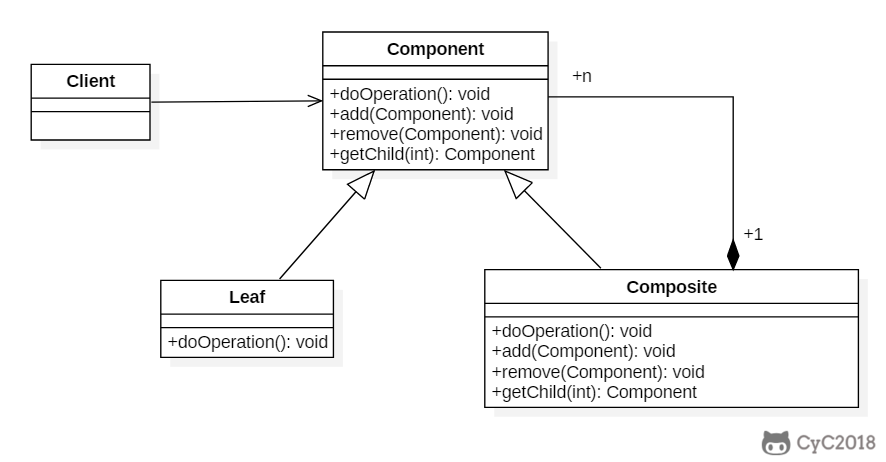
3. 实现(Implementation)
I 雇员案例1
直接看一个例子吧,每个员工都有姓名、部门、薪水这些属性,同时还有下属员工集合(虽然可能集合为空),而下属员工和自己的结构是一样的,也有姓名、部门这些属性,同时也有他们的下属员工集合。
public class Employee {private String name;private String dept;private int salary;private List<Employee> subordinates; // 下属public Employee(String name,String dept, int sal) {this.name = name;this.dept = dept;this.salary = sal;subordinates = new ArrayList<Employee>();}public void add(Employee e) {subordinates.add(e);}public void remove(Employee e) {subordinates.remove(e);}public List<Employee> getSubordinates(){return subordinates;}public String toString(){return ("Employee :[ Name : " + name + ", dept : " + dept + ", salary :" + salary+" ]");}}
通常,这种类需要定义 add(node)、remove(node)、getChildren() 这些方法。
II 雇员案例2
组件(Component)类
public abstract class Component {protected String name;public Component(String name) {this.name = name;}public void print() {print(0);}abstract void print(int level);abstract public void add(Component component);abstract public void remove(Component component);}
组合类(Composite)
public class Composite extends Component {private List<Component> child;public Composite(String name) {super(name);child = new ArrayList<>();}@Overridevoid print(int level) {for (int i = 0; i < level; i++) {System.out.print("--");}System.out.println("Composite:" + name);for (Component component : child) {component.print(level + 1);}}@Overridepublic void add(Component component) {child.add(component);}@Overridepublic void remove(Component component) {child.remove(component);}}
叶子类(Leaf)
public class Leaf extends Component {public Leaf(String name) {super(name);}@Overridevoid print(int level) {for (int i = 0; i < level; i++) {System.out.print("--");}System.out.println("left:" + name);}@Overridepublic void add(Component component) {// 牺牲透明性换取单一职责原则,这样就不用考虑是叶子节点还是组合节点throw new UnsupportedOperationException();}@Overridepublic void remove(Component component) {throw new UnsupportedOperationException();}}
客户端代码
public class Client {public static void main(String[] args) {Composite root = new Composite("root");Component node1 = new Leaf("1");Component node2 = new Composite("2");Component node3 = new Leaf("3");root.add(node1);root.add(node2);root.add(node3);Component node21 = new Leaf("21");Component node22 = new Composite("22");node2.add(node21);node2.add(node22);Component node221 = new Leaf("221");node22.add(node221);root.print();}}
Composite:root--left:1--Composite:2----left:21----Composite:22------left:221--left:3
4. JDK
- javax.swing.JComponent#add(Component)
- java.awt.Container#add(Component)
- java.util.Map#putAll(Map)
- java.util.List#addAll(Collection)
- java.util.Set#addAll(Collection)

若有收获,就点个赞吧
0 人点赞


