1. 反转链表
描述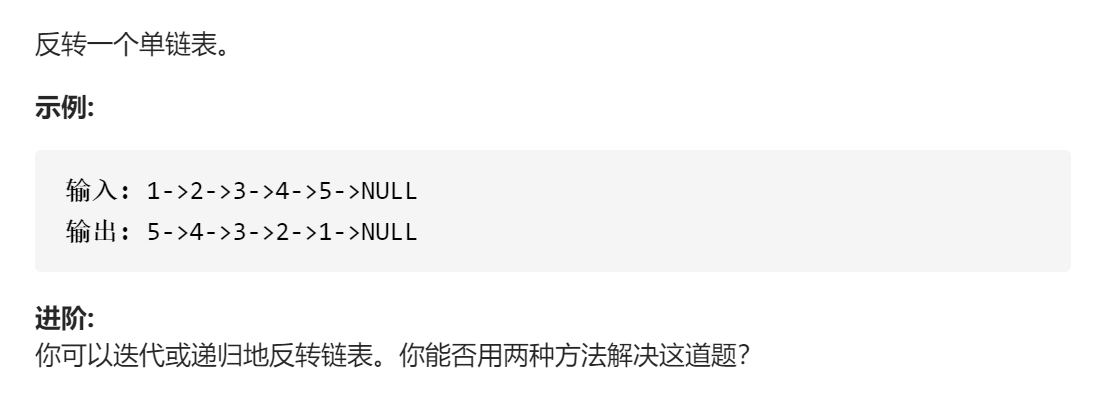
方法一:迭代
思路
假设存在链表 1 → 2 → 3 → Ø,我们想要把它改成 Ø ← 1 ← 2 ← 3。
在遍历列表时,将当前节点的 next 指针改为指向前一个元素。由于节点没有引用其上一个节点,因此必须事先存储其前一个元素。在更改引用之前,还需要另一个指针来存储下一个节点。不要忘记在最后返回新的头引用!
代码
/*** Definition for singly-linked list.* public class ListNode {* int val;* ListNode next;* ListNode(int x) { val = x; }* }*/class Solution {public ListNode reverseList(ListNode head) {ListNode pre = null;ListNode cur = head;while (cur != null) {ListNode nex = cur.next;cur.next = pre;pre = cur;cur = nex;}return pre;}}
# Definition for singly-linked list.# class ListNode:# def __init__(self, x):# self.val = x# self.next = Noneclass Solution:def reverseList(self, head: ListNode) -> ListNode:pre = Nonecur = headwhile cur:nex = cur.nextcur.next = prepre = curcur = nexreturn pre
/**
 * Definition for singly-linked list.
 * function ListNode(val) {
 *     this.val = val;
 *     this.next = null;
 * }
 */
/**
 * @param {ListNode} head
 * @return {ListNode}
 */
var reverseList = function(head) {
    let pre = null;
    let cur = head
    while (cur != null) {
        let nex = cur.next;
        cur.next = pre;
        pre = cur;
        cur = nex;
    }
    return pre;
};
复杂度分析
- 时间复杂度:O(n),假设 n 是列表的长度,时间复杂度是 O(n)。
- 空间复杂度:O(1)。
方法二:递归
思路
递归版本稍微复杂一些,其关键在于反向工作。假设列表的其余部分已经被反转,现在我该如何反转它前面的部分?
假设列表为:
若从节点 到
到  已经被反转,而我们正处于
 。
。
我们希望 的下一个节点指向 。
所以, 。
。
注意:要小心的是  的下一个必须指向 Ø 。如果你忽略了这一点,你的链表中可能会产生循环。如果使用大小为 2 的链表测试代码,则可能会捕获此错误。
不妨假设链表为1,2,3,4,5。按照递归,当执行reverseList(5)的时候返回了5这个节点,reverseList(4)中的p就是5这个节点,我们看看reverseList(4)接下来执行完之后,5->next = 4, 4->next = null。这时候返回了p这个节点,也就是链表5->4->null,接下来执行reverseList(3),代码解析为4->next = 3,3->next = null,这个时候p就变成了,5->4->3->null, reverseList(2), reverseList(1)依次类推,p就是:5->4->3->2->1->null
代码
public ListNode reverseList(ListNode head) {
    if (head == null || head.next == null) return head;
    ListNode p = reverseList(head.next);
    head.next.next = head;
    head.next = null;
    return p;
}
class Solution:
    def reverseList(self, head: ListNode) -> ListNode:
        if not head or not head.next:
            return head

        p = self.reverseList(head.next)
        head.next.next = head
        head.next = None
        return p
/**
 * Definition for singly-linked list.
 * function ListNode(val) {
 *     this.val = val;
 *     this.next = null;
 * }
 */
/**
 * @param {ListNode} head
 * @return {ListNode}
 */
var reverseList = function(head) {
    if (head == null || head.next == null) {
        return head;
    }
    let p = reverseList(head.next);
    head.next.next = head;
    head.next = null;
    return p;
};
复杂度分析
- 时间复杂度:O(n),假设 n 是列表的长度,那么时间复杂度为 O(n)。
空间复杂度:O(n),由于使用递归,将会使用隐式栈空间。递归深度可能会达到 n 层。
2. 两两交换链表中的节点
描述

方法一:递归
思路
这个题目要求我们从第一个节点开始两两交换链表中的节点,且要真正的交换节点。
算法:从链表的头节点 head 开始递归。
- 每次递归都负责交换一对节点。由 firstNode 和 secondNode 表示要交换的两个节点。
- 下一次递归则是传递的是下一对需要交换的节点。若链表中还有节点,则继续递归。
- 交换了两个节点以后,返回 secondNode,因为它是交换后的新头。
- 在所有节点交换完成以后,我们返回交换后的头,实际上是原始链表的第二个节点。
代码
/**
 * Definition for singly-linked list.
 * public class ListNode {
 *     int val;
 *     ListNode next;
 *     ListNode(int x) { val = x; }
 * }
 */
class Solution {
    public ListNode swapPairs(ListNode head) {
        if (head == null || head.next == null) {
            return head;
        }
        ListNode first = head;
        ListNode second = head.next;
        first.next = swapPairs(second.next);
        second.next = first;
        return second;
    }
}
# Definition for singly-linked list.
# class ListNode:
#     def __init__(self, x):
#         self.val = x
#         self.next = None

class Solution:
    def swapPairs(self, head: ListNode) -> ListNode:
        if not head or not head.next:
            return head
        first = head
        second = head.next
        first.next = self.swapPairs(second.next)
        second.next = first
        return second
var swapPairs = function(head) {
    if (head == null || head.next == null) {
        return head;
    }

    let first = head;
    let second = head.next;

    first.next = swapPairs(second.next)
    second.next = first

    return second;
};
复杂度分析
- 时间复杂度:O(N),其中 N 指的是链表的节点数量。
- 空间复杂度:O(N),递归过程使用的堆栈空间。
方法二:迭代
思路
我们把链表分为两部分,即奇数节点为一部分,偶数节点为一部分,A 指的是交换节点中的前面的节点,B 指的是要交换节点中的后面的节点。在完成它们的交换,我们还得用 prevNode 记录 A 的前驱节点。
算法:
firstNode(即 A) 和 secondNode(即 B)分别遍历偶数节点和奇数节点,即两步看作一步。
交换两个节点:
firstNode.next = secondNode.next
secondNode.next = firstNode
还需要更新 prevNode.next 指向交换后的头。
prevNode.next = secondNode
代码
class Solution:
    def swapPairs(self, head: ListNode) -> ListNode:
        dummpy = ListNode(-1)
        dummpy.next = head
        pre_node = dummpy
        while head and head.next:
            first = head
            second = head.next
            pre_node.next = second
            first.next = second.next
            second.next = first

            pre_node = first
            head = first.next
        return dummpy.next
class Solution {
    public ListNode swapPairs(ListNode head) {
        ListNode dummy = new ListNode(-1);
        dummy.next = head;
        ListNode pre = dummy;
        while(head != null && head.next != null) {
            ListNode first = head;
            ListNode second = head.next;

            pre.next = second;
            first.next = first.next.next;
            second.next = first;

            pre = first;
            head = first.next;
        }
        return dummy.next;
    }
}
var swapPairs = function(head) {
    let dummy = new ListNode(-1);
    dummy.next = head;
    let pre = dummy;
    while (head != null && head.next != null) {
        let firstNode = head;
        let secondNode = head.next;

        pre.next = secondNode;
        firstNode.next = secondNode.next;
        secondNode.next = firstNode;

        pre = firstNode;
        head = firstNode.next;
    }
    return dummy.next;
};
复杂度分析
- 时间复杂度:O(N),其中 N 指的是链表的节点数量。
-
3. 回文链表
描述
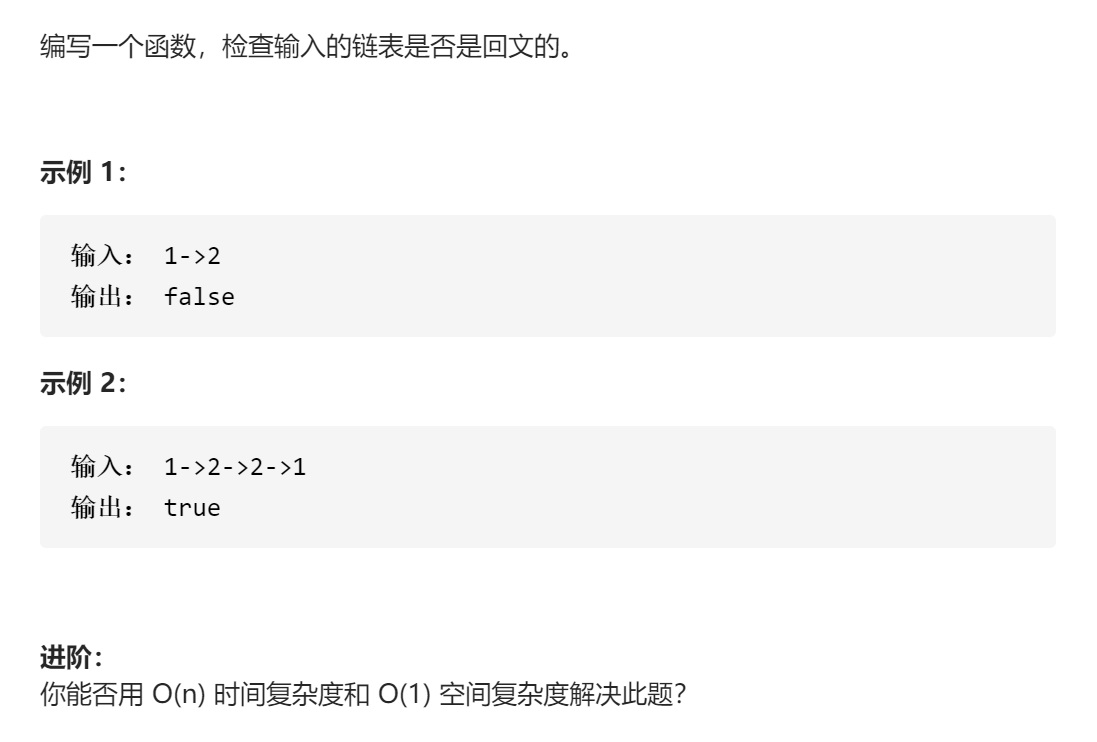
思路
题目中要求O(1)空间复杂度,所以所有保存链表值,然后再取出来比较的方法都不可能,保存链表值的话,本身就是O(n)了,所以换一种思路来看,从本质来讲的话,链表左右是对称的,所以可以找到链表的中间节点,然后找到头指针,再进行反转链表,最后就是个O(n)的遍历比较。需要考虑的是,翻转前一半还是后一半?
算法 初始化dummy节点(哑巴节点),方便后续处理
- 利用快慢指针找到中间节点
- 翻转链表后一半
- 翻转后的一半和之前记录的链表头结点开始比较,如果出现值不一样,就返回False;如果其中之一能遍历到空,说明是回文。
代码
class Solution {
    public boolean isPalindrome(ListNode head) {
        ListNode dummy = new ListNode(-1);
        dummy.next = head;
        ListNode slow = dummy;
        ListNode fast = dummy;
        while (fast != null && fast.next != null) {
            slow = slow.next;
            fast = fast.next.next;
        }
        ListNode q = slow.next;
        ListNode pre = null;
        while (q != null) {
            ListNode nex = q.next;
            q.next = pre;
            pre = q;
            q = nex;
        }
        while (head != null && pre != null) {
            if (head.val != pre.val) {
                return false;
            }
            head = head.next;
            pre = pre.next;
        }
        return true;
    }
}
class Solution:
    def isPalindrome(self, head: ListNode) -> bool:
        dummy = ListNode(-1)
        dummy.next = head
        slow = dummy
        fast = dummy
        while fast and fast.next:
            slow = slow.next
            fast = fast.next.next

        q = slow.next
        last = None
        while q:
            nex = q.next
            q.next = last
            last = q
            q = nex
        while head and last:
            if head.val != last.val:
                return False
            head = head.next
            last = last.next
        return True
/**
 * Definition for singly-linked list.
 * function ListNode(val) {
 *     this.val = val;
 *     this.next = null;
 * }
 */
/**
 * @param {ListNode} head
 * @return {boolean}
 */
var isPalindrome = function(head) {
    let dummy = new ListNode(-1);
    dummy.next = head;
    let slow = dummy;
    let fast = dummy;
    while (fast && fast.next) {
        slow = slow.next;
        fast = fast.next.next;
    }
    let q = slow.next;
    let pre = null;
    while (q != null) {
        let nex = q.next;
        q.next = pre;
        pre = q;
        q = nex;
    }
    while (head != null && pre != null) {
        if (head.val != pre.val) {
            return false;
        }
        head = head.next;
        pre = pre.next;
    }
    return true;
};
注意
- 这里我们用了哑巴节点,对于总长度为奇数(不包括dummy)的链表,如,dummy-1-2-3-2-1,slow会指向3,fast会指向4.next.next = null,这个时候翻转,即1-2 和 1-2-3作比较。
- 对于总长度为奇数(不包括dummy)的链表,如,dummy-1-2-3-3-2-1,slow会指向3,fast最后会指向3.next.next = 1,这个时候翻转,即1-2-3 和 1-2-3作比较。
以上两种情况,我们都能得到正确解。无需关注链表长度为奇数还是偶数。
4. K个一组翻转链表
描述

思路
我们需要把链表结点按照 k 个一组分组,所以可以使用一个指针 head 依次指向每组的头结点。这个指针每次向前移动 k 步,直至链表结尾。对于每个分组,我们先判断它的长度是否大于等于 k。若是,我们就翻转这部分链表,否则不需要翻转。
接下来的问题就是如何翻转一个分组内的子链表。翻转一个链表并不难,过程可以参考 206. 反转链表。但是对于一个子链表,除了翻转其本身之外,还需要将子链表的头部与上一个子链表连接,以及子链表的尾部与下一个子链表连接。
因此,在翻转子链表的时候,我们不仅需要子链表头结点head,还需要有head的上一个结点pre,以便翻转完后把子链表再接回pre。
代码class Solution: def reverseKGroup(self, head: ListNode, k: int) -> ListNode: def reverse(head, tail): prev = tail.next p = head while prev != tail: nex = p.next p.next = prev prev = p p = nex return tail, head dummy = ListNode(-1) dummy.next = head pre = dummy while head: tail = pre # 判断长度是否大于k for i in range(k): tail = tail.next if not tail: return dummy.next nex = tail.next # 返回的是翻转组的头和尾 head, tail = reverse(head, tail) # 进行连接 pre.next = head tail.next = nex # 重新赋值,准备下次翻转 pre = tail head = nex return dummy.nextclass Solution { public ListNode reverseKGroup(ListNode head, int k) { ListNode dummy = new ListNode(-1); dummy.next = head; ListNode pre = dummy; while (head != null) { ListNode tail = pre; for (int i = 0; i < k; i++) { tail = tail.next; if (tail == null) { return dummy.next; } } # 记录下一次要反转的头 ListNode nex = tail.next; tail.next = null; # 进行连接 pre.next = reverse(head); pre = head; # 第二次连接 head.next = nex; head = nex; } return dummy.next; } public ListNode reverse(ListNode head) { ListNode pre = null; while (head != null) { ListNode nex = head.next; head.next = pre; pre = head; head = nex; } return pre; } }```javascript var reverseKGroup = function(head, k) { let dummy = new ListNode(-1); dummy.next = head; let pre = dummy; while (head != null) {
  let tail = pre;
  for (let i = 0; i < k; i++) {
        tail = tail.next;
      if (tail == null) {
          return dummy.next;
      }
  }
  let nex = tail.next;
  tail.next = null;
  pre.next = reverse(head);

  pre = head;
  head.next = nex;
  head = nex;
} return dummy.next; };
var reverse = function(head){ let pre = null; while (head != null) { let nex = head.next; head.next = pre; pre = head; head = nex; } return pre; }
**复杂度分析**
- 时间复杂度:O(n),其中 n 为链表的长度。head 指针会在 个结点上停留,每次停留需要进行一次 O(k) 的翻转操作。
- 空间复杂度:O(1),我们只需要建立常数个变量。
**方法二:递归**<br />**思路**<br />递归解题要点:
- 递归的终止条件
- 最终我们要返回什么
- 递归的每一层我们要做什么。
我们先返回头结点,在递归的返回下一组的头结点,记录每一次的尾节点,指向下一次返回的头节点。<br />大致过程可以分解为<br />1、找到待翻转的k个节点(注意:若剩余数量小于 k 的话,则不需要反转,因此直接返回待翻转部分的头结点即可)。<br />2、对其进行翻转。并返回翻转后的头结点(**注意:翻转为左闭又开区间,所以本轮操作的尾结点其实就是下一轮操作的头结点**)。<br />3、对下一轮 k 个节点也进行翻转操作。<br />4、将上一轮翻转后的尾结点指向下一轮翻转后的头节点,即将每一轮翻转的k的节点连接起来。<br />**代码**
```javascript
var reverseKGroup = function(head, k) {
if (head == null) {
return null;
}
let a = head;
let b = head;
for (let i = 0; i < k; i++) {
if (b == null) {
return head;
}
b = b.next;
}
let newHead = reverse(a, b);
a.next = reverseKGroup(b, k)
return newHead;
};
var reverse = function(a, b){
let pre = null;
let cur = a;
let nex;
// 这里 判断 nex != b 也可以,因为while 循环最后一句,是cur = nex
while (cur != b) {
nex = cur.next;
cur.next = pre;
pre = cur;
cur = nex
}
return pre;
}
class Solution:
    def reverseKGroup(self, head: ListNode, k: int) -> ListNode:
        def reverse(a, b):
            pre = None
            cur = a
            while cur != b:
                nex = cur.next
                cur.next = pre
                pre = cur
                cur = nex
            return pre
        a = head
        b = head
        for i in range(k):
            if not b:
                return a
            b = b.next
        # 注意这里遍历完后,b节点指向的是下一组节点的头节点
        # 获取翻转后的头结点
        new_head = reverse(a, b)
        a.next = self.reverseKGroup(b, k)
        return new_head
/**
 * Definition for singly-linked list.
 * public class ListNode {
 *     int val;
 *     ListNode next;
 *     ListNode(int x) { val = x; }
 * }
 */
class Solution {
    public ListNode reverseKGroup(ListNode head, int k) {
        ListNode a = head;
        ListNode b = head;
        for (int i = 0; i < k; i++) {
            if (b == null){
                return a;
            }
            b = b.next;
        }
        ListNode newHead = reverse(a, b);
        a.next = reverseKGroup(b, k);
        return newHead;
    }
    public ListNode reverse(ListNode a, ListNode b) {
       ListNode pre = null;
       ListNode cur = a;
       while (cur != b) {
           ListNode nex = cur.next;
           cur.next = pre;
           pre = cur;
           cur = nex;
       }
       return pre;
    }
}
注意:这里翻转a到b之间的链表,是左闭右开,如 k = 3, 反转 1 - 2 - 3 - 4,此时a 指向 1, b指向 4,反转后为 3 - 2 - 1 - 4,所以有 a.next = reverseKGroup(b, k),需要注意用cur 来保存a,这样a 最后就变成链表尾部了。
复杂度分析
- 时间复杂度:O(N)
空间复杂度:O(1)我们使用了常数个遍历,并进行递归,递归深度约为(n/k)。
5. 合并K个排序链表
描述
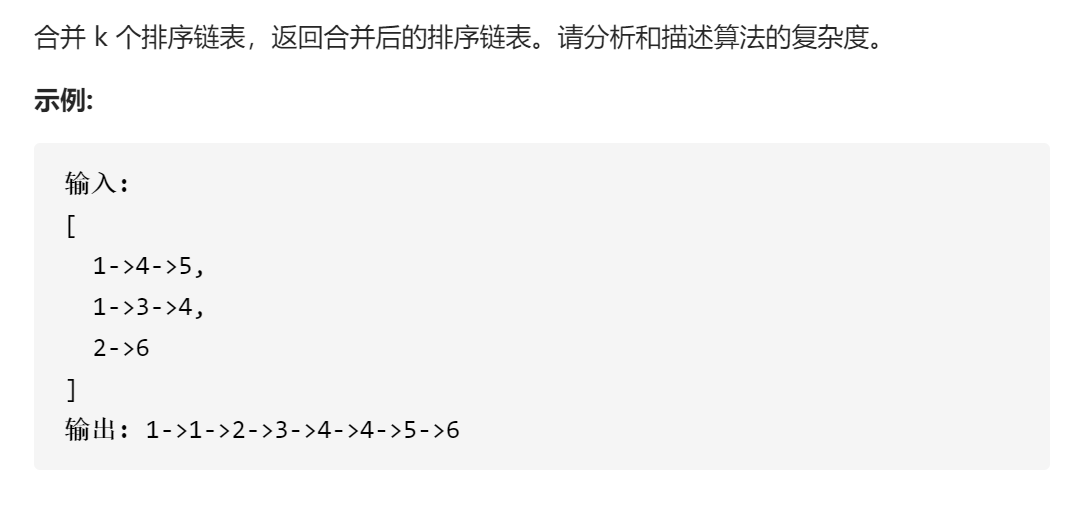
思路
递归归并排序即可,需要注意两个排序链表的合并。
代码var mergeKLists = function(lists) { if (lists.length === 0) { return null; } if (lists.length === 1) { return lists[0]; } if (lists.legnth === 2) { return mergeTwoLists(lists[0], lists[1]); } let mid = lists.length >> 1; let left = lists.slice(0, mid); let right = lists.slice(mid, lists.length); return mergeTwoLists(mergeKLists(left), mergeKLists(right)); }; var mergeTwoLists = function(l1, l2) { const dummy = new ListNode(-1); let p = dummy; while(l1 != null && l2 != null) { if (l1.val < l2.val) { p.next = l1; l1 = l1.next; } else { p.next = l2; l2 = l2.next; } p = p.next; } p.next = l1 === null? l2 : l1; return dummy.next; };class Solution: def mergeKLists(self, lists: List[ListNode]) -> ListNode: def merge_list(head_a, head_b): pa = head_a pb = head_b pre = ListNode(-1) new_head = pre while pa and pb: if pa.val > pb.val: pre.next = pb pb = pb.next else: pre.next = pa pa = pa.next pre = pre.next if pa: pre.next = pa if pb: pre.next = pb return new_head.next if len(lists) == 0: return None if len(lists) == 1: return lists[0] if len(lists) == 2: return merge_list(lists[0], lists[1]) mid = len(lists) // 2 left_part = self.mergeKLists(lists[:mid]) right_part = self.mergeKLists(lists[mid:]) return merge_list(left_part, right_part)Java迭代版
class Solution {
  public ListNode mergeKLists(ListNode[] lists) {
      if (lists.length == 0) {
          return null;
      }
      int k = lists.length;
      int interval = 1;
      while (interval < k) {
          for (int i = 0; i < k-interval; i += 2*interval) {
              lists[i] = merge2Lists(lists[i], lists[i+interval]);
          }
          interval *=2;
      }
      return lists[0];
  }

  private ListNode merge2Lists(ListNode l1, ListNode l2) {
      ListNode dummyHead = new ListNode(0);
      ListNode tail = dummyHead;
      while (l1 != null && l2 != null) {
      if (l1.val < l2.val) {
          tail.next = l1;
          l1 = l1.next;
      } else {
          tail.next = l2;
          l2 = l2.next;
      }
      tail = tail.next;
  }

  tail.next = l1 == null? l2: l1;

  return dummyHead.next;
  }
}
注意:这里的终止条件:interval < k = lists.length
6. 两数相加
描述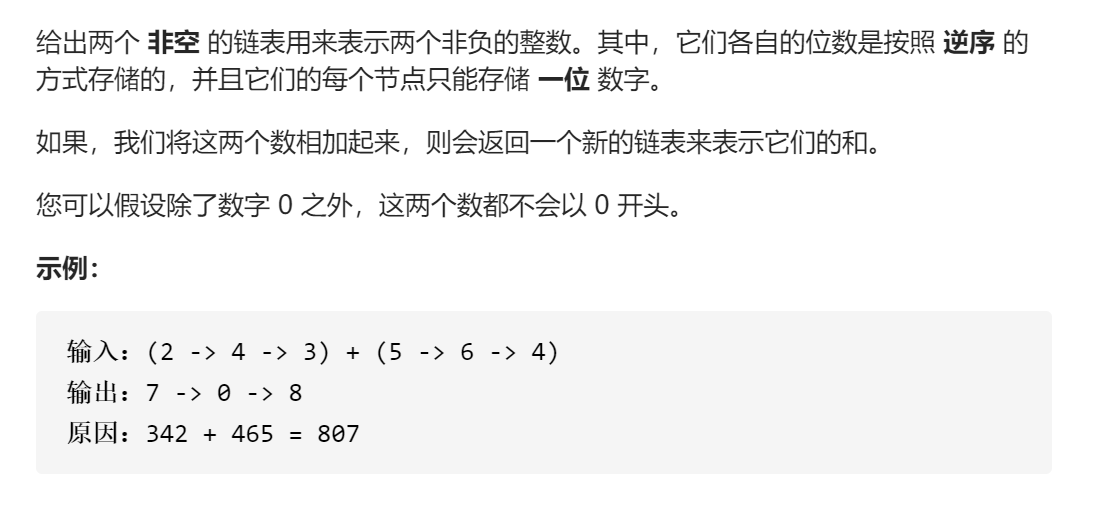
思路
- 初始化dummy节点
- 遍历两个链表,分别计算ans,carry,cur,pre指向ListNode(cur),pre= pre.next,p,q指向下一个。
- 注意判断p,q是否为空
- 终止条件为 while p or q
- 结束时,如果carry大于0,需要接在pre后面。
代码
class Solution:
    def addTwoNumbers(self, l1: ListNode, l2: ListNode) -> ListNode:
        dummy = ListNode(-1)
        pre = dummy
        p = l1
        q = l2
        carry = 0
        while p or q:
            a = p.val if p else 0
            b = q.val if q else 0
            ans = a + b + carry
            carry = ans // 10
            cur = ans % 10
            pre.next = ListNode(cur)
            pre = pre.next
            if p:
                p = p.next
            if q:
                q = q.next
        if carry > 0:
            pre.next = ListNode(carry)
        return dummy.next
class Solution {
    public ListNode addTwoNumbers(ListNode l1, ListNode l2) {
        ListNode dummy = new ListNode(-1);
        ListNode pre = dummy;
        int carry = 0;
        while (l1 != null || l2 != null) {
            int a = l1 == null? 0 : l1.val;
            int b = l2 == null? 0 : l2.val;
            int ans = a + b + carry;
            carry = ans / 10;
            pre.next = new ListNode(ans % 10);
            pre = pre.next;
            if (l1 != null) l1 = l1.next;
            if (l2 != null) l2 = l2.next;
        }
        if (carry > 0) {
            pre.next = new ListNode(carry);
        }
        return dummy.next;
    }
}
var addTwoNumbers = function(l1, l2) {
    let dummy = new ListNode(-1);
    let pre = dummy;
    let carry = 0;
    while (l1 != null || l2 != null) {
        let a = l1 === null ? 0 : l1.val;
        let b = l2 === null ? 0 : l2.val;
        let ans = a + b + carry;
        carry = Math.floor(ans / 10);
        let cur = ans % 10;
        pre.next = new ListNode(cur);
        pre = pre.next;
        if (l1 != null) l1 = l1.next;
        if (l2 != null) l2 = l2.next;
    }
    if (carry != 0) {
        pre.next = new ListNode(carry);
    }
    return dummy.next;
};
思考一下如果个位在链表尾部,怎么处理?答案是可以翻转链表,或者将链表放入栈中。对pre指针指向处理不太一样哦!
7. 两数相加 II
描述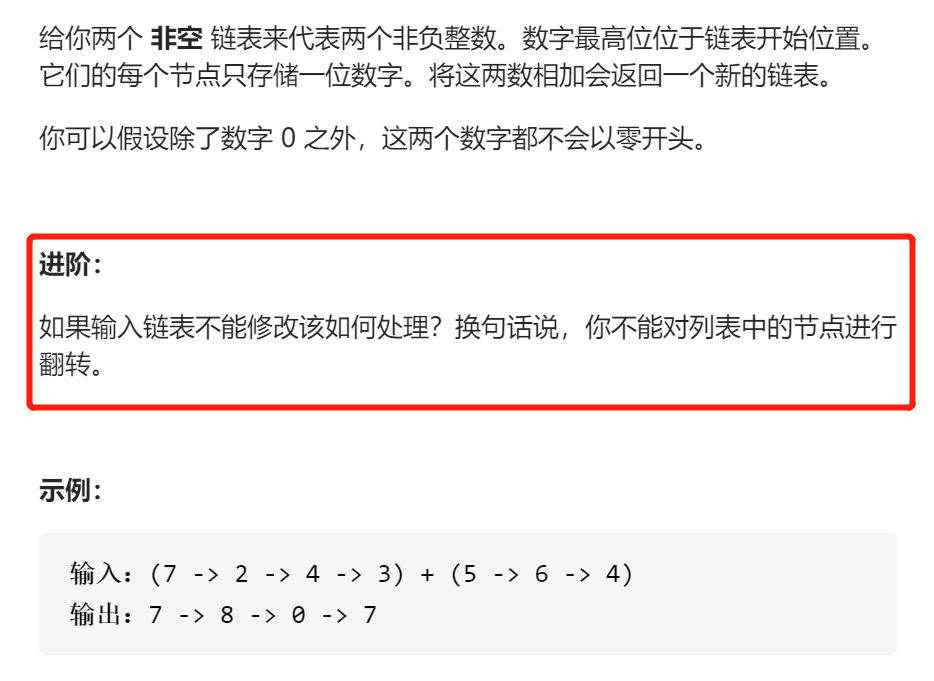
思路
我们将链表节点一次放入栈中,那么最后最先弹出的就是个位,这样我们就能进行正常计算了。
代码
class Solution {
    public ListNode addTwoNumbers(ListNode l1, ListNode l2) {
        Deque<Integer> sta1 = new ArrayDeque<>();
        Deque<Integer> sta2 = new ArrayDeque<>();
        while (l1 != null) {
            sta1.push(l1.val);
            l1 = l1.next;
        }
        while (l2 != null) {
            sta2.push(l2.val);
            l2 = l2.next;
        }
        int carry = 0;
        ListNode dummy = null;
        while (!sta1.isEmpty() || !sta2.isEmpty()) {
            int a = sta1.isEmpty() ? 0 : sta1.pop();
            int b = sta2.isEmpty() ? 0 : sta2.pop();
            int ans = a + b + carry;
            carry = ans / 10;
            ListNode cur = new ListNode(ans % 10);
            cur.next = dummy;
            dummy = cur;
        }
        // 最后carry可能不为0
        if (carry != 0) {
            ListNode cur = new ListNode(carry);
            cur.next = dummy;
            dummy = cur;
        }
        return dummy;
    }
}
class Solution:
    def addTwoNumbers(self, l1: ListNode, l2: ListNode) -> ListNode:
        s1,s2 = [], []
        while l1:
            s1.append(l1.val)
            l1 = l1.next
        while l2:
            s2.append(l2.val)
            l2 = l2.next
        carry = 0
        ans = None
        while s1 or s2 or carry != 0:
            a = 0 if not s1 else s1.pop()
            b = 0 if not s2 else s2.pop()
            cur = a + b + carry
            carry = cur // 10
            cur = cur % 10
            curnode = ListNode(cur)
            curnode.next = ans
            ans = curnode
        return ans
8. 环形链表
描述
方法 1:哈希表
思路
如果我们用一个 Set 保存已经访问过的节点,我们可以遍历整个列表并返回第一个出现重复的节点。
代码
public class Solution {
    public ListNode detectCycle(ListNode head) {
        Set<ListNode> s = new HashSet<>();
        while (head != null) {
            if (!s.add(head)) {
                return head;
            }
            head = head.next;
        }
        return null;
    }
}
class Solution:
    def detectCycle(self, head: ListNode) -> ListNode:
        s = set()
        while head:
            if head not in s:
                s.add(head)
                head = head.next
            else:
                return head
        return None
方法2:快慢指针
思路
当然一个跑得快的人和一个跑得慢的人在一个圆形的赛道上赛跑,会发生什么?在某一个时刻,跑得快的人一定会从后面赶上跑得慢的人。
初始化两个指针指向头结点,快指针每步走2步,慢指针走一步,如果有环,最终肯定会相遇。
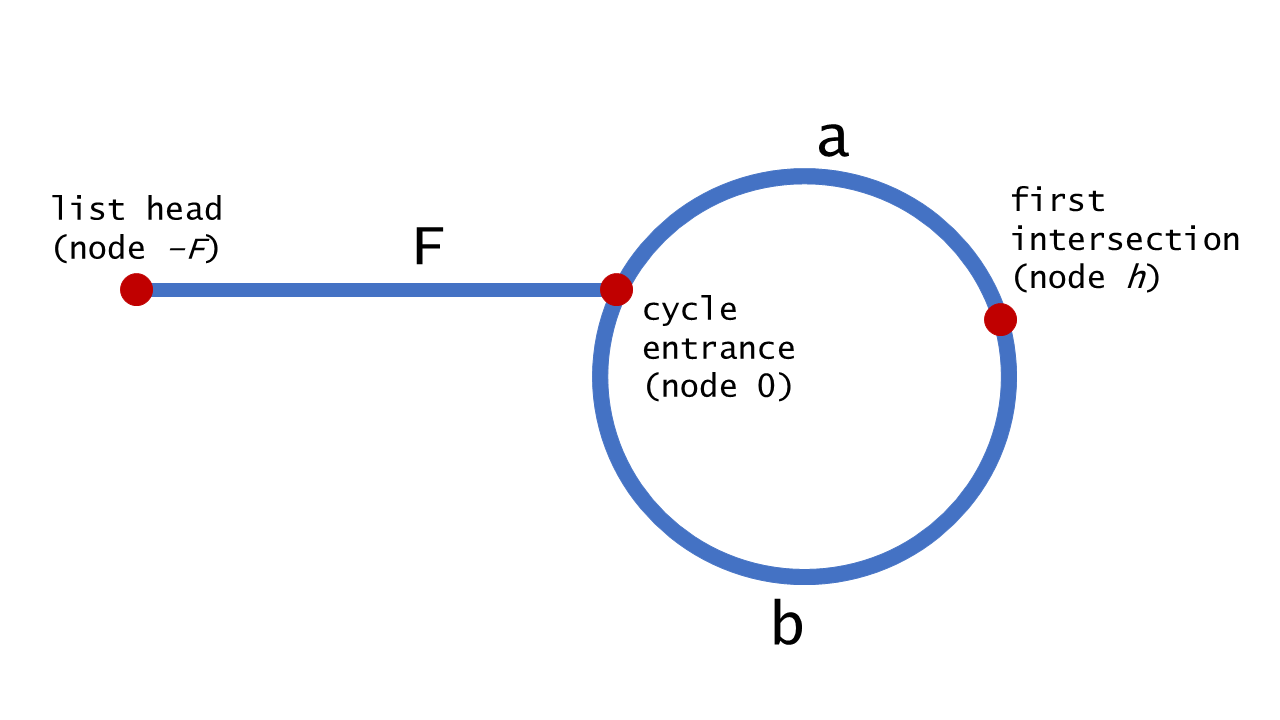
假设相遇点为node h,则有 2 (F + a)= F + a + b + a , 可得 F = b。
所以我们找到相遇点, 然后从相遇点和头结点一起出发,就会到达环的入口节点。
*代码
public class Solution {
    public ListNode detectCycle(ListNode head) {
        ListNode slow = head;
        ListNode fast = head;
        ListNode meet = null;
        while (fast != null && fast.next != null) {
            slow = slow.next;
            fast = fast.next.next;
            if (slow == fast) {
                meet = slow;
                break;
            }
        }
        if (meet == null) {
            return null;
        }
        ListNode p1 = head;
        while (p1 != meet) {
            p1 = p1.next;
            meet = meet.next;
        }
        return p1;
    }
}
class Solution:
    def detectCycle(self, head: ListNode) -> ListNode:
        slow = head
        fast = head
        meet = None
        while fast and fast.next:
            slow = slow.next
            fast = fast.next.next
            if slow == fast:
                meet = slow
                break
        if not meet:
            return None
        while head != meet:
            head = head.next
            meet = meet.next
        return head
var detectCycle = function(head) {
    let slow = head;
    let fast = head;
    let meet = null;
    while (fast != null && fast.next != null) {
        slow = slow.next;
        fast = fast.next.next;
        if (slow === fast) {
            meet = slow;
            break;
        }
    }
    if (meet === null) {
        return null;
    }

    while (head != meet) {
        head = head.next;
        meet = meet.next;
    }
    return head;
};
注意: 找到meet之后应该break,否则会死循环。
9. 相交链表
描述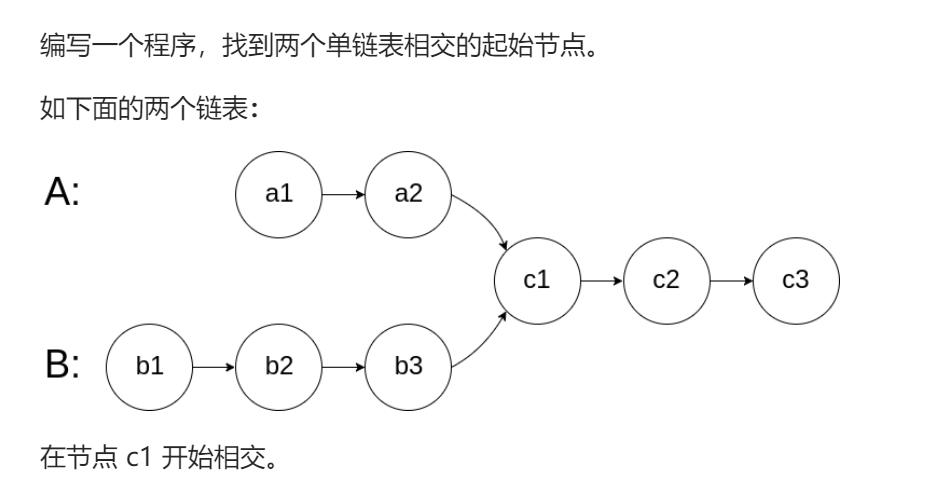
方法一:快慢指针
思路
如果两个链表相交,那么相交点之后的长度是相同的
我们需要做的事情是,让两个链表从同距离末尾同等距离的位置开始遍历。这个位置只能是较短链表的头结点位置。
为此,我们必须消除两个链表的长度差
指针 pA 指向 A 链表,指针 pB 指向 B 链表,依次往后遍历
如果 pA 到了末尾,则 pA = headB 继续遍历
如果 pB 到了末尾,则 pB = headA 继续遍历
比较长的链表指针指向较短链表head时,长度差就消除了
如此,只需要将最短链表遍历两次即可找到位置
代码
public class Solution {
    public ListNode getIntersectionNode(ListNode headA, ListNode headB) {
        if (headA == null || headB == null) return null;
        ListNode pa = headA;
        ListNode pb = headB;
        while (pa != pb) {
            pa = pa == null ? headB: pa.next;
            pb = pb == null ? headA: pb.next;
        }
        return pa;
    }
}
方法二:求长度
思路
我们可以求出两个链表的长度,然后,指定两个指针,让指向长链表的指针先移动长度差的距离,这样剩下要走的距离就一致了。
代码
class Solution:
    def getIntersectionNode(self, headA: ListNode, headB: ListNode) -> ListNode:
        def getLength(node):
            count = 0
            while node:
                node = node.next
                count +=1
            return count
        p = headA
        q = headB
        lenA = getLength(headA)
        lenB = getLength(headB)
        if lenA > lenB:
            for i in range(lenA-lenB):
                p = p.next
        else:
            for i in range(lenB-lenA):
                q = q.next

        while p and q:
            if p == q:
                return q
            p = p.next
            q = q.next
        return None
10. 排序链表
描述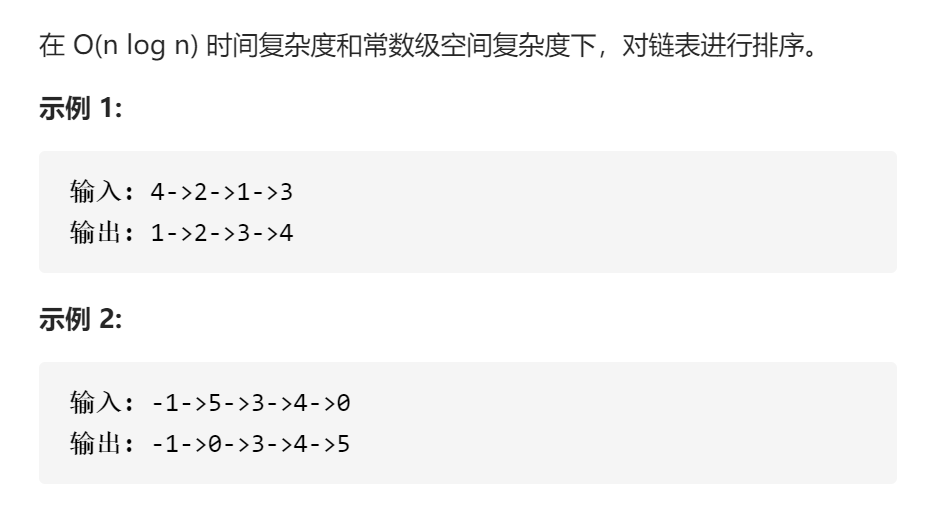
思路
题目要求O(n log n)的时间复杂度,很明显需要用归并排序或者快速排序,这里肯定使用归并排序。
归并排序,每次需要求中点位置,我们用快慢指针,快指针每次走两步,当快指针指向最后一个节点时,慢指针就刚好指向中间位置。
然后我们对两个链表进行归并。
我们需要记录,头结点,求中间节点,还需要一个dummy节点来作为最终链表的头结点的上一个元素。
代码
class Solution {
    public ListNode sortList(ListNode head) {
        if (head == null || head.next == null) {
            return head;
        }
        ListNode slow = head;
        ListNode fast = head.next;
        while (fast != null && fast.next != null) {
            slow = slow.next;
            fast = fast.next.next;
        }
        // mid 表示右半段链表的头结点
        ListNode mid = slow.next;
        // 前半段链表的尾结点指向空
        slow.next = null;

        // 递归求解
        ListNode left = sortList(head);
        ListNode right = sortList(mid);

        ListNode dummy = new ListNode(-1);
        ListNode p = dummy;
        while (left != null && right != null) {
            if (left.val < right.val) {
                p.next = left;
                left = left.next;
            } else {
                p.next = right;
                right = right.next;
            }
            p = p.next;
        }
        // 当其中一个链表遍历完了,就指向另一个链表
        p.next = left == null ? right : left;
        return dummy.next;
    }
}
class Solution:
    def sortList(self, head: ListNode) -> ListNode:
        if not head or not head.next:
            return head

        slow = head
        fast = head.next
        while fast and fast.next:
            slow = slow.next
            fast = fast.next.next
        mid = slow.next
        slow.next = None
        left = self.sortList(head)
        right = self.sortList(mid)

        new_head = ListNode(0)
        p = new_head
        while left and right:
            if left.val < right.val:
                p.next = left
                left = left.next
            else:
                p.next = right
                right = right.next
            p = p.next
        p.next = left if left else right
        return new_head.next
var sortList = function(head) {
    if (head == null || head.next == null) {
        return head;
    }
    let slow = head;
    let fast = head.next;
    while (fast != null && fast.next != null) {
        slow = slow.next;
        fast = fast.next.next;
    }
    let mid = slow.next;
    slow.next = null;
    let leftHead = sortList(head);
    let rightHead = sortList(mid);
    let dummy = new ListNode(-1);
    let p = dummy;
    while (leftHead !== null && rightHead !==null) {
        if (leftHead.val < rightHead.val) {
            p.next = leftHead;
            leftHead = leftHead.next;
        } else {
            p.next = rightHead;
            rightHead = rightHead.next;
        }
        p = p.next;
    }
    p.next = leftHead == null ? rightHead : leftHead;
    return dummy.next;
};
11. 移除重复节点
描述
思路
显然我们可以两重循环,暴力求解。题目要求去除重复节点,我们可以使用set来保存节点的值,进行去重。
我们需要两个指针,一个遍历,一个来保存要删除节点的前一个节点。
原理
- 初始化集合s,p指向head, q指向head.next,将q加入s中
- 用指针q进行遍历
- 如果q不在s中出现,就把q放入s,同时右移动一位p, q
- 如果q 在s中出现过,说明要删除q,执行q = q.next p.next = q
- 最后返回head
代码
class Solution {
    public ListNode removeDuplicateNodes(ListNode head) {
        if (head == null || head.next == null) {
            return head;
        }
        Set<Integer> s = new HashSet<>();
        ListNode p = head;
        ListNode q = head.next;
        s.add(p.val);
        while (q != null) {
            if (!s.add(q.val)) {
                q = q.next;
                p.next = q;
            } else {
                p = p.next;
                q = q.next;
            }
        }
        return head;
    }
}
class Solution:
    def removeDuplicateNodes(self, head: ListNode) -> ListNode:
        if not head or not head.next:
            return head
        s = set()
        p = head
        s.add(p.val)
        q = p.next
        while q:
            if q.val not in s:
                s.add(q.val)
                q = q.next
                p = p.next
            else:
                q = q.next
                p.next = q
        return head
12. 删除排序链表中的重复元素
描述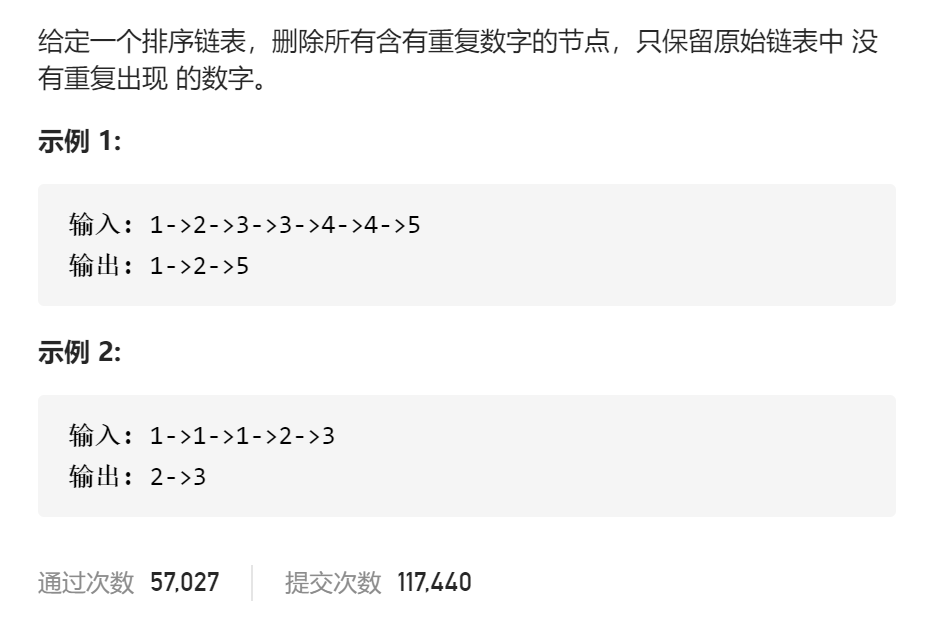
思路
这道题要我们删除所有的重复节点,链表是排序的,所以我们需要记录每个节点的前驱,然后判断该节点和后续节点是否是重复元素,来决定是否进行删除。
很明显我们需要一个dummy节点,因为第一个节点可能就是重复节点,我们需要一个pre保存前驱,一个nex作为当前节点的下一个节点。如果连续相等,我们就nex = nex.next,我们还需要一个遍历指针。
原理
1.需要一个哨兵节点,指向整个链表的head,用于最后返回结果链表。
2.遍历过程中,首先需要一个遍历指针(快指针),遇到相同的节点,需要有跳过相同值节点的操作,
快指针在最基本的只有两个节点值相同的情况下,至少指向第一个相同的节点,此时需要有前继节点(慢指针)
的记录,将前继节点指向最后一个相同节点的下一位。
3.明确了需要记录和操作的节点后,进行正常的遍历逻辑即可。
代码
class Solution {
    public ListNode deleteDuplicates(ListNode head) {
        ListNode dummy = new ListNode(-1);
        dummy.next = head;
        // pre记录前驱
        ListNode pre = dummy;
        while (head != null) {
            // nex记录后驱
            ListNode nex = head.next;
            if (nex != null && nex.val == head.val) {
                // 如果一直相等就右移nex
                while (nex !=null && nex.val == head.val) {
                    nex = nex.next;
                }
                // 更新pre 和 head
                pre.next = nex;
                head = nex;
            } else {
                // 如果不相等,两个一起右移
                pre = head;
                head = head.next;
            }
        }
        return dummy.next;
    }
}
class Solution:
    def deleteDuplicates(self, head: ListNode) -> ListNode:
        dummy = ListNode(-1)
        dummy.next = head
        pre = dummy

        while head:
            nex = head.next
            if nex and head.val == nex.val:
                while nex and head.val == nex.val:
                    nex = nex.next
                pre.next = nex
                head = nex
            else:
                pre = head
                head = head.next
        return dummy.next
13. 复杂链表的复制
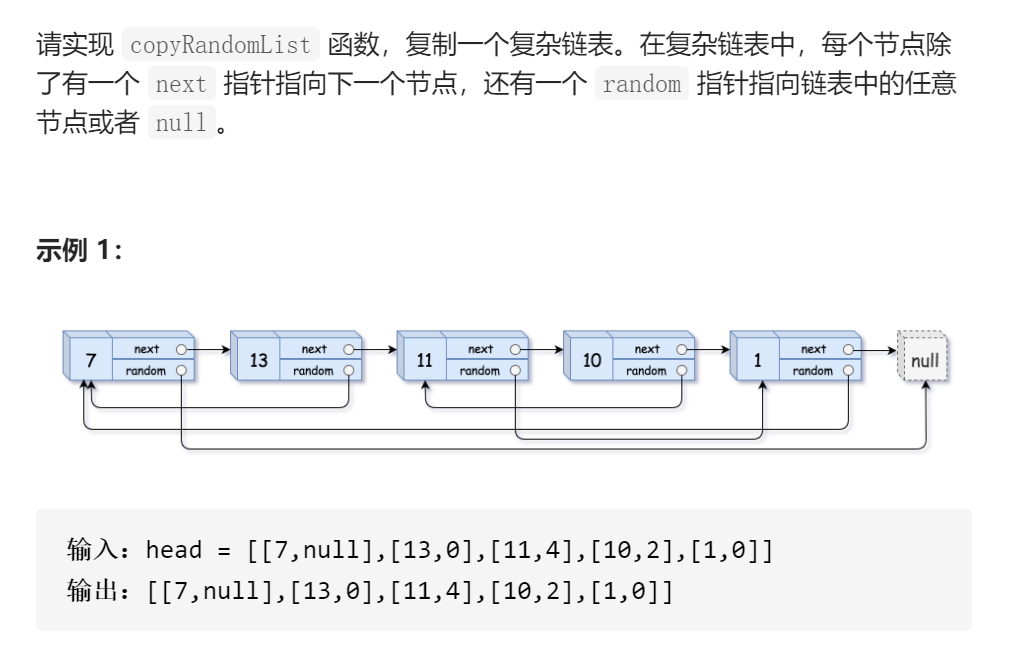
思路
hash表保存节点和值生成的新节点的映射关系,两次遍历就ok。哈希表存的是 node 和 Node(node.val)
代码
Python代码:
"""
# Definition for a Node.
class Node:
    def __init__(self, x: int, next: 'Node' = None, random: 'Node' = None):
        self.val = int(x)
        self.next = next
        self.random = random
"""
class Solution:
    def copyRandomList(self, head: 'Node') -> 'Node':
        if not head:
            return None

        p = head
        dic = {None: None}
        while p:
            dic[p] = Node(p.val)
            p = p.next

        p = head
        while p:
            dic[p].next = dic[p.next]
            dic[p].random = dic[p.random]
            p = p.next
        return dic[head]
Java代码:
/*
// Definition for a Node.
class Node {
    int val;
    Node next;
    Node random;

    public Node(int val) {
        this.val = val;
        this.next = null;
        this.random = null;
    }
}
*/
class Solution {
    public Node copyRandomList(Node head) {
        if (head == null) return null;
        HashMap<Node, Node> map = new HashMap<>();
        Node p = head;
        while(p != null) {
            map.put(p, new Node(p.val));
            p = p.next;
        }
        p = head;
        while(p != null) {
            map.get(p).next = map.get(p.next);
            map.get(p).random = map.get(p.random);
            p = p.next;
        }
        return map.get(head);
    }
}
14. 逆置链表位置m到n的节点
描述
将链表第m到第n个位置的节点进行翻转。
思路
我们肯定要保存第m个位置节点的前驱节点,我们还保存一下翻转之前,m位置的节点,因为翻转之后,它就跑到链表尾部了。然后我们进行翻转,翻转的长度为 n - m + 1,刚好nex保存n位置之后的节点,翻转后我们进行连接操作。需要判断 pre 是否为None,如果翻转位置是1开始,我们直接返回翻转后的头结点即可。
代码
Python代码:
 def reverse_between(self, m, n, head):
        change_len = n-m+1
        res = head
        pre_head = None
        while head and m-1 > 0:
            pre_head = head
            head = head.next
            m = m - 1
        modify_list_tail = head
        modify_list_head = None
        while head and change_len > 0:
            next = head.next
            head.next = modify_list_head
            modify_list_head = head
            head = next
            change_len -= 1
        modify_list_tail.next = next

        if pre_head:
            pre_head.next = modify_list_head
        else:
            res = modify_list_head
        return res

若有收获,就点个赞吧
0 人点赞


