前言
例题
1. 最小区间
描述 
思路
给定 k个列表,需要找到最小区间,使得每个列表都至少有一个数在该区间中。该问题可以转化为,从 k 个列表中各取一个数,使得这 k 个数中的最大值与最小值的差最小。
由于 k 个列表都是升序排列的,因此对每个列表维护一个指针,通过指针得到列表中的元素,指针右移之后指向的元素一定大于或等于之前的元素。
使用最小堆维护 k 个指针指向的元素中的最小值,同时维护堆中元素的最大值。初始时,k 个指针都指向下标 0,最大元素即为所有列表的下标 0 位置的元素中的最大值。每次从堆中取出最小值,根据最大值和最小值计算当前区间,如果当前区间小于最小区间则用当前区间更新最小区间,然后将对应列表的指针右移,将新元素加入堆中,并更新堆中元素的最大值。
如果一个列表的指针超出该列表的下标范围,则说明该列表中的所有元素都被遍历过,堆中不会再有该列表中的元素,因此退出循环。
代码
Python代码:
class Solution:def smallestRange(self, nums: List[List[int]]) -> List[int]:import heapqleft_range, right_range = -10**9, 10**9# 提前求最大值max_value = max(vec[0] for vec in nums)# 堆,保留行数和索引priority_queue = [(vec[0], i, 0) for i, vec in enumerate(nums)]heapq.heapify(priority_queue)while True:min_value, row, idx = heapq.heappop(priority_queue)if right_range - left_range > max_value - min_value:left_range, right_range = min_value, max_value# 这里是退出的条件,当idx遍历完if idx == len(nums[row]) - 1:break# 更新最大值max_value = max(max_value, nums[row][idx + 1])# 入堆,同样是元组形式heapq.heappush(priority_queue,(nums[row][idx + 1], row, idx+1))return [left_range, right_range]
Java代码:
class Solution {public int[] smallestRange(List<List<Integer>> nums) {int rangeLeft = 0, rangeRight = Integer.MAX_VALUE;int minRange = rangeRight - rangeLeft;int max = Integer.MIN_VALUE;int size = nums.size();int[] next = new int[size];PriorityQueue<Integer> priorityQueue = new PriorityQueue<>(new Comparator<Integer>(){public int compare(Integer index1, Integer index2) {return nums.get(index1).get(next[index1]) - nums.get(index2).get(next[index2]);}});for (int i = 0; i < size; i++) {priorityQueue.offer(i);max = Math.max(max, nums.get(i).get(0));}while (true) {int minIndex = priorityQueue.poll();int curRange = max - nums.get(minIndex).get(next[minIndex]);if (curRange < minRange) {minRange = curRange;rangeLeft = nums.get(minIndex).get(next[minIndex]);rangeRight = max;}next[minIndex]++;if (next[minIndex] == nums.get(minIndex).size()) {break;}priorityQueue.offer(minIndex);max = Math.max(max, nums.get(minIndex).get(next[minIndex]));}return new int[]{rangeLeft, rangeRight};}}
2. 猿辅导-小猿上课
描述
小猿非常热爱学习,所以他在猿辅导上购买了NN节课来提升自己,每节课有一个开始时间SS和结束时间EE(SS和EE均用正整数表示)。买完课程后,粗心的小袁发现这些课程之间有些时间冲突,幸好小猿有一种“一心多用”的超能力,能同时兼顾KK节课上课。当然是KK越大,使用这种能力就越累。请问小猿最少需要一心几用,才能上完所有他买的课程呢?输入描述第一行输入为NN(N≤200000N≤200000),表示购买课程数。接下来NN行,每行输入两个数Si、EiSi、Ei(0
41 41 22 33 4
输出
2
思路
- 区间问题一般都要排序,按起始点或者按终点
- 按开始时间和结束时间从小到大排序
- 使用堆维护时间区间,对于排序后两个课程a和b来说,如果a和b无法分开上,则须满足b的开始时间小于a的结束时间
- 答案为堆中同时存在的课程数量的最大值
代码
Python代码:
import heapqn = int(input())start_end_list = [list(map(int, input().split())) for _ in range(n)]start_end_list.sort(key=lambda x: x[0])q = []res = 0heapq.heapify(q)for start, end in start_end_list:while q and q[0] <= start:heapq.heappop(q)heapq.heappush(q, end)res = max(res, len(q))print(res)
3.堆排序
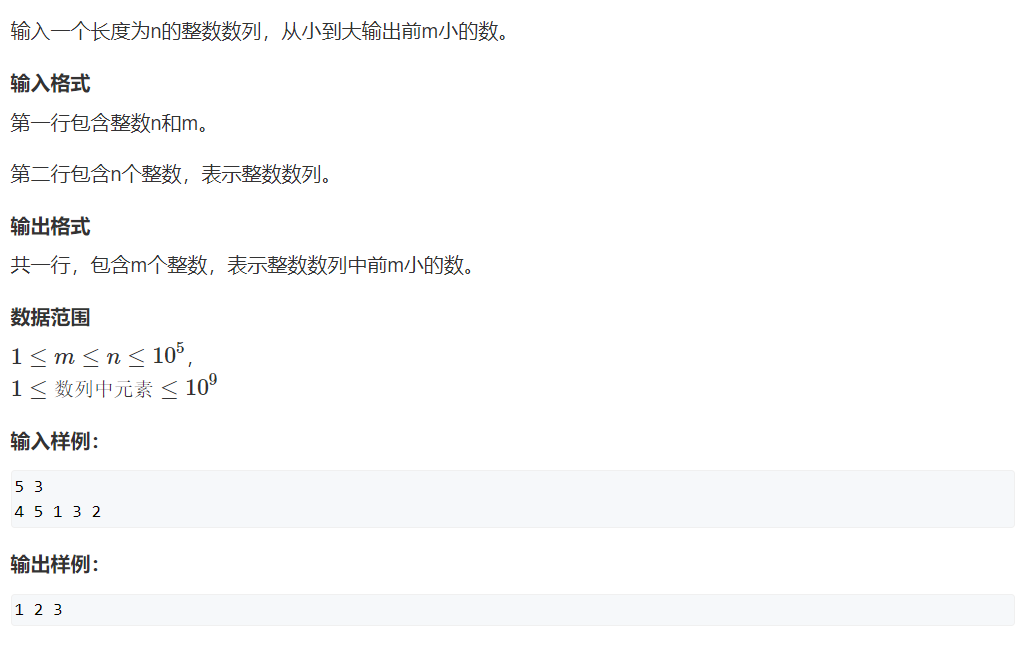
代码
import java.util.*;

public class Main {
    public static int size = 0;
    public static void main(String[] args) {
        Scanner in = new Scanner(System.in);
        int n = in.nextInt();
        int m = in.nextInt();
        size = n;
        int[] a = new int[n+1];
        for (int i = 1; i <= n; i++) {
            a[i] = in.nextInt();
        }
        for (int i = n / 2; i >= 1; i--) {
            down(a, i);
        }
        while (m > 0) {
            System.out.print(a[1] + " ");
            swap(a, 1, size--);
            down(a, 1);
            m--;
        }

    }
    public static void down(int[] a, int i) {
        int j = i;
        if (2 * i <= size && a[j] > a[2 * i]) {
            j = 2 * i;
        }
        if (2 * i + 1 <= size && a[j] > a[2 * i + 1]) {
            j = 2 * i + 1;
        }
        if (j != i) {
            swap(a, i, j);
            down(a, j);
        }
    }
    public static void swap(int[] a, int i, int j) {
        int temp = a[i];
        a[i] = a[j];
        a[j] = temp;
    }
}
4. 最少加油次数

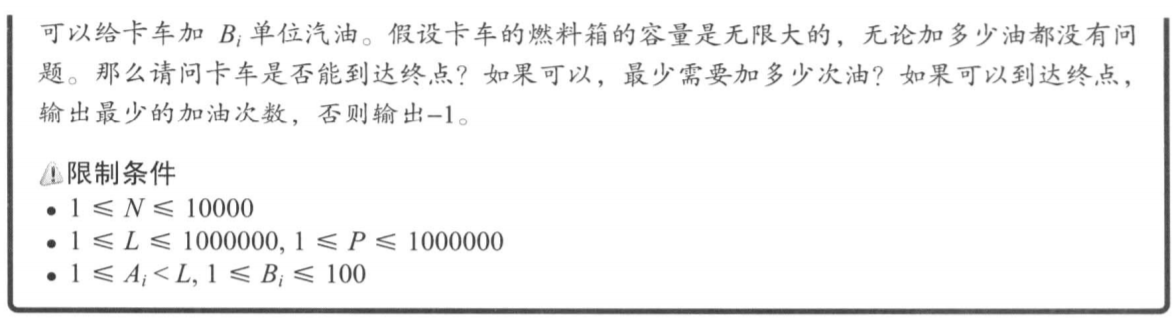

思路 

代码
import java.util.*;

public class Main {

    public static void main(String[] args) {
        Scanner in = new Scanner(System.in);
        int N = in.nextInt();
        int L = in.nextInt();
        int P = in.nextInt();
        int[] A = new int[N+1];
        int[] B = new int[N+1];
        for (int i = 0; i < N; i++) {
            A[i] = in.nextInt();
        }
        for (int i = 0; i < N; i++) {
            B[i] = in.nextInt();
        }

        A[N] = L;
        B[N] = 0;
        N++;
        PriorityQueue<Integer> q = new PriorityQueue<>(((o1, o2) -> o2 - o1));
        int ans = 0, pos = 0, tank = P;
        for (int i = 0; i < N; i++) {
            int d = A[i] - pos;
            while (tank - d < 0) {
                if (q.isEmpty()) {
                    System.out.println(-1);
                    return;
                }
                tank += q.peek();
                q.poll();
                ans++;
            }
            tank -= d;
            pos = A[i];
            q.offer(B[i]);
        }
        System.out.println(ans);
    }
}
5. Fence Repair

思路
- 优先级队列,贪心算法
代码
import java.util.*;

public class Main {

    public static void main(String[] args) {
        Scanner in = new Scanner(System.in);
        int N = in.nextInt();
        int[] L = new int[N];
        for (int i = 0; i < N; i++) {
            L[i] = in.nextInt();
        }
        int ans = 0;
        PriorityQueue<Integer> q = new PriorityQueue<>();
        for (int i = 0; i < N; i++) {
            q.offer(L[i]);
        }
        while (q.size() > 1) {
            int l1, l2;
            l1 = q.peek();
            q.poll();
            l2 = q.peek();
            q.poll();
            ans += l1 + l2;
            q.offer(l1 + l2);
        }
        System.out.println(ans);
    }
}

若有收获,就点个赞吧
0 人点赞


