例题
1. 丑数
描述 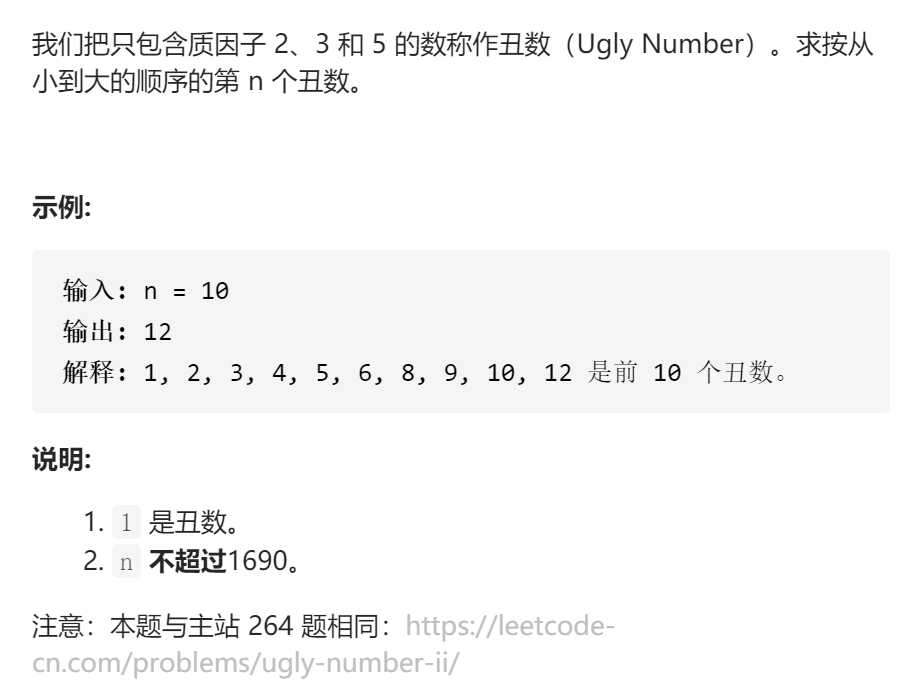
思路
三指针,指向最小值的向前移动。
代码
Python代码:
class Solution:def nthUglyNumber(self, n: int) -> int:q = [1]i, j, k = 0, 0, 0for _ in range(n-1):t = min(q[i] * 2, q[j] * 3, q[k] * 5)q.append(t)if q[i] * 2 == t:i += 1if q[j] * 3 == t:j += 1if q[k] * 5 == t:k += 1return q[-1]
c++代码:
class Solution {public:int nthUglyNumber(int n) {vector<int> q(1, 1);int i=0, j=0, k = 0;while (-- n) {int t = min(q[i] * 2, min(q[j] * 3, q[k] * 5));q.push_back(t);if (t == q[i] * 2) i++;if (t == q[j] * 3) j++;if (t == q[k] * 5) k++;}return q.back();}};
Java代码:
class Solution {public int nthUglyNumber(int n) {List<Integer> q = new ArrayList<>();q.add(1);int i = 0, j = 0, k = 0;while (n > 1) {int t = Math.min(q.get(i) * 2, Math.min(q.get(j)* 3, q.get(k) * 5));q.add(t);if (q.get(i) * 2 == t) i++;if (q.get(j) * 3 == t) j++;if (q.get(k) * 5 == t) k++;n--;}return q.get(q.size() - 1);}}
2. 最大公约数
C++代码:
int gcd(int a, int b)
{
    return b ? gcd(b, a % b) : a;
}
Java代码:
public static int gcd(int a, int b) {
        return b > 0? gcd(b, a % b) : a;
    }
Python代码:
def gcd(a, b):
    return gcd(b, a % b) if b else a
3. 最小公倍数
Java代码:
public static int gcd(int a, int b) {
        return b > 0? gcd(b, a % b) : a;
    }
public static int lcm(int a , int b) {
    return a * b / gcd(a, b);
}
Python代码:
def gcd(a, b):
    return gcd(b, a % b) if b else a


def lcm(a, b):
    return a * b // gcd(a, b)
4. 判断质数
Python代码:
def is_prime(a):
    if a < 2:
        return False
    for i in range(2, a // 2 + 1):
        if a % i == 0:
            return False
    return True
Java代码:
public static boolean isPrime(int a) {
        if (a < 2) return false;
        for (int i = 2; i < a / 2 + 1; i++) {
            if (a % i == 0) return false;
        }
        return true;
    }
5. 判断闰年
Python代码:
def is_leap(year):
    if year % 4 == 0 and year % 100 != 0 or year % 400 == 0:
        return True
    return False
6. 快速幂
c++代码:
// 求 m^k mod p,时间复杂度 O(logk)。

int qmi(int m, int k, int p)
{
    int res = 1 % p, t = m;
    while (k)
    {
        if (k&1) res = res * t % p;
        t = t * t % p;
        k >>= 1;
    }
    return res;
}
Java代码:
public static int mul(int m, int k, int p) {
        int res = 1 % p;
        while (k > 0) {
            if ((k & 1) == 1) {
                res = res * m % p;
            }
            m = m * m % p;
            k >>= 1;
        }
        return res;
    }
Python代码:
def mul(m, k, p):
    res = 1 % p
    t = m
    while k:
        if k & 1:
            res = res * t % p
        t = t * t % p
        k >>= 1
    return res

若有收获,就点个赞吧
0 人点赞


