Bahdanau Attention
:label:sec_seq2seq_attention
We studied the machine translation
problem in :numref:sec_seq2seq,
where we designed
an encoder-decoder architecture based on two RNNs
for sequence to sequence learning.
Specifically,
the RNN encoder
transforms
a variable-length sequence
into a fixed-shape context variable,
then
the RNN decoder
generates the output (target) sequence token by token
based on the generated tokens and the context variable.
However,
even though not all the input (source) tokens
are useful for decoding a certain token,
the same context variable
that encodes the entire input sequence
is still used at each decoding step.
In a separate but related
challenge of handwriting generation for a given text sequence,
Graves designed a differentiable attention model
to align text characters with the much longer pen trace,
where the alignment moves only in one direction :cite:Graves.2013.
Inspired by the idea of learning to align,
Bahdanau et al. proposed a differentiable attention model
without the severe unidirectional alignment limitation :cite:Bahdanau.Cho.Bengio.2014.
When predicting a token,
if not all the input tokens are relevant,
the model aligns (or attends)
only to parts of the input sequence that are relevant to the current prediction.
This is achieved
by treating the context variable as an output of attention pooling.
Model
When describing
Bahdanau attention
for the RNN encoder-decoder below,
we will follow the same notation in
:numref:sec_seq2seq.
The new attention-based model
is the same as that
in :numref:sec_seq2seq
except that
the context variable
$\mathbf{c}$
in
:eqref:eq_seq2seq_s_t
is replaced by
$\mathbf{c}_{t’}$
at any decoding time step $t’$.
Suppose that
there are $T$ tokens in the input sequence,
the context variable at the decoding time step $t’$
is the output of attention pooling:
\mathbf{c}{t’} = \sum{t=1}^T \alpha(\mathbf{s}_{t’ - 1}, \mathbf{h}_t) \mathbf{h}_t,
where the decoder hidden state
$\mathbf{s}_{t’ - 1}$ at time step $t’ - 1$
is the query,
and the encoder hidden states $\mathbf{h}_t$
are both the keys and values,
and the attention weight $\alpha$
is computed as in
:eqref:eq_attn-scoring-alpha
using the additive attention scoring function
defined by
:eqref:eq_additive-attn.
Slightly different from
the vanilla RNN encoder-decoder architecture
in :numref:fig_seq2seq_details,
the same architecture
with Bahdanau attention is depicted in
:numref:fig_s2s_attention_details.
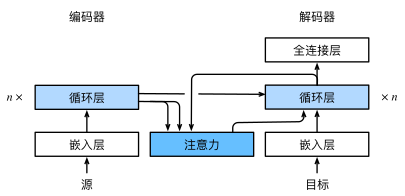 :label:
fig_s2s_attention_details
```{.python .input} from d2l import mxnet as d2l from mxnet import np, npx from mxnet.gluon import rnn, nn npx.set_np()
```{.python .input}#@tab pytorchfrom d2l import torch as d2limport torchfrom torch import nn
Defining the Decoder with Attention
To implement the RNN encoder-decoder
with Bahdanau attention,
we only need to redefine the decoder.
To visualize the learned attention weights more conveniently,
the following AttentionDecoder class
defines the base interface for
decoders with attention mechanisms.
```{.python .input}
@tab all
@save
class AttentionDecoder(d2l.Decoder): “””The base attention-based decoder interface.””” def init(self, kwargs): super(AttentionDecoder, self).init(kwargs)
@propertydef attention_weights(self):raise NotImplementedError
Now let us implementthe RNN decoder with Bahdanau attentionin the following `Seq2SeqAttentionDecoder` class.The state of the decoderis initialized withi) the encoder final-layer hidden states at all the time steps (as keys and values of the attention);ii) the encoder all-layer hidden state at the final time step (to initialize the hidden state of the decoder);and iii) the encoder valid length (to exclude the padding tokens in attention pooling).At each decoding time step,the decoder final-layer hidden state at the previous time step is used as the query of the attention.As a result, both the attention outputand the input embedding are concatenatedas the input of the RNN decoder.```{.python .input}class Seq2SeqAttentionDecoder(AttentionDecoder):def __init__(self, vocab_size, embed_size, num_hiddens, num_layers,dropout=0, **kwargs):super(Seq2SeqAttentionDecoder, self).__init__(**kwargs)self.attention = d2l.AdditiveAttention(num_hiddens, dropout)self.embedding = nn.Embedding(vocab_size, embed_size)self.rnn = rnn.GRU(num_hiddens, num_layers, dropout=dropout)self.dense = nn.Dense(vocab_size, flatten=False)def init_state(self, enc_outputs, enc_valid_lens, *args):# Shape of `outputs`: (`num_steps`, `batch_size`, `num_hiddens`).# Shape of `hidden_state[0]`: (`num_layers`, `batch_size`,# `num_hiddens`)outputs, hidden_state = enc_outputsreturn (outputs.swapaxes(0, 1), hidden_state, enc_valid_lens)def forward(self, X, state):# Shape of `enc_outputs`: (`batch_size`, `num_steps`, `num_hiddens`).# Shape of `hidden_state[0]`: (`num_layers`, `batch_size`,# `num_hiddens`)enc_outputs, hidden_state, enc_valid_lens = state# Shape of the output `X`: (`num_steps`, `batch_size`, `embed_size`)X = self.embedding(X).swapaxes(0, 1)outputs, self._attention_weights = [], []for x in X:# Shape of `query`: (`batch_size`, 1, `num_hiddens`)query = np.expand_dims(hidden_state[0][-1], axis=1)# Shape of `context`: (`batch_size`, 1, `num_hiddens`)context = self.attention(query, enc_outputs, enc_outputs, enc_valid_lens)# Concatenate on the feature dimensionx = np.concatenate((context, np.expand_dims(x, axis=1)), axis=-1)# Reshape `x` as (1, `batch_size`, `embed_size` + `num_hiddens`)out, hidden_state = self.rnn(x.swapaxes(0, 1), hidden_state)outputs.append(out)self._attention_weights.append(self.attention.attention_weights)# After fully-connected layer transformation, shape of `outputs`:# (`num_steps`, `batch_size`, `vocab_size`)outputs = self.dense(np.concatenate(outputs, axis=0))return outputs.swapaxes(0, 1), [enc_outputs, hidden_state,enc_valid_lens]@propertydef attention_weights(self):return self._attention_weights
```{.python .input}
@tab pytorch
class Seq2SeqAttentionDecoder(AttentionDecoder): def init(self, vocabsize, embedsize, num_hiddens, num_layers, dropout=0, **kwargs): super(Seq2SeqAttentionDecoder, self).__init(**kwargs) self.attention = d2l.AdditiveAttention( num_hiddens, num_hiddens, num_hiddens, dropout) self.embedding = nn.Embedding(vocab_size, embed_size) self.rnn = nn.GRU( embed_size + num_hiddens, num_hiddens, num_layers, dropout=dropout) self.dense = nn.Linear(num_hiddens, vocab_size)
def init_state(self, enc_outputs, enc_valid_lens, *args):# Shape of `outputs`: (`num_steps`, `batch_size`, `num_hiddens`).# Shape of `hidden_state[0]`: (`num_layers`, `batch_size`,# `num_hiddens`)outputs, hidden_state = enc_outputsreturn (outputs.permute(1, 0, 2), hidden_state, enc_valid_lens)def forward(self, X, state):# Shape of `enc_outputs`: (`batch_size`, `num_steps`, `num_hiddens`).# Shape of `hidden_state[0]`: (`num_layers`, `batch_size`,# `num_hiddens`)enc_outputs, hidden_state, enc_valid_lens = state# Shape of the output `X`: (`num_steps`, `batch_size`, `embed_size`)X = self.embedding(X).permute(1, 0, 2)outputs, self._attention_weights = [], []for x in X:# Shape of `query`: (`batch_size`, 1, `num_hiddens`)query = torch.unsqueeze(hidden_state[-1], dim=1)# Shape of `context`: (`batch_size`, 1, `num_hiddens`)context = self.attention(query, enc_outputs, enc_outputs, enc_valid_lens)# Concatenate on the feature dimensionx = torch.cat((context, torch.unsqueeze(x, dim=1)), dim=-1)# Reshape `x` as (1, `batch_size`, `embed_size` + `num_hiddens`)out, hidden_state = self.rnn(x.permute(1, 0, 2), hidden_state)outputs.append(out)self._attention_weights.append(self.attention.attention_weights)# After fully-connected layer transformation, shape of `outputs`:# (`num_steps`, `batch_size`, `vocab_size`)outputs = self.dense(torch.cat(outputs, dim=0))return outputs.permute(1, 0, 2), [enc_outputs, hidden_state,enc_valid_lens]@propertydef attention_weights(self):return self._attention_weights
In the following, we test the implementeddecoder with Bahdanau attentionusing a minibatch of 4 sequence inputsof 7 time steps.```{.python .input}encoder = d2l.Seq2SeqEncoder(vocab_size=10, embed_size=8, num_hiddens=16,num_layers=2)encoder.initialize()decoder = Seq2SeqAttentionDecoder(vocab_size=10, embed_size=8, num_hiddens=16,num_layers=2)decoder.initialize()X = d2l.zeros((4, 7)) # (`batch_size`, `num_steps`)state = decoder.init_state(encoder(X), None)output, state = decoder(X, state)output.shape, len(state), state[0].shape, len(state[1]), state[1][0].shape
```{.python .input}
@tab pytorch
encoder = d2l.Seq2SeqEncoder(vocab_size=10, embed_size=8, num_hiddens=16,
num_layers=2)
encoder.eval()
decoder = Seq2SeqAttentionDecoder(vocab_size=10, embed_size=8, num_hiddens=16,
num_layers=2)
decoder.eval()
X = d2l.zeros((4, 7), dtype=torch.long) # (batch_size, num_steps)
state = decoder.init_state(encoder(X), None)
output, state = decoder(X, state)
output.shape, len(state), state[0].shape, len(state[1]), state[1][0].shape
## TrainingSimilar to :numref:`sec_seq2seq_training`,here we specify hyperparemeters,instantiatean encoder and a decoder with Bahdanau attention,and train this model for machine translation.Due to the newly added attention mechanism,this training is much slower thanthat in :numref:`sec_seq2seq_training` without attention mechanisms.```{.python .input}#@tab allembed_size, num_hiddens, num_layers, dropout = 32, 32, 2, 0.1batch_size, num_steps = 64, 10lr, num_epochs, device = 0.005, 250, d2l.try_gpu()train_iter, src_vocab, tgt_vocab = d2l.load_data_nmt(batch_size, num_steps)encoder = d2l.Seq2SeqEncoder(len(src_vocab), embed_size, num_hiddens, num_layers, dropout)decoder = Seq2SeqAttentionDecoder(len(tgt_vocab), embed_size, num_hiddens, num_layers, dropout)net = d2l.EncoderDecoder(encoder, decoder)d2l.train_seq2seq(net, train_iter, lr, num_epochs, tgt_vocab, device)
After the model is trained, we use it to translate a few English sentences into French and compute their BLEU scores.
```{.python .input}
@tab all
engs = [‘go .’, “i lost .”, ‘he\’s calm .’, ‘i\’m home .’] fras = [‘va !’, ‘j\’ai perdu .’, ‘il est calme .’, ‘je suis chez moi .’] for eng, fra in zip(engs, fras): translation, dec_attention_weight_seq = d2l.predict_seq2seq( net, eng, src_vocab, tgt_vocab, num_steps, device, True) print(f’{eng} => {translation}, ‘, f’bleu {d2l.bleu(translation, fra, k=2):.3f}’)
```{.python .input}#@tab allattention_weights = d2l.reshape(d2l.concat([step[0][0][0] for step in dec_attention_weight_seq], 0),(1, 1, -1, num_steps))
By visualizing the attention weights when translating the last English sentence, we can see that each query assigns non-uniform weights over key-value pairs. It shows that at each decoding step, different parts of the input sequences are selectively aggregated in the attention pooling.
```{.python .input}
Plus one to include the end-of-sequence token
d2l.show_heatmaps( attention_weights[:, :, :, :len(engs[-1].split()) + 1], xlabel=’Key posistions’, ylabel=’Query posistions’)
```{.python .input}#@tab pytorch# Plus one to include the end-of-sequence tokend2l.show_heatmaps(attention_weights[:, :, :, :len(engs[-1].split()) + 1].cpu(),xlabel='Key posistions', ylabel='Query posistions')
Summary
- When predicting a token, if not all the input tokens are relevant, the RNN encoder-decoder with Bahdanau attention selectively aggregates different parts of the input sequence. This is achieved by treating the context variable as an output of additive attention pooling.
- In the RNN encoder-decoder, Bahdanau attention treats the decoder hidden state at the previous time step as the query, and the encoder hidden states at all the time steps as both the keys and values.
Exercises
- Replace GRU with LSTM in the experiment.
- Modify the experiment to replace the additive attention scoring function with the scaled dot-product. How does it influence the training efficiency?
:begin_tab:mxnet
Discussions
:end_tab:
:begin_tab:pytorch
Discussions
:end_tab:

若有收获,就点个赞吧
0 人点赞


