Shifts in Design Thinking 设计思维的改变
One of the hardest parts of the learning curve for mixed reality experiences is that the technical shift is only one piece of the puzzle. There’s also a heavy amount of design adjustment that must be made. World building is totally different now. The boundaries of the experience are no longer known up front. Even the basic posit of who’s in primary control of the experience is very much different.MR体验学习曲线中最困难的部分之一在于,技术转变仅仅只是拼图的一块。你必须作出大量的设计调整。现在世界的构建已经完全改变。体验的边界不再局限于前方。即便是谁主要体验这样的基本假设都变得非常不同。
“Best” Practices “最佳”实践
This is a huge new creative space of possiblities. We’ve been exploring and searching for compelling experiences for years, and we continue to find new, crazy different ways to do things. Because of that, we hesitate to call anything a “best practice” as of right now. More like the “best things we’ve found so far.” We strive to keep pushing further into the unknown, to find new ways to integrate the real world into digital experiences, and to incorporate compute into our lives in a more contextual and intuitive way. Our biggest hope is that all of you will join us in expanding our understanding of what wearable MR technology can achieve.这个全新的创意领域存在无限的可能性。Magic Leap在探索和寻找引人入胜的体验上已有多年时间,并将继续寻找全新和疯狂的解决方案。因此,Magic Leap不愿意对迄今为止最优秀的解决方案称为“最佳实践”。Magic Leap正努力拓展未知的领域,寻找将现实世界集成至数字体验的新方法,并且以一种更为情景化和直观化的方式来将计算融入至我们的生活之中。Magic Leap表示,他们最大的希望是每一人都能加入他们,扩展我们对可穿戴MR技术潜能的理解。
World Building 世界构建
When making rich experiences in virtual reality or on a screen, the main goal for a content developer is usually to make a fully realized world (see pic C1). Lush visuals, great locations that are detailed, stylistic, and consistent. The world should pull you in, make you forget about reality, and whisk you away to the vision of the developer. In effect, you are transported to another world, immersed in the creator’s vision of reality.在虚拟现实或屏幕上构建丰富的体验时,内容开发者的主要目标通常是制作完全数字化的世界。丰富的视觉,详细,风格化和持续的地点。这样的世界旨在令你忘记现实,用开发者的愿景来沉浸用户。实际上,你你将传送至另一个世界,沉浸在创作者所设想的现实之中。
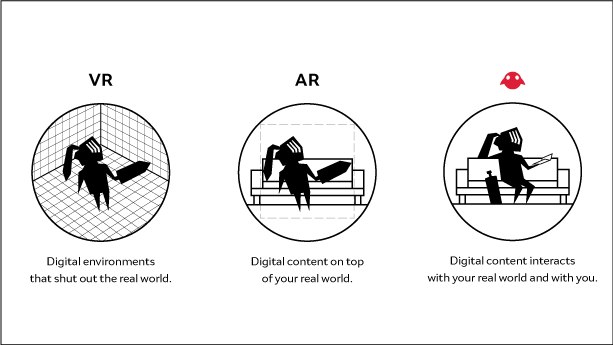 An immersive world, blocking out actual reality 一个沉浸式世界,能阻挡真实
In contrast, when creating mixed reality experiences, especially fully spatialized MR, the main goal is almost the exact opposite. In MR, the focus is on bringing content into the real world, and making it seem so integrated that the user questions what is real and what isn’t (see pic C2). It’s about keeping the user deeply rooted in actual reality, so that any given thing you add to the scene is magical — a fantastical yet plausible addition to the real world. It’s also about never taking the user out of their current world. They should always be in the present, taking most of their cues from the physical environment around them, so that the digital content is just one actor in the scene, along with the real world elements.与之对比,在创建混合现实体验时,尤其是完全空间化的MR时,我们的主要目标几乎与VR完全相反。在MR中,重点是把内容带到现实世界,令其变得与现实世界别无二致,以至于用户将扣问何谓真实,何谓虚拟。混合现实旨在令用户深深扎根于现实世界,所以任何添加至场景的对象都能带来神奇的感受:一种异想天开但又令人信服的现实世界补充。混合现实同样在于永不将用户与当前的世界隔离开来。他们应该总是临在现实世界,最大化利用物理环境的线索,从而令数字内容变成场景的一个自然元素,就如同真实世界元素一样。
 Reality, plus a little extra 真实,添加一些点缀
Another big part of traditional world building is to start by quickly teaching the user what the “rules” are. Is this a fantasy setting with Orcs and magic? A more traditional European city filled with assassin clans? An ancient Egyptian locale with living gods, or the sci-fi beweaponed mines of Mars? The goal is to give some backstory so that the user can understand the game world, and also what the possibilities for play are. If magic is present, then maybe I will be able to learn how to do that myself. I should get the skills and materials and start weaving spells.传统世界构建的另一个重要方面是,一开始就要快速向用户讲解“规则”。这是不是兽人与魔法的幻想设定呢?一个充斥着刺客氏族的传统欧洲城市?一个包含活神的古埃及场景,或者说这是火星上充满科幻武器的矿藏?目标是提供一定的背景故事,这样用户就能理解游戏世界,以及玩法的可能性。如果存在魔法,我或许就能知道自己的潜能。我应该能够掌握相应的技能,并开始吟唱咒语。
With MR experiences, it’s instead about quickly making the user understand how many of the “rules of actual reality” the experience will respect, and what key magical aspects the app adds. The location of the experience is wherever the user happens to be — their living room, kitchen, office, bedroom, wherever. The rules of reality are (mostly) known to the typical user. Your goal is to clearly communicate, hopefully by showing (rather than through a written tutorial) all the rules your experience will respect. Are objects solid? Will they fall to the ground if dropped, and collide physically with real world objects? Will they occlude if they go behind real things? Do they recognize other people in the world? The answers to all of these questions, and a lot more, need to be quickly given to the user so that they know what kinds of interactions to expect, and what the options for user interfacing are. Also note that the more rules of reality you follow, the more rooted in reality your experience will seem, and the more grounded your user will remain.对于MR体验,其目标是快速令用户明白体验将尊重多少“物理现实的规则”,以及应用程序带来的关键神奇元素是什么。体验可以发生在任何位置:用户的客厅,厨房,办公室,卧室,哪里都行。用户知晓(大部分)现实的规则。你的目标是清晰地传达出体验将尊重的所有规则。这是不是实在的对象呢?如果放手它们是否将掉落地下,并发生与真实世界对象的物理碰撞呢?如果位于真实对象的背后,它们是否将出现遮挡现象呢?它们是否能识别现实世界中的其他人呢?对于所有这些问题,以及其他问题,你都需要快速告知用户,这样他们才能预期将出现何种交互,以及用户界面存在何种选项。同时需要注意的是,你遵循的现实规则越多,体验看上去就越扎根于现实。
The Boundaries of Experience 体验的边界
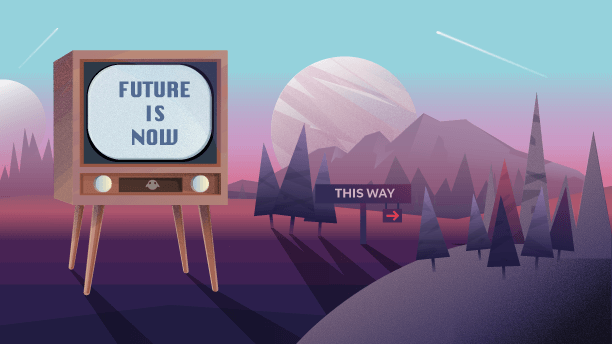
Mixed reality experiences aren’t just a developer novelty. On the end user side, there’s also a large mental shift with this new form of content. In older forms, the screen (and putting on a VR device is basically just putting your head fully into the screen and 100% cutting yourself off from reality) is the Boundary of Experience. The user knows where all the content is going to be shown and where to look for it, and can easily turn away in order to address something else in the room. In a mixed reality experience, this isn’t always the case. Content could come from anywhere, any direction, around corners, through doorways, and can move freely. This is a profoundly new concept for a lot of consumers and, if not handled well, can cause a lot of frustration. Part of onboarding becomes either explaining the particular bounds of your experience or giving the user options to decide their own bounds.混合现实体验不仅只是一项开发者创新。在终端用户一端,这种新形式的内容同样带来了大量的心智改变。在原有的形态下,屏幕(VR头显基本上就是穿戴一个360度的屏幕,并100%将自己与现实隔离开来)就是体验的边界。用户知道内容将在何处出现,自己应该看向何处。而且为了处理房间中的其他事情,用户可以轻松转头离去。在混合现实体验中,事情并不总是这样。内容可以出现在任意位置,任意方向,并且可以自由移动。这对大多数消费者而言都是一种全新的概念,如果处理不慎,这将造成大量的失望。
This isn’t some new problem, actually. Back when the television first came out, TV content was exactly the same as radio content; broadcasters just filmed it and showed the audience the studio recording. In fact, many early TV broadcasts were also played on the radio, in what could be called “cross-platform content.” It took developers a while to see the potential of the medium and start moving away from the old formulas to new stuff that was really only doable on film, with pictures that said a thousand words.实际上,这不是什么新的问题。当电视首次面世的时候,电视内容就跟电台内容一模一样。广播商只是向观众展示工作室的录制视频。事实上,大多数早期的电视广播节目同样在收音机上播放,而我们可以将其称为“跨平台内容”。人们花费了一定的时间才发现了这项媒介的潜能,并开始放弃旧有的配方,并转向只有视频才能实现的新解决方案。影像胜过千言万语。
Both radio and television started out as passive content platforms — there was no way to meaningfully interact with or affect the content. We now live in a world where almost all content is potentially interactive. Passive content is still around, but interactive is what the vast majority of consumers crave. However, interactions within MR are very different from other digital interactions. MR can be more accessible and intuitive because of the many ways we can capture inputs such as eye gaze and hand gestures, but the basic rules are still very fresh for most consumers. Also, because the experience happens in the real world, the “measure of quality” is quite a bit higher, making good MR interaction anything but easy.收音机和电视都是被动的内容平台,你无法以任何有意义的方式来与内容交互或影响内容。对于我们当前的世界,几乎所有内容都具备潜在的交互性。被动内容依然存在,但绝大多数消费者都渴望交互性。然而,MR中的交互非常不同于其他数字交互。MR可以非常亲民和直观,因为它支持一系列的输入方式,比如说眼睛注视和手势,但基本的规则对大部分消费者而言仍然非常新颖。另外,由于体验发生在现实世界,“品质衡量”相对更高,令优秀的MR交互更加轻松。
Some MR users want to linger and explore everything, while others rocket forward at their own pace. Besides pacing and experience bounds, there’s a lot of new terms and inputs to learn, and these require new ways to teach the user, and new ways to keep the user informed about their options. In fact, there’s so much to learn that early experiences should probably aim to be a bit simpler than the usual digital experiences. Since most users will feel inundated with all the new tech stuff, they won’t have a lot of extra space in their brains for other complications.一些MR用户希望能够逗留徘徊并探索一切,其他用户则希望以自己的节奏来快速进行。除了节奏和体验边界之外,我们需要学习大量的新词汇和输入,而且这需要全新的用户教学方法,以及告知用户可用选项的新方法。事实上,由于存在大量的新知识,早期的体验应该要比常规的数字体验更简单。因为所有这种新知识将令大多数用户感到喘不过气起,他们大脑没有多余的空间来处理其他复杂的事情。
Who’s Controlling the Experience? 谁在主导体验?

Mixed reality development can be a big change for developers. Experience creators are no longer fully in the driver’s seat, but rather a guest in the user’s territory.混合现实开发对开发者而言可以说是一次重大的改变。体验创作者将不再完全控制方向盘,而只是用户领域中的一位客人。
Think of immersive screen-based or VR experiences as more like theater. The user pays good money to be swept away to a new land. When you go to this new land, you’re expected to be quiet, turn off your phone, and sit still. You’re supposed to respect the rules of the theater. Of course, in a more active experience the rules are different, but there are still a lot of rules. The user withdraws from awareness of the familiar, gives over their full attention, and focuses on losing themselves in the experience. In mixed reality the situation is once again reversed. MR experiences should be considerate of the user’s environment, like a good houseguest, unless given permission to be otherwise. It’s like going over to a friend’s house and telling a story, or having a game night.你可以将沉浸式屏幕或VR体验更多地视为影院。用户支付了一大笔钱,并被传送至一片新土地上。在前往这片新土地时,你应该保持安静,关掉手机,静静地坐着。你应该尊重影院的规则。当然,在更积极的体验中,规则有所不同不同,但规则仍然有很多。用户将面对不熟悉的环境,需要全神贯注,并专注于沉浸在体验之中。在混合现实中,情况再次逆转。MR体验应该考虑到用户的环境,就像一位好房客那样,除非获得许可,否则不能随意胡来。这就像去朋友家玩,讲故事,或者是来一场游戏之夜。
Let’s say that I come over to your house. If somebody calls you on the phone, and I don’t quiet down and give you some space to answer, that’s being a bad guest. If I come into a room and sit down in a chair already taken by another person, that’s a bad guest. If I plow right through your coffee table, that’s a bad guest. These are the sorts of respectful considerations we want to strive for with our MR creations. Why? Because now YOU as a content creator are making guests, and your creations are entering somebody else’s world.比如说我过来你家。如果有人打电话给你,而这时我没有安静下来,反而不识相地大吵大闹,我就是一位糟糕的客人。如果我走进一个房间,并抢了本已有人坐的椅子,我就是一个糟糕的客人。如果我在你的咖啡桌上乱敲乱碰,我就是一位糟糕的客人。这都是我们希望在MR创作时考虑的尊重问题。为什么?因为作为内容创作者的你正在制造客人,而你的作品正在进入别人的世界。
In MR, typically the user doesn’t give their entire attention, or there’s give and take. The rules are different, and the relationship with the user can be a lot more intimate. If an MR experience is not respectful, it can feel invasive, or intimidating, just like a boorish houseguest. But done well, it can foster FAR stronger bonds with content, heighten trust with artificial characters, and make interactions feel much more personal. But with great power comes great responsibility.用户在MR中通常不会全神贯注,或者说不存在给予与索取。规则有所不同不同,与用户的关系可以更亲密。如果MR体验不给予尊重,用户可能会感觉自己的空间遭受入侵或恐吓,就像来了一位粗野房客那样。但如果正确处理,它可以建立起更强的联系,增强用户对人造角色的信任,并令交互更加个性化。但需要谨记的是,能力越大,责任越大。
Stairway of Exploration 探索的阶梯
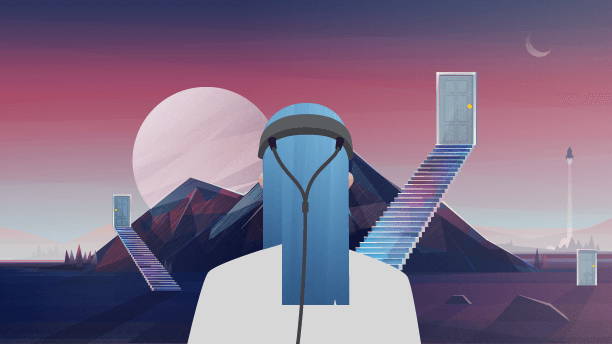
This is why, for both developers and consumers, we’ve seen over and over that there’s a path to getting your head around the MR medium. It’s almost a staircase of interactions and experience “layout types” that people tend to follow as they explore the new space of possibility. It’s somewhat like learning algebra, and then trigonometry, and then calculus, and so on. Each level builds on the previous, and gets your brain accustomed to thinking in a slightly new way.这就是为什么对于开发者和消费者来说,我们已经一遍又一遍地看到一条通往MR媒介的道路。它几乎就是一条交互和体验“布局类型”的阶梯,人们在探索新的可能性空间时往往会遵循这些“布局类型”。这有点像是学习代数,然后是三角函数,再到微积分等等。每个梯级都建立在前一个梯级之上,令你的大脑习惯于以一种稍微更新的方式进行思考。
Most devs start by making a tabletop experience (basically just a screen laid down on a table). This does two things: it maintains the boundary of experience and lets you assume the user is seated and facing the experience, just as if they were sitting in front of a laptop or a TV.大多数开发者在一开始都是制作桌面体验(基本上只是摆在桌子上的屏幕)。这做了两件事情:它保持了体验的边界,允许你假设用户坐下来并面对体验,就像坐在笔记本电脑或电视机前一样。
The next step is to keep the tabletop experience, but start to play with headpose. Typically, devs have the experience encourage the user to move around the tabletop and see the content from all sides, interacting at key points or angles. This still allows for a clear boundary, while introducing real world action.下一步是维持桌面体验,但开始涉足头部姿势。通常而言,开发者在鼓励用户围绕桌面移动并从各个方向浏览内容,在关键点或角度与之进行交互方面拥有丰富的经验。这仍然是允许一个清晰的边界,同时引入了现实世界的行动。
Room scale. The boundary of experience is now a full room, and the consumer can expect things to potentially happen all over that room. Devs can now practice full user movement, changing environmental conditions within a single room, and solving more semantic room challenges.房间规模。体验的边界现在是一个完整的空间,消费者可以期待能够在整个房间内发生的事情。开发者现在可以练习完整的用户移动,改变单个房间内的环境条件,并解决更多的房间语义挑战。
Multi-room. Now the boundary is largely gone. Consumers can wander around, seeing where content is manifest within large environments. Devs can make things that potentially scale in all directions, dealing with radically different rooms (lighting, types of furnishings, noise levels, etc.) as well as transitions between rooms, including doors.多房间。现在边界已经基本消失。消费者可以四处闲逛,看看内容在大型环境中出现的位置。开发者可以制作能够在各个方向扩展的内容,处理完全不同的房间(灯光,家具类型,噪音水平等),以及房间之间的过渡,包括门。
At some point during steps 2–4, multi-user content will also be experimented with. This is a “side quest” since some people have the opportunity and the desire for social content, and others don’t. That being said, social MR content is ridiculously compelling. See Sharing Is Caring in the MR Interaction Goals.在步骤2-4期间的某个时刻,开发者同时将实验多用户内容。这是一个“支线任务”,因为有些人有机会参或渴望社交内容,而有些人则没有这方面的需求。话虽如此,社交MR非常确实非常引人入胜

若有收获,就点个赞吧
0 人点赞


