线程安全一
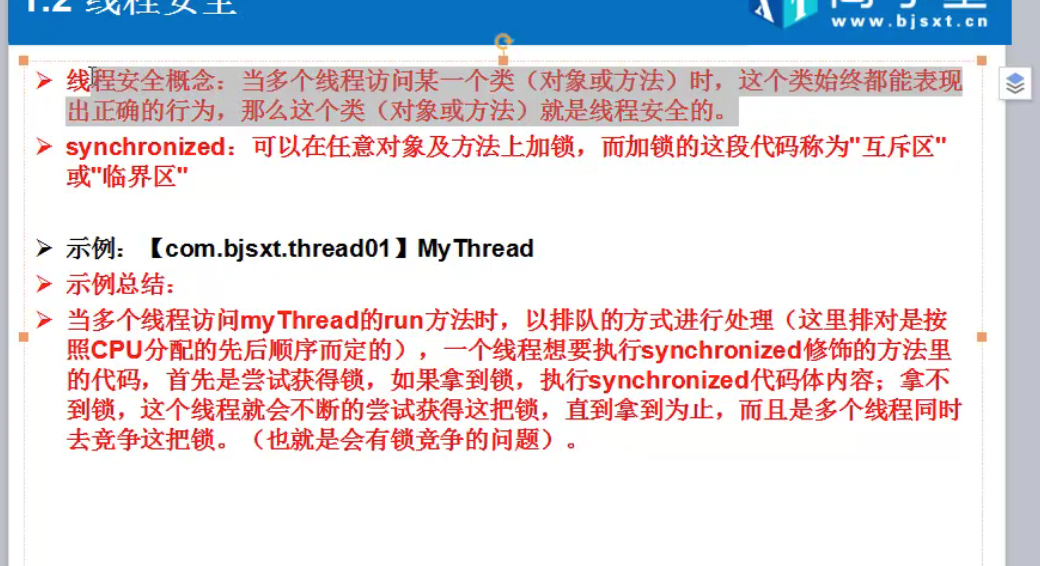
线程安全概念:当多个线程访问某一个类(对象或方法)时,这个类始终都能表现出正确的行为,那么这个类(对象或方法)就是线程安全的。
synchronized:可 以在任何对象及方法上加锁,而加锁的这段代码称为“互斥区”或“临界区”。
示例
package com.bjsxt.base.sync001;import java.util.concurrent.atomic.AtomicInteger;/*** 线程安全概念:当多个线程访问某一个类(对象或方法)时,这个对象始终都能表现出正确的行为,那么这个类(对象或方法)就是线程安全的。* synchronized:可以在任意对象及方法上加锁,而加锁的这段代码称为"互斥区"或"临界区"* @author alienware**/public class MyThread extends Thread{private int count = 5 ;//synchronized加锁public void run(){count--;System.out.println(this.currentThread().getName() + " count = "+ count);}public static void main(String[] args) {/*** 分析:当多个线程访问myThread的run方法时,以排队的方式进行处理(这里排对是按照CPU分配的先后顺序而定的),* 一个线程想要执行synchronized修饰的方法里的代码:* 1 尝试获得锁* 2 如果拿到锁,执行synchronized代码体内容;拿不到锁,这个线程就会不断的尝试获得这把锁,直到拿到为止,* 而且是多个线程同时去竞争这把锁。(也就是会有锁竞争的问题)*/MyThread myThread = new MyThread();Thread t1 = new Thread(myThread,"t1");Thread t2 = new Thread(myThread,"t2");Thread t3 = new Thread(myThread,"t3");Thread t4 = new Thread(myThread,"t4");Thread t5 = new Thread(myThread,"t5");t1.start();t2.start();t3.start();t4.start();t5.start();}}
线程安全二
多个线程多个锁

示例
package com.bjsxt.base.sync002;
/**
 * 关键字synchronized取得的锁都是对象锁,而不是把一段代码(方法)当做锁,
 * 所以代码中哪个线程先执行synchronized关键字的方法,哪个线程就持有该方法所属对象的锁(Lock),
 *
 * 在静态方法上加synchronized关键字,表示锁定.class类,类一级别的锁(独占.class类)。
 * @author alienware
 *
 */
public class MultiThread {

    private int num = 0;

    /** static */
    public synchronized void printNum(String tag){
        try {

            if(tag.equals("a")){
                num = 100;
                System.out.println("tag a, set num over!");
                Thread.sleep(1000);
            } else {
                num = 200;
                System.out.println("tag b, set num over!");
            }

            System.out.println("tag " + tag + ", num = " + num);

        } catch (InterruptedException e) {
            e.printStackTrace();
        }
    }

    //注意观察run方法输出顺序
    public static void main(String[] args) {

        //俩个不同的对象
        final MultiThread m1 = new MultiThread();
        final MultiThread m2 = new MultiThread();

        Thread t1 = new Thread(new Runnable() {
            @Override
            public void run() {
                m1.printNum("a");
            }
        });

        Thread t2 = new Thread(new Runnable() {
            @Override
            public void run() {
                m2.printNum("b");
            }
        });

        t1.start();
        t2.start();

    }
}
对象锁的同步和异步
示例
package com.bjsxt.base.sync003;

/**
 * 对象锁的同步和异步问题
 * @author alienware
 *
 */
public class MyObject {

    public synchronized void method1(){
        try {
            System.out.println(Thread.currentThread().getName());
            Thread.sleep(4000);
        } catch (InterruptedException e) {
            e.printStackTrace();
        }
    }

    /** synchronized */
    public void method2(){
            System.out.println(Thread.currentThread().getName());
    }

    public static void main(String[] args) {

        final MyObject mo = new MyObject();

        /**
         * 分析:
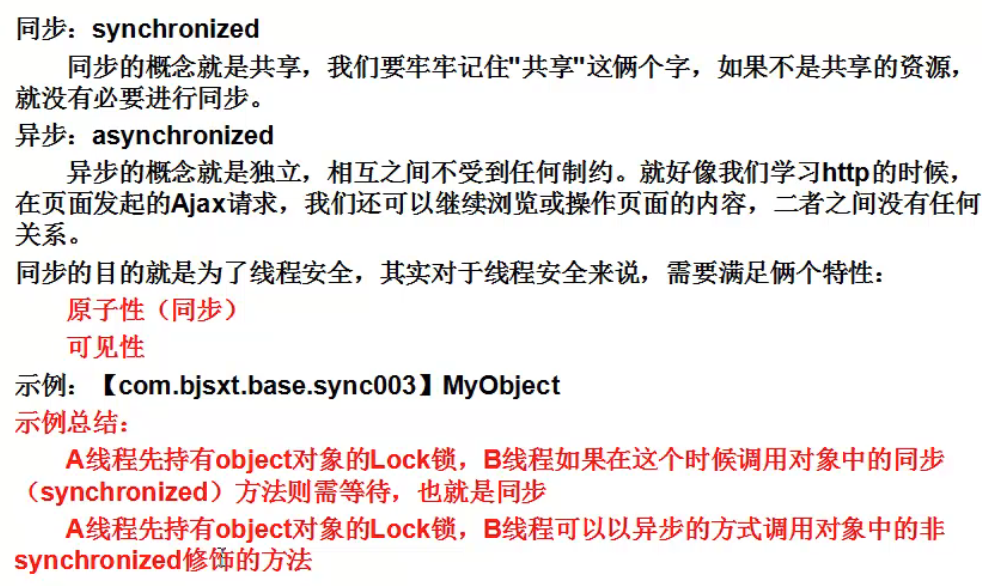
         * t1线程先持有object对象的Lock锁,t2线程可以以异步的方式调用对象中的非synchronized修饰的方法
         * t1线程先持有object对象的Lock锁,t2线程如果在这个时候调用对象中的同步(synchronized)方法则需等待,也就是同步
         */
        Thread t1 = new Thread(new Runnable() {
            @Override
            public void run() {
                mo.method1();
            }
        },"t1");

        Thread t2 = new Thread(new Runnable() {
            @Override
            public void run() {
                mo.method2();
            }
        },"t2");

        t1.start();
        t2.start();

    }

}
脏读

示例
package com.bjsxt.base.sync004;
/**
 * 业务整体需要使用完整的synchronized,保持业务的原子性。
 * @author alienware
 *
 */
public class DirtyRead {

    private String username = "bjsxt";
    private String password = "123";

    public synchronized void setValue(String username, String password){
        this.username = username;

        try {
            Thread.sleep(2000);
        } catch (InterruptedException e) {
            e.printStackTrace();
        }

        this.password = password;

        System.out.println("setValue最终结果:username = " + username + " , password = " + password);
    }

    public void getValue(){
        System.out.println("getValue方法得到:username = " + this.username + " , password = " + this.password);
    }


    public static void main(String[] args) throws Exception{

        final DirtyRead dr = new DirtyRead();
        Thread t1 = new Thread(new Runnable() {
            @Override
            public void run() {
                dr.setValue("z3", "456");
            }
        });
        t1.start();
        Thread.sleep(1000);

        dr.getValue();
    }
}
Synchronized
锁重入示例
package com.bjsxt.base.sync005;
/**
 * synchronized的重入
 * @author alienware
 *
 */
public class SyncDubbo1 {

    public synchronized void method1(){
        System.out.println("method1..");
        method2();
    }
    public synchronized void method2(){
        System.out.println("method2..");
        method3();
    }
    public synchronized void method3(){
        System.out.println("method3..");
    }

    public static void main(String[] args) {
        final SyncDubbo1 sd = new SyncDubbo1();
        Thread t1 = new Thread(new Runnable() {
            @Override
            public void run() {
                sd.method1();
            }
        });
        t1.start();
    }
}
父子类锁重入示例
package com.bjsxt.base.sync005;
/**
 * synchronized的重入
 * @author alienware
 *
 */
public class SyncDubbo2 {

    static class Main {
        public int i = 10;
        public synchronized void operationSup(){
            try {
                i--;
                System.out.println("Main print i = " + i);
                Thread.sleep(100);
            } catch (InterruptedException e) {
                e.printStackTrace();
            }
        }
    }

    static class Sub extends Main {
        public synchronized void operationSub(){
            try {
                while(i > 0) {
                    i--;
                    System.out.println("Sub print i = " + i);
                    Thread.sleep(100);
                    this.operationSup();
                }
            } catch (InterruptedException e) {
                e.printStackTrace();
            }
        }
    }

    public static void main(String[] args) {

        Thread t1 = new Thread(new Runnable() {
            @Override
            public void run() {
                Sub sub = new Sub();
                sub.operationSub();
            }
        });

        t1.start();
    }
}
锁异常的处理示例
package com.bjsxt.base.sync005;
/**
 * synchronized异常
 * @author alienware
 *
 */
public class SyncException {

    private int i = 0;
    public synchronized void operation(){
        while(true){
            try {
                i++;
                Thread.sleep(100);
                System.out.println(Thread.currentThread().getName() + " , i = " + i);
                if(i == 20){
                    //Integer.parseInt("a");
                    throw new RuntimeException();
                }
            } catch (InterruptedException e) {
                e.printStackTrace();
            }
        }
    }

    public static void main(String[] args) {

        final SyncException se = new SyncException();
        Thread t1 = new Thread(new Runnable() {
            @Override
            public void run() {
                se.operation();
            }
        },"t1");
        t1.start();
    }


}
package com.bjsxt.base.sync005;
/**
 * synchronized异常
 * @author alienware
 *
 */
public class SyncException {

    private int i = 0;
    public synchronized void operation(){
        while(true){
            try {
                i++;
                Thread.sleep(100);
                System.out.println(Thread.currentThread().getName() + " , i = " + i);
                if(i == 20){
                    //Integer.parseInt("a");
                    throw new RuntimeException();
                }
            } catch (InterruptedException e) {
                e.printStackTrace();
            }
        }
    }

    public static void main(String[] args) {

        final SyncException se = new SyncException();
        Thread t1 = new Thread(new Runnable() {
            @Override
            public void run() {
                se.operation();
            }
        },"t1");
        t1.start();
    }
}
其他示例
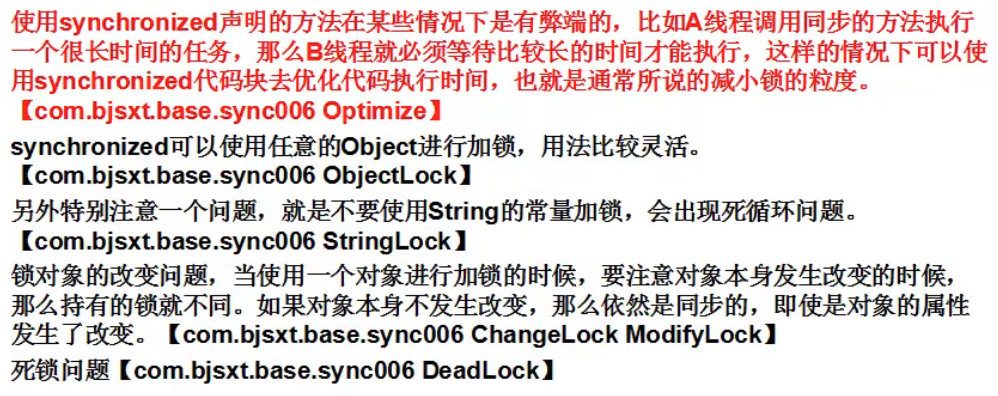
package com.bjsxt.base.sync006;
/**
 * 锁对象的改变问题
 * @author alienware
 *
 */
public class ChangeLock {

    private String lock = "lock";

    private void method(){
        synchronized (lock) {
            try {
                System.out.println("当前线程 : "  + Thread.currentThread().getName() + "开始");
                lock = "change lock";
                Thread.sleep(2000);
                System.out.println("当前线程 : "  + Thread.currentThread().getName() + "结束");
            } catch (InterruptedException e) {
                e.printStackTrace();
            }
        }
    }

    public static void main(String[] args) {

        final ChangeLock changeLock = new ChangeLock();
        Thread t1 = new Thread(new Runnable() {
            @Override
            public void run() {
                changeLock.method();
            }
        },"t1");
        Thread t2 = new Thread(new Runnable() {
            @Override
            public void run() {
                changeLock.method();
            }
        },"t2");
        t1.start();
        try {
            Thread.sleep(100);
        } catch (InterruptedException e) {
            e.printStackTrace();
        }
        t2.start();
    }

}
package com.bjsxt.base.sync006;

/**
 * 死锁问题,在设计程序时就应该避免双方相互持有对方的锁的情况
 * @author alienware
 *
 */
public class DeadLock implements Runnable{

    private String tag;
    private static Object lock1 = new Object();
    private static Object lock2 = new Object();

    public void setTag(String tag){
        this.tag = tag;
    }

    @Override
    public void run() {
        if(tag.equals("a")){
            synchronized (lock1) {
                try {
                    System.out.println("当前线程 : "  + Thread.currentThread().getName() + " 进入lock1执行");
                    Thread.sleep(2000);
                } catch (InterruptedException e) {
                    e.printStackTrace();
                }
                synchronized (lock2) {
                    System.out.println("当前线程 : "  + Thread.currentThread().getName() + " 进入lock2执行");
                }
            }
        }
        if(tag.equals("b")){
            synchronized (lock2) {
                try {
                    System.out.println("当前线程 : "  + Thread.currentThread().getName() + " 进入lock2执行");
                    Thread.sleep(2000);
                } catch (InterruptedException e) {
                    e.printStackTrace();
                }
                synchronized (lock1) {
                    System.out.println("当前线程 : "  + Thread.currentThread().getName() + " 进入lock1执行");
                }
            }
        }
    }

    public static void main(String[] args) {

        DeadLock d1 = new DeadLock();
        d1.setTag("a");
        DeadLock d2 = new DeadLock();
        d2.setTag("b");

        Thread t1 = new Thread(d1, "t1");
        Thread t2 = new Thread(d2, "t2");

        t1.start();
        try {
            Thread.sleep(500);
        } catch (InterruptedException e) {
            e.printStackTrace();
        }
        t2.start();
    }
}
package com.bjsxt.base.sync006;
/**
 * 同一对象属性的修改不会影响锁的情况
 * @author alienware
 *
 */
public class ModifyLock {

    private String name ;
    private int age ;

    public String getName() {
        return name;
    }
    public void setName(String name) {
        this.name = name;
    }
    public int getAge() {
        return age;
    }
    public void setAge(int age) {
        this.age = age;
    }

    public synchronized void changeAttributte(String name, int age) {
        try {
            System.out.println("当前线程 : "  + Thread.currentThread().getName() + " 开始");
            this.setName(name);
            this.setAge(age);

            System.out.println("当前线程 : "  + Thread.currentThread().getName() + " 修改对象内容为: "
                    + this.getName() + ", " + this.getAge());

            Thread.sleep(2000);
            System.out.println("当前线程 : "  + Thread.currentThread().getName() + " 结束");
        } catch (InterruptedException e) {
            e.printStackTrace();
        }
    }

    public static void main(String[] args) {
        final ModifyLock modifyLock = new ModifyLock();
        Thread t1 = new Thread(new Runnable() {
            @Override
            public void run() {
                modifyLock.changeAttributte("张三", 20);
            }
        },"t1");
        Thread t2 = new Thread(new Runnable() {
            @Override
            public void run() {
                modifyLock.changeAttributte("李四", 21);
            }
        },"t2");

        t1.start();
        try {
            Thread.sleep(100);
        } catch (InterruptedException e) {
            e.printStackTrace();
        }
        t2.start();
    }
}
package com.bjsxt.base.sync006;

/**
 * 使用synchronized代码块加锁,比较灵活
 * @author alienware
 *
 */
public class ObjectLock {

    public void method1(){
        synchronized (this) {    //对象锁
            try {
                System.out.println("do method1..");
                Thread.sleep(2000);
            } catch (InterruptedException e) {
                e.printStackTrace();
            }
        }
    }

    public void method2(){        //类锁
        synchronized (ObjectLock.class) {
            try {
                System.out.println("do method2..");
                Thread.sleep(2000);
            } catch (InterruptedException e) {
                e.printStackTrace();
            }
        }
    }

    private Object lock = new Object();
    public void method3(){        //任何对象锁
        synchronized (lock) {
            try {
                System.out.println("do method3..");
                Thread.sleep(2000);
            } catch (InterruptedException e) {
                e.printStackTrace();
            }
        }
    }


    public static void main(String[] args) {

        final ObjectLock objLock = new ObjectLock();
        Thread t1 = new Thread(new Runnable() {
            @Override
            public void run() {
                objLock.method1();
            }
        });
        Thread t2 = new Thread(new Runnable() {
            @Override
            public void run() {
                objLock.method2();
            }
        });
        Thread t3 = new Thread(new Runnable() {
            @Override
            public void run() {
                objLock.method3();
            }
        });

        t1.start();
        t2.start();
        t3.start();
    }
}
package com.bjsxt.base.sync006;

/**
 * 使用synchronized代码块减小锁的粒度,提高性能
 * @author alienware
 *
 */
public class Optimize {

    public void doLongTimeTask(){
        try {

            System.out.println("当前线程开始:" + Thread.currentThread().getName() +
                    ", 正在执行一个较长时间的业务操作,其内容不需要同步");
            Thread.sleep(2000);

            synchronized(this){
                System.out.println("当前线程:" + Thread.currentThread().getName() +
                    ", 执行同步代码块,对其同步变量进行操作");
                Thread.sleep(1000);
            }
            System.out.println("当前线程结束:" + Thread.currentThread().getName() +
                    ", 执行完毕");

        } catch (InterruptedException e) {
            e.printStackTrace();
        }
    }

    public static void main(String[] args) {
        final Optimize otz = new Optimize();
        Thread t1 = new Thread(new Runnable() {
            @Override
            public void run() {
                otz.doLongTimeTask();
            }
        },"t1");
        Thread t2 = new Thread(new Runnable() {
            @Override
            public void run() {
                otz.doLongTimeTask();
            }
        },"t2");
        t1.start();
        t2.start();
    }
}
package com.bjsxt.base.sync006;
/**
 * synchronized代码块对字符串的锁,注意String常量池的缓存功能
 * @author alienware
 *
 */
public class StringLock {

    public void method() {
        //new String("字符串常量")
        synchronized ("字符串常量") {
            try {
                while(true){
                    System.out.println("当前线程 : "  + Thread.currentThread().getName() + "开始");
                    Thread.sleep(1000);
                    System.out.println("当前线程 : "  + Thread.currentThread().getName() + "结束");
                }
            } catch (InterruptedException e) {
                e.printStackTrace();
            }
        }
    }

    public static void main(String[] args) {
        final StringLock stringLock = new StringLock();
        Thread t1 = new Thread(new Runnable() {
            @Override
            public void run() {
                stringLock.method();
            }
        },"t1");
        Thread t2 = new Thread(new Runnable() {
            @Override
            public void run() {
                stringLock.method();
            }
        },"t2");

        t1.start();
        t2.start();
    }
}
Volatile
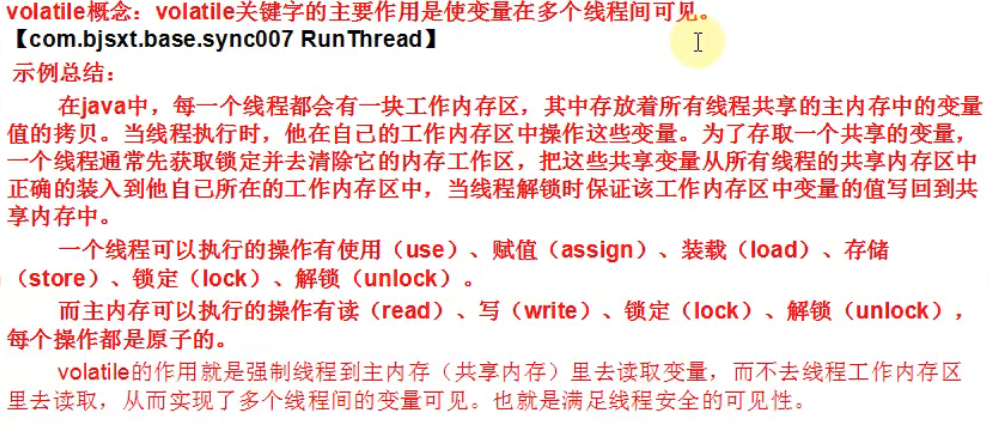
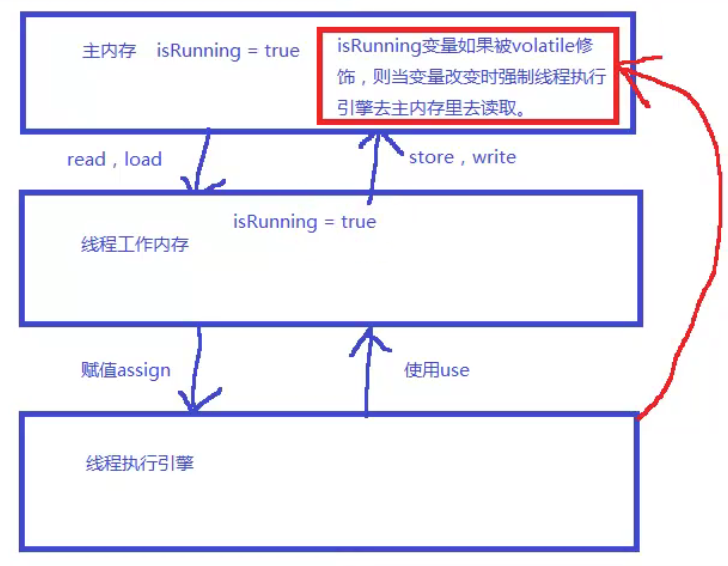
线程执行流程图
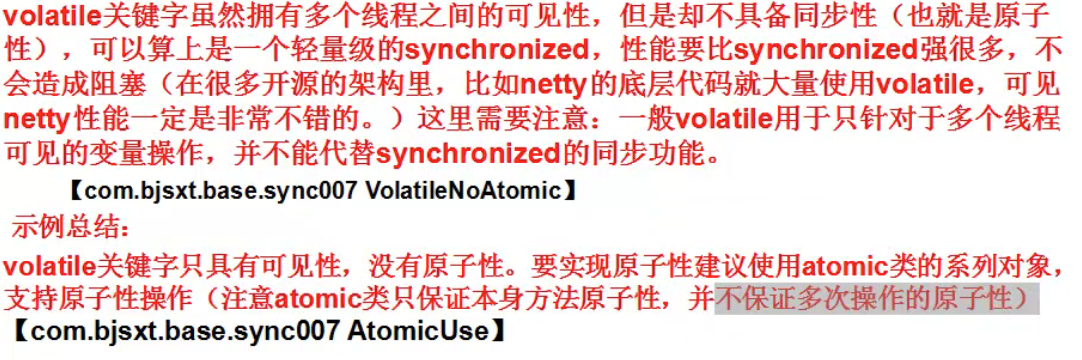
Volatile关键字的非原子性
package com.bjsxt.base.sync007;

import java.util.ArrayList;
import java.util.List;
import java.util.concurrent.atomic.AtomicInteger;

public class AtomicUse {

    private static AtomicInteger count = new AtomicInteger(0);

    //多个addAndGet在一个方法内是非原子性的,需要加synchronized进行修饰,保证4个addAndGet整体原子性
    /**synchronized*/
    public synchronized int multiAdd(){
            try {
                Thread.sleep(100);
            } catch (InterruptedException e) {
                e.printStackTrace();
            }
            count.addAndGet(1);
            count.addAndGet(2);
            count.addAndGet(3);
            count.addAndGet(4); //+10
            return count.get();
    }


    public static void main(String[] args) {

        final AtomicUse au = new AtomicUse();

        List<Thread> ts = new ArrayList<Thread>();
        for (int i = 0; i < 100; i++) {
            ts.add(new Thread(new Runnable() {
                @Override
                public void run() {
                    System.out.println(au.multiAdd());
                }
            }));
        }

        for(Thread t : ts){
            t.start();
        }
    }
}
package com.bjsxt.base.sync007;

public class RunThread extends Thread{

    private volatile boolean isRunning = true;
    private void setRunning(boolean isRunning){
        this.isRunning = isRunning;
    }

    public void run(){
        System.out.println("进入run方法..");
        int i = 0;
        while(isRunning == true){
            //..
        }
        System.out.println("线程停止");
    }

    public static void main(String[] args) throws InterruptedException {
        RunThread rt = new RunThread();
        rt.start();
        Thread.sleep(1000);
        rt.setRunning(false);
        System.out.println("isRunning的值已经被设置了false");
    }
}
package com.bjsxt.base.sync007;

import java.util.concurrent.atomic.AtomicInteger;

/**
 * volatile关键字不具备synchronized关键字的原子性(同步)
 * @author alienware
 *
 */
public class VolatileNoAtomic extends Thread{
    //private static volatile int count;
    private static AtomicInteger count = new AtomicInteger(0);
    private static void addCount(){
        for (int i = 0; i < 1000; i++) {
            //count++ ;
            count.incrementAndGet();
        }
        System.out.println(count);
    }

    public void run(){
        addCount();
    }

    public static void main(String[] args) {

        VolatileNoAtomic[] arr = new VolatileNoAtomic[100];
        for (int i = 0; i < 10; i++) {
            arr[i] = new VolatileNoAtomic();
        }

        for (int i = 0; i < 10; i++) {
            arr[i].start();
        }
    }
}

若有收获,就点个赞吧
0 人点赞


