DFS(深度优先搜索)
DFS/ 回溯模板 子序列的模板
List<List<Integer>> ans = new ArrayList<List<Integer>>();List<Integer> temp = new ArrayList<Integer>();public void dfs(int cur, int[] nums) {if (cur == nums.length) {// 判断是否合法,如果合法判断是否重复,将满足条件的加入答案if (isValid() && notVisited()) {ans.add(new ArrayList<Integer>(temp));}return;}// 如果选择当前元素temp.add(nums[cur]);dfs(cur + 1, nums);temp.remove(temp.size() - 1);// 如果不选择当前元素dfs(cur + 1, nums);}
486. 预测赢家

模拟一下这个操作,
841. 钥匙和房间
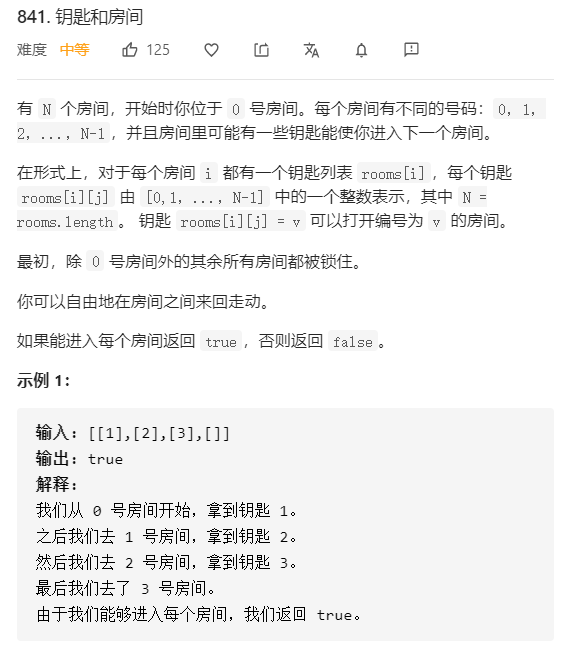
这道题需要一set 来记录一下什么已经放进去了。 对于每一个房间的钥匙,打开相应的门,如果里面的钥匙是没有过的,那就进入下一轮的搜索中去。
class Solution {
    HashSet<Integer> set = new HashSet<>();

    public boolean canVisitAllRooms(List<List<Integer>> rooms) {
        int n = rooms.size();
        set.add(0);
        dfs(rooms.get(0),rooms);
        // System.out.println(set.size());
        return set.size() == rooms.size();
    }

    private void dfs(List<Integer> room, List<List<Integer>> rooms) {
        if(room.size() == 0){
            return;
        }else {
            for (int i = 0; i < room.size(); i++) {
                int num = room.get(i);
                if(set.contains(num)){
                    continue;
                }
                else {
                    set.add(num);
                    dfs(rooms.get(num),rooms);
                }
            }
        }

    }
}
130. 被围绕的区域
这道题的里面,只有和边界连接的O才不会变成X。 所以从边界上的O开始DFS,把遇到的O 设置为Q,最后遍历一次,把Q变成O,其余的都是X。
class Solution {
    public void solve(char[][] board) {
        if(board==null||board.length<1){
            return;
        }
        if(board.length==1||board[0].length==1){
            return;
        }
        int m = board.length;
        int n = board[0].length;

        for (int i = 0; i < m; i++) {
            if(board[i][0] == 'O'){
                dfs(board,i,0);
            }
            if(board[i][n-1] =='O'){
                dfs(board,i,n-1);
            }
        }

        for (int i = 0; i < n; i++) {
            if(board[0][i] =='O'){
                dfs(board,0,i);
            }
            if(board[m-1][i] == 'O'){
                dfs(board,m-1,i);
            }
        }

        for (int i = 0; i <m; i++) {
            for (int j = 0; j < n; j++) {
                if(board[i][j] =='Q'){
                    board[i][j] = 'O';
                }else {
                    board[i][j] = 'X';
                }
            }
        }

    }

    private void dfs(char[][] board, int i, int j) {
        if(i<0||j<0||j>=board[0].length||i>=board.length||board[i][j]!='O'){
            return;
        }

        int[] dx = new int[]{1,0,0,-1};
        int[] dy = new int[]{0,-1,1,0};
        board[i][j] = 'Q';
        for (int k = 0; k < 4; k++) {
            dfs(board,i+dx[k],j+dy[k]);
        }

    }
}
78. 子集
对于每一个的选项,我们都有选择,或者不选择的情况。
class Solution {
    List<List<Integer>> res = new LinkedList<>();
    public List<List<Integer>> subsets(int[] nums) {
        LinkedList<Integer> tmp = new LinkedList<>();
        if(nums == null) return res;
        dfs(nums,tmp,0);

        return res;

    }

    private void dfs(int[] nums, LinkedList<Integer> tmp, int index) {
        if(index ==nums.length){
            res.add(new LinkedList<>(tmp));
            return;
        }

        dfs(nums,tmp,index+1);
        tmp.add(nums[index]);
        dfs(nums,tmp,index+1);

        tmp.removeLast();
    }
}
17. 电话号码的字母组合
有一点像是括号生成的题目。先把数值和字符串的对应起来。
对于每一个输入的数字。 我们都对他进行一个搜索。只要到了最后面,那就加入到结果里面。
class Solution {
    public List<String> letterCombinations(String digits) {
        List<String> res = new LinkedList<>();
        HashMap<Character,String> map = new HashMap<>();
        if(digits==null||digits.length()<1)return res;
        map.put('2',"abc");
        map.put('3',"def");
        map.put('4',"ghi");
        map.put('5',"jkl");
        map.put('6',"mno");
        map.put('7',"pqrs");
        map.put('8',"tuv");
        map.put('9',"wxyz");

        letterCombinations(res,digits,0,map,"");
        return  res;


    }

    private void letterCombinations(List<String> res, String digits, int index, HashMap<Character, String> map,String s) {
        if(index == digits.length()){
            res.add(s);
            return;
        }

        String tmp = map.get(digits.charAt(index));

        for (int i=0;i<tmp.length();i++){
            letterCombinations(res,digits,index+1,map,s+tmp.charAt(i));
        }
    }
}
199. 二叉树的右视图
根结点 -> 右子树 -> 左子树」 的顺序访问, 就可以保证每层都是最先访问最右边的节点的。
(与先序遍历 「根结点 -> 左子树 -> 右子树」 正好相反,先序遍历每层最先访问的是最左边的节点)
    List<Integer> res = new ArrayList<>();
    public List<Integer> rightSideView(TreeNode root) {
        int step = 0;
        dfs(root,step);
        return res;


    }
    private void dfs(TreeNode root ,int step){
        if(root ==null) return;
        if(step>=res.size()){
            res.add(root.val);
        }
        dfs(root.right,step+1);
        dfs(root.left,step+1);
    }
BFS解法:
其实在获得就是每一层的最后一个元素。这就和一层一层的遍历是一样的。在最后的一个元素的时候放到res里面。
/**
 * Definition for a binary tree node.
 * public class TreeNode {
 *     int val;
 *     TreeNode left;
 *     TreeNode right;
 *     TreeNode(int x) { val = x; }
 * }
 */
class Solution {
    public List<Integer> rightSideView(TreeNode root) {
        List<Integer> res =  new ArrayList<>();
        Queue<TreeNode> queue = new LinkedList<>();
        if(root ==null){
            return res;
        }
        queue.add(root);
        while (!queue.isEmpty()){
            int size = queue.size();
            for(int i=0;i<size;i++){
                TreeNode tmp = queue.poll();
                if(tmp.left!=null){
                    queue.add(tmp.left);
                }
                if(tmp.right!=null){
                    queue.add(tmp.right);
                }
                if(i == size-1){
                    res.add(tmp.val);
                }
            }
        }
        return res;
    }
}
22. 括号生成
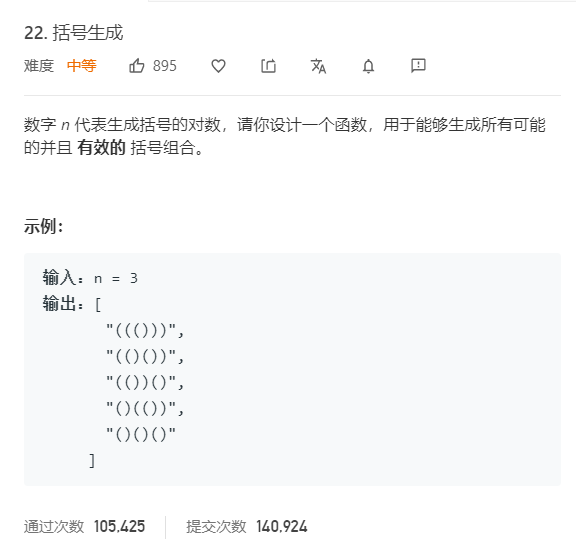
思路:tql我想不出来这么简洁的代码。TAT 其实就是一个递归。中间对于递归的条件有所限制。 left要大于0,right要大于left的时候才行
class Solution {
    List<String> res = new ArrayList<>();
    public List<String> generateParenthesis(int n) {


        dfs(n,n,"");
        return res;

    }
    private void dfs(int left,int right,String curStr){
        if(left == 0&&right ==0){
            res.add(curStr);
        }
        if(left>0){
            dfs(left-1,right,curStr+"(");
        }
        if(right>left){
            dfs(left,right-1,curStr+")");
        }
    }
}
面试题13. 机器人的运动范围
这道题的思路还是比较清晰的。 需要一个数组来记录一下是否访问过数组。DFS的话使用递归来实现。 判断一下当前的位置的下面有多少个可以找到的格子。
class Solution {
   int m,n,k;
    boolean[][] visited;
    public int movingCount(int m, int n, int k) {
        this.m = m;
        this.k = k;
        this.n = n;
        visited = new boolean[m][n];
        return dfs(0,0,0,0);


    }
    private int dfs(int i,int j,int sx,int sj){
        if(i>=m||j>=n||k<sx+sj||visited[i][j]){
            return 0;
        }
        visited[i][j] = true;
        return 1+dfs(i+1,j,(i+1)%10==0?sx-8:sx+1,sj)+dfs(i,j+1,sx,(j+1)%10==0?sj-8:sj+1);
    }
}
543-二叉树的直径
给定一棵二叉树,你需要计算它的直径长度。一棵二叉树的直径长度是任意两个结点路径长度中的最大值。这条路径可能穿过根结点。
示例 :
给定二叉树
1<br /> / \<br /> 2 3<br /> / \ <br /> 4 5 <br />返回 3, 它的长度是路径 [4,2,1,3] 或者 [5,2,1,3]。
注意:两结点之间的路径长度是以它们之间边的数目表示。
思路:
这道题其实在寻找根节点的左右子树的最大深度。直径的意思其实就是找到节点和其子树的的最大直径(因为最大的路径可能不经过根节点),设置某个节点的为 Node 深度分别为L 和R,maxd 是最大路径。如果节点为空,返回0. 不然就计算一下他的左右节点的深度。 maxd = max(L+R,maxd) 递归的返回值呢就是max(L+R)+1,左右子树的深度最大值+1,因为到了上一层,这里还有一个路径的。
/**
 * Definition for a binary tree node.
 * public class TreeNode {
 *     int val;
 *     TreeNode left;
 *     TreeNode right;
 *     TreeNode(int x) { val = x; }
 * }
 */
class Solution {
    int maxd = 0;
    public int diameterOfBinaryTree(TreeNode root) {
        deepth(root);
        return maxd;
    }
    private int deepth(TreeNode node){
        if(node == null) return 0;

        int left = deepth(node.left);
        int right = deepth(node.right);

        maxd = Math.max(left+right,maxd); //节点的最大直径(左边的深度+右边的深度)取最大值
        return Math.max(left,right)+1;// 返回节点的深度。

    }
}
695-岛屿的最大面积
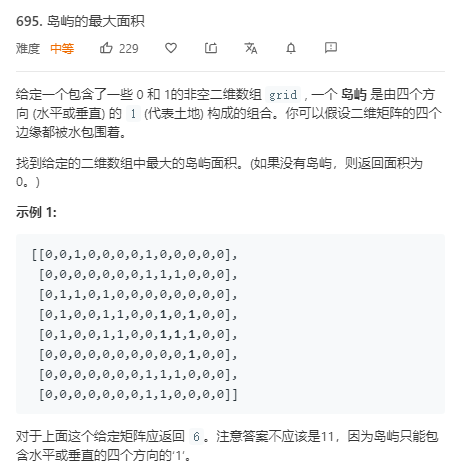
思路:
这道题的意思其实是说,给你一个这么大的数组,遍历一下看一看1连起来的地方有多大。返回最大值。
其实在考我们深度优先遍历的思想。
我们遍历一下整个数组,如果里面的有1,就遍历一下。遍历的流程是这样的,把现在的这个1变成0,递归计算一下他的上下左右的num值。加到一起作为这个点的结果。 结果取最大值。
class Solution {
    public int maxAreaOfIsland(int[][] grid) {
        int res = 0;

        for(int i=0;i<grid.length;i++){
            for(int j=0;j<grid[0].length;j++){
                if(grid[i][j] ==1){
                    res = Math.max(res,dfs(i,j,grid));
                }

            }
        }
        return res;

    }

    private int dfs(int i,int j,int[][] grid){
        if(i<0||j<0||i>grid.length-1||j>grid[0].length-1||grid[i][j] ==0){
            return 0;
        }
        grid[i][j] = 0;
        int num = 1;
        num+=dfs(i,j-1,grid);
        num+=dfs(i,j+1,grid);
        num+=dfs(i-1,j,grid);
        num+=dfs(i+1,j,grid);

        return num;
    }
}
BFS(广度优先搜索)
1030. 距离顺序排列矩阵单元格
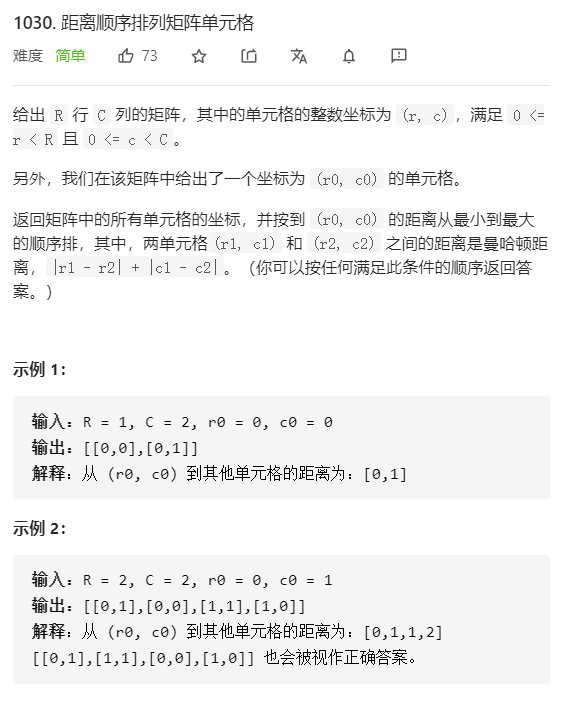
思路:
从给定的那个节点开始往外面逐层的遍历,不需要计算曼哈顿距离,依次加入到结果中进而好了,使用一个数组来确保每一个元素放在同一个位置里面。
class Solution {
    public int[][] allCellsDistOrder(int R, int C, int r0, int c0) {
        int[][] marix = new int[R*C][2];
        Queue<int[]> queue = new LinkedList<>();
        boolean[][] visited = new boolean[R][C];
        queue.add(new int[]{r0,c0});
        int cnt = 0;
        while(!queue.isEmpty()){
            int[] tmp = queue.poll();
            int x = tmp[0];
            int y = tmp[1];
            if(x<0||y<0||x>=R||y>=C||visited[x][y]){
                continue;
            }
            marix[cnt][0] = x;
            marix[cnt][1] = y;
            cnt++;
            visited[x][y] = true;
            queue.add(new int[]{x+1,y});
            queue.add(new int[]{x-1,y});
            queue.add(new int[]{x,y-1});
            queue.add(new int[]{x,y+1});
        }
        return marix;
    }
}
210. 课程表 II
可以想象成一个超级节点下面连着别的节点。 一个图的样子。 我们需要记录一下,每门课需要的前置课程的数量。 把前置课程是0的加入到队列里面。 每一次循环的时候,取出相应的课程。 把需要门课的课程的前置数量减1. 如果已经是0 的话,加入到队列里面。
class Solution {
    public int[] findOrder(int numCourses, int[][] prerequisites) {
        Queue<Integer> queue = new LinkedList<>();
        int[] input = new int[numCourses];
        int[] res = new int[numCourses];

        int index = 0;

        for(int[] edge: prerequisites){
            input[edge[0]]++;
        }
        for(int i=0;i<input.length;i++){
            if(input[i] ==0){
                queue.add(i);
            }
        }

        while(!queue.isEmpty()){
            int tmp = queue.poll();
            res[index++] = tmp;
            for(int[] edge:prerequisites){
                if(edge[1] == tmp){
                    input[edge[0]]--;
                    if(input[edge[0]] == 0){
                        queue.add(edge[0]);
                    }
                }
            }


        }

        if(index!= numCourses){
            return new int[]{};

        }
        return res;

    }
}
542. 01 矩阵
这道题和1162非常的接近,这道题是从0扩散到1的过程。
class Solution {
    public int[][] updateMatrix(int[][] matrix) {
        Queue<int[]> queue = new LinkedList<>();

        for(int i=0;i<matrix.length;i++){
            for (int j=0;j<matrix[0].length;j++){
                if(matrix[i][j] ==0){
                    queue.add(new int[]{i,j});
                }else{
                    matrix[i][j] = -1;
                }
            }
        }

        int[] dx = new int[]{0,0,1,-1};
        int[] dy = new int[]{1,-1,0,0};

        while (!queue.isEmpty()){
            int[] tmp = queue.poll();
            int x = tmp[0];
            int y = tmp[1];

            for(int i=0;i<4;i++){
                int newX = x+dx[i];
                int newY = y+dy[i];

                if(newX<0||newY<0||newX>=matrix.length||newY>=matrix[0].length||matrix[newX][newY]!=-1){
                    continue;
                }
                matrix[newX][newY] = matrix[x][y]+1;
                queue.add(new int[]{newX,newY});

            }
        }
        return matrix;
    }
}
1162. 地图分析
BFS的题目一般来说都是使用一个队列来标记待检测的区域。对于这道题来说,各你一个矩阵,找到里面0到1的最大距离、可以把0先全部入队,一层一层的进行扩散遍历。
class Solution {
    public int maxDistance(int[][] grid) {
          int[] dx = {0,0,1,-1};
        int[] dy = {1,-1,0,0};

        Deque<int[]> queue = new ArrayDeque<>();

        int m = grid.length;
        int n = grid[0].length;

        for(int i=0;i<m;i++){
            for (int j=0;j<n;j++){
                if(grid[i][j]==1){
                    queue.add(new int[]{i,j});
                }
            }
        }
        boolean isSea = false;//标记一下是不是都是海洋的情况
        int[] point = null; // 记录一下最后的一个元素。因为是一层一层的,所以最后的肯定是最大的

        while (!queue.isEmpty()){
            point = queue.poll();
            int x = point[0],y = point[1];

            for(int i=0;i<4;i++){
                int newX = x+dx[i];
                int newY = y+dy[i];
                if(newX<0||newY<0||newX>=m||newY>=n||grid[newX][newY]!=0){
                    continue;
                }
                isSea = true;
                grid[newX][newY] = grid[x][y]+1;
                queue.add(new int[]{newX,newY});
            }
        }

        if(point==null||!isSea){
            return -1;
        }
        return grid[point[0]][point[1]]-1;
    }
}
面试题13. 机器人的运动范围
使用BFS的话,一般我使用一个队列来标记,接下来需要访问的节点。计算数位和的方法。假如有进位的话,那就-8,不然加1.
class Solution {
    public int movingCount(int m, int n, int k) {
        boolean[][] visited =  new boolean[m][n];
        Queue<int[]> queue = new LinkedList<>();
        queue.add(new int[]{0,0,0,0});
        int res = 0;
        while (!queue.isEmpty()){
            int[] tmp = queue.poll();
            int x = tmp[0],y=tmp[1],sx = tmp[2],sj = tmp[3];
            if(x<0||y<0||x>=m||y>=n||visited[x][y]||sj+sx>k)continue;
            res++;
            visited[x][y] = true;
            queue.add(new int[]{x+1,y,(x+1)%10==0?sx-8:sx+1,sj});
            queue.add(new int[]{x,y+1,sx,(y+1)%10==0?sj-8:sj+1});
        }
        return res;

    }
}
994-腐烂的橘子

思路:
有一点像回溯的思路。每个隔一次时间,橘子会把相邻的橘子都腐烂掉。先遍历一下述,找到不好的橘子的坐标。记录一下橘子的总数。使用队列来存储不好的橘子。每次取出不好的橘子,搜索一下他的上下左右又没有新鲜的橘子。有的话,将橘子标为坏的,存入队列里面。时间加一。假如队列中没有橘子了,判断一下count。是否有到达不了的橘子。
代码:
class Solution {
    public int orangesRotting(int[][] grid) {
        int R = grid.length;
        int C = grid[0].length;

        Queue<int[]> queue = new LinkedList<>();
        // 遍历一下里面好的橘子和坏的橘子
        int count =0;
        for(int r = 0;r<R;++r){
            for(int c=0;c<C;++c){
                if(grid[r][c] == 1){
                    ++count;
                }else if(grid[r][c] == 2){
                    queue.add(new int[]{r,c});
                }

            }
        }

        int round = 0;
        while(count>0&&!queue.isEmpty()){//只要队列不为空
            ++round;
            int n = queue.size();
            for(int i=0;i<n;i++){ // 每次都取空,执行size次。
                int[] orange = queue.poll();
                int r = orange[0];
                int c = orange[1];
                // 判断他的上下左右又没有橘子,有的话加入到队列里面。
                if(r-1>=0&&grid[r-1][c]==1){
                    grid[r-1][c]=2;
                    queue.add(new int[]{r-1,c});
                    --count;
                }
                if(c-1>=0&&grid[r][c-1]==1){
                    grid[r][c-1]=2;
                    queue.add(new int[]{r,c-1});
                    --count;
                }
                if(r+1<R&&grid[r+1][c]==1){
                    grid[r+1][c]=2;
                    queue.add(new int[]{r+1,c});
                    --count;
                }
                if(c+1<C&&grid[r][c+1]==1){
                    grid[r][c+1]=2;
                    queue.add(new int[]{r,c+1});
                    --count;
                }
            }
        }
        if(count>0){ // 说明有到达不了的位置
            return -1;
        }else
            return round;

    }
}
滑动窗口
使用滑动窗口的模板,需要回答几个问题。
- 当移动 right 扩大窗口,即加入字符时,应该更新那些数据?
- 什么条件下,窗口应该停止扩大,开始移动 left 缩小窗口?
- 当移动 left 缩小窗口的时候,就是说移除字符时,应该更新那些数据?
-
滑动窗口的模板
```java public void slidingWindow(String s,String t){
 HashMap<Character,Integer> need  = new HashMap<>();
 HashMap<Character,Integer> window  = new HashMap<>();
 int left = 0,right = 0;
 int vaild = 0;

 while (right<s.length()){
// c是将要加入滑动窗口的哪个字符。
char c = s.charAt(right);// 右移窗口
right++;// 对窗口内的数据进行一系列的操作。
// Debug 输出位置 System.out.println(“window:[“+left+”,%d]”+right);
while (window need shrink){
// d 是需要移除的哪个字符 char d = s.charAt(left); left++;
// 进行窗口内的数据的变化
        }

    }

}
<a name="zInJZ"></a>
### [76. 最小覆盖子串](https://leetcode-cn.com/problems/minimum-window-substring/)
[参考资料](https://leetcode-cn.com/problems/minimum-window-substring/solution/hua-dong-chuang-kou-suan-fa-tong-yong-si-xiang-by-/)
```java
 public String minWindow(String s, String t) {
        int left = 0 ,right = 0;

        int start = 0; // 开始的位置
        int len = Integer.MAX_VALUE;// 偏移的位数
        HashMap<Character, Integer> need = new HashMap<>();
        HashMap<Character, Integer> window = new HashMap<>();
        //      把 t 中的字符需要的数量做记录。
        for(char c:t.toCharArray()){
            need.put(c,need.getOrDefault(c,0)+1);
        }

        int valid = 0; // window 里面符合 need 字符的个数。
        while (right<s.length()){
            char c = s.charAt(right);
            right++;
            //          假如这个字符在 need 中,把他出现的频率+1 假如达到了need中需要的数量。则+1;
            if(need.containsKey(c)){
                window.put(c,window.getOrDefault(c,0)+1);
                if(window.get(c).equals(need.get(c))){
                    valid++;
                }
            }

            while (valid == need.size()){// need.size() 方法返回的是key的数量。 而不是value的总数。
//               更新一下这个最小的子串的范围。
                if(right-left<len){
                    start = left;
                    len = right-left;
                }
                char d = s.charAt(left);

                left++;
                if(need.containsKey(d)){
                    // 原来是达标的,现在将left 移除了所以数量还没有达标,vaild--;
                    if(window.get(d).equals(need.get(d))){
                        valid--;
                    }
                    // 将频率-1
                    window.put(d,window.get(d)-1);
                }
            }

        }

        return

    }
567. 字符串的排列
对于这道题的解法代码,基本上和最小覆盖子串一模一样,只需要改变两个地方:
1、本题移动 left 缩小窗口的时机是窗口大小大于 t.size() 时,应为排列嘛,显然长度应该是一样的。
2、当发现 valid == need.size() 时,就说明窗口中就是一个合法的排列,所以立即返回 true。
至于如何处理窗口的扩大和缩小,和最小覆盖子串完全相同。
class Solution {
    public boolean checkInclusion(String s1, String s2) {
                int left = 0,right = 0;
        int vaild = 0;
        HashMap<Character,Integer> need =new HashMap<>();
        HashMap<Character,Integer> window =new HashMap<>();
        for(char c:s1.toCharArray()){
            need.put(c,need.getOrDefault(c,0)+1);
        }
        while (right<s2.length()){
            char c = s2.charAt(right);
            right++;
            if(need.containsKey(c)){
                window.put(c,window.getOrDefault(c,0)+1);
                if(window.get(c).equals(need.get(c))){
                    vaild++;
                }
            }

            while (right-left>=s1.length()){
                if(vaild == need.size()){
                    return true;
                }
                char d = s2.charAt(left);
                left++;
                if(need.containsKey(d)){
                    if(window.get(d).equals(need.get(d))){
                        vaild--;
                    }
                    window.put(d,window.get(d)-1);
                }
            }
        }
        return false;
    }
}
438. 找到字符串中所有字母异位词
class Solution {
    public List<Integer> findAnagrams(String s, String p) {
                List<Integer> res = new LinkedList<>();
        int left=0,right = 0;
        int vaild = 0;
        HashMap<Character,Integer> need = new HashMap<>();
        HashMap<Character,Integer> window = new HashMap<>();

        for(char c:p.toCharArray()){
            need.put(c,need.getOrDefault(c,0)+1);
        }
        while (right<s.length()){
            char c = s.charAt(right);
            right++;
            if(need.containsKey(c)){
                window.put(c,window.getOrDefault(c,0)+1);
                if(window.get(c).equals(need.get(c))){
                    vaild++;
                }
            }

            while (right-left>=p.length()){
                if(vaild == need.size()){
                    res.add(left);
                }
                char d = s.charAt(left);
                left++;
                if(window.containsKey(d)){
                    if(need.get(d).equals(window.get(d))){
                        vaild--;
                    }
                    window.put(d,window.get(d)-1);
                }

            }
        }
        return res;

    }
}
3. 无重复字符的最长子串
和前面的差不多,但是这道题只需要一个map来记录一下。收缩的条件是里面的个数大于1。
把遍历到的每一个字符加入到map里面,记录相应的频次。 只要频次大于1 就说明有重复的字符,需要进行收缩。因为在滑动的时候已经记录了当前的最大值。所以我们需要直接滑动到重复的数那儿,重新开始计算。
class Solution {
    public int lengthOfLongestSubstring(String s) {
        HashMap<Character,Integer> window = new HashMap<>();
        int left = 0,right=0;
        int valid = 0;
        int max = 0;

        while (right<s.length()){
            char c = s.charAt(right++);
            window.put(c,window.getOrDefault(c,0)+1);

            while (window.get(c)>1){
                char d = s.charAt(left++);
                window.put(d,window.get(d)-1);
            }
            max = Math.max(max,right-left);
        }
        return max;
    }
}
和为s的连续正数序列
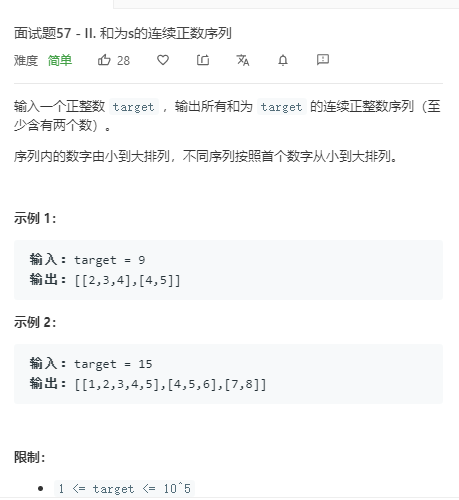
思路: 诗使用滑动窗口的方法去做。滑动窗口可以看成数组中框起来的一个部分。在一些数组类题目中,我们可以用滑动窗口来观察可能的候选结果。当滑动窗口从数组的左边滑到了右边,我们就可以从所有的候选结果中找到最优的结果。
滑动窗口的重要性质是:窗口的左边界和右边界永远只能向右移动,而不能向左移动。这是为了保证滑动窗口的时间复杂度是 O(n)O(n)。如果左右边界向左移动的话,这叫做“回溯”,算法的时间复杂度就可能不止 O(n)O(n)。
要用滑动窗口解这道题,我们要回答两个问题:
第一个问题,窗口何时扩大,何时缩小?
第二个问题,滑动窗口能找到全部的解吗?
对于第一个问题,回答非常简单:
当窗口的和小于 target 的时候,窗口的和需要增加,所以要扩大窗口,窗口的右边界向右移动
当窗口的和大于 target 的时候,窗口的和需要减少,所以要缩小窗口,窗口的左边界向右移动
当窗口的和恰好等于 target 的时候,我们需要记录此时的结果。设此时的窗口为 [i, j)[i,j),那么我们已经找到了一个 ii 开头的序列,也是唯一一个 ii 开头的序列,接下来需要找 i+1i+1 开头的序列,所以窗口的左边界要向右移动
class Solution {
    public int[][] findContinuousSequence(int target) {
        List<int[]> res = new LinkedList<>();
        int head = 1;
        int end = 2;
        int sum = 1;

        while(head<=target/2){

            if(sum>target){
                sum-=head;
                ++head;
            }else if(sum<target){
                sum+=end;
                ++end;
            }else{
                int[] tmp = new int[end-head];
                for(int i=0;i<tmp.length;i++){
                    tmp[i] = head+i;
                }
                res.add(tmp);
                sum-=head;
                ++head;
            }
        }
        return res.toArray(new int[res.size()][]);

    }
}
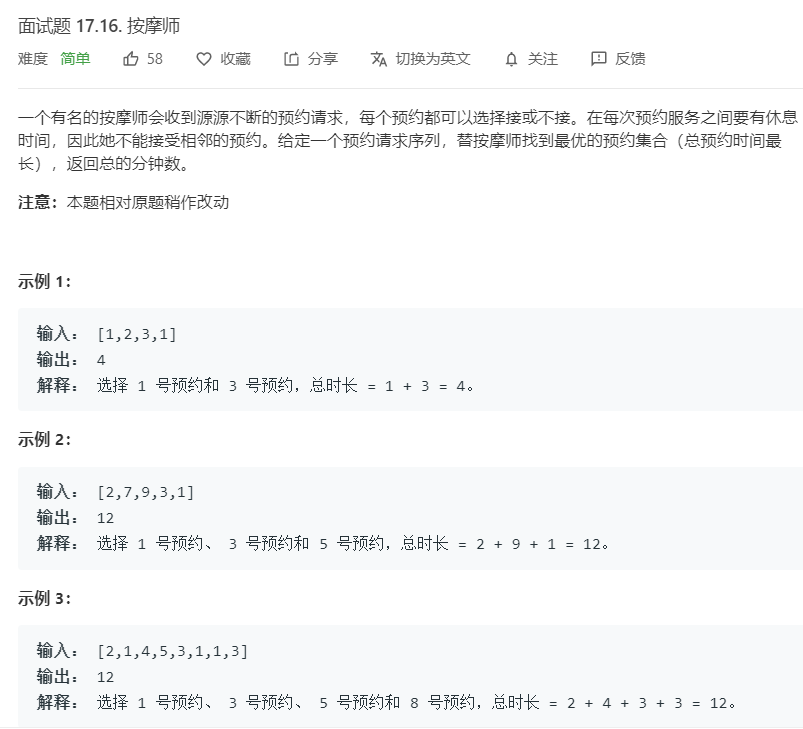
面试题 17.16. 按摩师

若有收获,就点个赞吧
0 人点赞


