1.catch语句块中可以抛出异常
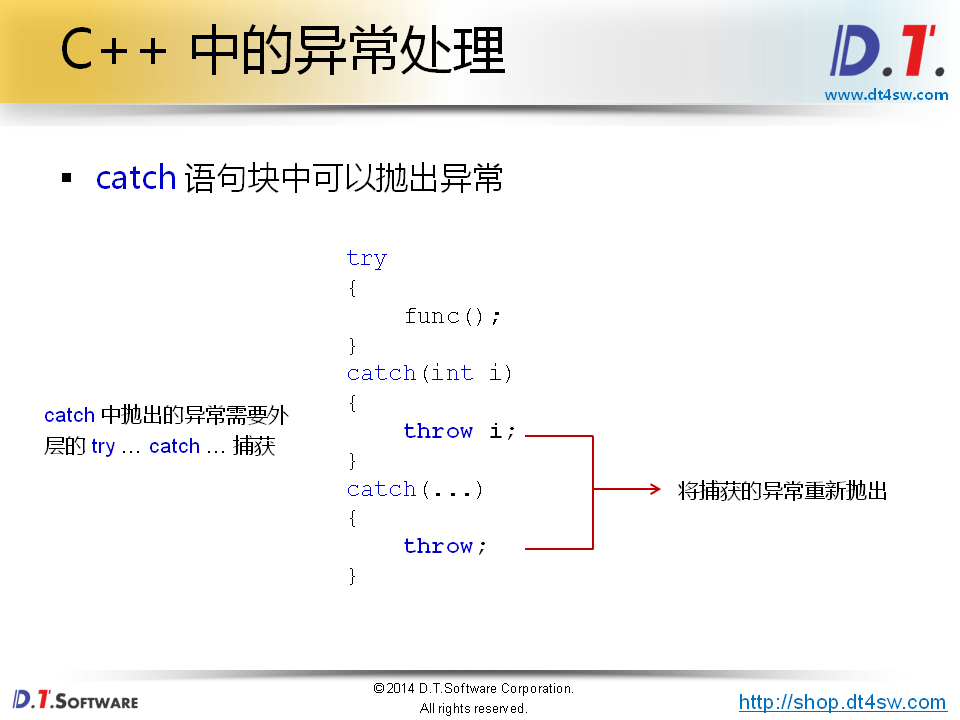
为什么要在catch中重新抛出异常?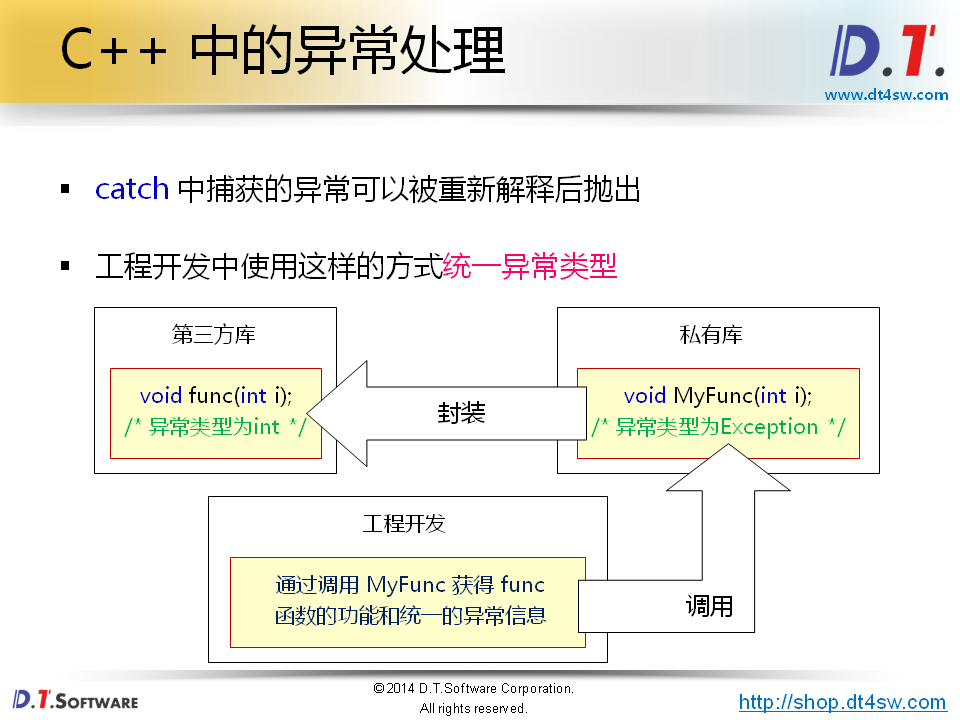
用来统一异常的类型
#include <iostream>#include <string>using namespace std;void Demo(){try{try{throw 'c';}catch(int i){cout << "Inner: catch(int i)" << endl;throw i;}catch(...){cout << "Inner: catch(...)" << endl;throw;}}catch(...){cout << "Outer: catch(...)" << endl;}}/*假设: 当前的函数式第三方库中的函数,因此,我们无法修改源代码函数名: void func(int i)抛出异常的类型: int-1 ==》 参数异常-2 ==》 运行异常-3 ==》 超时异常*/void func(int i){if( i < 0 ){throw -1;}if( i > 100 ){throw -2;}if( i == 11 ){throw -3;}cout << "Run func..." << endl;}void MyFunc(int i){try{func(i);}catch(int i){switch(i){case -1:throw "Invalid Parameter";break;case -2:throw "Runtime Exception";break;case -3:throw "Timeout Exception";break;}}}int main(int argc, char *argv[]){// Demo();try{MyFunc(11);}catch(const char* cs){cout << "Exception Info: " << cs << endl;}return 0;}
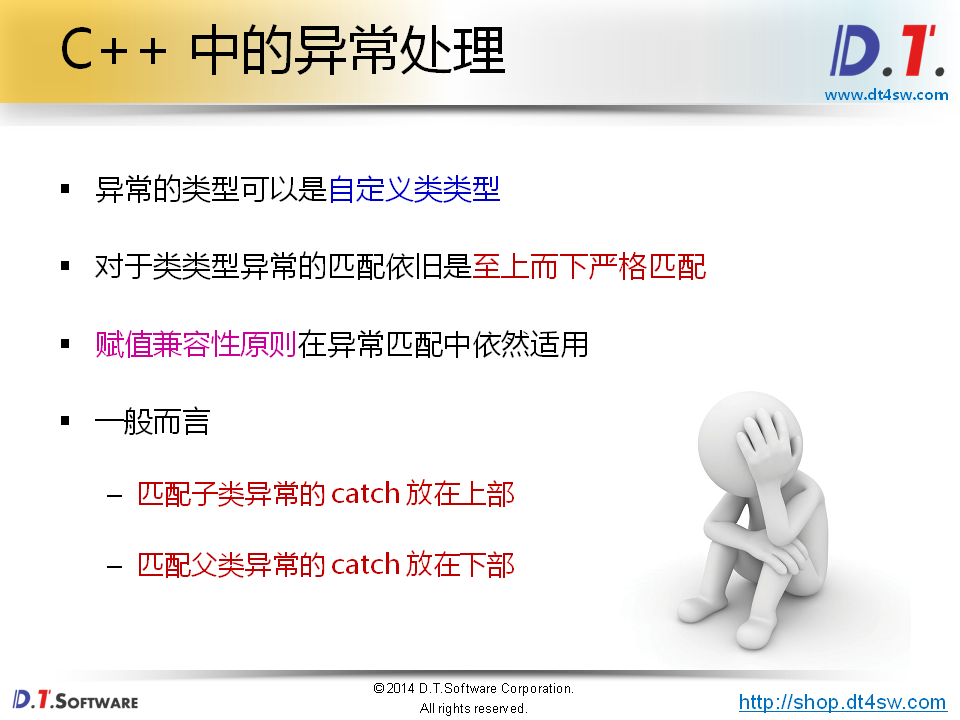
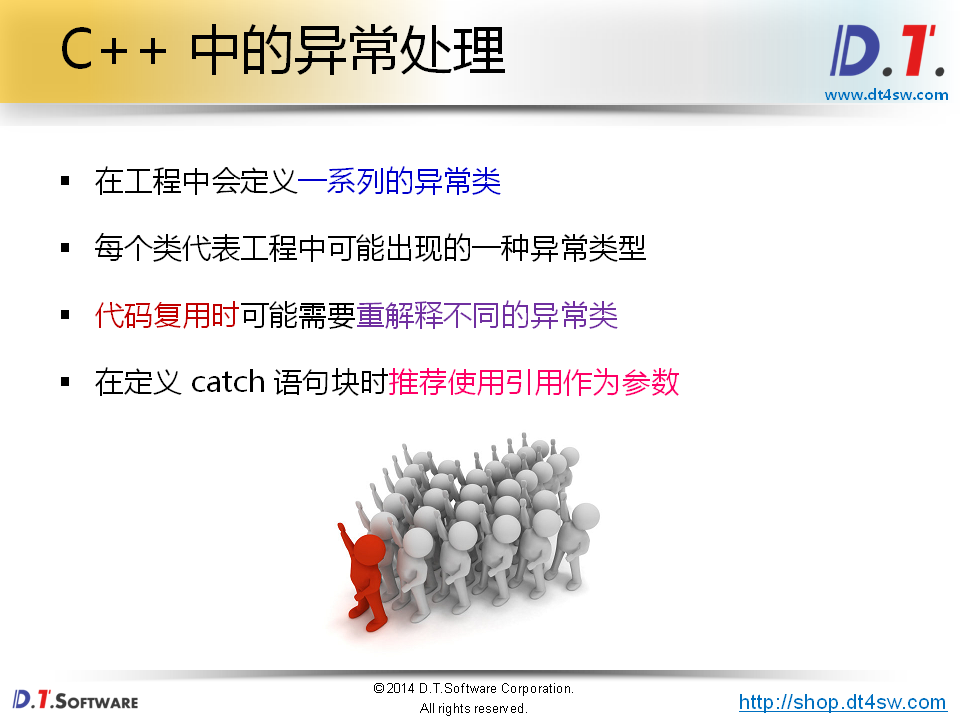
#include <iostream>#include <string>using namespace std;class Base{};class Exception : public Base{int m_id;string m_desc;public:Exception(int id, string desc){m_id = id;m_desc = desc;}int id() const{return m_id;}string description() const{return m_desc;}};/*假设: 当前的函数式第三方库中的函数,因此,我们无法修改源代码函数名: void func(int i)抛出异常的类型: int-1 ==》 参数异常-2 ==》 运行异常-3 ==》 超时异常*/void func(int i){if( i < 0 ){throw -1;}if( i > 100 ){throw -2;}if( i == 11 ){throw -3;}cout << "Run func..." << endl;}void MyFunc(int i){try{func(i);}catch(int i){switch(i){case -1:throw Exception(-1, "Invalid Parameter");break;case -2:throw Exception(-2, "Runtime Exception");break;case -3:throw Exception(-3, "Timeout Exception");break;}}}int main(int argc, char *argv[]){try{MyFunc(11);}catch(const Exception& e){cout << "Exception Info: " << endl;cout << " ID: " << e.id() << endl;cout << " Description: " << e.description() << endl;}catch(const Base& e){cout << "catch(const Base& e)" << endl;}return 0;}
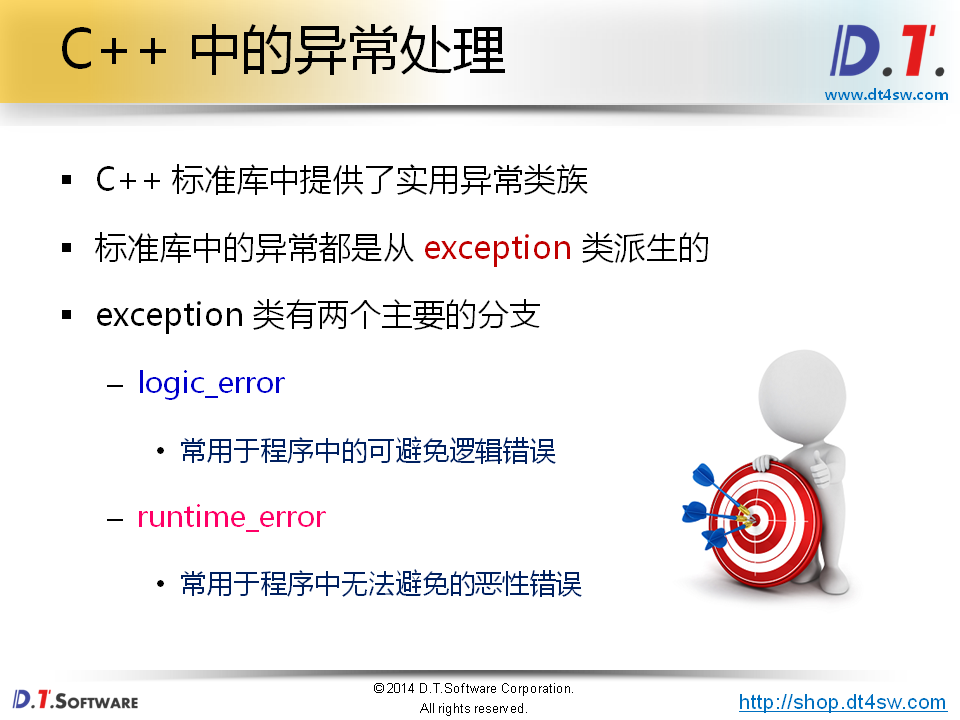
#ifndef _ARRAY_H_#define _ARRAY_H_#include <stdexcept>using namespace std;template< typename T, int N >class Array{T m_array[N];public:int length() const;bool set(int index, T value);bool get(int index, T& value);T& operator[] (int index);T operator[] (int index) const;virtual ~Array();};template< typename T, int N >int Array<T, N>::length() const{return N;}template< typename T, int N >bool Array<T, N>::set(int index, T value){bool ret = (0 <= index) && (index < N);if( ret ){m_array[index] = value;}return ret;}template< typename T, int N >bool Array<T, N>::get(int index, T& value){bool ret = (0 <= index) && (index < N);if( ret ){value = m_array[index];}return ret;}template< typename T, int N >T& Array<T, N>::operator[] (int index){if( (0 <= index) && (index < N) ){return m_array[index];}else{throw out_of_range("T& Array<T, N>::operator[] (int index)");}}template< typename T, int N >T Array<T, N>::operator[] (int index) const{if( (0 <= index) && (index < N) ){return m_array[index];}else{throw out_of_range("T Array<T, N>::operator[] (int index) const");}}template< typename T, int N >Array<T, N>::~Array(){}#endif#ifndef _HEAPARRAY_H_#define _HEAPARRAY_H_#include <stdexcept>using namespace std;template< typename T >class HeapArray{private:int m_length;T* m_pointer;HeapArray(int len);HeapArray(const HeapArray<T>& obj);bool construct();public:static HeapArray<T>* NewInstance(int length);int length() const;bool get(int index, T& value);bool set(int index ,T value);T& operator [] (int index);T operator [] (int index) const;HeapArray<T>& self();const HeapArray<T>& self() const;~HeapArray();};template< typename T >HeapArray<T>::HeapArray(int len){m_length = len;}template< typename T >bool HeapArray<T>::construct(){m_pointer = new T[m_length];return m_pointer != NULL;}template< typename T >HeapArray<T>* HeapArray<T>::NewInstance(int length){HeapArray<T>* ret = new HeapArray<T>(length);if( !(ret && ret->construct()) ){delete ret;ret = 0;}return ret;}template< typename T >int HeapArray<T>::length() const{return m_length;}template< typename T >bool HeapArray<T>::get(int index, T& value){bool ret = (0 <= index) && (index < length());if( ret ){value = m_pointer[index];}return ret;}template< typename T >bool HeapArray<T>::set(int index, T value){bool ret = (0 <= index) && (index < length());if( ret ){m_pointer[index] = value;}return ret;}template< typename T >T& HeapArray<T>::operator [] (int index){if( (0 <= index) && (index < length()) ){return m_pointer[index];}else{throw out_of_range("T& HeapArray<T>::operator [] (int index)");}}template< typename T >T HeapArray<T>::operator [] (int index) const{if( (0 <= index) && (index < length()) ){return m_pointer[index];}else{throw out_of_range("T HeapArray<T>::operator [] (int index) const");}}template< typename T >HeapArray<T>& HeapArray<T>::self(){return *this;}template< typename T >const HeapArray<T>& HeapArray<T>::self() const{return *this;}template< typename T >HeapArray<T>::~HeapArray(){delete[]m_pointer;}#endif#include <iostream>#include <string>#include "Array.h"#include "HeapArray.h"using namespace std;void TestArray(){Array<int, 5> a;for(int i=0; i<a.length(); i++){a[i] = i;}for(int i=0; i<a.length(); i++){cout << a[i] << endl;}}void TestHeapArray(){HeapArray<double>* pa = HeapArray<double>::NewInstance(5);if( pa != NULL ){HeapArray<double>& array = pa->self();for(int i=0; i<array.length(); i++){array[i] = i;}for(int i=0; i<array.length(); i++){cout << array[i] << endl;}}delete pa;}int main(int argc, char *argv[]){try{TestArray();cout << endl;TestHeapArray();}catch(...){cout << "Exception" << endl;}return 0;}

若有收获,就点个赞吧
0 人点赞


