1.逻辑回归API介绍
- sklearn.linear_model.LogisticRegression(solver=’liblinear’, penalty=’l2’, C=1.0)
- solver可选参数:{‘liblinear’, ‘sag’, ‘saga’, ‘newton-cg’, ‘lbfgs’}
- 默认:’liblinear’,用于优化问题的算法
- ‘liblinear’用于小数集,sag和saga适用于大型数据集
- 对于多类问题,只有newton-cg,sag,saga和lbfgs可以处理多项损失,liblinear仅局限于one-versus-rest分类
- penalty:正则化种类
- C:正则化力度
- 默认将数量少的类别当做正例
- solver可选参数:{‘liblinear’, ‘sag’, ‘saga’, ‘newton-cg’, ‘lbfgs’}
LogisticRegression与SGDClassifier(loss=’log’, penalty=’’)的区别在于前者使用SAGD,后者使用SGD
2.分类评估标准
2.1准确率、精准率、召回率
准确率
- (TP+TN)/(TP+TN+FN+FP)
- 精准率(Precision)—查的准不准
- TP/(TP+FP)
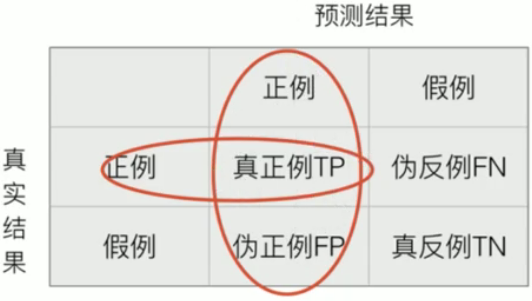
- 召回率(Recall)—查的全不全
- TP/(TP+FN)

- F1-score
API:sklearn.metrics.classification_report(y_true, y_pred, labels=[], target_names=None)
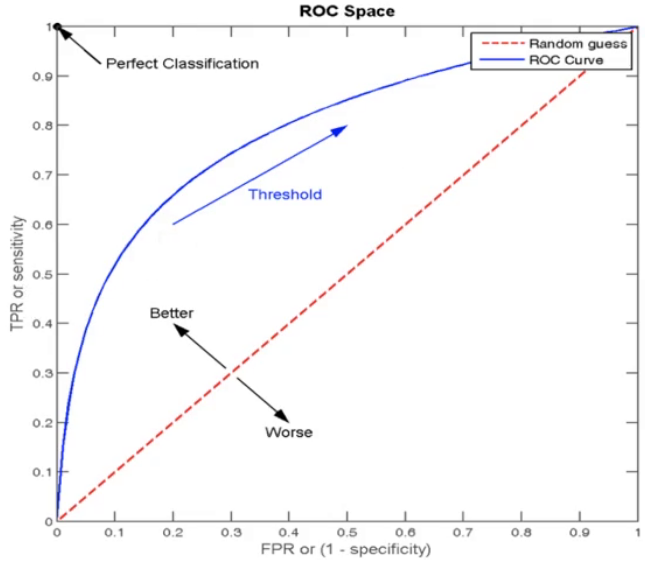
TPR=TP/(TP+FN):所有真实类别为1的样本中,预测类别为1的比例
- FPR=FP/(FP+TN):所有真实类别为0的样本中,预测类别为1的比例
- AUC的概率意义是随机取一对正负样本,正样本得分大于负样本的概率,AUC∈[0.5,1]越大越好
- API:sklean.metrics.roc_auc_score(y_true, y_score)
- ROC曲线面积,即为AUC值
- y_true:每个样本的真实标签,必须为0反例,1正例
- y_score:预测得分,可以是正类的估计概率、置信值或者分类器返回值
- AUC只能用评估二分类问题,擅长评价样本不平衡时分类器性能。

3.代码
import pandas as pdimport numpy as npfrom sklearn.model_selection import train_test_splitfrom sklearn.preprocessing import StandardScalerfrom sklearn.linear_model import LogisticRegressionfrom sklearn.metrics import classification_report, roc_auc_score# 加载数据names = ['Sample code number', 'Clump Thickness', 'Uniformity of Cell Size', 'Uniformity of Cell Shape','Marginal Adhesion', 'Single Epithelial Cell size', 'Bare Nuclei', 'Bland Chromatin','Normal Nucleoli', 'Mitoses', 'Class']data = pd.read_csv("https://archive.ics.uci.edu/ml/machine-learning-databases/breast-cancer-wisconsin/breast-cancer-wisconsin.data",names=names)# 处理缺失值data = data.replace('?', np.nan).dropna()print(data.describe())# 生成特征和标签x = data.iloc[:, 1:-1]y = data['Class']# 分割数据集x_train, x_test, y_train, y_test = train_test_split(x, y, test_size=0.2, random_state=0)# 数据标准化transfer = StandardScaler()x_train = transfer.fit_transform(x_train)x_test = transfer.fit_transform(x_test)# 模型构建estimator = LogisticRegression()estimator.fit(x_train, y_train)# 模型评估y_pre = estimator.predict(x_test)print("预测值为:", y_pre)print("准确率为:", estimator.score(x_test, y_test)) # "准确率为: 0.9562043795620438"print(classification_report(y_test, y_pre, labels=(2, 4), target_names=('良性', '恶性')))# precision recall f1-score support## 良性 0.97 0.97 0.97 87# 恶性 0.94 0.94 0.94 50## accuracy 0.96 137# macro avg 0.95 0.95 0.95 137# weighted avg 0.96 0.96 0.96 137# 替换标签y_test = np.where(y_test > 2.5, 1, 0)print("AUC指标为:", roc_auc_score(y_true=y_test, y_score=y_pre)) # "AUC指标为: 0.9527586206896552"

若有收获,就点个赞吧
0 人点赞


