1.介绍
- 分类算法
- 原理:为待分类个体寻找K个最近的邻居,邻居中频次最多的种类几即为待分类个体的种类。
- sklearn.neighbors.KNeighborsCalssifier(n_neighbors=n) # 参数为K值
- 优点:1.简单有效 2.重新训练代价低 3.适合类域交叉样本 4.适合大样本自动分类
缺点:1.惰性学习 2.类别评分非规范化 3.输出可解释性不强 4.不擅长不均衡样本 5.计算量大
2.细节
n维空间求距离方法
- 欧式距离
- 曼哈顿距离
- 切比雪夫距离
- 闵可夫斯基距离
- p=1,曼哈顿
- p=2,欧氏距离
- p->∞,切比雪夫距离
- 标准化欧式距离,其中为方差
- 余弦距离
- 汉明距离:两个等长字符串相同位置不同字符的个数
- 杰卡德距离
- 马氏距离,判断属于哪个正态分布(距离哪个正态分布近)
k值选择
交叉验证
- 将拿到的训练数据分为训练集和验证集
- 分割方式:
- 训练集:训练集+验证集
- 测试集:测试集
- 分割方式:
- 为什么要交叉验证:
- 为了让评估模型更加准确可信(交叉验证不能提高模型准确率)
- 将拿到的训练数据分为训练集和验证集
- 网格搜索(Grid Search)
- 超参数:sklearn中,需要手动指定的参数,叫做超参数
- 网格搜索将超参数通过字典传递,然后进行最优质选择

4.KNN鸢尾花分类代码
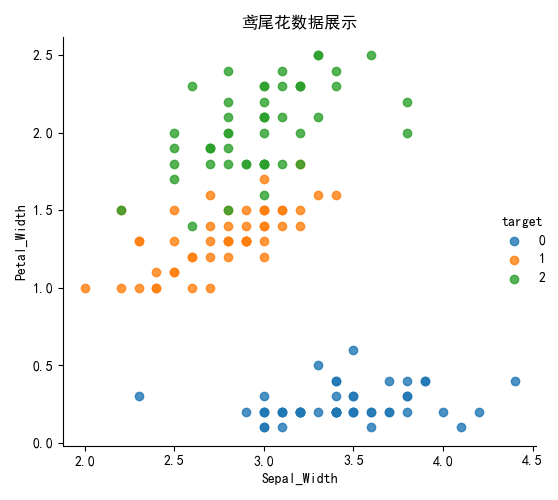
import seaborn as snsimport matplotlib.pyplot as pltimport pandas as pdfrom sklearn.datasets import load_irisfrom sklearn.model_selection import train_test_split, GridSearchCVfrom sklearn.preprocessing import MinMaxScaler, StandardScaler # 归一化,标准化from sklearn.neighbors import KNeighborsClassifier# 加载数据集iris = load_iris()# 将数据集封装成DataFrameiris_data = pd.DataFrame(data=iris.data, columns=['Swpal_Length', 'Sepal_Width', 'Petal_Length', 'Petal_Width'])iris_data['target'] = iris.target# 封装绘图函数def plot_iris(iris, col1, col2):sns.lmplot(x=col1, y=col2, data=iris, hue='target', fit_reg=False) # hue:目标值 fit_reg:是否线性回归plt.title("鸢尾花数据展示")plt.rcParams['font.sans-serif'] = ['SimHei'] # 显示中文标签plt.rcParams['axes.unicode_minus'] = Falseplt.show()# 预览数据分布plot_iris(iris_data, 'Sepal_Width', 'Petal_Width')# 分割数据集 test_size测试集比例 random_state随机数种子(取相同的随机数种子可以得到相同的测试集-训练集划分)x_train, x_test, y_train, y_test = train_test_split(iris.data, iris.target, test_size=0.2)# 数据预处理--标准化数据x_train = StandardScaler().fit_transform(x_train)x_test = StandardScaler().fit_transform(x_test)# KKN训练algorithm默认为auto,自动选择使用ball_tree(高维),kd_tree,bruteKNN = KNeighborsClassifier(n_neighbors=5, algorithm='auto')# 交叉验证网格搜索:param_grid字典设置参数列表,cv设置交叉验证折数,n_jobs并行数(-1开启全部核心)KNN = GridSearchCV(KNN, param_grid={"n_neighbors": [1, 3, 5]}, cv=10, n_jobs=-1) # 若不使用交叉验证网格搜索注释这行KNN.fit(x_train, y_train)# 模型评估print("准确率为:", KNN.score(x_test, y_test)) # 输出:“准确率为: 0.9”print("最好的模型:", KNN.best_estimator_) # "最好的模型: KNeighborsClassifier(n_neighbors=1)"print("最好的结果:", KNN.best_score_) # "最好的结果: 0.9666666666666666"print("整体模型结果:", KNN.cv_results_)# "整体模型结果:# {'mean_fit_time': array([0.00140276, 0.00119739, 0.00109811]),# 'std_fit_time': array([0.00048949, 0.00039933, 0.00029917]),# 'mean_score_time': array([0.002197 , 0.00215209, 0.00230212]),# 'std_score_time': array([0.00040177, 0.00054972, 0.00078119]),# 'param_n_neighbors': masked_array(data=[1, 3, 5],mask=[False, False, False],fill_value='?',dtype=object),# 'params': [{'n_neighbors': 1}, {'n_neighbors': 3}, {'n_neighbors': 5}],# 'split0_test_score': array([1. , 1. , 1. ]),# 'split1_test_score': array([1. , 1. , 1. ]),# 'split2_test_score': array([1. , 1. , 1. ]),# 'split3_test_score': array([1. , 1. , 1. ]),# 'split4_test_score': array([0.91666667, 0.91666667, 0.91666667]),# 'split5_test_score': array([1. , 0.91666667, 1. ]),# 'split6_test_score': array([1. , 1. , 1. ]),# 'split7_test_score': array([1. , 0.91666667, 0.91666667]),# 'split8_test_score': array([0.91666667, 0.91666667, 0.91666667]),# 'split9_test_score': array([0.83333333, 0.83333333, 0.83333333]),# 'mean_test_score': array([0.96666667, 0.95 , 0.95833333]),# 'std_test_score': array([0.05527708, 0.05527708, 0.0559017 ]),# 'rank_test_score': array([1, 3, 2])}"

若有收获,就点个赞吧
0 人点赞


