ts101 #工作记录 #c/c++ #学习
在 构建一个 Hello World 项目 中我们分析到了编译器在编译的时候会使用到 -char-size-32 -double-size-32 来设置数据类型的大小.
在此我们对常用的数据类型大小进行检查和评估.
- int short char long float double
- struct 的大小分配问题
未修改项目配置
```c typedef struct { char a; short b; int c; long d; long long e; double f; float g; } TestSize;
void testSizeOf() {
printf("Test the sizeof for every type\n");printf("char: %d\n", sizeof(char));printf("short: %d\n", sizeof(short));printf("int: %d\n", sizeof(int));printf("long: %d\n", sizeof(long));printf("unsigned char: %d\n", sizeof(unsigned char));printf("unsigned short: %d\n", sizeof(unsigned short));printf("unsigned int: %d\n", sizeof(unsigned int));printf("unsigned long: %d\n", sizeof(unsigned long));printf("float: %d\n", sizeof(float));printf("double: %d\n", sizeof(double));printf("long double: %d\n", sizeof(long double));printf("TestSize: %d\n", sizeof(TestSize));
}
输出结果:<br />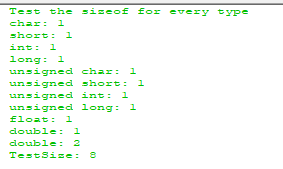
<a name="AL8Gz"></a>
# 修改配置项
- 修改项目中char 类型为 8bits
- **Project -> Project Options -> Processor** , 设置为 8 bit
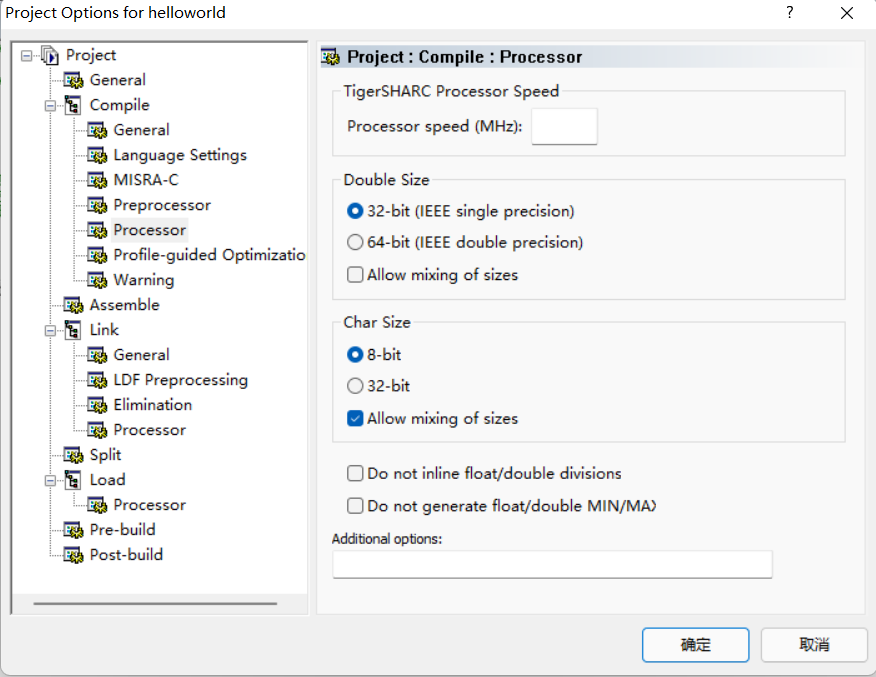<br />运行之前的程序, 出现如下结果. 通过对内存分析可知,在 char 和 int 类型中都做了补零操作
Test the sizeof for every type char: 1 short: 2 int: 4 long: 4 unsigned char: 1 unsigned short: 2 unsigned int: 4 unsigned long: 4 float: 4 double: 4 long double: 8 TestSize: 32

<a name="wd8tL"></a>
# 各种结构体的长度测试
下面我们对数据结构进行多次修改并看其长度
- 长度 8
```c
typedef struct {
char a;
short b;
int c;
} TestSize;
typedef struct {
short a;
char b;
char c;
char d;
} TestSize;
长度 4
typedef struct {
  char a;
  short b;
} TestSize;
typedef struct { short a; char b; char c; } TestSize;typedef struct { char b; char c; } TestSize;长度12
typedef struct {
  char a;
  short b;
  int c;
  long d;
} TestSize;
长度 16
typedef struct {
  char a;
  short b;
  char z;
  int c;
  int d;
} TestSize;
typedef struct { long long a; long long b; } TestSize;typedef struct { long long a; int b; } TestSize;typedef struct { long long a; int b; int c; } TestSize;长度24
typedef struct {
  char a;
  short b;
  int c;
  long d;
  long long e;
} TestSize;
typedef struct { char a; short b; int c; long long e; int d; } TestSize;typedef struct { char a; char z; short b; int c; long long e; int d; } TestSize;typedef struct { long long a; int b; int c; int d; } TestSize;长度 32
typedef struct {
  char a; //  1, 2    [实际,占用]
  short b; // 2, 2
  char z; //   1,4
  int c; //    4,8
  long long e; // 8, 8
  int d; // 4,8
} TestSize;
结论:
- 使用 longlong 之后数据都是按照8字节对齐的,不够的地方会补 0 .
- 使用 int, short,char 则是按照 4字节对齐, 在dsp 中最小的就 是 4字节这个不可以调整.
根据我们的使用情况都是两个short 类型数据,可以采用4 字节对齐方式建立结构体方便取数据.
研究开发手册调整对齐模式
Help -> Contents 打开帮助手册

- Manuals -> Software Tool Manuals -> TigerSHARC … -> … -> Compiler -> C/C++ Compiler Language Extensions -> Pragmas -> Data Alignment Pragmas 讲述了如何控制对齐模式.
- 下面有两个语法
```c
// 将下一行按照指定数字对齐 1 代表4 bit
pragma align 4
pragma alignment_region (2)
<a name="GhRWS"></a>
## pragma align
> 下面是使用说明的译文

此 pragma 可在变量和字段声明之前使用。它适用于紧跟在 pragma 后面的变量或字段声明。pragma 的作用是将下一个变量或字段声明在 num 指定的边界上对齐。

- 如果将pragma应用于局部变量,则由于局部变量存储在堆栈上,因此只有当num不大于堆栈对齐(即4个字)时,才会更改变量的对齐方式。如果num大于堆栈对齐方式,则会发出警告,提示忽略pragma。
- 如果num大于以下变量或字段声明通常要求的对齐方式,则变量或字段声明的对齐方式将更改为num。
- 如果num小于通常需要的对齐方式,则变量或字段声明的对齐方式将更改为num,并发出警告,表示对齐方式已减少。
```c
typedef struct {
    #pragma align 4
    int foo;
    int bar;
    #pragma align 4
    int baz;
} aligned_ints;
- 在本例中,任何声明为aligned_ints类型的对象的foo和baz成员都在四字边界上对齐。这个结构的大小是八个字,在bar和baz之间有两个未使用的字,在结构的末尾有三个填充字。在字节寻址模式下,要对齐的NUM参数必须是16而不是4,因为要对齐的参数是以可寻址单位表示的。
【在 8位 模式下这个 struct 还是 12 字节 及 3 个字, 下面是在 8位模式的测试, 也正好符合上面标红语句的内容】
typedef struct {
    #pragma align 4
    int foo;
    int bar;
    #pragma align 8
    int baz;
} aligned_ints;
// 长度 16
pragma alignment_region
这个只拷贝样例了, 这个由两个部分组成 alignment_region 和 alignment_region_end. 范围内的数据将都按照指定num进行对齐. 同样在 8位模式下 这个数字应该是 4 的整数倍.
#pragma align 4
int aa;         /* alignment 4 */
int bb;         /* alignment 1 */
#pragma alignment_region (2)
int cc;         /* alignment 2 */
int dd;         /* alignment 2 */
int ee;         /* alignment 2 */
#pragma align 4
int ff;         /* alignment 4 */
int gg;         /* alignment 2 */
int hh;         /* alignment 2 */
#pragma alignment_region_end
int ii;         /* alignment 1 */
#pragma alignment_region (1)
long double jj;   /* alignment 1, but the compiler warns
                      about the reduction */
#pragma alignment_region_end
#pragma alignment_region (3)
long double kk;   /* the compiler faults this, alignment is not
                      a power of two */
#pragma alignment_region_end
不论如何修改还是长度为 24 字节, 即在 8字节处对齐, 结构体内尽量使用相同长度的数据类型进行定义, 方便使用功能
typedef struct {
#pragma align 4
    int b; // 4,4
#pragma align 4
    int c; // 4,4
#pragma align 4
    int d;// 4,8
    long long a; //8,8
} TestSize;
word 单位说明
一个 word 应该是 4 字节
当我这只 char 为 8 位时, num 代表的含义将是 1 字节
系统内建的数据类型
对系统内建的一些数据类型进行测试, 这样可以方便代码在不同c 程序之间的复用
printf("__uint8: %d\n", sizeof(__uint8));
printf("__uint16: %d\n", sizeof(__uint16));
printf("__uint32: %d\n", sizeof(__uint32));
printf("__uint64: %d\n", sizeof(__uint64));
printf("__int8: %d\n", sizeof(__int8));
printf("__int16: %d\n", sizeof(__int16));
printf("__int32: %d\n", sizeof(__int32));
printf("__int64: %d\n", sizeof(__int64));
定义自己的通用数据类型
下面是 types.h 文件定义的通用数据类型, 为后面的代码迁移提供便利
// 用于对库中的函数的公开性进行区分
#define PUBLIC
#define PRIVATE static

// 常用数据类型定义
typedef __uint8 UINT8;
typedef __uint16 UINT16;
typedef __uint32 UINT32;
typedef __uint64 UINT64;

typedef __int8 INT8;
typedef __int16 INT16;
typedef __int32 INT32;
typedef __int64 INT64;
struct 的大小说明
Within a structure, members of the fundamental types are aligned on a multiple of their size. Structures are aligned on the strictest alignment of any of their members, but are always aligned to at least 32 bits. As always, the size of a structure is a multiple of its alignment, so this last restriction leads to subtle differences from C implementations on Windows and UNIX® platforms. For example, struct A { short a; short b; short c; }; sizeof(struct A) // is 8 not 6 !!!. Entire variables are aligned to at least 32 bits. They are more strictly aligned if their type requires it. Entire array variables are aligned to 128 bits.
结构体必须按照 32bit 对齐

若有收获,就点个赞吧
0 人点赞


