关于 LinkedHashSet
- LinkedHashSet 是 HashSet 的子类;
- LinkedHashSet 底层是一个 LinkedHashMap,底层维护了一个数组+双向链表;
- LinkedHashSet 根据元素的 hashCode 值来决定元素的存储位置,同时使用链表维护元素的次序,使得元素看起来是以插入顺序保存的;
- LinkedHashSet 不允许添加重复元素;
- LinkedHashSet 是有序的。
public class LinkedHashSet<E>extends HashSet<E>implements Set<E>, Cloneable, java.io.Serializable {
在 LinkedHashSet 中维护了一个 hash 表和双向链表( LinkedHashSet 有 head 和 tail )。
每一个节点有 pre 和 next 属性,这样可以形成双向链表。
在添加一个元素时,先求 hash 值,再求索引,确定该元素在 hashtable 的位置,然后将添加的元素加入到双向链表(如果已经存在,不添加,原则和 HashSet 一样)。
构造器
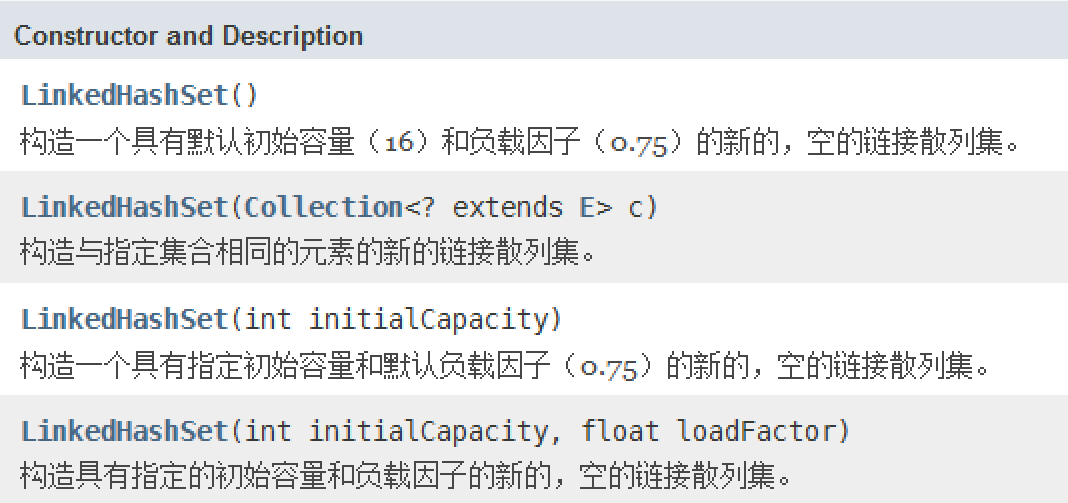
/*** Constructs a new, empty linked hash set with the specified initial* capacity and load factor.** @param initialCapacity the initial capacity of the linked hash set* @param loadFactor the load factor of the linked hash set* @throws IllegalArgumentException if the initial capacity is less* than zero, or if the load factor is nonpositive*/public LinkedHashSet(int initialCapacity, float loadFactor) {super(initialCapacity, loadFactor, true);}/*** Constructs a new, empty linked hash set with the specified initial* capacity and the default load factor (0.75).** @param initialCapacity the initial capacity of the LinkedHashSet* @throws IllegalArgumentException if the initial capacity is less* than zero*/public LinkedHashSet(int initialCapacity) {super(initialCapacity, .75f, true);}/*** Constructs a new, empty linked hash set with the default initial* capacity (16) and load factor (0.75).*/public LinkedHashSet() {super(16, .75f, true);}/*** Constructs a new linked hash set with the same elements as the* specified collection. The linked hash set is created with an initial* capacity sufficient to hold the elements in the specified collection* and the default load factor (0.75).** @param c the collection whose elements are to be placed into* this set* @throws NullPointerException if the specified collection is null*/public LinkedHashSet(Collection<? extends E> c) {super(Math.max(2*c.size(), 11), .75f, true);addAll(c);}
源码
package java.util;/*** <p>Hash table and linked list implementation of the <tt>Set</tt> interface,* with predictable iteration order. This implementation differs from* <tt>HashSet</tt> in that it maintains a doubly-linked list running through* all of its entries. This linked list defines the iteration ordering,* which is the order in which elements were inserted into the set* (<i>insertion-order</i>). Note that insertion order is <i>not</i> affected* if an element is <i>re-inserted</i> into the set. (An element <tt>e</tt>* is reinserted into a set <tt>s</tt> if <tt>s.add(e)</tt> is invoked when* <tt>s.contains(e)</tt> would return <tt>true</tt> immediately prior to* the invocation.)** <p>This implementation spares its clients from the unspecified, generally* chaotic ordering provided by {@link HashSet}, without incurring the* increased cost associated with {@link TreeSet}. It can be used to* produce a copy of a set that has the same order as the original, regardless* of the original set's implementation:* <pre>* void foo(Set s) {* Set copy = new LinkedHashSet(s);* ...* }* </pre>* This technique is particularly useful if a module takes a set on input,* copies it, and later returns results whose order is determined by that of* the copy. (Clients generally appreciate having things returned in the same* order they were presented.)** <p>This class provides all of the optional <tt>Set</tt> operations, and* permits null elements. Like <tt>HashSet</tt>, it provides constant-time* performance for the basic operations (<tt>add</tt>, <tt>contains</tt> and* <tt>remove</tt>), assuming the hash function disperses elements* properly among the buckets. Performance is likely to be just slightly* below that of <tt>HashSet</tt>, due to the added expense of maintaining the* linked list, with one exception: Iteration over a <tt>LinkedHashSet</tt>* requires time proportional to the <i>size</i> of the set, regardless of* its capacity. Iteration over a <tt>HashSet</tt> is likely to be more* expensive, requiring time proportional to its <i>capacity</i>.** <p>A linked hash set has two parameters that affect its performance:* <i>initial capacity</i> and <i>load factor</i>. They are defined precisely* as for <tt>HashSet</tt>. Note, however, that the penalty for choosing an* excessively high value for initial capacity is less severe for this class* than for <tt>HashSet</tt>, as iteration times for this class are unaffected* by capacity.** <p><strong>Note that this implementation is not synchronized.</strong>* If multiple threads access a linked hash set concurrently, and at least* one of the threads modifies the set, it <em>must</em> be synchronized* externally. This is typically accomplished by synchronizing on some* object that naturally encapsulates the set.** If no such object exists, the set should be "wrapped" using the* {@link Collections#synchronizedSet Collections.synchronizedSet}* method. This is best done at creation time, to prevent accidental* unsynchronized access to the set: <pre>* Set s = Collections.synchronizedSet(new LinkedHashSet(...));</pre>** <p>The iterators returned by this class's <tt>iterator</tt> method are* <em>fail-fast</em>: if the set is modified at any time after the iterator* is created, in any way except through the iterator's own <tt>remove</tt>* method, the iterator will throw a {@link ConcurrentModificationException}.* Thus, in the face of concurrent modification, the iterator fails quickly* and cleanly, rather than risking arbitrary, non-deterministic behavior at* an undetermined time in the future.** <p>Note that the fail-fast behavior of an iterator cannot be guaranteed* as it is, generally speaking, impossible to make any hard guarantees in the* presence of unsynchronized concurrent modification. Fail-fast iterators* throw <tt>ConcurrentModificationException</tt> on a best-effort basis.* Therefore, it would be wrong to write a program that depended on this* exception for its correctness: <i>the fail-fast behavior of iterators* should be used only to detect bugs.</i>** <p>This class is a member of the* <a href="{@docRoot}/../technotes/guides/collections/index.html">* Java Collections Framework</a>.** @param <E> the type of elements maintained by this set** @author Josh Bloch* @see Object#hashCode()* @see Collection* @see Set* @see HashSet* @see TreeSet* @see Hashtable* @since 1.4*/public class LinkedHashSet<E>extends HashSet<E>implements Set<E>, Cloneable, java.io.Serializable {private static final long serialVersionUID = -2851667679971038690L;/*** Constructs a new, empty linked hash set with the specified initial* capacity and load factor.** @param initialCapacity the initial capacity of the linked hash set* @param loadFactor the load factor of the linked hash set* @throws IllegalArgumentException if the initial capacity is less* than zero, or if the load factor is nonpositive*/public LinkedHashSet(int initialCapacity, float loadFactor) {super(initialCapacity, loadFactor, true);}/*** Constructs a new, empty linked hash set with the specified initial* capacity and the default load factor (0.75).** @param initialCapacity the initial capacity of the LinkedHashSet* @throws IllegalArgumentException if the initial capacity is less* than zero*/public LinkedHashSet(int initialCapacity) {super(initialCapacity, .75f, true);}/*** Constructs a new, empty linked hash set with the default initial* capacity (16) and load factor (0.75).*/public LinkedHashSet() {super(16, .75f, true);}/*** Constructs a new linked hash set with the same elements as the* specified collection. The linked hash set is created with an initial* capacity sufficient to hold the elements in the specified collection* and the default load factor (0.75).** @param c the collection whose elements are to be placed into* this set* @throws NullPointerException if the specified collection is null*/public LinkedHashSet(Collection<? extends E> c) {super(Math.max(2*c.size(), 11), .75f, true);addAll(c);}/*** Creates a <em><a href="Spliterator.html#binding">late-binding</a></em>* and <em>fail-fast</em> {@code Spliterator} over the elements in this set.** <p>The {@code Spliterator} reports {@link Spliterator#SIZED},* {@link Spliterator#DISTINCT}, and {@code ORDERED}. Implementations* should document the reporting of additional characteristic values.** @implNote* The implementation creates a* <em><a href="Spliterator.html#binding">late-binding</a></em> spliterator* from the set's {@code Iterator}. The spliterator inherits the* <em>fail-fast</em> properties of the set's iterator.* The created {@code Spliterator} additionally reports* {@link Spliterator#SUBSIZED}.** @return a {@code Spliterator} over the elements in this set* @since 1.8*/@Overridepublic Spliterator<E> spliterator() {return Spliterators.spliterator(this, Spliterator.DISTINCT | Spliterator.ORDERED);}}

若有收获,就点个赞吧
0 人点赞


