导学
在之前的学习中,我们使用MyBatis进行了数据的CRUD操作,而且还学习了它里面一些开发小技巧。那么在本节课程中,我们将要学习MyBatis的一些高级特性。
MyBatis日志管理
日志接口jar包及其实现jar包
什么是日志?这个问题其实很简单,日志是对生活和工作的记录。
那么MyBatis的日志,实际上就是对MyBatis工作的记录,就如同飞机的黑匣子会记录飞机飞行产生的一切数据一样。我们可以使用MyBatis的日志,来记录和分析,应用程序使用过程中对数据库的操作及其影响,也是我们诊断问题和理解系统活动的重要依据。
通常日志是记录和保存在日志文件中的,同学们其实也接触过日志,就是我们在Tomcat使用过程中控制台所显示的那些内容。
其实,在Java中也可以通过第三方的日志的接口模块创建日志记录和文件,再由不同的jar包实现对应的接口模块,比如常用的有Comms-Logging=>log4j和SLF4J=>logback等。
从目前的趋势来看,越来越多的开源项目从Commons-Logging加Log4j转向了SLF4J加logback。我们在使用日志记录的时候,需要注意项目中使用的是Commons-Logging还是SLF4J,虽然切换日志实现不会造成什么影响。比如SLF4J还是Commons-Logging,都可以使用logBack作为日志实现,但是它们的接口方法的定义还是不同的。
logback
早期的Java项目中,基本都是使用的log4j。但是,在本教程中我们将针对logback做着重的讲解。
因为log4j和logback是近亲,这两个日志管理实现都是由一个人开发的。英文log4j虽然经过多次更新迭代,仍然有些问题积重难返,所以作者另起炉灶开发了另一款日志管理实现logback,而且logback的性能要好的多。在MyBatis底层可以通过SLF4J支持logback!
代码实现:
- pom.xml增加依赖
<dependency><groupId>ch.qos.logback</groupId><artifactId>logback-classic</artifactId><version>1.2.3</version></dependency>
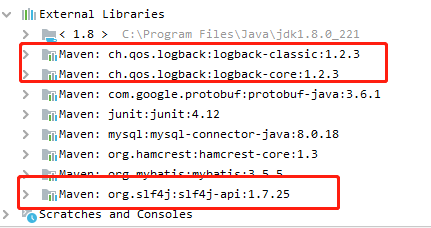
其实此时,如果我们运行测试类中方法,就会发现在控制台中就会打印日志信息了。
2. 对日志管理进行自定义设置
在resources目录下新增logback.xml文件。注意,必须叫这个名字!<?xml version="1.0" encoding="UTF-8" ?><configuration><!-- 指定在控制台中输出日志 --><!-- name属性可以随意,如果要在控制台输出,一般称之为console --><!-- class属性指定何处打印输出 --><appender name="console" class="ch.qos.logback.core.ConsoleAppender"><!-- 编码节点 --><encoder><!--%d{HH:mm:ss.SSS}:输出时间格式,精确到毫秒[%thread]:当前操作的线程%-5level:以5个字符右对齐以及级别%logger{36}:具体哪个类的日志(只显示36个字符)%msg:日志信息%n:换行这些表达式在logback官网上都有详细说明--><pattern>%d{HH:mm:ss.SSS} [%thread] %-5level %logger{36} - %msg%n</pattern></encoder></appender><!--日志输出级别(优先级高到低):error: 错误 - 系统的故障日志warn: 警告 - 存在风险或使用不当的日志info: 一般性消息debug: 程序内部用于调试信息trace: 程序运行的跟踪信息下方root标签表示日志的最低输出级别为debug,即debug级别以下的信息不进行输出--><root level="debug"><appender-ref ref="console"></appender-ref></root></configuration>
MyBatis的动态SQL
在我们使用SQL语句时,有的时候参数是不固定的。比如用户可以指定多个检索条件,也可能单独只指定一个检索条件。在这个时候,我们无法确定条件参数的数量,只能使用动态SQL完成。在实际的开发中,动态SQL的使用非常普遍。动态SQL是指根据参数数据动态组织SQL的技术,它有些类似于对SQL执行拼接。
可以使用<where>标签和<if>组合使用,或是单独使用<if>标签来实现动态SQL。
<select id="dynamicSQL" parameterType="java.util.Map" resultType="com.dodoke.mybatis.entity.Goods">select * from t_goods<!-- 不需要写where关键字,只需要利用where标签智能判断and是否要添加 --><where><!-- 针对map中的key进行判断对应的value值是否为null和空 --><if test="categoryId != null and categoryId!=''">and category_id = #{categoryId}</if><if test="currentPrice != null and categoryId!=''">and current_price < #{currentPrice}</if></where></select>
/*** 动态SQL语句* @throws Exception*/@Testpublic void testDynamicSQL() throws Exception {SqlSession session = null;try{session = MyBatisUtils.openSqlSession();Map param = new HashMap();param.put("categoryId", 44);param.put("currentPrice", 500);//查询条件List<Goods> list = session.selectList("com.dodoke.mybatis.resources.mappers.GoodsMapper.delete.dynamicSQL", param);for(Goods g:list){System.out.println(g.getTitle() + ":" +g.getCategoryId() + ":" + g.getCurrentPrice());}}catch (Exception e){throw e;}finally {MyBatisUtils.closeSqlSession(session);}}
MyBatis的缓存机制
在一个项目中,查询数据库中的操作算是一个非常常用的操作,但是有些数据会被经常性的查询,而每一次都去数据库中查询这些重复的数据,会很消耗数据库的资源,同时使得查询效率也很低。
而 MyBatis 中就通过缓存技术来解决这样的问题,也就是说:将一些经常查询,并且不经常改变的,以及数据的正确对最后的结果影响不大的数据,放置在一个缓存容器中,当用户再次查询这些数据的时候,就不必再去数据库中查询,直接在缓存中提取就可以了。
注:缓存可以简单理解为存在于内存中的临时数据
在MyBatis中,存在一级缓存和二级缓存,一级缓存的效果,可以体现为同一个sqlSession对象操作同一条SQL时,只要参数相同就不会再去进行数据库查询,一级缓存默认开启。二级缓存需要手动开启。
关于如何使用二级缓存,可以参考如下文章,这里不再赘述,各位同学自由补充。
参考文档:
https://zhuanlan.zhihu.com/p/106258135
MyBatis多表级联查询
MyBatis多表级联查询和之前学习的MyBatis多表关联查询不一样。
- 多表关联查询:两个表通过主外键在一条SQL中完成所有数据的提取。
- 多表级联查询:通过一个对象来获取与它关联的另外一个对象,执行的SQL语句分为多条。
确定对象之间的关系是双向的:
双向的一对多,应该变成多对多,在进行数据库设计的时候需要单独抽象出一张中间表来!!!
一对多关联查询
案例:要求查询某件商品的详细信息
新建实体类
package com.dodoke.mybatis.entity;public class GoodsDetail {private Integer gdId;private Integer goodsId;private String gdPicUrl;private Integer gdOrder;public Integer getGdId() {return gdId;}public void setGdId(Integer gdId) {this.gdId = gdId;}public Integer getGoodsId() {return goodsId;}public void setGoodsId(Integer goodsId) {this.goodsId = goodsId;}public String getGdPicUrl() {return gdPicUrl;}public void setGdPicUrl(String gdPicUrl) {this.gdPicUrl = gdPicUrl;}public Integer getGdOrder() {return gdOrder;}public void setGdOrder(Integer gdOrder) {this.gdOrder = gdOrder;}}
新建mapper xml文件
GoodsDetailMapper.xml<?xml version="1.0" encoding="UTF-8"?><!DOCTYPE mapperPUBLIC "-//mybatis.org//DTD Mapper 3.0//EN""http://mybatis.org/dtd/mybatis-3-mapper.dtd"><mapper namespace="goodsDetail"><select id="selectByGoodsId" parameterType="Integer"resultType="com.dodoke.mybatis.entity.GoodsDetail">select * from t_goods_detail where goods_id = #{value}</select></mapper>
修改Goods类,为体现一对多的关系,新增一个属性
/*** 数据库t_goods表对应映射的实体类*/public class Goods {private Integer goodsId;//商品编号private String title;//标题private String subTitle;//子标题private Float originalCost;//原始价格private Float currentPrice;//当前价格private Float discount;//折扣率private Integer isFreeDelivery;//是否包邮 ,1-包邮 0-不包邮private Integer categoryId;//分类编号private List<GoodsDetail> goodsDetails;public List<GoodsDetail> getGoodsDetails() {return goodsDetails;}public void setGoodsDetails(List<GoodsDetail> goodsDetails) {this.goodsDetails = goodsDetails;}public Integer getGoodsId() {return goodsId;}public void setGoodsId(Integer goodsId) {this.goodsId = goodsId;}public String getTitle() {return title;}public void setTitle(String title) {this.title = title;}public String getSubTitle() {return subTitle;}public void setSubTitle(String subTitle) {this.subTitle = subTitle;}public Float getOriginalCost() {return originalCost;}public void setOriginalCost(Float originalCost) {this.originalCost = originalCost;}public Float getCurrentPrice() {return currentPrice;}public void setCurrentPrice(Float currentPrice) {this.currentPrice = currentPrice;}public Float getDiscount() {return discount;}public void setDiscount(Float discount) {this.discount = discount;}public Integer getIsFreeDelivery() {return isFreeDelivery;}public void setIsFreeDelivery(Integer isFreeDelivery) {this.isFreeDelivery = isFreeDelivery;}public Integer getCategoryId() {return categoryId;}public void setCategoryId(Integer categoryId) {this.categoryId = categoryId;}}
利用resultMap实现一对多映射,GoodsMapper.xml
<!--resultMap可用于说明一对多或者多对一的映射逻辑id 是resultMap属性引用的标志type 指向One的实体(Goods)--><resultMap id="rmGoods1" type="com.dodoke.mybatis.entity.Goods"><!-- 映射goods对象的主键到goods_id字段 --><id column="goods_id" property="goodsId"></id><!--collection的含义是,在select * from t_goods limit 0,10 得到结果后,对所有Goods对象遍历得到goods_id字段值,并代入到goodsDetail命名空间的findByGoodsId的SQL中执行查询,将得到的"商品详情"集合赋值给goodsDetails List对象.--><collection property="goodsDetails" select="goodsDetail.selectByGoodsId"column="goods_id"/></resultMap><select id="selectOneToMany" resultMap="rmGoods1">select * from t_goods limit 0,10</select>
编写测试方法
/*** 一对多对象关联查询* @throws Exception*/@Testpublic void testOneToMany() throws Exception {SqlSession session = null;try {session = MyBatisUtils.openSqlSession();List<Goods> list = session.selectList("com.dodoke.mybatis.resources.mappers.GoodsMapper.selectOneToMany");for(Goods goods:list) {System.out.println(goods.getTitle() + ":" + goods.getGoodsDetails().size());}} catch (Exception e) {throw e;} finally {MyBatisUtils.closeSqlSession(session);}}
多对一关联查询
当多对一的时候,只需要在多的一方实体类中,持有一的一方的实体!
即:package com.dodoke.mybatis.entity;public class GoodsDetail {private Integer gdId;private Integer goodsId;private String gdPicUrl;private Integer gdOrder;private Goods goods;//添加goods类属性public Integer getGdId() {return gdId;}public void setGdId(Integer gdId) {this.gdId = gdId;}public Integer getGoodsId() {return goodsId;}public void setGoodsId(Integer goodsId) {this.goodsId = goodsId;}public String getGdPicUrl() {return gdPicUrl;}public void setGdPicUrl(String gdPicUrl) {this.gdPicUrl = gdPicUrl;}public Integer getGdOrder() {return gdOrder;}public void setGdOrder(Integer gdOrder) {this.gdOrder = gdOrder;}public Goods getGoods() {return goods;}public void setGoods(Goods goods) {this.goods = goods;}}
修改GoodsDetailMapper.xml
<?xml version="1.0" encoding="UTF-8"?><!DOCTYPE mapperPUBLIC "-//mybatis.org//DTD Mapper 3.0//EN""http://mybatis.org/dtd/mybatis-3-mapper.dtd"><mapper namespace="goodsDetail"><select id="selectByGoodsId" parameterType="Integer"resultType="com.dodoke.mybatis.entity.GoodsDetail">select * from t_goods_detail where goods_id = #{value}</select><resultMap id="rmGoodsDetail" type="com.dodoke.mybatis.entity.GoodsDetail"><!-- 除了id,只有其它的属性符合驼峰命名规则就不需要填写大量的result标签 --><id column="gd_id" property="gdId"/><!-- 因为在下方使用了goods属性,导致goods_id没有对goodsId进行正确赋值,所以需要进行手动赋值 --><result column="goods_id" property="goodsId"/><!-- 该标签表示从多的一方关联到一的一方 --><association property="goods" select="com.dodoke.mybatis.resources.mappers.GoodsMapper.selectById" column="goods_id"></association></resultMap><select id="selectManyToOne" resultMap="rmGoodsDetail">select * from t_goods_detail limit 0,20</select></mapper>
MyBatis整合C3P0连接池
在之前的课程中,我们就使用过连接池。而且在mybatis-config.xml文件中也设置了使用数据库连接池,但是这个数据库连接池是使用的MyBatis自带的数据库连接池。我们希望使用更好的数据库连接池,可以采用C3P0连接池替换掉自带连接池。
pom.xml中添加依赖<dependency><groupId>com.mchange</groupId><artifactId>c3p0</artifactId><version>0.9.5.2</version></dependency>
新增一个C3P0DataSourceFactory扩展类
package com.dodoke.mybatis.datasources;import com.mchange.v2.c3p0.ComboPooledDataSource;import org.apache.ibatis.datasource.unpooled.UnpooledDataSourceFactory;/*** C3P0与MyBatis兼容使用的数据源工厂类* 继承UnpooledDataSourceFactory类实现C3P0的迁入工作。*/public class C3P0DataSourceFactory extends UnpooledDataSourceFactory {public C3P0DataSourceFactory(){//指UnpooledDataSourceFactory类的数据源由C3P0提供this.dataSource = new ComboPooledDataSource();}}
修改mybatis-config.xml,type改成指向新增的类:C3P0DataSourceFactory
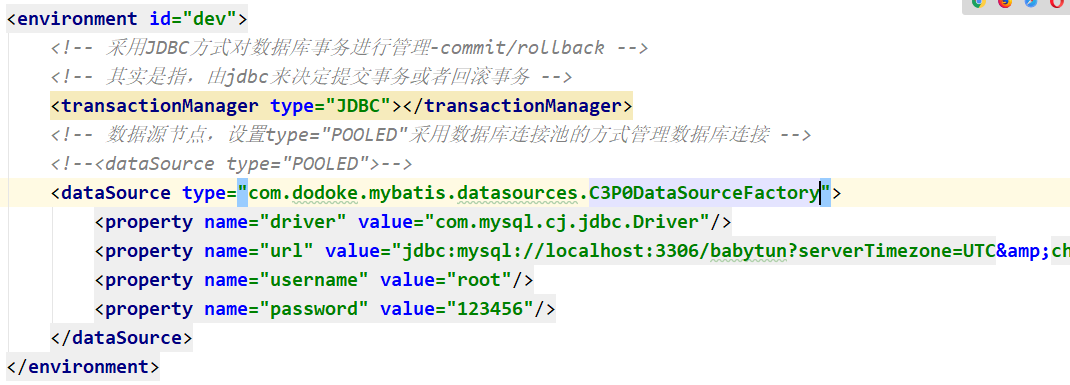
修改C3P0属性值<!--<dataSource type="POOLED">--><dataSource type="com.dodoke.mybatis.datasources.C3P0DataSourceFactory"><property name="driverClass" value="com.mysql.cj.jdbc.Driver"/><property name="jdbcUrl" value="jdbc:mysql://localhost:3306/babytun?serverTimezone=UTC&characterEncoding=UTF-8"/><property name="user" value="root"/><property name="password" value="123456"/><property name="initialPoolSize" value="5"/><property name="maxPoolSize" value="20"/><property name="minPoolSize" value="5"/></dataSource>
MyBatis的批量处理
MyBatis的批量处理实际上就是通过循环实现SQL的批量执行
<!--INSERT INTO table--><!--VALUES ("a" , "a1" , "a2"),("b" , "b1" , "b2"),(....)--><insert id="batchInsert" parameterType="java.util.List">INSERT INTO t_goods(title, sub_title, original_cost, current_price, discount, is_free_delivery, category_id)VALUES<foreach collection="list" item="item" index="index" separator=",">(#{item.title},#{item.subTitle}, #{item.originalCost}, #{item.currentPrice}, #{item.discount}, #{item.isFreeDelivery}, #{item.categoryId})</foreach></insert><!--in (1901,1902)--><delete id="batchDelete" parameterType="java.util.List">DELETE FROM t_goods WHERE goods_id in<foreach collection="list" item="item" index="index" open="(" close=")" separator=",">#{item}</foreach></delete>
- collection=”list”代表迭代的数据源从哪来,一般情况下书写list,指代从外侧传来的List集合,这个名字是mybatis强制要求不能随意修改
- item=”item” 循环中的迭代遍历
- indx=”index” 循环的索引,当前是第几次循环
- separator=”,” 分割器,生成文本时((“a”,”a1”,”a2”),(“b”,”b1”,”b2”),…),每个记录用逗号分割
- 批量删除中传入的list中包含的是每一个要删除的数据的编号,foreach标签中要加入open=”(“ close=”)”
批量插入数据的局限,需要通过压力测试来调整/*** 批量插入测试* @throws Exception*/@Testpublic void testBatchInsert() throws Exception {SqlSession session = null;try {long st = new Date().getTime();session = MyBatisUtils.openSqlSession();List list = new ArrayList();for (int i = 0; i < 10000; i++) {Goods goods = new Goods();goods.setTitle("测试商品");goods.setSubTitle("测试子标题");goods.setOriginalCost(200f);goods.setCurrentPrice(100f);goods.setDiscount(0.5f);goods.setIsFreeDelivery(1);goods.setCategoryId(43);//insert()方法返回值代表本次成功插入的记录总数list.add(goods);}session.insert("goods.batchInsert", list);session.commit();//提交事务数据long et = new Date().getTime();System.out.println("执行时间:" + (et - st) + "毫秒");// System.out.println(goods.getGoodsId());} catch (Exception e) {if (session != null) {session.rollback();//回滚事务}throw e;} finally {MyBatisUtils.closeSqlSession(session);}}/*** 10000次数据插入对比测试用例* @throws Exception*/@Testpublic void testInsert1() throws Exception {SqlSession session = null;try{long st = new Date().getTime();session = MyBatisUtils.openSqlSession();List list = new ArrayList();for(int i = 0 ; i < 10000 ; i++) {Goods goods = new Goods();goods.setTitle("测试商品");goods.setSubTitle("测试子标题");goods.setOriginalCost(200f);goods.setCurrentPrice(100f);goods.setDiscount(0.5f);goods.setIsFreeDelivery(1);goods.setCategoryId(43);//insert()方法返回值代表本次成功插入的记录总数session.insert("goods.insert" , goods);}session.commit();//提交事务数据long et = new Date().getTime();System.out.println("执行时间:" + (et-st) + "毫秒");// System.out.println(goods.getGoodsId());}catch (Exception e){if(session != null){session.rollback();//回滚事务}throw e;}finally {MyBatisUtils.closeSqlSession(session);}}/*** 批量删除测试* @throws Exception*/@Testpublic void testBatchDelete() throws Exception {SqlSession session = null;try {long st = new Date().getTime();session = MyBatisUtils.openSqlSession();List list = new ArrayList();list.add(1920);list.add(1921);list.add(1922);session.delete("goods.batchDelete", list);session.commit();//提交事务数据long et = new Date().getTime();System.out.println("执行时间:" + (et - st) + "毫秒");// System.out.println(goods.getGoodsId());} catch (Exception e) {if (session != null) {session.rollback();//回滚事务}throw e;} finally {MyBatisUtils.closeSqlSession(session);}}
- 无法获得插入的数据id
- 批量生成的SQL太长,可能会被服务器拒绝。
对MyBatis中使用到的类起别名
之前,我们在 mapper xml 文件中的引用实体类时,需要写上实体类的全类名(包名+类名),每次都写这么一长串内容挺麻烦的,而我们希望能够采用一种简写的形式。比如写成这种形式就挺舒服的。
可以在mybatis-config.xml标签中添加<select id="selectAll" resultType="_Goods">select * from t_goods order by goods_id desc limit 10</select>
typeAliases,注意添加位置。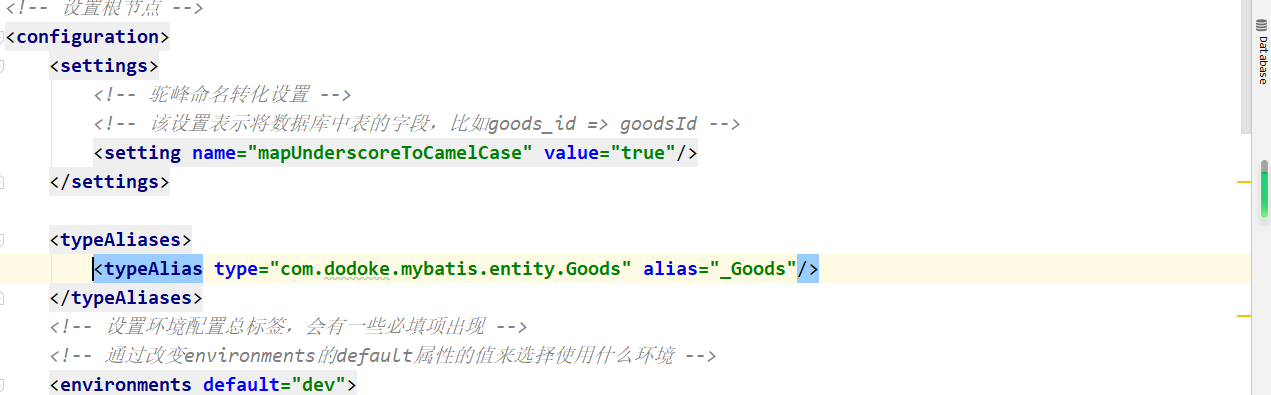
<settings><!-- 驼峰命名转化设置 --><!-- 该设置表示将数据库中表的字段,比如goods_id => goodsId --><setting name="mapUnderscoreToCamelCase" value="true"/></settings><typeAliases><typeAlias type="com.dodoke.mybatis.entity.Goods" alias="_Goods"/></typeAliases>
Mybatis使用注解进行开发
对于Mybatis而言,它提供了一种使用注解的开发方式,这种开发方式与使用xml进行开发比较,它更适合使用在一些小型敏捷的项目中。
在之前的项目基础上新建一个项目:(pom.xml中依赖不变,工具类不变,logback自定义文件不变)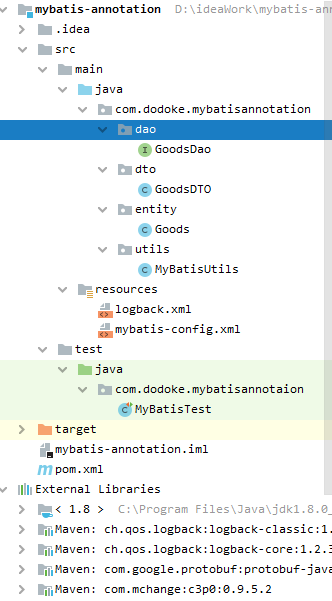
mybatis-config.xml
实体类<?xml version="1.0" encoding="utf-8" ?><!-- 官网复制DTD约束 --><!DOCTYPE configurationPUBLIC "-//mybatis.org//DTD Config 3.0//EN""http://mybatis.org/dtd/mybatis-3-config.dtd"><!-- 设置根节点 --><configuration><settings><!-- 驼峰命名转化设置 --><setting name="mapUnderscoreToCamelCase" value="true"/></settings><environments default="dev"><environment id="dev"><transactionManager type="JDBC"></transactionManager><!-- 数据源节点,设置type="POOLED"采用数据库连接池的方式管理数据库连接 --><dataSource type="POOLED"><property name="driver" value="com.mysql.cj.jdbc.Driver"/><property name="url" value="jdbc:mysql://localhost:3306/babytun?serverTimezone=UTC&characterEncoding=UTF-8"/><property name="username" value="root"/><property name="password" value="123456"/></dataSource></environment></environments><mappers><!-- mybatis如果使用注解开发,需要将接口当做mapper xml 进行注册--><!--<mapper class="com.dodoke.mybatisannotation.dao.GoodsDao"/>--><!-- 可以通过package标签将该包中接口全部注册 --><package name="com.dodoke.mybatisannotation.dao"/></mappers></configuration>
数据传输类public class Goods {private Integer goodsId;//商品编号private String title;//标题private String subTitle;//子标题private Float originalCost;//原始价格private Float currentPrice;//当前价格private Float discount;//折扣率private Integer isFreeDelivery;//是否包邮 ,1-包邮 0-不包邮private Integer categoryId;//分类编号public Integer getGoodsId() {return goodsId;}public void setGoodsId(Integer goodsId) {this.goodsId = goodsId;}public String getTitle() {return title;}public void setTitle(String title) {this.title = title;}public String getSubTitle() {return subTitle;}public void setSubTitle(String subTitle) {this.subTitle = subTitle;}public Float getOriginalCost() {return originalCost;}public void setOriginalCost(Float originalCost) {this.originalCost = originalCost;}public Float getCurrentPrice() {return currentPrice;}public void setCurrentPrice(Float currentPrice) {this.currentPrice = currentPrice;}public Float getDiscount() {return discount;}public void setDiscount(Float discount) {this.discount = discount;}public Integer getIsFreeDelivery() {return isFreeDelivery;}public void setIsFreeDelivery(Integer isFreeDelivery) {this.isFreeDelivery = isFreeDelivery;}public Integer getCategoryId() {return categoryId;}public void setCategoryId(Integer categoryId) {this.categoryId = categoryId;}@Overridepublic String toString() {return "Goods{" +"goodsId=" + goodsId +", title='" + title + '\'' +", subTitle='" + subTitle + '\'' +", originalCost=" + originalCost +", currentPrice=" + currentPrice +", discount=" + discount +", isFreeDelivery=" + isFreeDelivery +", categoryId=" + categoryId +'}';}}
接口注解开发-接口package com.dodoke.mybatisannotation.dto;public class GoodsDTO {private int goodsId;private String title;private String subTitle;public int getGoodsId() {return goodsId;}public void setGoodsId(int goodsId) {this.goodsId = goodsId;}public String getTitle() {return title;}public void setTitle(String title) {this.title = title;}public String getSubTitle() {return subTitle;}public void setSubTitle(String subTitle) {this.subTitle = subTitle;}@Overridepublic String toString() {return "GoodsDTO{" +"goodsId=" + goodsId +", title='" + title + '\'' +", subTitle='" + subTitle + '\'' +'}';}}
package com.dodoke.mybatisannotation.dao;
import com.dodoke.mybatisannotation.dto.GoodsDTO;
import com.dodoke.mybatisannotation.entity.Goods;
import org.apache.ibatis.annotations.*;
import java.util.List;
import java.util.Map;
/**
* 该接口用操作数据库
*/
public interface GoodsDao {
 @Select("select * from t_goods where current_price between #{min} and #{max} order by current_price limit 0,#{limt}")
 public List<Goods> selectByPriceRange(@Param("min") Float min, @Param("max") Float max, @Param("limt") Integer limt);
 /**
  * 对于注解开发来说,新增和删除,以及修改方法的返回值都要是int类型
  * @param goods
  * @return
  */
 @Insert("INSERT INTO t_goods(title, sub_title, original_cost, current_price, discount, is_free_delivery, category_id) VALUES (#{title} , #{subTitle} , #{originalCost}, #{currentPrice}, #{discount}, #{isFreeDelivery}, #{categoryId})")
 @SelectKey(statement = "select last_insert_id()" ,before=false,keyProperty = "goodsId" ,resultType = Integer.class)
 public int insert(Goods goods);
 @Select(" select * from t_goods order by goods_id desc limit 10")
 //如果没有设置驼峰命令转换或者要设置数据转换类,或者多对一,一对多的时候,可以利用results注解
 @Results({
         //设置id=true,明确指示id属性
         @Result(column = "goods_id",property = "goodsId" , id=true),
         @Result(column = "title",property = "title" ),
         @Result(column = "sub_title",property = "subTitle" ),
 })
 public List<GoodsDTO> selectLimit();
}

若有收获,就点个赞吧
0 人点赞


