Pipline:
- 准备数据
- 调整输入
- 搭建网络
- 设定损失
- 设定优化器
- 开始迭代训练
- 执行前向传播
model.forward(inputs) - 计算损失
- 损失反向传播
loss.backward() - 执行优化
- 保存模型
- 验证集上测试效果, 获得指标
F_measure, mae - 存储最好的模型
- 直到迭代结束
Tips
- 在GPU和CPU进行张量的转换的时候,如果张量过大,会有
pin memory不足的现象:

建议在频繁在GPU和CPU传递数据的部分,使用下面的方法:
ori_img = ori_img.cpu().clone().numpy().squeeze()
使用 .cpu().clone() 代替 .cpu() ,克隆之后原来的 Pinned Tensor 就会释放。 Pinned Memory 就会空出来。
Pyramid Pooling Module(PPM)
- Paper(PSPNet): https://arxiv.org/pdf/1612.01105.pdf
不改变特征图尺寸的情况下,扩大感受野
- 采用四种尺寸的池化层,将特征图尺寸池化到[1×1, 2×2, 3×3, 4×4]
- 通过1×1卷积将特征图尺寸减少到channel/4
- 将上面的特征利用
bilinear插值的方法,恢复特征图尺寸到原特征图尺寸 - 将池化后的特征和原来的特征图
concat到一起,此时channel为原来的两倍 - 通过1×1卷积将通道恢复到源特征图的通道数
class PyramidPooling(nn.Module):"""Pyramid pooling module"""def __init__(self, in_channels, out_channels, **kwargs):super(PyramidPooling, self).__init__()inter_channels = int(in_channels / 4) #这里N=4与原文一致self.conv1 = _ConvBNReLU(in_channels, inter_channels, 1, **kwargs) # 四个1x1卷积用来减小channel为原来的1/Nself.conv2 = _ConvBNReLU(in_channels, inter_channels, 1, **kwargs)self.conv3 = _ConvBNReLU(in_channels, inter_channels, 1, **kwargs)self.conv4 = _ConvBNReLU(in_channels, inter_channels, 1, **kwargs)self.out = _ConvBNReLU(in_channels * 2, out_channels, 1) #最后的1x1卷积缩小为原来的channeldef pool(self, x, size):avgpool = nn.AdaptiveAvgPool2d(size) # 自适应的平均池化,目标size分别为1x1,2x2,3x3,6x6return avgpool(x)def upsample(self, x, size): #上采样使用双线性插值return F.interpolate(x, size, mode='bilinear', align_corners=True)def forward(self, x):size = x.size()[2:]feat1 = self.upsample(self.conv1(self.pool(x, 1)), size)feat2 = self.upsample(self.conv2(self.pool(x, 2)), size)feat3 = self.upsample(self.conv3(self.pool(x, 3)), size)feat4 = self.upsample(self.conv4(self.pool(x, 6)), size)x = torch.cat([x, feat1, feat2, feat3, feat4], dim=1) #concat 四个池化的结果x = self.out(x)return x
Feature Pyramid Networks(FPN)
特征金字塔:多尺度的信息融合,结合不同层次的语义信息,对特征进行融合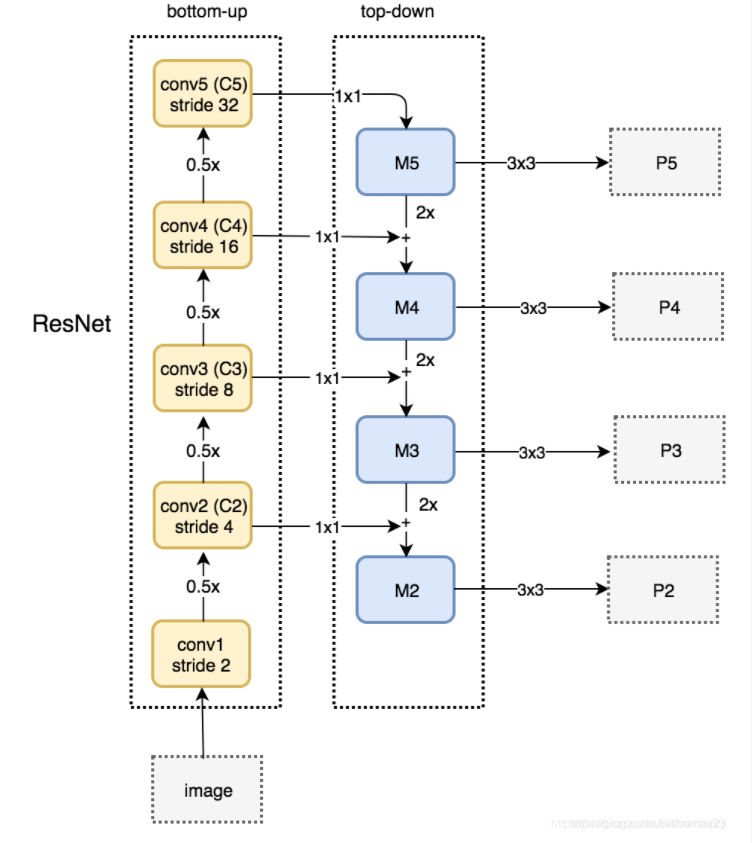
共有四个部分:
- 自下而上:c2-c5表示ResNet的卷积组,卷积组包含了多个Bottleneck结构
- 自上而下:首先对C5 进行1*1的卷积降低通道数得到P5,依次上采样
- 横向连接:将上采样后的高层语义信息与浅层的位置细节进行融合。将上一层上采样后的,通道数相同的特征直接进行相加
- 卷积融合:用3*3的卷积对相加后的特征进行融合,目的在于消除上采样过程的重叠效应,生成最终的特征图 ```
import torch.nn as nn import torch.nn.functional as F import math
ResNet的基本Bottleneck类
class Bottleneck(nn.Module): expansion=4#通道倍增数 def init(self,inplanes,planes,stride=1,downsample=None): super(Bottleneck,self)._init() self.bottleneck=nn.Sequential( nn.Conv2d(in_planes,planes,1,bias=False), nn.BatchNorm2d(planes), nn.ReLU(inplace=True), nn.Conv2d(planes,planes,3,stride,1,bias=False), nn.BatchNorm2d(planes), nn.ReLU(inplace=True), nn.Conv2d(planes,self.expansionplanes,1,bias=False), nn.BatchNorm2d(self.expansionplanes), ) self.relu=nn.ReLU(inplace=True) self.downsample=downsample def forward(self,x): identity=x out=self.bottleneck(x) if self.expansion is not None: identity=self.downsample(x) out+=identity out=self.relu(out) return out
FNP的类,初始化需要一个list,代表RESNET的每一个阶段的Bottleneck的数量
class FPN(nn.Module): def init(self,layers): super(FPN,self).init() self.inplanes=64
#处理输入的C1模块(C1代表了RestNet的前几个卷积与池化层)self.conv1=nn.Conv2d(3,64,7,2,3,bias=False)self.bn1=nn.BatchNorm2d(64)self.relu=nn.ReLU(inplace=True)self.maxpool=nn.MaxPool2d(3,2,1)#搭建自下而上的C2,C3,C4,C5self.layer1=self._make_layer(64,layers[0])self.layer2=self._make_layer(128,layers[1],2)self.layer3=self._make_layer(256,layers[2],2)self.layer4=self._make_layer(512,layers[3],2)#对C5减少通道数,得到P5self.toplayer=nn.Conv2d(2048,256,1,1,0)#3x3卷积融合特征self.smooth1=nn.Conv2d(256,256,3,1,1)self.smooth2=nn.Conv2d(256,256,3,1,1)self.smooth3=nn.Conv2d(256,256,3,1,1)#横向连接,保证通道数相同self.latlayer1=nn.Conv2d(1024,256,1,1,0)self.latlayer2=nn.Conv2d(512,256,1,1,0)self.latlayer3=nn.Conv2d(256,256,1,1,0)def _make_layer(self,planes,blocks,stride=1):downsample=Noneif stride!=1 or self.inplanes != Bottleneck.expansion*planes:downsample=nn.Sequential(nn.Conv2d(self.inplanes,Bottleneck.expansion*planes,1,stride,bias=False),nn.BatchNorm2d(Bottleneck.expansion*planes))layers=[]layers.append(Bottleneck(self.inplanes,planes,stride,downsample))self.inplanes=planes*Bottleneck.expansionfor i in range(1,blocks):layers.append(Bottleneck(self.inplanes,planes))return nn.Sequential(*layers)#自上而下的采样模块def _upsample_add(self,x,y):_,_,H,W=y.shapereturn F.upsample(x,size=(H,W),mode='bilinear')+ydef forward(self,x):#自下而上c1=self.maxpool(self.relu(self.bn1(self.conv1(x))))c2=self.layer1(c1)c3=self.layer2(c2)c4=self.layer3(c3)c5=self.layer4(c4)#自上而下p5=self.toplayer(c5)p4=self._upsample_add(p5,self.latlayer1(c4))p3=self._upsample_add(p4,self.latlayer2(c3))p2=self._upsample_add(p3,self.latlayer3(c2))#卷积的融合,平滑处理p4=self.smooth1(p4)p3=self.smooth2(p3)p2=self.smooth3(p2)return p2,p3,p4,p5
net=FPN([3,4,6,3]) # list中的数字表示重复多少个Bottleneck net
```

若有收获,就点个赞吧
0 人点赞


