A*算法
A* 算法的最大时间消耗在于将节点插入open_set中,如果我们用优先队列优化,底层实际是二叉堆,因此时间复杂度是O(log(n))。所以我们的最大优化方式有两个,一个是优化open_set的数据结构,而另外一个就是尽可能的减少在寻路过程中加入到open_set中的点。
因此可行的解决的方式有:
open_set数据结构的优化可以使用优先队列实现,如下面示例代码所示- 判断是否将点插入
open_set的依据是F值,而如果在寻路的过程中,如果两点中间存在大阻挡,将会使得将很多无用的点塞入open_set中,因此常见的一种做法是进行分块处理,在可绕过阻挡块处设置寻路点。
以下图为例,不同块之间除了黑点之外都是阻挡(黑点是桥梁),因此可以把黑点直接设置为寻路点,这样A -> C,只要分成三个 A 寻路即可,避免了“撞墙”,大大提升了效率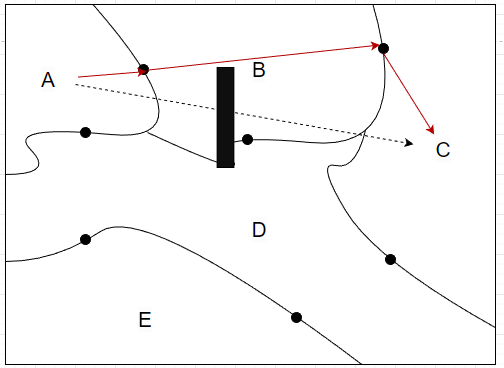
如果图形是没有阻挡的,实际上使用分块的方式依然可以提升整体的性能,所以还是有必要提前划分某些寻路点。
*当然要注意,这种分块的形式,得到的一般是一个近似的最短路径,在实际项目工程中是可以接受的
- 第三种方式就是使用更快的寻路方式了,可以使用
JPS寻路算法
import mathimport heapq# f = g + hclass Node():Weight = 10 # 这里的权重可以根据不同的地形修改,比如沙漠,那么值应该大些,平原值可以小些D = 10DD = 14def __init__(self, x, y, g=0, h=0):self.x = x # 坐标xself.y = y # 坐标yself.g = g # 当前点到起始点的代价,dijkstra算法self.h = h # 当前点到终点的代价,最佳优先搜索算法self.father = Nonedef calAddG(self, current_node):if abs(self.x - current_node.x) == 1 and abs(self.y - current_node.y) == 1:return DD * Node.Weight # 斜线距离,代价为14else:return D * Node.Weight # 直线距离,代价为10def setG(self, val):self.g = valdef calH(self, node): # 曼哈顿距离,也可以使用欧氏距离dx = abs(self.x - node.x)dy = abs(self.y - node.y)# H的计算主要有三种# 1. 曼哈顿距离,适用于只有直线的情况下:(dx + dy) * D# 2. 对角距离:适用于直线+45度角的情况:(dx + dy) + (DD - 2*D) * min(dx, dy)# 3. 欧几里得距离:适用于任意角度,但是还有sqrt操作,相对较慢# D * sqrt(dx * dx + dy * dy)return D * sqrt(dx * dx + dy * dy)def setH(self, val):self.h = valdef setFather(self, node):self.father = nodedef __lt__(self, other):return id(self) < id(other)def __le__(self, other):return id(self) >= id(other)class AStar():def __init__(self, graph):self.graph = graphself.max_row = len(graph)self.max_col = len(graph[0])def isValid(self, node):row = node.xcol = node.yreturn 0 <= row < self.max_row and 0 <= col < self.max_col and self.graph[row][col] != "#"def search(self, start_node, end_node):if not (self.isValid(start_node) and self.isValid(end_node)): # 检查节点的合法性return []start_node.calH(end_node)start_node.setG(0)path_list = [] # 最后的路径列表open_list = [] # 当前可选择的点(f, node)close_list = [] # 已经选择过的点(x,y)heapq.heappush(open_list, (start_node.g + start_node.h, start_node))while True:_val, current_node = heapq.heappop(open_list) # 从优先队列中弹出最小值close_list.append((current_node.x, current_node.y))self.searchNear(current_node, end_node, open_list, close_list)open_node = self.getFromOpenList(end_node, open_list)if open_node: # 最后的结束节点已在open_list中while True:path_list.append((open_node.x, open_node.y))if open_node.father != None:open_node = open_node.fatherelse:breakelif len(open_list) == 0:breakreturn path_listdef searchNear(self, current_node, end_node, open_list, close_list):"""搜索节点周围的点按照八个方位搜索(x-1,y-1)(x-1,y)(x-1,y+1)(x ,y-1)(x ,y)(x ,y+1)(x+1,y-1)(x+1,y)(x+1,y+1)"""pos_list = [(-1, -1), (-1, 0), (-1, 1), (0, -1), (0, 1), (1, -1), (1, 0), (1, 1)]for pos_x, pos_y in pos_list:self.searchOneNode(current_node, end_node, Node(current_node.x + pos_x, current_node.y + pos_y), close_list,open_list)def searchOneNode(self, current_node, end_node, node, close_list, open_list):"""搜索一个节点"""row = node.xcol = node.yif self.graph[row][col] == "#": # 是障碍点returnif (node.x, node.y) in close_list: # 已遍历过returnopen_node = self.getFromOpenList(node, open_list)tempG = current_node.g + node.calAddG(current_node)tempH = node.calH(end_node)if not open_node: # 当前node不在open_list中,计算其G,H存入open_list中node.setG(tempG)node.setH(tempH)node.setFather(current_node)heapq.heappush(open_list, (node.g + node.h, node))else:if (open_node.g > tempG):# need heapifyopen_node.setG(tempG)open_node.setH(tempH)open_node.setFather(current_node)heapq.heapify(open_list) # 重新调整def getFromOpenList(self, node, open_list): # 如果不在open_list中则返回False,亦可作为判断用if not open_list:return Nonefor _val, open_node in open_list:if open_node.x == node.x and open_node.y == node.y:return open_nodereturn Noneif __name__ == '__main__':graph = [list("####################"),list("#*****#************#"),list("#*****#*****#*####*#"),list("#*########*##******#"),list("#*****#*****######*#"),list("#*****#####*#******#"),list("####**#*****#*######"),list("#*****#**#**#**#***#"),list("#**#*****#**#****#*#"),list("####################")]print('graph: ')for g in graph:print(g)star = AStar(graph)path_list = star.search(Node(1, 1), Node(8, 18))for x, y in path_list:graph[x][y] = "O"print('after A* graph: ')for g in graph:print(g)
#include <limits.h>#include <memory>#include <vector>#include <queue>#include <math.h>#include <unordered_map>#include <iostream>using namespace std;class aStar{public:using Map = vector<vector<int>>;vector<pair<int, int>> search(const Map&, int, int, int, int);private:bool _isValid(const Map&, int, int);int _calH(int, int, int, int);int _calG(const Map&, int, int, int);static int D; // 直线运动的代价static int DD; // 斜线运动的代价static vector<pair<int, int>> path;int _maxX; // 当前地图X的最大值int _maxY; // 当前地图Y的最大值struct Node{int x; // x轴位置int y; // y轴位置int g; // g值int h; // h值Node* parent; // 父节点bool close; // 是否已经在close中,true是,false否Node(int x, int y): x(x), y(y), close(false), parent(nullptr){}};struct cmp{bool operator()(const Node* node1, const Node* node2){return node1->g + node1->h > node2->g + node2->h;}};};int aStar::D = 10;int aStar::DD = 14;vector<pair<int, int>> aStar::path{/*搜索节点周围的点按照八个方位搜索(x-1,y-1)(x-1,y)(x-1,y+1)(x ,y-1)(x ,y)(x ,y+1)(x+1,y-1)(x+1,y)(x+1,y+1)*/{-1, 0}, {1, 0}, {0, -1}, {0, 1}, {-1, -1}, {-1, 1}, {1, -1}, {1, 1} // 前四个方向是直线,后四个是斜线};bool aStar::_isValid(const Map& map, int x, int y){return 0 <= x < _maxX && 0 <= y < _maxY && map[x][y] > -1;}int aStar::_calH(int current_x, int current_y, int end_x, int end_y){int dx = abs(current_x - end_x);int dy = abs(current_y - end_y);/*三种计算方式:1. 曼哈顿距离,适合只能直线运动的场景:(dx + dy) * D2. 对角距离,适合直线+45度角运动的场景:(dx + dy) + (DD - 2*D) * min(dx, dy)3. 欧几里得距离:适合任意角度运行,有sqrt操作,相对较慢,开方可以使用别的方式优化:D * sqrt(dx * dx + dy * dy)*/return D * sqrt(dx * dx + dy * dy);}int aStar::_calG(const Map& map, int dest_x, int dest_y, int weight){/*如果是直线运动,则结果会是 D * 目标坐标点的地形权重,比如沙漠权重高点,平地权重就低点,即优先走平地*/return weight * map[dest_x][dest_y];}vector<pair<int, int>> aStar::search(const Map& map, int start_x, int start_y, int end_x, int end_y){_maxX = map.size();_maxY = map[0].size();if (!_isValid(map, start_x, start_y) or !_isValid(map, end_x, end_y)) // 起始/终点坐标异常{return {};}unordered_map<int, Node*> nodeMap;Node* startNode = new Node(start_x, start_y);nodeMap[startNode->x + _maxX * startNode->y] = startNode; // x + maxX * y 这种方式可以保证x和y计算出来的值是唯一的startNode->g = 0;startNode->h = _calH(startNode->x, startNode->y, end_x, end_y);priority_queue<Node*, vector<Node*>, cmp> Que; // 使用 priority_queue 会有重复插入的问题,因此需要使用close字段进行判断,和dijkstra算法处理相似Que.emplace(startNode);vector<pair<int, int>> ret;while (!Que.empty()){Node* parentNode = Que.top();Que.pop();if (parentNode->close) continue; // 过滤重复parentNode->close = true;if (parentNode->x == end_x && parentNode->y == end_y){while (parentNode->parent != nullptr){ret.emplace_back(parentNode->x, parentNode->y);parentNode = parentNode->parent;}ret.emplace_back(parentNode->x, parentNode->y);// 内存释放,在实际项目工程中可以预先创建一定数量的node节点,然后每次申请节点只返回其中未被使用的节点,用完之后清除状态数据(x\y\close等),不用释放,这样是空间换时间for (auto iter = nodeMap.begin(); iter != nodeMap.end(); ++iter) delete iter->second;return ret;}for (int i = 0; i < path.size(); ++i){int new_x = path[i].first + parentNode->x;int new_y = path[i].second + parentNode->y;if (!_isValid(map, new_x, new_y)) continue;int idx = new_x + _maxX * new_y;if (nodeMap.find(idx) != nodeMap.end()) // 已经遍历过{Node* childNode = nodeMap[idx];if (childNode->close) continue;int new_g = _calG(map, new_x, new_y, i < 4 ? D : DD); // 直线 or 斜线,对于重复的节点,这里就会由于父节点位置的不同产生不同的值int new_h = _calH(new_x, new_y, end_x, end_y);if (new_g + new_h < childNode->g + childNode->h) // 有更小的权重,这里会造成重复插入,上面有过滤,因此无妨{childNode->g = new_g;childNode->h = new_h;childNode->parent = parentNode;Que.emplace(childNode);}}else{Node* childNode = new Node(new_x, new_y);nodeMap[idx] = childNode;int new_g = _calG(map, new_x, new_y, i < 4 ? D : DD); // 直线 or 斜线int new_h = _calH(new_x, new_y, end_x, end_y);childNode->g = new_g;childNode->h = new_h;childNode->parent = parentNode;Que.emplace(childNode);}}}return {}; // 没有找到路径}int main(){// vector<vector<int>> map{ // -1表示阻挡,其他数值表示当前点的权重值,值越大代表地形越"难走",优先级越低// {1, 1, 1, 1, 1, 1, 1, 1, 1, 1, 1, 1, 1, 1, 1, 1, 1, 1, 1, 1},// {1, 0, 0, 0, 0, 0, 1, 0, 0, 0, 0, 0, 0, 0, 0, 0, 0, 0, 0, 1},// {1, 0, 0, 0, 0, 0, 1, 0, 0, 0, 0, 0, 1, 0, 1, 1, 1, 1, 1, 1},// {1, 0, 1, 1, 1, 1, 1, 1, 1, 1, 0, 1, 1, 0, 0, 0, 0, 0, 0, 1},// {1, 0, 0, 0, 0, 0, 1, 0, 0, 0, 0, 0, 1, 1, 1, 1, 1, 1, 0, 1},// {1, 0, 0, 0, 0, 0, 1, 1, 1, 1, 1, 0, 1, 0, 0, 0, 0, 0, 0, 1},// {1, 1, 1, 1, 0, 0, 1, 0, 0, 0, 0, 0, 1, 0, 1, 1, 1, 1, 1, 1},// {1, 0, 0, 0, 0, 0, 1, 0, 0, 1, 0, 0, 1, 0, 0, 1, 0, 0, 0, 1},// {1, 0, 0, 1, 0, 0, 0, 0 ,0, 1, 0 ,0, 1, 0, 0, 0, 0, 1, 0, 1},// {1, 1, 1, 1, 1, 1, 1, 1, 1, 1, 1, 1, 1, 1, 1, 1, 1, 1, 1, 1}// };vector<vector<int>> map{ // -1表示阻挡,其他数值表示当前点的权重值,值越大代表地形越"难走",优先级越低{-1, -1, -1, -1, -1, -1, -1, -1, -1, -1},{-1, 0, 5, 0, 0, 0, 1, 0, -1, -1},{-1, 0, 10, 0, 0, 0, 1, 0, -1, -1},{-1, 10, -1, -1, -1, -1, -1, -1, 0, -1},{-1, 0, 0, 0, 0, 0, 1, 0, -1, -1},{-1, 0, 0, 0, 0, 0, 1, 1, 0, -1},{-1, -1, -1, -1, -1, -1, -1, -1, -1, -1}};aStar a;auto path = a.search(map, 1, 1, 5, 8);for (int i = path.size()-1; i >= 0; --i){cout << "(" << path[i].first << ", " << path[i].second << ")";if (i != 0) cout << " => ";}cout << endl;}

若有收获,就点个赞吧
0 人点赞


