初始化工作
点击查看【processon】
·SqlSessionFactoryBuilder build
·XMLConfigBuilder parse()
·XMLConfigBuilder parseConfiguration()
propertiesElement(root.evalNode("properties"));Properties settings = settingsAsProperties(root.evalNode("settings"));loadCustomVfs(settings);loadCustomLogImpl(settings);typeAliasesElement(root.evalNode("typeAliases"));//解析插件pluginElement(root.evalNode("plugins"));objectFactoryElement(root.evalNode("objectFactory"));objectWrapperFactoryElement(root.evalNode("objectWrapperFactory"));reflectorFactoryElement(root.evalNode("reflectorFactory"));settingsElement(settings);// read it after objectFactory and objectWrapperFactory issue #631environmentsElement(root.evalNode("environments"));databaseIdProviderElement(root.evalNode("databaseIdProvider"));typeHandlerElement(root.evalNode("typeHandlers"));//解析mappermapperElement(root.evalNode("mappers"));
·解析mapper
·mapperElement(XNode parent)
·configuration.addMappers
·XMLMapperBuilder.parse()
·configurationElement(parser.evalNode(“/mapper”));
Mapper里面的一个namespace+sql语句标签对于一个MappedStatement
buildStatementFromContext(context.evalNodes(“select|insert|update|delete”));
1.解析成mapperstatement
statementParser.parseStatementNode();
builderAssistant.addMappedStatement()
2.根据namespace拿到mapper接口
private void bindMapperForNamespace() {
    String namespace = builderAssistant.getCurrentNamespace();
    if (namespace != null) {
        Class<?> boundType = null;
        try {
            boundType = Resources.classForName(namespace);
        } catch (ClassNotFoundException e) {
            // ignore, bound type is not required
        }
        if (boundType != null && !configuration.hasMapper(boundType)) {
            // Spring may not know the real resource name so we set a flag
            // to prevent loading again this resource from the mapper interface
            // look at MapperAnnotationBuilder#loadXmlResource
            configuration.addLoadedResource("namespace:" + namespace);
            configuration.addMapper(boundType);
        }
    }
}
3.MapperRegistry 把mapper接口与MapperProxyFactory 一一映射放入一个map
 public <T> void addMapper(Class<T> type) {
    if (type.isInterface()) {
      if (hasMapper(type)) {
        throw new BindingException("Type " + type + " is already known to the MapperRegistry.");
      }
      boolean loadCompleted = false;
      try {
        knownMappers.put(type, new MapperProxyFactory<>(type));
        // It's important that the type is added before the parser is run
        // otherwise the binding may automatically be attempted by the
        // mapper parser. If the type is already known, it won't try.
        MapperAnnotationBuilder parser = new MapperAnnotationBuilder(config, type);
        parser.parse();
        loadCompleted = true;
      } finally {
        if (!loadCompleted) {
          knownMappers.remove(type);
        }
      }
    }
  }
会话创建
sqlSessionFactory.openSession()
private SqlSession openSessionFromDataSource(ExecutorType execType, TransactionIsolationLevel level, boolean autoCommit) {
    Transaction tx = null;
    try {
        final Environment environment = configuration.getEnvironment();
        //获取事务工厂
        final TransactionFactory transactionFactory = getTransactionFactoryFromEnvironment(environment);
        //创建事务
        tx = transactionFactory.newTransaction(environment.getDataSource(), level, autoCommit);
        //创建执行器
        final Executor executor = configuration.newExecutor(tx, execType);
        return new DefaultSqlSession(configuration, executor, autoCommit);
    } catch (Exception e) {
        closeTransaction(tx); // may have fetched a connection so lets call close()
        throw ExceptionFactory.wrapException("Error opening session.  Cause: " + e, e);
    } finally {
        ErrorContext.instance().reset();
    }
}
从environments标签中解析出事务工厂,有以下种类
JDBC,使用connection对象的commit().rollback(),close()管理事务
MANAGED,会把事务交给web容器来管理。
Spring+Mybatis,会被spring配置的数据源和事务管理器覆盖掉
创建执行器
public Executor newExecutor(Transaction transaction, ExecutorType executorType) {
    executorType = executorType == null ? defaultExecutorType : executorType;
    executorType = executorType == null ? ExecutorType.SIMPLE : executorType;
    Executor executor;
    if (ExecutorType.BATCH == executorType) {
        executor = new BatchExecutor(this, transaction);
    } else if (ExecutorType.REUSE == executorType) {
        executor = new ReuseExecutor(this, transaction);
    } else {
        //默认simple 执行器
        executor = new SimpleExecutor(this, transaction);
    }
    //二级缓存开关 settings 中默认是true
    if (cacheEnabled) {
        //装饰器模式
        executor = new CachingExecutor(executor);
    }
    //植入插件的逻辑
    executor = (Executor) interceptorChain.pluginAll(executor);
    return executor;
}
执行器
simple: 普通执行器,默认, 对每条sql进行预编译->设置参数->执行等操作
reuse:执行器会重用预处理语句(PreparedStatement)
batch:执行器不仅重用语句还会执行批量更新 批量执行器, 对相同sql进行一次预编译, 然后设置参
数, 最后统一执行操作
这些执行器都继承BaseExecutor
CachingExecutor 是和 BaseExecutor 同级的,装饰器模式,装饰上面这些执行器。
语句执行
问:
1.getMapper获得的是一个什么对象?为什么可以执行它的方法?
2.到底是怎么根据Mapper找到XML中的SQL执行的?
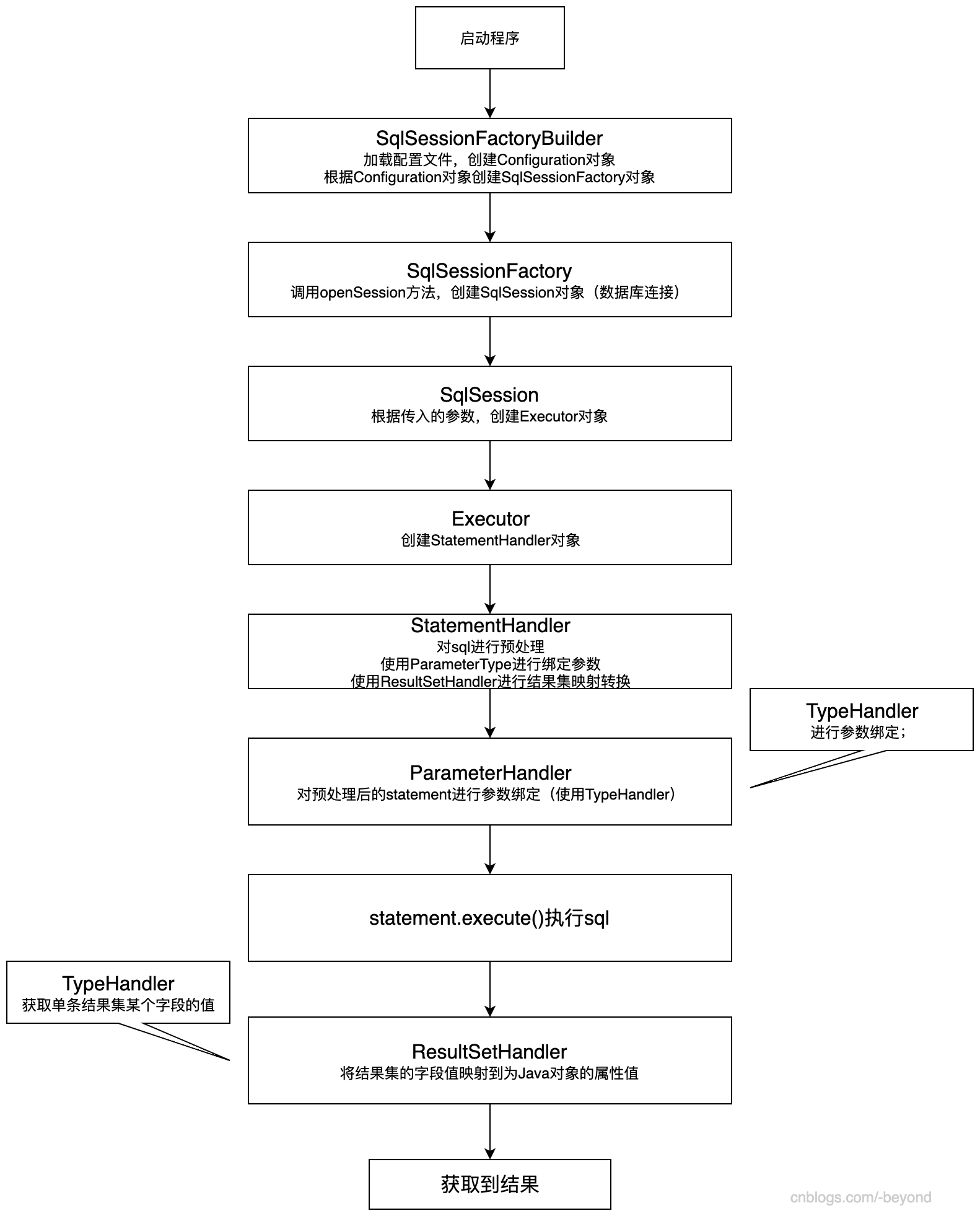
得到代理对象
1.MapperRegistry getMapper
public <T> T getMapper(Class<T> type, SqlSession sqlSession) {
    final MapperProxyFactory<T> mapperProxyFactory = (MapperProxyFactory<T>) knownMappers.get(type);
    if (mapperProxyFactory == null) {
        throw new BindingException("Type " + type + " is not known to the MapperRegistry.");
    }
    try {
        return mapperProxyFactory.newInstance(sqlSession);
    } catch (Exception e) {
        throw new BindingException("Error getting mapper instance. Cause: " + e, e);
    }
}
2.使用jdk动态代理生成接口的代理类
protected T newInstance(MapperProxy<T> mapperProxy) {
    //1.类加载器,2.被代理的接口,3.实现了 InvocationHandler 的触发管理类
    return (T) Proxy.newProxyInstance(mapperInterface.getClassLoader(), new Class[] { mapperInterface }, mapperProxy);
}
3.执行mapper接口方法,到代理类的代理方法invoke里面
@Override
public Object invoke(Object proxy, Method method, Object[] args) throws Throwable {
    try {
        if (Object.class.equals(method.getDeclaringClass())) {
            return method.invoke(this, args);
        } else if (method.isDefault()) {
            if (privateLookupInMethod == null) {
                return invokeDefaultMethodJava8(proxy, method, args);
            } else {
                return invokeDefaultMethodJava9(proxy, method, args);
            }
        }
    } catch (Throwable t) {
        throw ExceptionUtil.unwrapThrowable(t);
    }
    //使用缓存优化效率
    final MapperMethod mapperMethod = cachedMapperMethod(method);
    return mapperMethod.execute(sqlSession, args);
}
private MapperMethod cachedMapperMethod(Method method) {
    //如果key 不存在就,把后面的参数加入进去
    return methodCache.computeIfAbsent(method,
                                       k -> new MapperMethod(mapperInterface, method, sqlSession.getConfiguration()));
}
根据语句的类型进行判断
public Object execute(SqlSession sqlSession, Object[] args) {
    Object result;
    switch (command.getType()) {
        case INSERT: {
            Object param = method.convertArgsToSqlCommandParam(args);
            result = rowCountResult(sqlSession.insert(command.getName(), param));
            break;
        }
        case UPDATE: {
            Object param = method.convertArgsToSqlCommandParam(args);
            result = rowCountResult(sqlSession.update(command.getName(), param));
            break;
        }
        case DELETE: {
            Object param = method.convertArgsToSqlCommandParam(args);
            result = rowCountResult(sqlSession.delete(command.getName(), param));
            break;
        }
        case SELECT:
            if (method.returnsVoid() && method.hasResultHandler()) {
                executeWithResultHandler(sqlSession, args);
                result = null;
            } else if (method.returnsMany()) {
                result = executeForMany(sqlSession, args);
            } else if (method.returnsMap()) {
                result = executeForMap(sqlSession, args);
            } else if (method.returnsCursor()) {
                result = executeForCursor(sqlSession, args);
            } else {
                Object param = method.convertArgsToSqlCommandParam(args);
                result = sqlSession.selectOne(command.getName(), param);
                if (method.returnsOptional()
                    && (result == null || !method.getReturnType().equals(result.getClass()))) {
                    result = Optional.ofNullable(result);
                }
            }
            break;
        case FLUSH:
            result = sqlSession.flushStatements();
            break;
        default:
            throw new BindingException("Unknown execution method for: " + command.getName());
    }
    if (result == null && method.getReturnType().isPrimitive() && !method.returnsVoid()) {
        throw new BindingException("Mapper method '" + command.getName()
                                   + " attempted to return null from a method with a primitive return type (" + method.getReturnType() + ").");
    }
    return result;
}
找到MappedStatement
@Override
public <E> List<E> selectList(String statement, Object parameter, RowBounds rowBounds) {
    try {
        MappedStatement ms = configuration.getMappedStatement(statement);
        return executor.query(ms, wrapCollection(parameter), rowBounds, Executor.NO_RESULT_HANDLER);
    } catch (Exception e) {
        throw ExceptionFactory.wrapException("Error querying database.  Cause: " + e, e);
    } finally {
        ErrorContext.instance().reset();
    }
}
@Override
public <E> List<E> query(MappedStatement ms, Object parameter, RowBounds rowBounds, ResultHandler resultHandler) throws SQLException {
    BoundSql boundSql = ms.getBoundSql(parameter);
    //创建缓存的key
    CacheKey key = createCacheKey(ms, parameter, rowBounds, boundSql);
    return query(ms, parameter, rowBounds, resultHandler, key, boundSql);
}
缓存生成的可以
CacheKey cacheKey = new CacheKey();
cacheKey.update(ms.getId());
cacheKey.update(rowBounds.getOffset());
cacheKey.update(rowBounds.getLimit());
cacheKey.update(boundSql.getSql());
//缓存的key   方法相同,翻页偏移相同,sql相同,参数值相同,数据库环境相同,才会被认为是同一个查询
如果没有开启二级缓存,进入BaseExecutor,执行query方法
  public <E> List<E> query(MappedStatement ms, Object parameter, RowBounds rowBounds, ResultHandler resultHandler, CacheKey key, BoundSql boundSql) throws SQLException {
    ErrorContext.instance().resource(ms.getResource()).activity("executing a query").object(ms.getId());
    if (closed) {
      throw new ExecutorException("Executor was closed.");
    }
    if (queryStack == 0 && ms.isFlushCacheRequired()) {
      clearLocalCache();
    }
    List<E> list;
    try {
      queryStack++;
      list = resultHandler == null ? (List<E>) localCache.getObject(key) : null;
      if (list != null) {
        handleLocallyCachedOutputParameters(ms, key, parameter, boundSql);
      } else {
        list = queryFromDatabase(ms, parameter, rowBounds, resultHandler, key, boundSql);
      }
    } finally {
      queryStack--;
    }
    if (queryStack == 0) {
      for (DeferredLoad deferredLoad : deferredLoads) {
        deferredLoad.load();
      }
      // issue #601
      deferredLoads.clear();
      if (configuration.getLocalCacheScope() == LocalCacheScope.STATEMENT) {
        // issue #482
        clearLocalCache();
      }
    }
    return list;
  }
一级缓存
走BaseExecutor
queryFromDatabase 放入
PerpetualCache
Map
一级缓存失效/清除的情景
1.手动清空缓存(提交,回滚)
2.配置flushCache = true
3.执行update
4.缓存作用域是Statement
Spring整合mybatis后一级缓存失效
未开启事务,mapper每次调用一次方法都会构造一个新的会话。
开启事务后,会用同一个会话。?
二级缓存
二级缓存先于一级缓存处理
事务缓存管理器,事务缓存,缓存暂存区
clearLocalCache
走CachingExecutor
TransactionalCacheManager 事务缓存管理器
TransactionalCache 事务缓存
Cache 二级缓存
Map
事务提交后,缓存才会写入
public class TransactionalCache implements Cache {

  private static final Log log = LogFactory.getLog(TransactionalCache.class);

  private final Cache delegate;
  private boolean clearOnCommit;
  //事务缓存中的暂存区
  private final Map<Object, Object> entriesToAddOnCommit;
  private final Set<Object> entriesMissedInCache;
二级缓存失效/清除的情景
分布式环境,flush标签,更新
插件流程
使用
1.实现Interceptor接口
2.实现接口的方法
3.拦截器类上加注解
//1.被拦截的对象 2.对象的方法 3.对象方法上面的参数
@Intercepts({ @Signature(type = StatementHandler.class, method = "query", args = { Statement.class, ResultHandler.class}) })
public class SQLInterceptor implements Interceptor
4.在mybatis-config.xml中配置
什么样的对象可以被拦截
- Executor (update, query, flushStatements, commit, rollback, getTransaction, close, isClosed)
- ParameterHandler (getParameterObject, setParameters)
- ResultSetHandler (handleResultSets, handleOutputParameters)
- StatementHandler (prepare, parameterize, batch, update, query)
代理类什么时候被创建的
configuration
public ParameterHandler newParameterHandler(MappedStatement mappedStatement,
Object parameterObject, BoundSql boundSql) {
 ParameterHandler parameterHandler =
mappedStatement.getLang().createParameterHandler(mappedStatement,
parameterObject, boundSql);
 // 植入插件逻辑(返回代理对象)
 parameterHandler = (ParameterHandler)
interceptorChain.pluginAll(parameterHandler);
 return parameterHandler;
}
public ResultSetHandler newResultSetHandler(Executor executor, MappedStatement
mappedStatement, RowBounds rowBounds, ParameterHandler parameterHandler,
  ResultHandler resultHandler, BoundSql boundSql) {
 ResultSetHandler resultSetHandler = new DefaultResultSetHandler(executor,
mappedStatement, parameterHandler, resultHandler, boundSql, rowBounds);
 // 植入插件逻辑(返回代理对象)
 resultSetHandler = (ResultSetHandler)
interceptorChain.pluginAll(resultSetHandler);
 return resultSetHandler;
}
public StatementHandler newStatementHandler(Executor executor, MappedStatement
mappedStatement, Object parameterObject, RowBounds rowBounds, ResultHandler
resultHandler, BoundSql boundSql) {
 StatementHandler statementHandler = new RoutingStatementHandler(executor,
mappedStatement, parameterObject, rowBounds, resultHandler, boundSql);
 // 植入插件逻辑(返回代理对象)
 statementHandler = (StatementHandler)
interceptorChain.pluginAll(statementHandler);
 return statementHandler;
}
代理类如何创建的
public interface Interceptor {

  Object intercept(Invocation invocation) throws Throwable;

  default Object plugin(Object target) {
    return Plugin.wrap(target, this);
  }

  default void setProperties(Properties properties) {
    // NOP
  }

}
被代理后的调用顺序
多个代理类的执行顺序
mybatis-spring流程
SqlSessionFactoryBean
@Override
public SqlSessionFactory getObject() throws Exception {
    if (this.sqlSessionFactory == null) {
        afterPropertiesSet();
    }

    return this.sqlSessionFactory;
}
用到的设计模式
模板方法模式—-BaseExecutor
代理模式—-MapperRegistry
责任链模式—plugins
参考资料

若有收获,就点个赞吧
0 人点赞


