
NioServer.java
package io.torey.niotest;import java.io.IOException;import java.net.InetSocketAddress;import java.nio.ByteBuffer;import java.nio.channels.*;import java.nio.charset.Charset;import java.util.Iterator;import java.util.Set;/*** NIO服务器端*/public class NioServer {public static void main(String[] args){NioServer nioServer = new NioServer();try {nioServer.start();} catch (IOException e) {e.printStackTrace();}}/*** 启动*/public void start() throws IOException{//1 创建Selector//2 通过ServerSocketChannel创建channel通道//3 为channel通道绑定监听端口//4 重点:设置channel为非阻塞模式//5 将channel注册到selector上,监听连接事件//6 循环等待新接入的连接//7 根据就绪状态,调用对应方法处理业务逻辑//1 创建SelectorSelector selector = Selector.open();//2 通过ServerSocketChannel创建channel通道ServerSocketChannel serverSocketChannel= ServerSocketChannel.open();//3 为channel通道绑定监听端口serverSocketChannel.bind(new InetSocketAddress(8000));//4 重点:设置channel为非阻塞模式serverSocketChannel.configureBlocking(false);//5 将channel注册到selector上,监听连接事件serverSocketChannel.register(selector,SelectionKey.OP_ACCEPT);System.out.println("服务器启动成功!!");//6 循环等待新接入的连接while (true) {//这个方法是阻塞方法,获取可用的channel数量int readyChannels= selector.select();if (readyChannels==0) {continue;}//获取可用channel的集合Set<SelectionKey> selectionKeys = selector.selectedKeys();Iterator<SelectionKey> iterator = selectionKeys.iterator();while (iterator.hasNext()) {//selectionKey的实例SelectionKey selectionKey = iterator.next();//移除Set中当前的selectionKey,重点iterator.remove();//7 根据就绪状态,调用对应方法处理业务逻辑//如果是 接入事件if (selectionKey.isAcceptable()) {acceptHandler(serverSocketChannel,selector);}//如果是 可读事件if (selectionKey.isReadable()) {readHandler(selectionKey,selector);}}}}/*** 接入事件处理器* @param serverSocketChannel* @param selector* @throws IOException*/private void acceptHandler(ServerSocketChannel serverSocketChannel,Selector selector) throws IOException{//如果要是接入事件,创建socketChannel//将socketChannel设置为非阻塞工作模式//将channel注册到selector上,监听 可读事件//回复客户端提示信息System.out.println("有一个客户端进来了...");//如果要是接入事件,创建socketChannelSocketChannel socketChannel = serverSocketChannel.accept();//将socketChannel设置为非阻塞工作模式socketChannel.configureBlocking(false);//将channel注册到selector上,监听 可读事件socketChannel.register(selector,SelectionKey.OP_READ);//回复客户端提示信息socketChannel.write(Charset.forName("UTF-8").encode("你与聊天室里其他人都不是朋友关系,请注意隐私安全!!"));}/*** 可读事件处理器*/private void readHandler(SelectionKey selectionKey,Selector selector) throws IOException{//要从selectionKey中获取到已经就绪的channel//创建buffer//循环读取客户端请求信息//将channel再次注册到selector上,监听他的可读事件//将客户端发送的请求信息,广播给其他客户端//要从selectionKey中获取到已经就绪的channelSocketChannel socketChannel= (SocketChannel)selectionKey.channel();//创建bufferByteBuffer byteBuffer = ByteBuffer.allocate(1024);//循环读取客户端请求信息StringBuilder reques=new StringBuilder();while (socketChannel.read(byteBuffer) > 0) {//切换buffer为读模式byteBuffer.flip();//读取buffer中的内容reques.append(Charset.forName("UTF-8").decode(byteBuffer));}//将channel再次注册到selector上,监听他的可读事件socketChannel.register(selector,SelectionKey.OP_READ);//将客户端发送的请求信息,广播给其他客户端if (reques.length()>0) {String requesStr = reques.toString();System.out.println("收到客户端消息:"+requesStr);broadCast(selector,socketChannel,requesStr);}}/*** 广播给其他客户端*/private void broadCast(Selector selector,SocketChannel sourceChannel,String request){//获取到所有已接入的客户端channel//循环向所有channel广播消息//获取到所有已接入的客户端channelSet<SelectionKey> selectionKeySet = selector.keys();selectionKeySet.forEach(selectionKey -> {SelectableChannel targetChannel = selectionKey.channel();//需要将发送消息的channel剔除掉,自己发的消息,广播的时候不在给自己发消息if (targetChannel instanceof SocketChannel&& targetChannel!=sourceChannel) {try {//将消息发送到其他客户端((SocketChannel) targetChannel).write(Charset.forName("UTF-8").encode(request));} catch (IOException e) {e.printStackTrace();}}});//循环向所有channel广播消息}}
NioClientHandler.java
package io.torey.niotest;import java.io.IOException;import java.net.InetSocketAddress;import java.nio.ByteBuffer;import java.nio.channels.SelectionKey;import java.nio.channels.Selector;import java.nio.channels.ServerSocketChannel;import java.nio.channels.SocketChannel;import java.nio.charset.Charset;import java.util.Iterator;import java.util.Set;/*** 服务器端线程类,专门接收服务器端响应*/public class NioClientHandler implements Runnable {private Selector selector;public NioClientHandler(Selector selector) {this.selector = selector;}@Overridepublic void run() {try{while (true) {//这个方法是阻塞方法,获取可用的channel数量int readyChannels= selector.select();if (readyChannels==0) {continue;}//获取可用channel的集合Set<SelectionKey> selectionKeys = selector.selectedKeys();Iterator<SelectionKey> iterator = selectionKeys.iterator();while (iterator.hasNext()) {//selectionKey的实例SelectionKey selectionKey = iterator.next();//移除Set中当前的selectionKey,重点iterator.remove();//7 根据就绪状态,调用对应方法处理业务逻辑//如果是 可读事件if (selectionKey.isReadable()) {readHandler(selectionKey,selector);}}}}catch (Exception ex){ex.printStackTrace();}}/*** 可读事件处理器*/private void readHandler(SelectionKey selectionKey,Selector selector) throws IOException {//要从selectionKey中获取到已经就绪的channel//创建buffer//循环读取服务器端请求信息//将channel再次注册到selector上,监听他的可读事件//将服务器端发送的请求信息,广播给其他服务器端//要从selectionKey中获取到已经就绪的channelSocketChannel socketChannel= (SocketChannel)selectionKey.channel();//创建bufferByteBuffer byteBuffer = ByteBuffer.allocate(1024);//循环读取服务器端请求信息StringBuilder response=new StringBuilder();while (socketChannel.read(byteBuffer) > 0) {//切换buffer为读模式byteBuffer.flip();//读取buffer中的内容response.append(Charset.forName("UTF-8").decode(byteBuffer));}//将channel再次注册到selector上,监听他的可读事件socketChannel.register(selector,SelectionKey.OP_READ);//将服务器端发送的请求信息,打印到本地if (response.length()>0) {System.out.println("收到服务器端消息:"+response.toString());}}}
NioClient.java
package io.torey.niotest;import java.io.IOException;import java.net.InetSocketAddress;import java.nio.channels.SelectionKey;import java.nio.channels.Selector;import java.nio.channels.SocketChannel;import java.nio.charset.Charset;import java.util.Scanner;/*** NIO客户端*/public class NioClient {/*** 启动*/public void start(String nickname) throws IOException {//连接服务器端//向服务器端发送数据//接收服务器端相应//连接服务器端SocketChannel socketChannel = SocketChannel.open(new InetSocketAddress("127.0.0.1", 8000));//接收服务器端相应//新开一个线程,专门负责来接收服务器端的相应数据Selector selector = Selector.open();socketChannel.configureBlocking(false);socketChannel.register(selector,SelectionKey.OP_READ);new Thread(new NioClientHandler(selector)).start();//向服务器端发送数据Scanner scanner = new Scanner(System.in);while (scanner.hasNextLine()) {String request =nickname+":"+ scanner.nextLine();if (null!= request&&request.length()>0) {socketChannel.write(Charset.forName("UTF-8").encode(request));}}}}
AClient.java
package io.torey.niotest;import java.io.IOException;public class AClient {public static void main(String[] args) {NioClient client=new NioClient();try {client.start("客户端A");} catch (IOException e) {e.printStackTrace();}}}
BClient.java
package io.torey.niotest;import java.io.IOException;public class AClient {public static void main(String[] args) {NioClient client=new NioClient();try {client.start("客户端B");} catch (IOException e) {e.printStackTrace();}}}
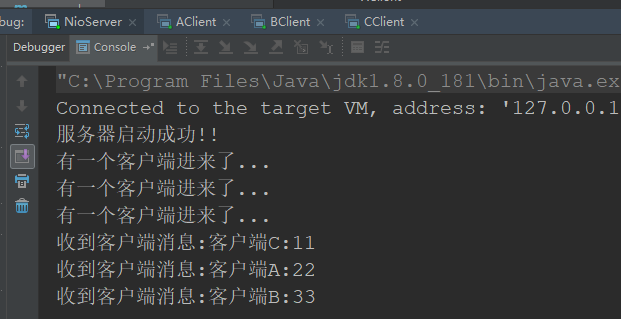
测试截图


若有收获,就点个赞吧
0 人点赞


