Basic behavior of floating point types
/* floats.c* --------* A program to explore the behavior of floating point types for lab.*/#include <float.h>#include <stdbool.h>#include <stdio.h>#include <string.h>// Just a little helper to convert bool to string value when printingstatic char *boolstr(bool b){return b ? "true" : "false";}// helper to display raw float bitsstatic void print_float_bits(float f, const char *name, const char *comment){unsigned int bits = *(unsigned int *)&f; // trick compiler into giving us access to raw bitsunsigned int mask = 1 << 31;printf(" %d ", (mask & bits) != 0); // msb is sign bitfor (int i = 0; i < 8; i++) // next 8 bits are exponentprintf("%d", ((mask >>= 1) & bits) != 0);printf(" ");for (int i = 0; i < 23; i++) // remaining 23 bits are significandprintf("%d", ((mask >>= 1) & bits) != 0);printf(" raw bits of %s ", name);if (!comment) printf("(float value = %g)\n", f);else printf("(%s)\n", comment);}/* Function: float_behavior* ------------------------* Tries various floating point operations and prints results so you can observe beahvior.*/static void float_behavior(){printf("sizeof(float) = %zu FLT_MIN = %g FLT_MAX = %g FLT_DIG = %d (num decimal digits of precision)\n",sizeof(float), FLT_MIN, FLT_MAX, FLT_DIG);printf("sizeof(double) = %zu DBL_MIN = %g DBL_MAX = %g DBL_DIG = %d\n\n",sizeof(double), DBL_MIN, DBL_MAX, DBL_DIG);printf("max * 2 = %g\n", DBL_MAX*2);printf("1.0/0.0 = %g\n", 2.0/0.0);printf("0.0/0.4 = %g\n", 0.0/0.4);double infinity = 1.0/0.0;printf("inf * 2 = %g\n", infinity * 2);printf("inf - inf = %g\n", infinity - infinity);printf("does inf == inf? %s, does inf == -inf? %s\n", boolstr(infinity == infinity), boolstr(infinity == -infinity));double nan = 0.0/0.0;printf("nan * 2 = %g\n", nan * 2);printf("nan - nan = %g\n", nan - nan);printf("does nan == inf? %s, does nan == nan? %s\n", boolstr(nan == infinity), boolstr(nan == nan));}/* Function: float_bits* --------------------* Prints bit patterns for various float values.*/static void float_bits(){unsigned int rawbits = 1;float f = *(float *)&rawbits;printf("\nFloat bit patterns:\n");print_float_bits(FLT_MAX, "FLT_MAX", NULL);print_float_bits(FLT_MIN, "FLT_MIN", NULL);print_float_bits(f, "smallest non-zero denorm", NULL);print_float_bits(1.0/0.0, "Infinity", NULL);print_float_bits(0.0/0.0, "nan", NULL);print_float_bits(1.0, "1.0", NULL);print_float_bits(1.5, "1.5", "how did float bits change from 1.0 to 1.5?");print_float_bits(1.25, "1.25", "how did float bits change from 1.5 to 1.25?");print_float_bits(-1.25, "-1.25", "how did negation change float bits?");print_float_bits(127.0, "127.0", "note bit pattern for integer 127 appears within float bits!");print_float_bits(126.0, "126.0", "how did subtract 1 change float bits?");print_float_bits(126.5, "126.5", "how did add 0.5 change float bits?");print_float_bits(253.0, "253.0", "how did multiply by 2 change float bits of norm?");print_float_bits(f, "smallest non-zero denorm", NULL);print_float_bits(f*2, "denorm*2", "how did multiply by 2 change float bits of min denorm?");print_float_bits(.5, ".5", "2 to power -1");print_float_bits(8, "8", "2 to power 3");print_float_bits(1024, "1024", "2 to power 10");print_float_bits(32768, "32768", "what do normalized powers of two have in common?");}int main(int argc, char *argv[]){float_behavior();float_bits();return 0;}
Float bits


Practice converting normalized floats to decimal
https://www.h-schmidt.net/FloatConverter/IEEE754.html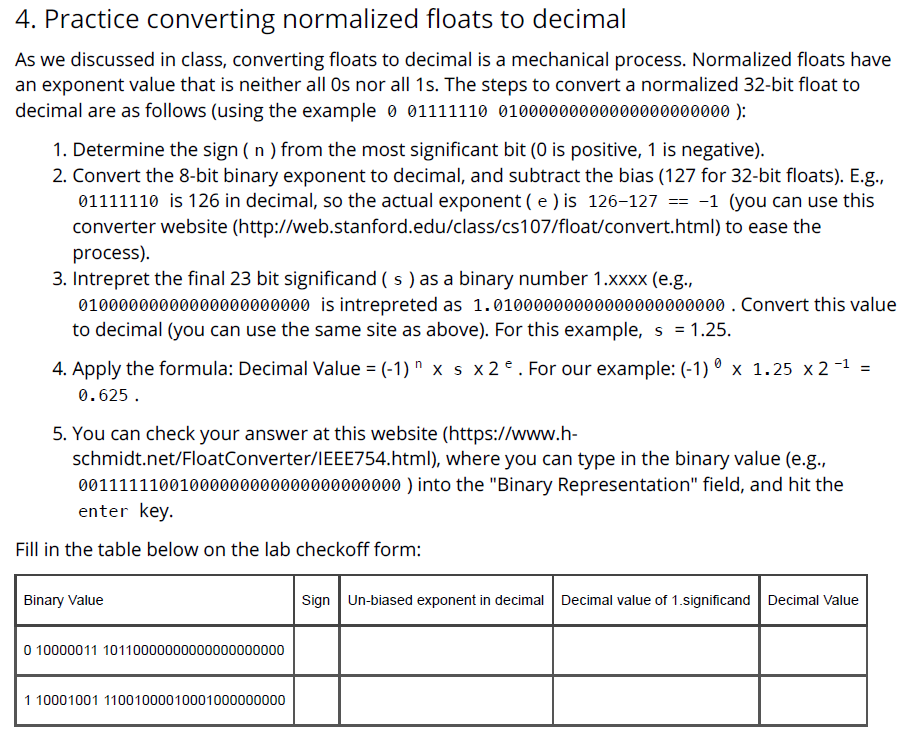
Converting decimal to IEEE floating point representation
http://web.stanford.edu/class/cs107/float/convert.html
Limits of a finite representation (nearest representable floats)

Floating point arithmetic


若有收获,就点个赞吧
0 人点赞


