Vuex
我们在使用Vue.js开发复杂的应用时,经常会遇到多个组件共享同一个状态,亦或是多个组件会去更新同一个状态,在应用代码量较少的时候,我们可以组件间通信去维护修改数据,或者是通过事件总线来进行数据的传递以及修改。但是当应用逐渐庞大以后,代码就会变得难以维护,从父组件开始通过prop传递多层嵌套的数据由于层级过深而显得异常脆弱,而事件总线也会因为组件的增多、代码量的增大而显得交互错综复杂,难以捋清其中的传递关系。
那么为什么我们不能将数据层与组件层抽离开来呢?把数据层放到全局形成一个单一的Store,组件层变得更薄,专门用来进行数据的展示及操作。所有数据的变更都需要经过全局的Store来进行,形成一个单向数据流,使数据变化变得“可预测”。
Vuex是一个专门为Vue.js框架设计的、用于对Vue.js应用程序进行状态管理的库,它借鉴了Flux、redux的基本思想,将共享的数据抽离到全局,以一个单例存放,同时利用Vue.js的响应式机制来进行高效的状态管理与更新。正是因为Vuex使用了Vue.js内部的“响应式机制”,所以Vuex是一个专门为Vue.js设计并与之高度契合的框架(优点是更加简洁高效,缺点是只能跟Vue.js搭配使用)。具体使用方法及API可以参考Vuex的官网。
先来看一下这张Vuex的数据流程图,熟悉Vuex使用的同学应该已经有所了解。
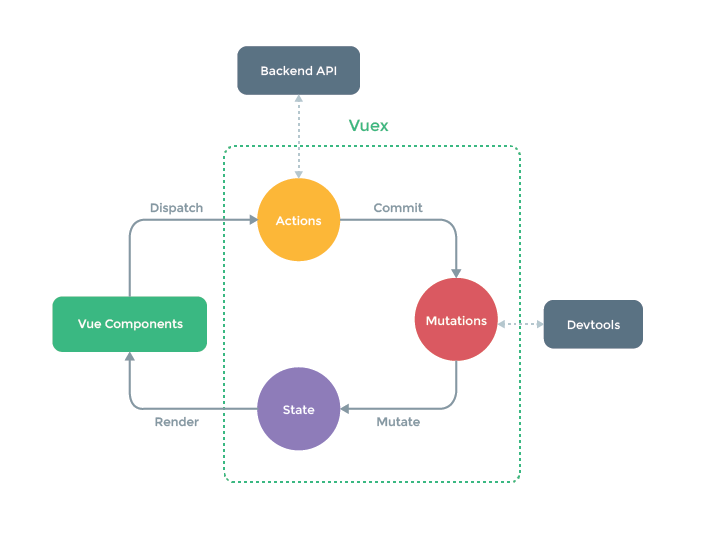
Vuex实现了一个单向数据流,在全局拥有一个State存放数据,所有修改State的操作必须通过Mutation进行,Mutation的同时提供了订阅者模式供外部插件调用获取State数据的更新。所有异步接口需要走Action,常见于调用后端接口异步获取更新数据,而Action也是无法直接修改State的,还是需要通过Mutation来修改State的数据。最后,根据State的变化,渲染到视图上。Vuex运行依赖Vue内部数据双向绑定机制,需要new一个Vue对象来实现“响应式化”,所以Vuex是一个专门为Vue.js设计的状态管理库。
安装
使用过Vuex的朋友一定知道,Vuex的安装十分简单,只需要提供一个store,然后执行下面两句代码即完成的Vuex的引入。
Vue.use(Vuex);/*将store放入Vue创建时的option中*/new Vue({el: '#app',store});
那么问题来了,Vuex是怎样把store注入到Vue实例中去的呢?
Vue.js提供了Vue.use方法用来给Vue.js安装插件,内部通过调用插件的install方法(当插件是一个对象的时候)来进行插件的安装。
我们来看一下Vuex的install实现。
/*暴露给外部的插件install方法,供Vue.use调用安装插件*/export function install (_Vue) {if (Vue) {/*避免重复安装(Vue.use内部也会检测一次是否重复安装同一个插件)*/if (process.env.NODE_ENV !== 'production') {console.error('[vuex] already installed. Vue.use(Vuex) should be called only once.')}return}/*保存Vue,同时用于检测是否重复安装*/Vue = _Vue/*将vuexInit混淆进Vue的beforeCreate(Vue2.0)或_init方法(Vue1.0)*/applyMixin(Vue)}
这段install代码做了两件事情,一件是防止Vuex被重复安装,另一件是执行applyMixin,目的是执行vuexInit方法初始化Vuex。Vuex针对Vue1.0与2.0分别进行了不同的处理,如果是Vue1.0,Vuex会将vuexInit方法放入Vue的_init方法中,而对于Vue2.0,则会将vuexinit混淆进Vue的beforeCreate钩子中。来看一下vuexInit的代码。
/*Vuex的init钩子,会存入每一个Vue实例等钩子列表*/function vuexInit () {const options = this.$options// store injectionif (options.store) {/*存在store其实代表的就是Root节点,直接执行store(function时)或者使用store(非function)*/this.$store = typeof options.store === 'function'? options.store(): options.store} else if (options.parent && options.parent.$store) {/*子组件直接从父组件中获取$store,这样就保证了所有组件都公用了全局的同一份store*/this.$store = options.parent.$store}}
vuexInit会尝试从options中获取store,如果当前组件是根组件(Root节点),则options中会存在store,直接获取赋值给store引用。这样一来,所有的组件都获取到了同一份内存地址的Store实例,于是我们可以在每一个组件中通过this.$store愉快地访问全局的Store实例了。
那么,什么是Store实例?
Store
我们传入到根组件的store,就是Store实例,用Vuex提供的Store方法构造。
export default new Vuex.Store({strict: true,modules: {moduleA,moduleB}});
我们来看一下Store的实现。首先是构造函数。
constructor (options = {}) {// Auto install if it is not done yet and `window` has `Vue`.// To allow users to avoid auto-installation in some cases,// this code should be placed here. See #731/*在浏览器环境下,如果插件还未安装(!Vue即判断是否未安装),则它会自动安装。它允许用户在某些情况下避免自动安装。*/if (!Vue && typeof window !== 'undefined' && window.Vue) {install(window.Vue)}if (process.env.NODE_ENV !== 'production') {assert(Vue, `must call Vue.use(Vuex) before creating a store instance.`)assert(typeof Promise !== 'undefined', `vuex requires a Promise polyfill in this browser.`)assert(this instanceof Store, `Store must be called with the new operator.`)}const {/*一个数组,包含应用在 store 上的插件方法。这些插件直接接收 store 作为唯一参数,可以监听 mutation(用于外部地数据持久化、记录或调试)或者提交 mutation (用于内部数据,例如 websocket 或 某些观察者)*/plugins = [],/*使 Vuex store 进入严格模式,在严格模式下,任何 mutation 处理函数以外修改 Vuex state 都会抛出错误。*/strict = false} = options/*从option中取出state,如果state是function则执行,最终得到一个对象*/let {state = {}} = optionsif (typeof state === 'function') {state = state()}// store internal state/* 用来判断严格模式下是否是用mutation修改state的 */this._committing = false/* 存放action */this._actions = Object.create(null)/* 存放mutation */this._mutations = Object.create(null)/* 存放getter */this._wrappedGetters = Object.create(null)/* module收集器 */this._modules = new ModuleCollection(options)/* 根据namespace存放module */this._modulesNamespaceMap = Object.create(null)/* 存放订阅者 */this._subscribers = []/* 用以实现Watch的Vue实例 */this._watcherVM = new Vue()// bind commit and dispatch to self/*将dispatch与commit调用的this绑定为store对象本身,否则在组件内部this.dispatch时的this会指向组件的vm*/const store = thisconst { dispatch, commit } = this/* 为dispatch与commit绑定this(Store实例本身) */this.dispatch = function boundDispatch (type, payload) {return dispatch.call(store, type, payload)}this.commit = function boundCommit (type, payload, options) {return commit.call(store, type, payload, options)}// strict mode/*严格模式(使 Vuex store 进入严格模式,在严格模式下,任何 mutation 处理函数以外修改 Vuex state 都会抛出错误)*/this.strict = strict// init root module.// this also recursively registers all sub-modules// and collects all module getters inside this._wrappedGetters/*初始化根module,这也同时递归注册了所有子module,收集所有module的getter到_wrappedGetters中去,this._modules.root代表根module才独有保存的Module对象*/installModule(this, state, [], this._modules.root)// initialize the store vm, which is responsible for the reactivity// (also registers _wrappedGetters as computed properties)/* 通过vm重设store,新建Vue对象使用Vue内部的响应式实现注册state以及computed */resetStoreVM(this, state)// apply plugins/* 调用插件 */plugins.forEach(plugin => plugin(this))/* devtool插件 */if (Vue.config.devtools) {devtoolPlugin(this)}}
Store的构造类除了初始化一些内部变量以外,主要执行了installModule(初始化module)以及resetStoreVM(通过VM使store“响应式”)。
installModule
installModule的作用主要是为module加上namespace名字空间(如果有)后,注册mutation、action以及getter,同时递归安装所有子module。
/*初始化module*/function installModule (store, rootState, path, module, hot) {/* 是否是根module */const isRoot = !path.length/* 获取module的namespace */const namespace = store._modules.getNamespace(path)// register in namespace map/* 如果有namespace则在_modulesNamespaceMap中注册 */if (module.namespaced) {store._modulesNamespaceMap[namespace] = module}// set stateif (!isRoot && !hot) {/* 获取父级的state */const parentState = getNestedState(rootState, path.slice(0, -1))/* module的name */const moduleName = path[path.length - 1]store.`_withCommit`(() => {/* 将子module设成响应式的 */Vue.set(parentState, moduleName, module.state)})}const local = module.context = makeLocalContext(store, namespace, path)/* 遍历注册mutation */module.forEachMutation((mutation, key) => {const namespacedType = namespace + keyregisterMutation(store, namespacedType, mutation, local)})/* 遍历注册action */module.forEachAction((action, key) => {const namespacedType = namespace + keyregisterAction(store, namespacedType, action, local)})/* 遍历注册getter */module.forEachGetter((getter, key) => {const namespacedType = namespace + keyregisterGetter(store, namespacedType, getter, local)})/* 递归安装mudule */module.forEachChild((child, key) => {installModule(store, rootState, path.concat(key), child, hot)})}
resetStoreVM
在说resetStoreVM之前,先来看一个小demo。
let globalData = {d: 'hello world'};new Vue({data () {return {$$state: {globalData}}}});/* modify */setTimeout(() => {globalData.d = 'hi~';}, 1000);Vue.prototype.globalData = globalData;/* 任意模板中 */<div>{{globalData.d}}</div>
上述代码在全局有一个globalData,它被传入一个Vue对象的data中,之后在任意Vue模板中对该变量进行展示,因为此时globalData已经在Vue的prototype上了所以直接通过this.prototype访问,也就是在模板中的{{prototype.d}}。此时,setTimeout在1s之后将globalData.d进行修改,我们发现模板中的globalData.d发生了变化。其实上述部分就是Vuex依赖Vue核心实现数据的“响应式化”。
不熟悉Vue.js响应式原理的同学可以通过笔者另一篇文章响应式原理了解Vue.js是如何进行数据双向绑定的。
接着来看代码。
/* 通过vm重设store,新建Vue对象使用Vue内部的响应式实现注册state以及computed */function resetStoreVM (store, state, hot) {/* 存放之前的vm对象 */const oldVm = store._vm// bind store public gettersstore.getters = {}const wrappedGetters = store._wrappedGettersconst computed = {}/* 通过Object.defineProperty为每一个getter方法设置get方法,比如获取this.$store.getters.test的时候获取的是store._vm.test,也就是Vue对象的computed属性 */forEachValue(wrappedGetters, (fn, key) => {// use computed to leverage its lazy-caching mechanismcomputed[key] = () => fn(store)Object.defineProperty(store.getters, key, {get: () => store._vm[key],enumerable: true // for local getters})})// use a Vue instance to store the state tree// suppress warnings just in case the user has added// some funky global mixinsconst silent = Vue.config.silent/* Vue.config.silent暂时设置为true的目的是在new一个Vue实例的过程中不会报出一切警告 */Vue.config.silent = true/* 这里new了一个Vue对象,运用Vue内部的响应式实现注册state以及computed*/store._vm = new Vue({data: {$$state: state},computed})Vue.config.silent = silent// enable strict mode for new vm/* 使能严格模式,保证修改store只能通过mutation */if (store.strict) {enableStrictMode(store)}if (oldVm) {/* 解除旧vm的state的引用,以及销毁旧的Vue对象 */if (hot) {// dispatch changes in all subscribed watchers// to force getter re-evaluation for hot reloading.store._withCommit(() => {oldVm._data.$$state = null})}Vue.nextTick(() => oldVm.$destroy())}}
resetStoreVM首先会遍历wrappedGetters,使用Object.defineProperty方法为每一个getter绑定上get方法,这样我们就可以在组件里访问this.$store.getters.test就等同于访问store._vm.test。
forEachValue(wrappedGetters, (fn, key) => {// use computed to leverage its lazy-caching mechanismcomputed[key] = () => fn(store)Object.defineProperty(store.getters, key, {get: () => store._vm[key],enumerable: true // for local getters})})
之后Vuex采用了new一个Vue对象来实现数据的“响应式化”,运用Vue.js内部提供的数据双向绑定功能来实现store的数据与视图的同步更新。
store._vm = new Vue({data: {$$state: state},computed})
这时候我们访问store._vm.test也就访问了Vue实例中的属性。
这两步执行完以后,我们就可以通过this.$store.getter.test访问vm中的test属性了。
严格模式
Vuex的Store构造类的option有一个strict的参数,可以控制Vuex执行严格模式,严格模式下,所有修改state的操作必须通过mutation实现,否则会抛出错误。
/* 使能严格模式 */function enableStrictMode (store) {store._vm.$watch(function () { return this._data.$$state }, () => {if (process.env.NODE_ENV !== 'production') {/* 检测store中的_committing的值,如果是false代表不是通过mutation的方法修改的 */assert(store._committing, `Do not mutate vuex store state outside mutation handlers.`)}}, { deep: true, sync: true })}
首先,在严格模式下,Vuex会利用vm的$state,也就是Store的state,在它被修改的时候进入回调。我们发现,回调中只有一句话,用assert断言来检测store._committing,当store._committing为false的时候会触发断言,抛出异常。
我们发现,Store的commit方法中,执行mutation的语句是这样的。
this._withCommit(() => {entry.forEach(function commitIterator (handler) {handler(payload)})})
再来看看_withCommit的实现。
_withCommit (fn) {/* 调用withCommit修改state的值时会将store的committing值置为true,内部会有断言检查该值,在严格模式下只允许使用mutation来修改store中的值,而不允许直接修改store的数值 */const committing = this._committingthis._committing = truefn()this._committing = committing}
我们发现,通过commit(mutation)修改state数据的时候,会在调用mutation方法之前将committing置为true,接下来再通过mutation函数修改state中的数据,这时候触发watch的回调执行断言,这时committing为false,则会抛出异常。这就是Vuex的严格模式的实现。
接下来我们来看看Store提供的一些API。
commit(mutation)
/* 调用mutation的commit方法 */commit (_type, _payload, _options) {// check object-style commit/* 校验参数 */const {type,payload,options} = unifyObjectStyle(_type, _payload, _options)const mutation = { type, payload }/* 取出type对应的mutation的方法 */const entry = this._mutations[type]if (!entry) {if (process.env.NODE_ENV !== 'production') {console.error(`[vuex] unknown mutation type: ${type}`)}return}/* 执行mutation中的所有方法 */this._withCommit(() => {entry.forEach(function commitIterator (handler) {handler(payload)})})/* 通知所有订阅者 */this._subscribers.forEach(sub => sub(mutation, this.state))if (process.env.NODE_ENV !== 'production' &&options && options.silent) {console.warn(`[vuex] mutation type: ${type}. Silent option has been removed. ` +'Use the filter functionality in the vue-devtools')}}
commit方法会根据type找到并调用_mutations中的所有type对应的mutation方法,所以当没有namespace的时候,commit方法会触发所有module中的mutation方法。再执行完所有的mutation之后会执行_subscribers中的所有订阅者。我们来看一下_subscribers是什么。
Store给外部提供了一个subscribe方法,用以注册一个订阅函数,会push到Store实例的_subscribers中,同时返回一个从_subscribers中注销该订阅者的方法。
/* 注册一个订阅函数,返回取消订阅的函数 */subscribe (fn) {const subs = this._subscribersif (subs.indexOf(fn) < 0) {subs.push(fn)}return () => {const i = subs.indexOf(fn)if (i > -1) {subs.splice(i, 1)}}}
在commit结束以后则会调用这些_subscribers中的订阅者,这个订阅者模式提供给外部一个监视state变化的可能。state通过mutation改变时,可以有效补获这些变化。
dispatch(action)
来看一下dispatch的实现。
/* 调用action的dispatch方法 */dispatch (_type, _payload) {// check object-style dispatchconst {type,payload} = unifyObjectStyle(_type, _payload)/* actions中取出type对应的action */const entry = this._actions[type]if (!entry) {if (process.env.NODE_ENV !== 'production') {console.error(`[vuex] unknown action type: ${type}`)}return}/* 是数组则包装Promise形成一个新的Promise,只有一个则直接返回第0个 */return entry.length > 1? Promise.all(entry.map(handler => handler(payload))): entry[0](payload)}
以及registerAction时候做的事情。
/* 遍历注册action */function registerAction (store, type, handler, local) {/* 取出type对应的action */const entry = store._actions[type] || (store._actions[type] = [])entry.push(function wrappedActionHandler (payload, cb) {let res = handler.call(store, {dispatch: local.dispatch,commit: local.commit,getters: local.getters,state: local.state,rootGetters: store.getters,rootState: store.state}, payload, cb)/* 判断是否是Promise */if (!isPromise(res)) {/* 不是Promise对象的时候转化称Promise对象 */res = Promise.resolve(res)}if (store._devtoolHook) {/* 存在devtool插件的时候触发vuex的error给devtool */return res.catch(err => {store._devtoolHook.emit('vuex:error', err)throw err})} else {return res}})}
因为registerAction的时候将push进_actions的action进行了一层封装(wrappedActionHandler),所以我们在进行dispatch的第一个参数中获取state、commit等方法。之后,执行结果res会被进行判断是否是Promise,不是则会进行一层封装,将其转化成Promise对象。dispatch时则从_actions中取出,只有一个的时候直接返回,否则用Promise.all处理再返回。
watch
/* 观察一个getter方法 */watch (getter, cb, options) {if (process.env.NODE_ENV !== 'production') {assert(typeof getter === 'function', `store.watch only accepts a function.`)}return this._watcherVM.$watch(() => getter(this.state, this.getters), cb, options)}
熟悉Vue的朋友应该很熟悉watch这个方法。这里采用了比较巧妙的设计,_watcherVM是一个Vue的实例,所以watch就可以直接采用了Vue内部的watch特性提供了一种观察数据getter变动的方法。
registerModule
/* 注册一个动态module,当业务进行异步加载的时候,可以通过该接口进行注册动态module */registerModule (path, rawModule) {/* 转化称Array */if (typeof path === 'string') path = [path]if (process.env.NODE_ENV !== 'production') {assert(Array.isArray(path), `module path must be a string or an Array.`)assert(path.length > 0, 'cannot register the root module by using registerModule.')}/*注册*/this._modules.register(path, rawModule)/*初始化module*/installModule(this, this.state, path, this._modules.get(path))// reset store to update getters.../* 通过vm重设store,新建Vue对象使用Vue内部的响应式实现注册state以及computed */resetStoreVM(this, this.state)}
registerModule用以注册一个动态模块,也就是在store创建以后再注册模块的时候用该接口。内部实现实际上也只有installModule与resetStoreVM两个步骤,前面已经讲过,这里不再累述。
unregisterModule
/* 注销一个动态module */unregisterModule (path) {/* 转化称Array */if (typeof path === 'string') path = [path]if (process.env.NODE_ENV !== 'production') {assert(Array.isArray(path), `module path must be a string or an Array.`)}/*注销*/this._modules.unregister(path)this._withCommit(() => {/* 获取父级的state */const parentState = getNestedState(this.state, path.slice(0, -1))/* 从父级中删除 */Vue.delete(parentState, path[path.length - 1])})/* 重制store */resetStore(this)}
同样,与registerModule对应的方法unregisterModule,动态注销模块。实现方法是先从state中删除模块,然后用resetStore来重制store。
resetStore
/* 重制store */function resetStore (store, hot) {store._actions = Object.create(null)store._mutations = Object.create(null)store._wrappedGetters = Object.create(null)store._modulesNamespaceMap = Object.create(null)const state = store.state// init all modulesinstallModule(store, state, [], store._modules.root, true)// reset vmresetStoreVM(store, state, hot)}
这里的resetStore其实也就是将store中的_actions等进行初始化以后,重新执行installModule与resetStoreVM来初始化module以及用Vue特性使其“响应式化”,这跟构造函数中的是一致的。
插件
Vue提供了一个非常好用的插件Vue.js devtools
/* 从window对象的__VUE_DEVTOOLS_GLOBAL_HOOK__中获取devtool插件 */const devtoolHook =typeof window !== 'undefined' &&window.__VUE_DEVTOOLS_GLOBAL_HOOK__export default function devtoolPlugin (store) {if (!devtoolHook) return/* devtoll插件实例存储在store的_devtoolHook上 */store._devtoolHook = devtoolHook/* 出发vuex的初始化事件,并将store的引用地址传给deltool插件,使插件获取store的实例 */devtoolHook.emit('vuex:init', store)/* 监听travel-to-state事件 */devtoolHook.on('vuex:travel-to-state', targetState => {/* 重制state */store.replaceState(targetState)})/* 订阅store的变化 */store.subscribe((mutation, state) => {devtoolHook.emit('vuex:mutation', mutation, state)})}
如果已经安装了该插件,则会在windows对象上暴露一个VUE_DEVTOOLS_GLOBAL_HOOK。devtoolHook用在初始化的时候会触发“vuex:init”事件通知插件,然后通过on方法监听“vuex:travel-to-state”事件来重置state。最后通过Store的subscribe方法来添加一个订阅者,在触发commit方法修改mutation数据以后,该订阅者会被通知,从而触发“vuex:mutation”事件。
最后
Vuex是一个非常优秀的库,代码量不多且结构清晰,非常适合研究学习其内部实现。最近的一系列源码阅读也使我自己受益匪浅,写这篇文章也希望可以帮助到更多想要学习探索Vuex内部实现原理的同学。

若有收获,就点个赞吧
0 人点赞


