面试中最好将题目的图结构转化成自己习惯使用的图结构,然后使用下面的算法模板
public class Graph {public HashMap<Integer,Node> nodes; // Integer点的编号 Node点的数据public HashSet<Edge> edges;public Graph() {nodes = new HashMap<>();edges = new HashSet<>();}}public class Node {public int value;public int in; // 有几个点连向此点,入度public int out; // 此点连向其它点的个数,出度。无向图的入度和出度都一样public ArrayList<Node> nexts; // 与此点直接连接的点,并且是此点发散出去的。public ArrayList<Edge> edges;public Node(int value) {this.value = value;in = 0;out = 0;nexts = new ArrayList<>();edges = new ArrayList<>();}}public class Edge {public int weight;public Node from;public Node to;public Edge(int weight, Node from, Node to) {this.weight = weight;this.from = from;this.to = to;}}public class GraphGenerator {public static Graph createGraph(Integer[][] matrix) {Graph graph = new Graph();for (int i = 0; i < matrix.length; i++) {Integer weight = matrix[i][0];Integer from = matrix[i][1];Integer to = matrix[i][2];if (!graph.nodes.containsKey(from)) {graph.nodes.put(from, new Node(from));}if (!graph.nodes.containsKey(to)) {graph.nodes.put(to, new Node(to));}Node fromNode = graph.nodes.get(from);Node toNode = graph.nodes.get(to);Edge newEdge = new Edge(weight, fromNode, toNode);fromNode.nexts.add(toNode);fromNode.out++;toNode.in++;fromNode.edges.add(newEdge);graph.edges.add(newEdge);}return graph;}}
图的宽度优先遍历
- 利用队列实现
- 从源节点开始依次按照宽度进队列,然后弹出
- 每弹出一个点,把该节点所有没有进过队列的邻接点放入队列
直到队列变空
public static void bfs(Node node) {
     if (node == null) {
         return;
     }
     Queue<Node> queue = new LinkedList<>();
     HashSet<Node> map = new HashSet<>();
     queue.add(node);
     map.add(node);
     while (!queue.isEmpty()) {
         Node cur = queue.poll();
         System.out.println(cur.value);
         for (Node next : cur.nexts) {
             if (!map.contains(next)) {
                 map.add(next);
                 queue.add(next);
             }
         }
     }
 }
广度优先遍历
利用栈实现
- 从源节点开始把节点按照深度放入栈,然后弹出
- 每弹出一个点,把该节点下一个没有进过栈的邻接点放入栈
- 直到栈变空
public static void dfs(Node node) {
     if (node == null) {
         return;
     }
     Stack<Node> stack = new Stack<>();
     HashSet<Node> set = new HashSet<>();
     stack.add(node);
     set.add(node);
     System.out.println(node.value);
     while (!stack.isEmpty()) {
         Node cur = stack.pop();
         for (Node next : cur.nexts) {
             if (!set.contains(next)) {
                 stack.push(cur);
                 stack.push(next);
                 set.add(next);
                 System.out.println(next.value);
                 break;
             }
         }
     }
 }
拓扑排序算法
适用范围:要求有向图,且有入度为0的节点,且没有环
public static List<Node> sortedTopology(Graph graph) {
        HashMap<Node, Integer> inMap = new HashMap<>();
        Queue<Node> zeroInQueue = new LinkedList<>();
        for (Node node : graph.nodes.values()) {
            inMap.put(node, node.in);
            if (node.in == 0) {
                zeroInQueue.add(node);
            }
        }
        List<Node> result = new ArrayList<>();
        while (!zeroInQueue.isEmpty()) {
            Node cur = zeroInQueue.poll();
            result.add(cur);
            for (Node next : cur.nexts) {
                inMap.put(next, inMap.get(next) - 1);
                if (inMap.get(next) == 0) {
                    zeroInQueue.add(next);
                }
            }
        }
        return result;
    }
最小生成树
由生成树定义可知,无向连通图的生成树不是唯一 的,于是最小生成树的定义诞生,即:无向连通图是一个带权图,她的所有生成树中必有一棵边的权值总和最小的生成树(称为:最小代价生成树,即:最小生成树)
综合来说:
- Prim算法时间复杂度(O(n^n))当顶点较少时选择;
- Kruskal算法时间复杂度(O(e*loge))主要耗费在边的排序上,故当边较少时适合选择
首先将每一个点放到一个集合里,然后找到与它连接的另一个点,看看是否是相同的集合如果是,则不要,不是则将两个集合合并成一个,要这两个点连接成的边。
下面这种方式利用了并差集,需要研究
可以用MySet代替UnionFind
public static class MySet {
        public HashMap<Node, List<Node>> setMap = new HashMap<>();

        public MySet (List<Node> nodes) {
            for (Node node : nodes) {
                ArrayList<Node> arrayList = new ArrayList<Node>();
                arrayList.add(node);
                setMap.put(node, arrayList);
            }
        }

        public boolean isSameSet (Node from,Node to) {
            List<Node> fromSet = setMap.get(from);
            List<Node> toSet = setMap.get(to);
            return fromSet == toSet;
        }

        public void union (Node from,Node to) {
            List<Node> fromSet = setMap.get(from);
            List<Node> toSet = setMap.get(to);
            for (Node node : toSet) {
                fromSet.add(to);
                setMap.put(node, fromSet);
            }
        }
    }
    // Union-Find Set
    public static class UnionFind {
        private HashMap<Node, Node> fatherMap;
        private HashMap<Node, Integer> rankMap;

        public UnionFind() {
            fatherMap = new HashMap<Node, Node>();
            rankMap = new HashMap<Node, Integer>();
        }

        private Node findFather(Node n) {
            Node father = fatherMap.get(n);
            if (father != n) {
                father = findFather(father);
            }
            fatherMap.put(n, father);
            return father;
        }

        public void makeSets(Collection<Node> nodes) {
            fatherMap.clear();
            rankMap.clear();
            for (Node node : nodes) {
                fatherMap.put(node, node);
                rankMap.put(node, 1);
            }
        }

        public boolean isSameSet(Node a, Node b) {
            return findFather(a) == findFather(b);
        }

        public void union(Node a, Node b) {
            if (a == null || b == null) {
                return;
            }
            Node aFather = findFather(a);
            Node bFather = findFather(b);
            if (aFather != bFather) {
                int aFrank = rankMap.get(aFather);
                int bFrank = rankMap.get(bFather);
                if (aFrank <= bFrank) {
                    fatherMap.put(aFather, bFather);
                    rankMap.put(bFather, aFrank + bFrank);
                } else {
                    fatherMap.put(bFather, aFather);
                    rankMap.put(aFather, aFrank + bFrank);
                }
            }
        }
    }

    public static class EdgeComparator implements Comparator<Edge> {

        @Override
        public int compare(Edge o1, Edge o2) {
            return o1.weight - o2.weight;
        }

    }

    public static Set<Edge> kruskalMST(Graph graph) {
        UnionFind unionFind = new UnionFind();
        unionFind.makeSets(graph.nodes.values());
        // 讲所有的边按照权值从小到大排序
        PriorityQueue<Edge> priorityQueue = new PriorityQueue<>(new EdgeComparator());
        for (Edge edge : graph.edges) {
            priorityQueue.add(edge);
        }
        Set<Edge> result = new HashSet<>();
        while (!priorityQueue.isEmpty()) {
            Edge edge = priorityQueue.poll();
            if (!unionFind.isSameSet(edge.from, edge.to)) {
                result.add(edge);
                unionFind.union(edge.from, edge.to);
            }
        }
        return result;
    }
Prim算法
目的:求最小生成树 适用范围:要求无向图
先找到一个点,然后找该点与其它点连接权值最小的,且被连接点没有走过的。
public static class EdgeComparator implements Comparator<Edge> {

        @Override
        public int compare(Edge o1, Edge o2) {
            return o1.weight - o2.weight;
        }

    }

    public static Set<Edge> primMST(Graph graph) {
        PriorityQueue<Edge> priorityQueue = new PriorityQueue<>(
                new EdgeComparator());
        HashSet<Node> set = new HashSet<>();
        Set<Edge> result = new HashSet<>();
        for (Node node : graph.nodes.values()) { // 防止此图是由多个大片图连接成的
            if (!set.contains(node)) {
                set.add(node);
                for (Edge edge : node.edges) {
                    priorityQueue.add(edge);
                }
                while (!priorityQueue.isEmpty()) {
                    Edge edge = priorityQueue.poll();
                    Node toNode = edge.to;
                    if (!set.contains(toNode)) {
                        set.add(toNode);
                        result.add(edge);
                        for (Edge nextEdge : toNode.edges) {
                            priorityQueue.add(nextEdge);
                        }
                    }
                }
            }
        }
        return result;
    }
Dijkstra算法
目的:找最短路径 适用范围:可以有权值为负数的边,不能有累加和权值为负数的环。
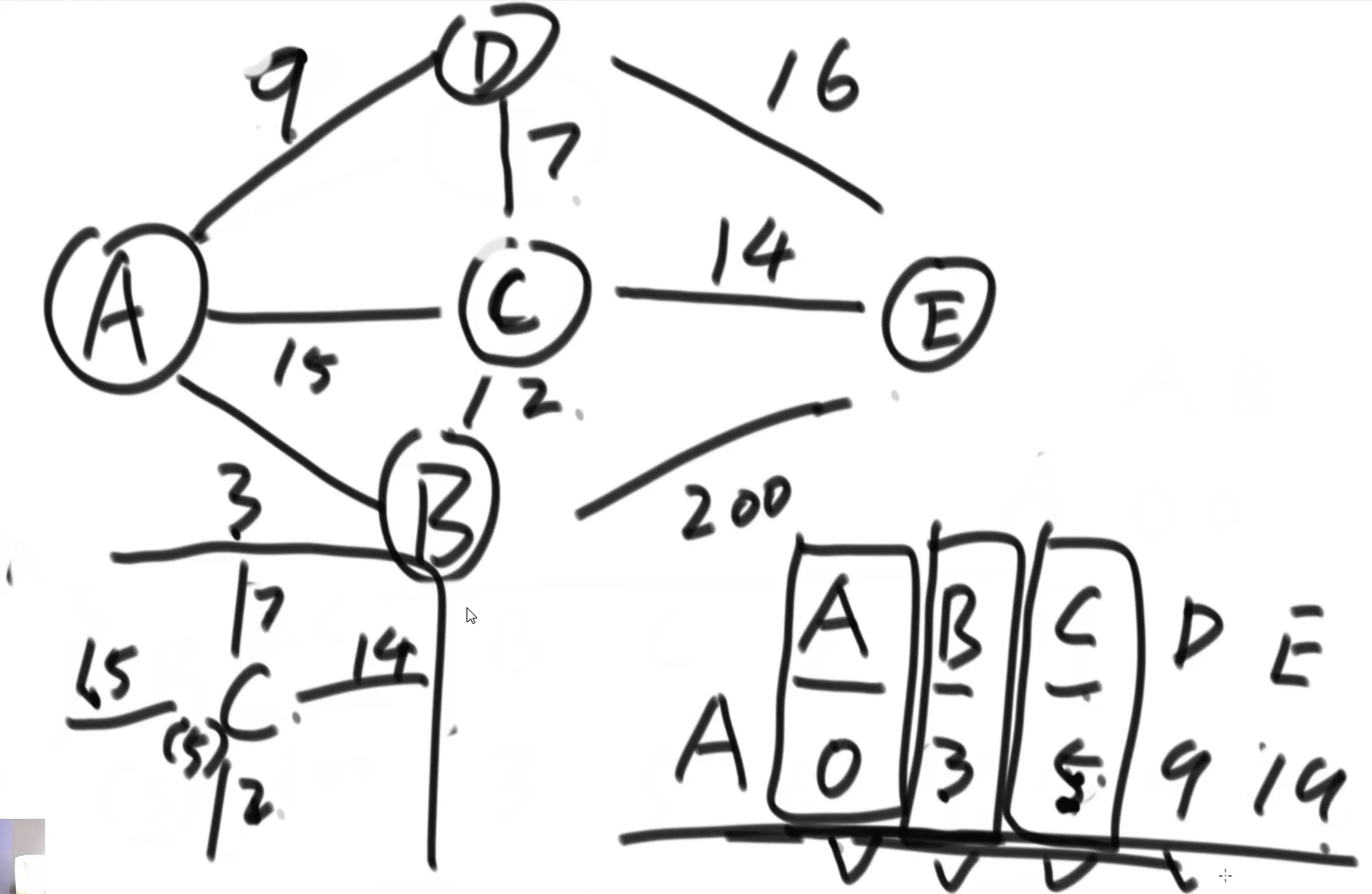
public static HashMap<Node, Integer> dijkstra1(Node head) {
        // 从head出发到所有点的最小距离
        // key: 从head出发到达key
        // value: 从head出发到达key的最小距离
        // 如果在表中,没有T的记录,含义是从head出发到T这个点的距离为正无穷
        HashMap<Node, Integer> distanceMap = new HashMap<>();
        distanceMap.put(head, 0);
        // 已经求过距离的节点,存在selectedNodes中,以后再也不碰
        HashSet<Node> selectedNodes = new HashSet<>();

        Node minNode = getMinDistanceAndUnselectedNode(distanceMap, selectedNodes);
        while (minNode != null) {
            int distance = distanceMap.get(minNode);
            for (Edge edge : minNode.edges) {
                Node toNode = edge.to;
                if (!distanceMap.containsKey(toNode)) {
                    distanceMap.put(toNode, distance + edge.weight);
                }
                distanceMap.put(edge.to, Math.min(distanceMap.get(toNode), distance + edge.weight));
            }
            selectedNodes.add(minNode);
            minNode = getMinDistanceAndUnselectedNode(distanceMap, selectedNodes);
        }
        return distanceMap;
    }

    public static Node getMinDistanceAndUnselectedNode(HashMap<Node, Integer> distanceMap,
            HashSet<Node> touchedNodes) {
        Node minNode = null;
        int minDistance = Integer.MAX_VALUE;
        for (Entry<Node, Integer> entry : distanceMap.entrySet()) {
            Node node = entry.getKey();
            int distance = entry.getValue();
            if (!touchedNodes.contains(node) && distance < minDistance) {
                minNode = node;
                minDistance = distance;
            }
        }
        return minNode;
    }
一定要会自定义重写堆,下面有例子
// no negative weight
public class Dijkstra {

    public static HashMap<Node, Integer> dijkstra1(Node head) {
        HashMap<Node, Integer> distanceMap = new HashMap<>();
        distanceMap.put(head, 0);
        HashSet<Node> selectedNodes = new HashSet<>();

        Node minNode = getMinDistanceAndUnselectedNode(distanceMap, selectedNodes);
        while (minNode != null) {
            int distance = distanceMap.get(minNode);
            for (Edge edge : minNode.edges) {
                Node toNode = edge.to;
                if (!distanceMap.containsKey(toNode)) {
                    distanceMap.put(toNode, distance + edge.weight);
                }
                distanceMap.put(edge.to, Math.min(distanceMap.get(toNode), distance + edge.weight));
            }
            selectedNodes.add(minNode);
            minNode = getMinDistanceAndUnselectedNode(distanceMap, selectedNodes);
        }
        return distanceMap;
    }

    public static Node getMinDistanceAndUnselectedNode(HashMap<Node, Integer> distanceMap,
            HashSet<Node> touchedNodes) {
        Node minNode = null;
        int minDistance = Integer.MAX_VALUE;
        for (Entry<Node, Integer> entry : distanceMap.entrySet()) {
            Node node = entry.getKey();
            int distance = entry.getValue();
            if (!touchedNodes.contains(node) && distance < minDistance) {
                minNode = node;
                minDistance = distance;
            }
        }
        return minNode;
    }

    public static class NodeRecord {
        public Node node;
        public int distance;

        public NodeRecord(Node node, int distance) {
            this.node = node;
            this.distance = distance;
        }
    }
    // 改进后的算法用自定义的堆
    // 一定要会自己重写堆
    public static class NodeHeap {
        private Node[] nodes;
        private HashMap<Node, Integer> heapIndexMap;
        private HashMap<Node, Integer> distanceMap;
        private int size;

        public NodeHeap(int size) {
            nodes = new Node[size];
            heapIndexMap = new HashMap<>();
            distanceMap = new HashMap<>();
            this.size = 0;
        }

        public boolean isEmpty() {
            return size == 0;
        }

        public void addOrUpdateOrIgnore(Node node, int distance) {
            if (inHeap(node)) {
                distanceMap.put(node, Math.min(distanceMap.get(node), distance));
                insertHeapify(node, heapIndexMap.get(node));
            }
            if (!isEntered(node)) {
                nodes[size] = node;
                heapIndexMap.put(node, size);
                distanceMap.put(node, distance);
                insertHeapify(node, size++);
            }
        }

        public NodeRecord pop() {
            NodeRecord nodeRecord = new NodeRecord(nodes[0], distanceMap.get(nodes[0]));
            swap(0, size - 1);
            heapIndexMap.put(nodes[size - 1], -1);
            distanceMap.remove(nodes[size - 1]);
            nodes[size - 1] = null;
            heapify(0, --size);
            return nodeRecord;
        }

        private void insertHeapify(Node node, int index) {
            while (distanceMap.get(nodes[index]) < distanceMap.get(nodes[(index - 1) / 2])) {
                swap(index, (index - 1) / 2);
                index = (index - 1) / 2;
            }
        }

        private void heapify(int index, int size) {
            int left = index * 2 + 1;
            while (left < size) {
                int smallest = left + 1 < size && distanceMap.get(nodes[left + 1]) < distanceMap.get(nodes[left])
                        ? left + 1 : left;
                smallest = distanceMap.get(nodes[smallest]) < distanceMap.get(nodes[index]) ? smallest : index;
                if (smallest == index) {
                    break;
                }
                swap(smallest, index);
                index = smallest;
                left = index * 2 + 1;
            }
        }

        private boolean isEntered(Node node) {
            return heapIndexMap.containsKey(node);
        }

        private boolean inHeap(Node node) {
            return isEntered(node) && heapIndexMap.get(node) != -1;
        }

        private void swap(int index1, int index2) {
            heapIndexMap.put(nodes[index1], index2);
            heapIndexMap.put(nodes[index2], index1);
            Node tmp = nodes[index1];
            nodes[index1] = nodes[index2];
            nodes[index2] = tmp;
        }
    }
    // 改进后的算法
    // 从head出发,所有head能到达的节点,生成到达每个节点的最小路径记录并返回
    public static HashMap<Node, Integer> dijkstra2(Node head, int size) {
        NodeHeap nodeHeap = new NodeHeap(size);
        nodeHeap.addOrUpdateOrIgnore(head, 0);
        HashMap<Node, Integer> result = new HashMap<>();
        while (!nodeHeap.isEmpty()) {
            NodeRecord record = nodeHeap.pop();
            Node cur = record.node;
            int distance = record.distance;
            for (Edge edge : cur.edges) {
                nodeHeap.addOrUpdateOrIgnore(edge.to, edge.weight + distance);
            }
            result.put(cur, distance);
        }
        return result;
    }

}

若有收获,就点个赞吧
0 人点赞


