11、二进制中1的个数
输入一个整数,输出该数32位二进制表示中1的个数。其中负数用补码表示
解法一
- 找一个标志位1,从最右边开始和这个二进制数做&运算,每个不为0的与结果就表明出现了一个1
public class Solution {public int NumberOf(int n) {int t = 0;int flag = 1;while(flag != 0){if((n&flag)!=0){t++;}flag = flag << 1; //当位运算到最大值(32位)时,回到0,跳出循环}return t;}}
- 找一个标志位1,从最右边开始和这个二进制数做&运算,每个不为0的与结果就表明出现了一个1
解法二
一个二进制数1100,从右边数起第三位是处于最右边的一个1,减去1后,第三位变成0,它后面的两位0变成了1,而前面的1保持不变,因此得到的结果是1011.我们发现减1的结果是把最右边的一个1开始的所有位都取反了。这个时候如果我们再把原来的整数和减去1之后的结果做与运算,从原来整数最右边一个1那一位开始所有位都会变成0。如1100&1011=1000.也就是说,把一个整数减去1,再和原整数做与运算,会把该整数最右边一个1变成0那么一个整数的二进制有多少个1,就可以进行多少次这样的操作
public class Solution {public int NumberOf(int n) {int t=0;while(n != 0){t++;n=n&(n-1);}return t;}}
12、数值的整数次方给定一个double类型的浮点数base和int类型的整数exponent。求base的exponent次方保证base和exponent不同时为0。不得使用库函数,同时不需要考虑大数问题,也不用考虑小数点后面0的位数
解法一
- 直接暴力求解
- 先对指数进行处理,指数为负数,则底数base变成1/base,exponent=-exponent
public class Solution {public double Power(double base, int exponent) {if(exponent<0){base = 1/base;exponent = -exponent;}double result = 1;for(int i=0;i<exponent;i++){result = result*base;}return result;}}
解法二
- 主要是讨论指数大于0,等于0,小于0 以及底数为0时 的情况
/*** 1.全面考察指数的正负、底数是否为零等情况* 2.写出指数的二进制表达,例如13表达为二进制1101* 3.举例:10^1101 = 10^0001 * 10^0100 * 10^1000* 4.通过&1和>>1来逐位读取1101,为1时将该位代表的乘数累乘到最终结果*/
public class Solution {public double Power(double base, int exponent) {double res = 1,curr = base;int temp; //temp对指数进行处理,若为负数,转换为正指数if(exponent>0){temp = exponent;}else if(exponent<0){if(base==0)throw new RuntimeException("分母不能为0");temp = -exponent;}else{// exponent==0return 1;// 0的0次方}while(temp!=0){if((temp&1)==1)res*=curr;curr*=curr;// 翻倍temp>>=1;// 右移一位}return exponent>=0?res:(1/res);}}
13、调整数组顺序使奇数位于偶数前面
输入一个整数数组,实现一个函数来调整该数组中数字的顺序,使得所有的奇数位于数组的前半部分,所有的偶数位于数组的后半部分,并保证奇数和奇数,偶数和偶数之间的相对位置不变
- 主要是讨论指数大于0,等于0,小于0 以及底数为0时 的情况
解法一
- 使用辅助数据,遍历数组,将奇数添加到数据里面;再次遍历数组,将偶数添加到数组里面
import java.util.*;public class Solution {/*** 代码中的类名、方法名、参数名已经指定,请勿修改,直接返回方法规定的值即可* @param array int整型一维数组* @return int整型一维数组*/public int[] reOrderArray (int[] array) {// write code hereint[] temp = new int[array.length];int t = 0;for(int i=0;i<array.length;i++){if(array[i]%2 == 1){temp[t++] = array[i];}}for(int i=0;i<array.length;i++){if(array[i]%2 == 0){temp[t++] = array[i];}}return temp;}}
14、链表中倒数第k个结点
输入一个链表,输出该链表中倒数第k个结点如果该链表长度小于k,请返回空
- 使用辅助数据,遍历数组,将奇数添加到数据里面;再次遍历数组,将偶数添加到数组里面
解法一,遍历列表,通过算术计算出这是正数第几个结点 ```java import java.util.; /
- public class ListNode {
- int val;
- ListNode next = null;
- public ListNode(int val) {
- this.val = val;
- }
- } */
public class Solution { /**
* 代码中的类名、方法名、参数名已经指定,请勿修改,直接返回方法规定的值即可* @param pHead ListNode类* @param k int整型* @return ListNode类*/public ListNode FindKthToTail (ListNode pHead, int k) {// write code hereint length = 0;ListNode temp = pHead;while(temp != null){length++;temp = temp.next;}if(length < k){return null;}int key = length - k;temp = pHead;while(key>0){temp = temp.next;key--;}return temp;}
}
- 解法二- 快慢指针,快指针先走k步,假如还未到k步就为空,就返回空;否则,在快指针走了k步后,快慢指针同时走,直到快指针为空,返回慢指针```javaimport java.util.*;/** public class ListNode {* int val;* ListNode next = null;* public ListNode(int val) {* this.val = val;* }* }*/public class Solution {/*** 代码中的类名、方法名、参数名已经指定,请勿修改,直接返回方法规定的值即可* @param pHead ListNode类* @param k int整型* @return ListNode类*/public ListNode FindKthToTail (ListNode pHead, int k) {// write code hereif(pHead == null){return pHead;}ListNode fast = pHead;int i = 0;while(i < k){if(fast == null){return fast;}i++;fast = fast.next;}ListNode slow = pHead;while(fast != null){fast = fast.next;slow = slow.next;}return slow;}}
15、反转链表
输入一个链表,反转链表后,输出新链表的表头
解法一
定义三个指针,第1个指针和第2个指针为待处理指针指向的前后指针,第3个指针为正准备处理的链表尾部
/*public class ListNode {int val;ListNode next = null;ListNode(int val) {this.val = val;}}*/public class Solution {public ListNode ReverseList(ListNode head) {if(head == null){return head;}ListNode left = head;ListNode mid = left.next;if(mid == null){return head;}ListNode right = mid.next;head.next = null;while(right != null){mid.next = left;left = mid;mid = right;right = right.next;}mid.next = left;return mid;}}
与解法一类似,更巧妙
/*public class ListNode {int val;ListNode next = null;ListNode(int val) {this.val = val;}}*/public class Solution {public ListNode ReverseList(ListNode head) {if(head==null)return null;ListNode pre = null;ListNode next = null;while(head!=null){next = head.next;head.next = pre;pre = head;head = next;}return pre;}}
16、合并两个排序的链表
输入两个单调递增的链表,输出两个链表合成后的链表,当然我们需要合成后的链表满足单调不减规则
解法一
- 递归:怎么理解呢,为啥想不上来
从两个头结点中取出小数,那么它的下一个结点就是剩下的链表继续合并,跳出递归是:list1为空,返回剩下的list2;list2为空,返回的是剩下的list1
/*public class ListNode {int val;ListNode next = null;ListNode(int val) {this.val = val;}}*/public class Solution {public ListNode Merge(ListNode list1,ListNode list2) {if(list1 == null){return list2;}if(list2 == null){return list1;}if(list1.val <= list2.val){list1.next = Merge(list1.next,list2);return list1;}else{list2.next = Merge(list1,list2.next);return list2;}}}
解法二
- 合并时,每次取出链表小的结点,最后将剩下的不为空的链表接上去即可
public class Solution {public ListNode Merge(ListNode list1,ListNode list2) {//注意传入参数就为空,参数在后端来说,都是不被信任的if(list1 == null){return list2;}if(list2 == null){return list1;}ListNode head = null; //合并后头指针ListNode current = null; //正在处理的结点指针if(list1.val <= list2.val){ //找到头指针head = current = list1;list1 = list1.next;}else{head = current = list2;list2 = list2.next;}while(list1 != null && list2!= null){if(list1.val <= list2.val){current.next = list1;list1 = list1.next;current = current.next; //注意正在处理指针后移}else{current.next = list2;list2 = list2.next;current = current.next;}}if(list1 != null){current.next = list1;}if(list2 != null){current.next = list2;}return head;}}
17、树的子结构
输入两棵二叉树A,B,判断B是不是A的子结构。(ps:我们约定空树不是任意一个树的子结构)
- 合并时,每次取出链表小的结点,最后将剩下的不为空的链表接上去即可
什么时候是子结构的开始
树问题解法好多需要递归来解决
比较根节点,比较左子树,比较右子树
/**public class TreeNode {int val = 0;TreeNode left = null;TreeNode right = null;public TreeNode(int val) {this.val = val;}}*/public class Solution {public boolean HasSubtree(TreeNode root1,TreeNode root2) {boolean result = false;//当Tree1和Tree2都不为零的时候,才进行比较。否则直接返回falseif (root2 != null && root1 != null) {//如果找到了对应Tree2的根节点的点if(root1.val == root2.val){//以这个根节点为为起点判断是否包含Tree2result = doTree1HaveTree2(root1,root2);}//如果找不到,那么就再去root的左儿子当作起点,去判断时候包含Tree2if (!result) {result = HasSubtree(root1.left,root2);}//如果还找不到,那么就再去root的右儿子当作起点,去判断时候包含Tree2if (!result) {result = HasSubtree(root1.right,root2);}}//返回结果return result;}public static boolean doTree1HaveTree2(TreeNode node1, TreeNode node2) {//如果Tree2已经遍历完了都能对应的上,返回trueif (node2 == null) {return true;}//如果Tree2还没有遍历完,Tree1却遍历完了。返回falseif (node1 == null) {return false;}//如果其中有一个点没有对应上,返回falseif (node1.val != node2.val) {return false;}//如果根节点对应的上,那么就分别去子节点里面匹配return doTree1HaveTree2(node1.left,node2.left) && doTree1HaveTree2(node1.right,node2.right);}}
18、二叉树的镜像
操作给定的二叉树,将其变换为源二叉树的镜像
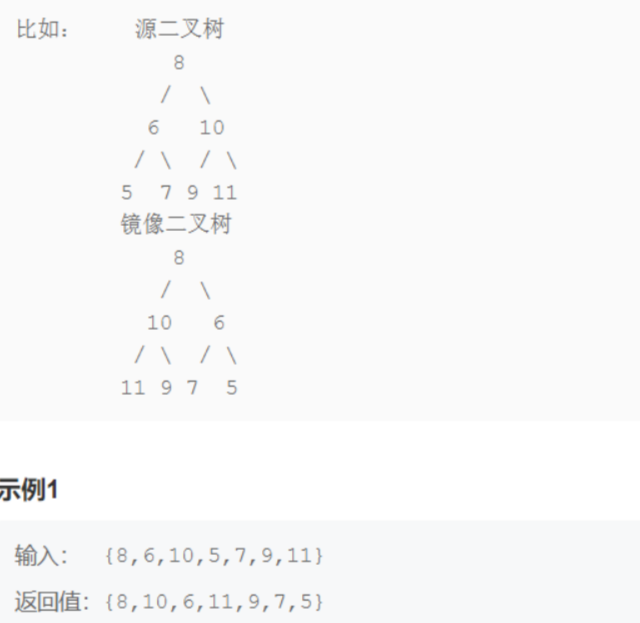
解法
- 使用递归
- 先判断根节点,若根节点为null或者是单个结点则直接返回
- 处理根节点的左子树
- 处理根节点的右子树 ```java import java.util.*;
- 使用递归
/*
- public class TreeNode {
- int val = 0;
- TreeNode left = null;
- TreeNode right = null;
- public TreeNode(int val) {
- this.val = val;
- }
- } */
public class Solution { /**
* 代码中的类名、方法名、参数名已经指定,请勿修改,直接返回方法规定的值即可* @param pRoot TreeNode类* @return TreeNode类*/public TreeNode Mirror (TreeNode pRoot) {// 递归结束条件if(pRoot == null){return pRoot;}if(pRoot.left == null && pRoot.right == null){return pRoot;}// 交换根节点的左右儿子TreeNode temp = pRoot.left;pRoot.left = pRoot.right;pRoot.right = temp;Mirror(pRoot.left);Mirror(pRoot.right);return pRoot;}
}
<a name="bcTrz"></a># 19、顺时针打印矩阵```java输入一个矩阵,按照从外向里以顺时针的顺序依次打印出每一个数字例如,如果输入如下4 X 4矩阵: 1 2 3 4 5 6 7 8 9 10 11 12 13 14 15 16则依次打印出数字1,2,3,4,8,12,16,15,14,13,9,5,6,7,11,10
解法
- 定义四个变量表示边界范围,其中up、down表示上下边界,left、right表示左右边界。不断收缩边界范围
- 首先向右遍历,将找到的数加入到集合中,并且边界值up++,如果边界值up大于down,跳出循环
- 其次向下遍历,将找到的数加入到集合中,并且边界值right—,如果边界值left大于right,跳出循环
- 其次向左遍历,将找到的数加入到集合中,并且边界值down—,如果边界值up大于down,跳出循环
- 最后向上遍历,将找到的数加入到集合中,并且边界值left++,如果边界值left大于right,跳出循环
- 循环遍历下去
import java.util.ArrayList;public class Solution {public ArrayList<Integer> printMatrix(int [][] matrix) {ArrayList<Integer> list = new ArrayList<>();if(matrix == null || matrix.length == 0 || matrix[0].length == 0){return list;}int up = 0;int down = matrix.length - 1;int left = 0;int right = matrix[0].length - 1;while(true){for(int col = left; col<=right;col++){list.add(matrix[up][col]);}up++;if(up > down){break;}for(int row = up; row<=down;row++){list.add(matrix[row][right]);}right--;if(left > right){break;}for(int col = right; col>=left;col--){list.add(matrix[down][col]);}down--;if(up > down){break;}for(int row = down; row>=up;row--){list.add(matrix[row][left]);}left++;if(left > right){break;}}return list;}}
20、包含min函数的栈
定义栈的数据结构,请在该类型中实现一个能够得到栈中所含最小元素的min函数(时间复杂度应为O(1))
- 定义四个变量表示边界范围,其中up、down表示上下边界,left、right表示左右边界。不断收缩边界范围
用空间换时间
- 使用一个辅助栈minStack来存最小值
- 如果此时的数据小于minStack的栈顶,则允许存入该值,否则把minStack的栈顶重新存一遍到minStack
- push,push数据到stack;如果辅助栈minStack为null,则数据push到minStack,否则 数据小于minStack的栈顶时,则允许存入该值,不然把minStack的栈顶重新存一遍到minStack
- pop,直接弹出两个栈
- top,返回stack的栈顶
- min,返回minStack的栈顶 ```java import java.util.Stack;
- 使用一个辅助栈minStack来存最小值
public class Solution {
private static Stack<Integer> stack = new Stack<Integer>();private static Stack<Integer> minStack = new Stack<Integer>();public void push(int node) {stack.push(node);if(minStack.empty()){minStack.push(node);}else{if(node <= minStack.peek()){minStack.push(node);}else{minStack.push(minStack.peek());}}}public void pop() {stack.pop();minStack.pop(); //弹出栈顶,做删除}public int top() {return stack.peek(); //弹出栈顶,不做删除}public int min() {return minStack.peek();}
} ```

若有收获,就点个赞吧
0 人点赞


