What is PLEG?
PLEG 的全称是 Pod Lifecycle Events Generator(Pod 生命周期事件生成器)。kubelet 是每个节点的 agent,负责管理节点上的 Pod,并使它们运行到 Spec 中期望的状态。为了实现这一目标,kubelet 需要对于 Pod Spec 和 Container 的状态变化作出反应。对于 Spec 的变化,kubelet 会从多个来源来观测这一改动;对于 Container 状态变化,kubelet 采用定时轮询的方式去获取容器的最新状态。但是随着 Pod/Container 的数量增加,轮询会产生很大的开销。并且 kubelet 对于每一个 Pod 都有一个 goroutine 进行管理,这个会在后面的文章中分析 PodWorker。在没有 PLEG 之前,是直接查询 Container 状态的所以会导致周期性大量并发的请求到 Container Runtime,造成性能问题。PLEG 的引入便是为了解决这个问题:
- Reduce unnecessary work during inactivity (no spec/state changes)
- Lower the concurrent requests to the container runtime.
为了生成 Pod 生命周期事件,PLEG 需要检测 Container 状态的变化。 与之前的方案相比较,虽然也是轮询,但是PLEG 是单 goroutine 的,计算出事件后,之后相关的 Pod Worker 会被唤醒进行工作。虽然有些 Container Runtime 会有自己的事件,但是 PLEG 并没有进行对接,依旧采用定时轮询对比前后两次状态来生成的事件
pleg作用示意图,图源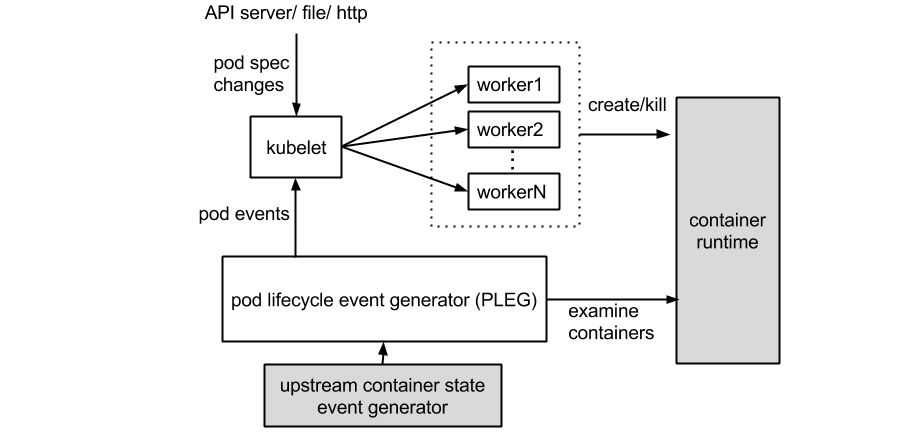
PLEG 相关的代码位于 pkg/kubelet/pleg 目录下。首先我们来看 kubelet 结构体中的 pleg 的定义,它的类型是 PodLifecycleEventGenerator interface。
// PodLifecycleEventGenerator contains functions for generating pod life cycle events.type PodLifecycleEventGenerator interface {Start() // 生产PodLifecycleEvent到channelWatch() chan *PodLifecycleEvent // 直接返回了channelHealthy() (bool, error)}
我们将围绕上面三个函数展开,分析PLEG对外提供的功能。PLEG中定义了4种事件类型:
// PodLifeCycleEventType define the event type of pod life cycle events.
type PodLifeCycleEventType string

const (
    // ContainerStarted - event type when the new state of container is running.
    ContainerStarted PodLifeCycleEventType = "ContainerStarted"
    // ContainerDied - event type when the new state of container is exited.
    ContainerDied PodLifeCycleEventType = "ContainerDied"
    // ContainerRemoved - event type when the old state of container is exited.
    ContainerRemoved PodLifeCycleEventType = "ContainerRemoved"
    // PodSync is used to trigger syncing of a pod when the observed change of
    // the state of the pod cannot be captured by any single event above.
    PodSync PodLifeCycleEventType = "PodSync"
    // ContainerChanged - event type when the new state of container is unknown.
    ContainerChanged PodLifeCycleEventType = "ContainerChanged"
)
GenericPLEG.Start
Start 函数会创建一个 goroutine,核心的逻辑位于 relist 函数中。
// Start spawns a goroutine to relist periodically.
func (g *GenericPLEG) Start() {
    go wait.Until(g.relist, g.relistPeriod, wait.NeverStop)
}
我们把此函数拆为两部分来看,第一部分比对新旧所有的容器,然后生成对应的 Event
pkg/kubelet/pleg/generic.go:190
// relist queries the container runtime for list of pods/containers, compare
// with the internal pods/containers, and generates events accordingly.
func (g *GenericPLEG) relist() {
    klog.V(5).InfoS("GenericPLEG: Relisting")

    if lastRelistTime := g.getRelistTime(); !lastRelistTime.IsZero() {
        metrics.PLEGRelistInterval.Observe(metrics.SinceInSeconds(lastRelistTime))
    }

    timestamp := g.clock.Now()
    defer func() {
        metrics.PLEGRelistDuration.Observe(metrics.SinceInSeconds(timestamp))
    }()

    // 1. Get all the pods.  参数为true的时候会包含 exited and dead containers
    podList, err := g.runtime.GetPods(true)
    // 更新最近一次的执行时间
    g.updateRelistTime(timestamp)

    pods := kubecontainer.Pods(podList)
    // update running pod and container count
    updateRunningPodAndContainerMetrics(pods)
    // 将pod信息暂存到缓存中,每个pod都有old和current两种状态的记录
    g.podRecords.setCurrent(pods)

    // 2. Compare the old and the current pods, and generate events.
    eventsByPodID := map[types.UID][]*PodLifecycleEvent{}
    // 全量比较Pod中所有容器当前和原来的状态,生成事件
    for pid := range g.podRecords {
        oldPod := g.podRecords.getOld(pid)
        pod := g.podRecords.getCurrent(pid)
        // Get all containers in the old and the new pod.
        allContainers := getContainersFromPods(oldPod, pod)
        for _, container := range allContainers {
            events := computeEvents(oldPod, pod, &container.ID)
            for _, e := range events {
                // 等价于 eventsByPodID[e.ID] = append(eventsByPodID[e.ID], e)
                updateEvents(eventsByPodID, e)
            }
        }
    }
    // ...接下文
}
基本逻辑就是将当前Pod列表和上一次relist的Pod列表进行对比,就会针对每一个变化生成相应的Pod事件。
对比并生成事件的函数为computeEvents,pkg/kubelet/pleg/generic.go:355
func computeEvents(oldPod, newPod *kubecontainer.Pod, cid *kubecontainer.ContainerID) []*PodLifecycleEvent {
    var pid types.UID
    if oldPod != nil {
        pid = oldPod.ID
    } else if newPod != nil {
        pid = newPod.ID
    }
    oldState := getContainerState(oldPod, cid)
    newState := getContainerState(newPod, cid)
    return generateEvents(pid, cid.ID, oldState, newState)
}
getContainerState 根据 cid(containerId) 在 POD 的 Containers 和 Sandboxes 中查找对应的 container,然后将 state 转换成 plegContainerState。对应的映射关系如下,pkg/kubelet/pleg/generic.go:86 convertState 的内容。
由runtime中定义的状态映射至pleg中定义的容器状态:
- ContainerStateCreated => plegContainerUnknown // runtime中创建中,pleg还没感知
- ContainerStateRunning => plegContainerRunning
- ContainerStateExited => plegContainerExited
- ContainerStateUnknown => plegContainerUnknown
然后我们来实际生成事件的函数 generateEvents,此函数接收新旧两个 State 然后返回对应事件
func generateEvents(podID types.UID, cid string, oldState, newState plegContainerState) []*PodLifecycleEvent {
    if newState == oldState {
        return nil
    }

    klog.V(4).InfoS("GenericPLEG", "podUID", podID, "containerID", cid, "oldState", oldState, "newState", newState)
    switch newState {
    case plegContainerRunning:
        return []*PodLifecycleEvent{{ID: podID, Type: ContainerStarted, Data: cid}}
    case plegContainerExited:
        return []*PodLifecycleEvent{{ID: podID, Type: ContainerDied, Data: cid}}
    case plegContainerUnknown:
        return []*PodLifecycleEvent{{ID: podID, Type: ContainerChanged, Data: cid}}
    case plegContainerNonExistent:
        switch oldState {
        case plegContainerExited:
            // We already reported that the container died before.
            return []*PodLifecycleEvent{{ID: podID, Type: ContainerRemoved, Data: cid}}
        default:
            return []*PodLifecycleEvent{{ID: podID, Type: ContainerDied, Data: cid}, {ID: podID, Type: ContainerRemoved, Data: cid}}
        }
    default:
        panic(fmt.Sprintf("unrecognized container state: %v", newState))
    }
}
其实这里的模型就是状态机,不过不是一般的给予状态 A 加状态转移函数,然后跳转到 B 这种。而是给予状态 A 和 状态 B,返回了从 A 到 B 的状态转移的名称
得到 Events 后,我们接着看 relist 函数的后半部份
func (g *GenericPLEG) relist() {
    // .. 承上
    for pid, events := range eventsByPodID {
        // 这里省略开启 Cache 后需要更新 Cache 并且判断是否需要二次核对的逻辑
        pod := g.podRecords.getCurrent(pid)
        // Update the internal storage and send out the events.
        // 更新 podRecord,将 current 赋值到 old,然后将 current 赋值为 nil
        g.podRecords.update(pid)
        for i := range events {
            // Filter out events that are not reliable and no other components use yet.
            if events[i].Type == ContainerChanged {
                continue
            }
            select {
            case g.eventChannel <- events[i]:
            default:
                klog.ErrorS(nil, "Event channel is full, discard this relist() cycle event")
            }
        }
    }
}
事件会被发送到 eventCahnnel 中
GenericPLEG.Healthy
在 syncLoop 函数中的 for 循环内,每次都会检查 runtimeState.runtimeErrors
pkg/kubelet/kubelet.go:1971
// syncLoop is the main loop for processing changes. It watches for changes from
// three channels (file, apiserver, and http) and creates a union of them. For
// any new change seen, will run a sync against desired state and running state. If
// no changes are seen to the configuration, will synchronize the last known desired
// state every sync-frequency seconds. Never returns.
func (kl *Kubelet) syncLoop(updates <-chan kubetypes.PodUpdate, handler SyncHandler) {
   //...省略
    for {
        if err := kl.runtimeState.runtimeErrors(); err != nil {
            klog.ErrorS(err, "Skipping pod synchronization")
            // exponential backoff
            time.Sleep(duration)
            duration = time.Duration(math.Min(float64(max), factor*float64(duration)))
            continue
        }
        // reset backoff if we have a success
        duration = base

        kl.syncLoopMonitor.Store(kl.clock.Now())
        if !kl.syncLoopIteration(updates, handler, syncTicker.C, housekeepingTicker.C, plegCh) {
            break
        }
        kl.syncLoopMonitor.Store(kl.clock.Now())
    }
}
runtimeErrors 会遍历所有的 healthChecks 数组中的健康检查函数,然后逐一调用,最后通过 NewAggregate 函数进行聚合
func (s *runtimeState) runtimeErrors() error {
    s.RLock()
    defer s.RUnlock()
    errs := []error{}
    if s.lastBaseRuntimeSync.IsZero() {
        errs = append(errs, errors.New("container runtime status check may not have completed yet"))
    } else if !s.lastBaseRuntimeSync.Add(s.baseRuntimeSyncThreshold).After(time.Now()) {
        errs = append(errs, errors.New("container runtime is down"))
    }
    // 遍历执行所有的healthChecks函数
    for _, hc := range s.healthChecks {
        if ok, err := hc.fn(); !ok {
            errs = append(errs, fmt.Errorf("%s is not healthy: %v", hc.name, err))
        }
    }
    if s.runtimeError != nil {
        errs = append(errs, s.runtimeError)
    }
    // 进行错误聚合操作
    return utilerrors.NewAggregate(errs)
}
通过 addHealthCheck 函数可以向此数组中追加检查项。对于 PLEG 是在 NewMainKubelet 函数中添加的
pkg/kubelet/kubelet.go:341
// NewMainKubelet instantiates a new Kubelet object along with all the required internal modules.
// No initialization of Kubelet and its modules should happen here.
func NewMainKubelet(...) (*Kubelet, error) {
    // ...省略

    klet := &Kubelet{
        // ...
    }

    klet.pleg = pleg.NewGenericPLEG(klet.containerRuntime, plegChannelCapacity, plegRelistPeriod, klet.podCache, clock.RealClock{})
    klet.runtimeState = newRuntimeState(maxWaitForContainerRuntime)
    klet.runtimeState.addHealthCheck("PLEG", klet.pleg.Healthy)
    if _, err := klet.updatePodCIDR(kubeCfg.PodCIDR); err != nil {
        klog.ErrorS(err, "Pod CIDR update failed")
    }

    return klet, nil
}
klet.pleg.Healthy 函数的定义如下
pkg/kubelet/pleg/generic.go:134
const {
    // The threshold needs to be greater than the relisting period + the
    // relisting time, which can vary significantly. Set a conservative
    // threshold to avoid flipping between healthy and unhealthy.
    relistThreshold = 3 * time.Minute
}


// Healthy check if PLEG work properly.
// relistThreshold is the maximum interval between two relist.
func (g *GenericPLEG) Healthy() (bool, error) {
    relistTime := g.getRelistTime()
    if relistTime.IsZero() {
        return false, fmt.Errorf("pleg has yet to be successful")
    }
    // Expose as metric so you can alert on `time()-pleg_last_seen_seconds > nn`
    metrics.PLEGLastSeen.Set(float64(relistTime.Unix()))
    elapsed := g.clock.Since(relistTime)
    if elapsed > relistThreshold {
        return false, fmt.Errorf("pleg was last seen active %v ago; threshold is %v", elapsed, relistThreshold)
    }
    return true, nil
}
即最近 3 分钟内没有执行过 PLEG 的逻辑,那么变会报错
9月 25 11:05:06 k8s-dev-node1 kubelet[546]: I0925 11:05:06.003645 546 kubelet.go:1794] skipping pod synchronization - [container runtime is down PLEG is not healthy: pleg was last seen active 21m18.877402888s ago; threshold is 3m0s]
GenericPLEG.Watch
调用 Watch 函数可以得到 eventChannel 然后取出事件
pkg/kubelet/pleg/generic.go: 125
// Watch returns a channel from which the subscriber can receive PodLifecycleEvent
// events.
// TODO: support multiple subscribers.
func (g *GenericPLEG) Watch() chan *PodLifecycleEvent {
    return g.eventChannel
}
这些事件会在 pkg/kubelet/kubelet.go:1919 的 syncLoopIteration 被消费。这里便和前面的 syncLoop 衔接起来了
func (kl *Kubelet) syncLoopIteration(
    configCh <-chan kubetypes.PodUpdate,
    handler SyncHandler,
    syncCh <-chan time.Time,
    housekeepingCh <-chan time.Time,
    plegCh <-chan *pleg.PodLifecycleEvent
) bool {
    select {
    // .. 省略
    case e := <-plegCh:
        if e.Type == pleg.ContainerStarted {
            // record the most recent time we observed a container start for this pod.
            // this lets us selectively invalidate the runtimeCache when processing a delete for this pod
            // to make sure we don't miss handling graceful termination for containers we reported as having started.
            kl.lastContainerStartedTime.Add(e.ID, time.Now())
        }
        // 即 event.Type != pleg.ContainerRemoved
        if isSyncPodWorthy(e) {
            // PLEG event for a pod; sync it.
            if pod, ok := kl.podManager.GetPodByUID(e.ID); ok {
                klog.V(2).InfoS("SyncLoop (PLEG): event for pod", "pod", klog.KObj(pod), "event", e)
                handler.HandlePodSyncs([]*v1.Pod{pod})
            } else {
                // If the pod no longer exists, ignore the event.
                klog.V(4).InfoS("SyncLoop (PLEG): pod does not exist, ignore irrelevant event", "event", e)
            }
        }

        if e.Type == pleg.ContainerDied {
            if containerID, ok := e.Data.(string); ok {
                kl.cleanUpContainersInPod(e.ID, containerID)
            }
        }

    }
    return true
}
- 如果事件类型为 pleg.ContainerStarted 则会在 Pod 维度上纪录最近一个 Container 的启动时间
- 对于非 pleg.ContainerRemoved 类型的事件,则会分发任务到 PodWorker 然后进行同步
- 如果事件类型为 pleg.ContainerDied,那么会删除 Container,这里只负责删除。如果 spec 中有 restart-always 之类的配置,是由 syncLoop 中的逻辑检测然后重新创建 container 的

若有收获,就点个赞吧
0 人点赞


